When an arrogant billionaire woman mocked a black janitor, “If you can play that piano, I'll marry you.”
She had no idea.
That night would become the greatest shock of her life.
That night, New York blazed with light.
Outside the Whitmore Grand Hotel, spotlights swept across the red carpet, cameras flashing like bursts of fire.
Inside the grand hall, crystal chandeliers spilled golden light over marble floors, and evening gowns brushed past each other with carefully practiced smiles.
It was a typical high-society fundraising gala, where stories of generosity flowed as smoothly as the champagne, and the hands that had polished the floors since dawn seemed to vanish into thin air.
Marcus Reed pushed his cleaning cart along a side corridor, the rags folded with the same precision he'd kept for five years working here.
He knew the silent language of this space.
The cool nods.
The eyes that looked past your shoulder.
The way footsteps shifted away from the camera frame.
A PR staffer passed, clipboard in hand, tilting her chin slightly.
“Let's make sure staff stay out of the frame. Thanks.”
Her tone was neither harsh nor rude.
It was simply spoken as if it were a natural law, as if the lights only shone on certain people.
At the start of his shift, the manager had said, “Marcus, use the service elevator, buddy. Don't cross the main hall while guests are being photographed.”
The buddy sounded friendly, but distant, avoiding the need to read the gleaming Marcus on his name badge.
A security guard happened to walk in the same direction.
His glance was not exactly hostile, just trained.
Scanning.
Preventing.
Monitoring.
Marcus showed his staff ID with a polite smile.
The man nodded and walked on.
But when Marcus skirted the edge of the main hall to collect a few empty glasses, the sound of black dress shoes followed him for a few beats.
On a small stage at the far end of the room sat a Steinway & Sons Model D, still and elegant like a promise.
The polished black surface caught the chandelier's light, scattering it into tiny stars.
Marcus paused.
Not because he was tired, but because a memory brushed against him.
The scent of polished wood.
The cool touch of ivory keys under his fingertips.
He turned away.
Here, he was here to clean, not to play.
The crowd flowed around him.
A society lady halted when Marcus happened to step near the camera's edge.
“Excuse me. Go around, please.”
A man beckoned with a subtle wave.
“Hey, you.”
Marcus turned.
“Yes, sir. My name's Marcus.”
The man held out car keys, pointing toward the entrance.
“Where's valet?”
“Sir, I'm maintenance staff. Valet is at the front entrance.”
The man gave a flat “ah” and let his gaze slide off Marcus's face as if it had touched glass.
Marcus was used to it.
Here, slipping out of sight was a survival skill.
Moving slowly at the carpet's edge.
Avoiding the camera's eye.
Circling around columns.
Always making sure he was the last through a doorway so no one had to step aside for him.
Occasionally, someone would mutter behind him, “You don't belong here.”
Not addressed to him directly.
Just to the air shaped like him passing by.
He collected glasses, replaced ashtrays, wiped table edges.
Another PR assistant hurried by, adjusting the backdrop.
“Staff, please stay outside the photo line.”
“Understood,” Marcus replied, his voice as flat as the freshly polished floor.
Gloria Johnson, the veteran housekeeper, passed by and set a pack of tissues on his tray.
“Marcus, take a break. Have some water.”
“I'm fine, Miss Gloria.”
She looked at him a moment longer, as if she wanted to say something, but knew not to in a crowded hall.
From the grand doors, a group of guests entered under a choreography of lights.
Smile.
Flash.
Turn.
Flash.
Fingers touched the glass.
Victoria Whitmore emerged at the end, her red silk gown catching the light like a sculpted flame.
Diamonds flickered along her collarbone and wrist.
She strode to the microphone, her voice firm and bright as polished glass.
“We are here tonight to remind each other that hope always has a place. I trust everyone will be generous.”
The applause was polite, blending with the scent of expensive perfume and champagne foam.
The same security guard trailed Marcus as he kept to the edge of the hall.
No one had told him to.
It just happened as part of a collective reflex.
When Marcus bent to pick up an empty glass, he caught his own reflection in a wall mirror.
Navy shirt.
Black gloves.
Calm eyes trained over years.
On the far side of the glass lay a neat story of kindness and charity.
On his side was the man who polished those stories until they gleamed.
A young female guest holding her phone paused where Marcus stood.
“You—sorry, could you move?”
She didn't look at his name tag.
“Yes, ma'am. I'm Marcus. I'll step aside.”
His name fell softly between strands of background music, so light it seemed no one heard.
He stopped at the edge of the stage, scanning the table setup.
Napkins folded precisely.
Glass count correct.
Ashtrays under half full.
Another security guard approached with a polite smile.
“Sir, this area is for guests.”
“Yes, I'll be out once I check the glasses.”
“Thank you.”
The smile wasn't unfriendly.
It just had a thin layer.
Default suspicion.
From the mic, the PR host announced the schedule.
Speeches.
An art auction.
Then a special piano performance by a guest artist.
Marcus glanced at the Steinway again.
From somewhere, his old teacher's voice whispered, “Don't count the keys. Feel the music.”
He shook his head.
Here, feelings weren't his job.
Invisibility was.
A couple walked past.
The man squinted.
“Hey, buddy, spill over there.”
Marcus turned.
“Yes, I'll get it right away.”
He moved like a shadow over the marble.
Every motion calculated to be smaller than the room.
Shoulders lowered.
Elbows tucked.
Standing at an angle to give way.
He had learned to exist like a ripple.
Present everywhere, but gone from every frame.
Once in a while, a pang hit him when the piano was tested.
Three scattered chords.
Someone pressing the pedal.
The sound was full, deep, recalling nights he sat at a piano until his fingertips numbed, trying to place a melody exactly where it belonged on the score of his life.
Now that melody sat behind a door he had locked himself.
The key, he thought, was lost somewhere on the road to becoming someone no one needed to notice.
“Marcus, service route,” the manager reminded, eyes flicking toward the photo corner where donors lined up their smiles. “Don't cross the main hall.”
“Yes, sir.”
Marcus turned toward the service elevator.
At the narrow junction of two corridors, he paused, not from fatigue, but to swallow something unnamed.
Then he moved on.
The gala was running like clockwork.
Speeches on cue.
Laughter in the right places.
Cameras at the right angles.
Invisibility ran just as smoothly.
Staff took the back route.
Names blurred into buddy or you.
Eyes reminding you: don't belong here.
Every piece fit neatly into the gleaming machine.
Only Marcus, in a brief moment before the service door closed, looked back at the Steinway.
The chandelier's light spilled over the piano's surface, pooling into a quiet glow.
He exhaled softly, as if placing a small stone into a river.
Then he pushed his cart inside, the door closing behind him, quiet as a blink.
Dignity has no uniform.
It has courage.
The service elevator door had barely closed softly behind him when Marcus steered his cart back toward the edge of the hall to collect the last few glasses before the speeches began.
Everything was running on schedule, and he knew a single scratch in the flow could shift the entire tone of the room.
A PR woman, clipboard in hand, swept past, speaking as if to the air.
“Remember, keep staff out of the photo line.”
Across the room, a security guard unconsciously matched Marcus's movements without needing any orders.
In the camera's circle of light, Victoria Whitmore stood as if she were the fixed point of a carefully drawn graph.
The red silk gown.
The diamonds.
Her smile set to the correct angle.
In her head ran a list of risks.
A major shareholder irritated by last week's labor lawsuit.
An unpredictable journalist present tonight.
A new donor who needed wooing.
The speech outline.
The camera angles.
Who stood with whom.
What must not happen.
She knew them all by heart like multiplication tables.
What she didn't factor in was the human element outside the plan.
Marcus bent on one knee, reaching for a glass that had rolled deep under a table.
He straightened just as Victoria turned away from a camera, flicking her wrist.
Champagne splashed in a golden streak across the red silk.
A breathless second passed before the room's attention shifted, eyes converging, phones lifting.
“What the hell are you doing?”
Victoria's voice cracked, sharp as glass.
Marcus placed the glass on his tray, straightened, and opened his hands as if to steady the air in the room.
“I'm sorry, ma'am. I—”
“Sorry?” she cut in. “You stained this dress. Do you have any idea how much it costs?”
The question wasn't meant to be answered.
It measured the gap between someone entitled to demand and someone who needed permission to exist.
A businessman smirked.
“No janitor could cover a scratch on that dress.”
Laughter rippled on instinct.
Another voice, loud enough to be heard:
“People like you should stick to the back.”
The security guard stepped closer, not to threaten, just standing like a period at the end of an accusation.
Marcus kept his voice even.
“I can cover the dry-cleaning bill, ma'am.”
He knew the words were as thin as tissue.
A month's wages wouldn't survive a boutique invoice.
For Victoria, the fatigue of living in a cage of expectations condensed into a reflex.
Reclaim control.
She half turned, pulling the room's attention back to herself.
“How about this?” she said. “If you can play that piano better than a professional, I'll marry you.”
She smiled.
The sound cold and sharp like a command redirecting the crowd.
A beat of silence.
Then the room erupted.
Someone joked, “Careful, more white keys than black.”
A few tittered, but eyes kept smiling.
The harmless joke slid neatly into an old mental groove.
Race wrapped in laughter to avoid naming it.
Standing at the fringe, Gloria Johnson tightened her hold on a packet of tissues.
She looked at Marcus, then at Victoria.
She recognized that look.
Someone who had never had to ask themselves whether they were allowed to stand here.
“No need to make this a big deal, just a little accident,” a woman said.
But the cameras stayed up.
Marcus could have slipped into the service hall as always, becoming a gap for the wave to glide past.
But tonight, something in him refused to retreat.
“I don't need you to marry me,” Marcus said, eyes steady, voice low but clear. “If I can do it, I want you to keep your word.”
A few chuckles shot out, testing how serious he was.
Victoria arched a brow, trying to reel the moment back into a joke.
“Perfect. Show us, buddy.”
She pressed the word buddy like a stamp.
One more way to avoid saying his name.
“Make it a bet,” a guest called. “Five hundred if you play the whole piece without a mistake.”
“A thousand if you last more than thirty seconds.”
Money flicked from wallets.
That clean excitement allowed them to cheer without facing the fact they were fueling a public humiliation.
The PR woman glanced at Victoria.
A second's frown, then a thin smile.
If framed right, the clip could boost reach.
In Victoria's mind, goodwill charts, audience reach, and headline potential flickered past.
She'd learned to measure everything in numbers and forgotten how to measure in people.
Marcus shook his head when the bills were pushed toward him.
“I'm not taking your money.”
“Then what do you want?”
“Just one thing. If I do it, you'll remember every word you just said in front of everyone here.”
A thin pause.
Victoria laughed longer this time, confident she still owned the story.
“Deal. Plenty of witnesses here.”
She pointed toward the stage.
“That piano. The whole city's ready to watch you.”
The security guard walked in parallel, escorting a moving risk.
David Chen, the music critic, stood still like a comma, observing how a smirk could rewrite a person.
He looked at the Steinway, then at Marcus, eyes flickering with anticipation.
“Come on,” someone urged, smiling as thin as a blade. “Don't keep us waiting. Lots of white keys.”
More laughter.
Loud, but cold.
Victoria adjusted her gown.
For a split second, her gaze touched Marcus, not as a person, but as a prop to be assessed.
Deep down, the fatigue was still there.
Urgent emails.
Early meetings.
Shareholder pressure.
But she'd chosen to let that exhaustion spill into power.
And power without restraint always found the lowest surface to pour onto.
Marcus inhaled.
He set the tray on the nearest table, removed his gloves, folding them neatly.
All the habits of making himself smaller than the room.
He performed them one last time before stepping into the space opened by eyes and cameras waiting for a fall.
“After you,” Victoria said, voice smooth but cold. “Time to prove it, buddy.”
The room swelled with an ooh of excitement.
At the crowd's edge, Gloria gave the smallest shake of her head.
Only Marcus saw it.
David Chen stepped half a pace forward, hand in his suit pocket, ready to witness ability, not spectacle.
Marcus walked.
The sound of his soles on the marble barely carried, but each step seemed to reset the room's center of gravity.
At the end of the path, the black Steinway & Sons Model D lay still, its lid catching the chandelier's light into its own private sky.
The laughter hadn't fully faded, still falling here and there like late hail.
But beneath the noise, a thin silence began to form.
A space just wide enough for music, if it came, to enter.
Marcus placed a hand on the stage edge.
The guard stopped at the perimeter, not advancing.
The PR woman stepped back half a pace, camera still rolling.
Victoria kept her chin high, convinced she still controlled the moment.
But for the first time that night, Marcus wasn't trying to make himself smaller.
He simply stood at the full size of a man.
“My name is Marcus,” he said, loud enough for the first row to hear. “Not buddy.”
Then he stepped up onto the wooden riser, heading toward the piano the way a person approaches a real conversation, not a sideshow.
From that moment, the night shifted, and the marriage dare that had sounded like a joke was hardening into a binding promise in front of a room full of witnesses.
What came next would no longer be entertainment.
It would be a test of dignity, talent, and one's word.
Right after the calm statement, “My name is Marcus, not buddy,” the room seemed to drop a notch in noise.
He kept walking, each step on the marble even and deliberate, not fast, not slow, as if he were resetting the dimensions of himself in a space that was never meant for him.
A stack of bills slid forward, the snap of wallets opening.
“500 if you play a full piece.”
“1,000 if you don't run off in 30 seconds.”
Clean excitement.
They could enjoy themselves without realizing they were cheering for a public humiliation.
Marcus didn't look at the money.
“I'm not here to perform like a trained pet. I'm not taking your bets.”
Then he turned toward the one who had issued the dare.
“I accept, and I only want one thing. If I succeed, Miss Whitmore will keep her word in front of everyone here.”
A few whistles rang out, half mocking, half testing.
Victoria Whitmore lifted her chin, her smile locking into place.
In her mind, the risk chart scrolled fast.
Last week's labor lawsuit.
An unpredictable journalist present.
A new donor to impress.
She thought in graphs and headlines, not in people.
If he failed, the whole room laughed.
If he was decent, spin the narrative into a night of discovering hidden talent.
What she wasn't used to was an employee demanding that she keep her word.
Marcus reached the foot of the stage.
Two security guards immediately stepped in, blocking him out of habit.
“Sir, this area is for performers and guests only.”
The tone was polite, the boundary soft, but real.
Marcus stopped.
He didn't argue.
He tilted his head so they could see to the left.
A white couple leaning happily over the stage edge, taking selfies with the Steinway in the background.
No one stopped them.
The guards hesitated for a beat, then returned to their positions in front of Marcus.
The small moment laid bare the skew in the room.
Same rule, enforced for only one person.
At the edge of the hall, Gloria Johnson saw it, her lips pressing together.
This wasn't the first time.
A deep, clear male voice cut in.
“Let him through.”
David Chen, the music critic, had been standing nearby.
He didn't raise his voice, just shifted his shoulder slightly.
“Tonight, I want to hear music, not watch barricades move.”
The guards glanced at each other, then stepped half aside, opening the path, but still flanking him as if escorting a risk in motion.
Victoria's brow tightened just slightly.
She didn't like anyone else setting the rhythm.
PR touched her sleeve and murmured, “Better if Chen speaks up. Adds legitimacy.”
Victoria inhaled, returned her smile to its trained setting, the one she'd perfected all her life, turning emotion into procedure.
A female guest muttered, “They should clean the piano, too. Sweat.”
A light touch, bitter underneath, a polite remark carrying baked-in bias.
Marcus removed his gloves, folded them neatly onto the tray, a small, decisive gesture like shedding the invisible uniform.
He looked up at Victoria.
“Let's confirm one last time. You said if I play better than a professional pianist, you'll marry me. I don't want that. I want you to keep your word in whatever way you can publicly.”
A male guest laughed.
“Smart. Customizing the prize.”
Another added, “Keep her word? How? Write a check.”
Marcus shook his head.
“I don't need a check. I need proof that words here carry weight.”
David Chen nodded.
“You're talking about public accountability.”
“Yes.”
In Victoria's eyes, a flicker of hesitation.
Then it was gone.
Around the room, phones were raised.
Tiny lights blinked.
The risk chart ran again.
Labor hashtags.
Conservative shareholders.
She smiled, stamping it shut.
“We're all witnesses here.”
David Chen followed.
“And if he plays at a professional level, I'll say so to the press.”
A few short bursts of applause.
Part of the room was ready to value principle, not just spectacle.
Marcus nodded, stepped onto the riser.
One guard instinctively shifted closer.
Marcus didn't look at him, only at the path ahead.
For years, it had always been blocked by mechanisms dressed in courtesy.
Tonight, he was walking through under his own name.
“Let him through,” David Chen repeated, as if placing a period at the end of the sentence.
The guard froze, then moved to the edge.
Below, the selfie couple still joked about white keys, black keys.
No one shushed them.
The entire room's eyes were on one man, and its expectations gathered for a fall.
Marcus stood before the Steinway & Sons Model D.
He placed his palm on the lid.
Cool, solid, familiar.
He didn't open it yet.
He looked down, calling the challenger by name.
“Miss Whitmore, I want to hear you say one thing. Clearly. I will keep my word.”
For the first time that evening, Victoria missed half a beat.
She wasn't used to reading lines someone else had written.
But in front of too many cameras, with PR nodding for her to lock the narrative, she lifted her chin.
“I will keep my word.”
The final syllable was thin as wire.
It was both a promise and a fence.
Gloria released a breath only Marcus noticed.
He lifted the lid.
The hinge gave a soft, clean click.
In the front row, a woman whispered to her friend, “What if he really can play?”
The friend shrugged.
“Then we've got a good story.”
They still spoke about a story, not a man.
Victoria kept her smile, her thumb brushing the now-dry champagne stain.
The fatigue at the base of her neck, daylong meetings, urgent emails, difficult shareholders, had been poured into a dare as easy as snapping her fingers.
A discordant thought crossed her mind.
Why had she tossed that line so easily?
Then the PR logic covered it again.
If he's good, we discover talent.
If he's bad, the room laughs.
Win-win.
Somewhere, the word dignity still waited outside the door.
Marcus pulled the bench out and sat.
He checked his distance from the keys, dropped his shoulders, loosened his wrists.
Old rituals returning like muscle memory.
He spoke loud enough for the first rows to hear.
“Thank you for making way.”
It sounded polite, but anyone hit by it would understand.
He was speaking to the guards, and to a system that had long kept him at the hall's edge.
The crowd steadied itself with a few jibes.
“Get on with it.”
“Don't keep us waiting.”
At the fringe, the man from earlier murmured, “Look, his hands are shaking.”
His friend replied, “Of course they are. Who wouldn't be?”
David Chen gave a small smile.
“Shaking or not, the music will answer.”
Marcus set his fingertips on the keys.
Just touching.
Not pressing.
The air felt taut and thin, as if waiting for a snap.
He had refused the money, made I will keep my word echo in front of witnesses, and walked through the barrier under his own name.
All that remained was the sound of the piano.
All that remained was the sound of the piano, and when it came, it arrived not with noise, but with a breath that seemed to touch the air itself.
Marcus struck the first key as if tapping gently on the surface of water.
No showy flourish.
No robotic display.
Just a clean note, then a second that opened the door for Summertime to step in.
He chose a tempo half a beat slower than usual, giving each phrase room to breathe.
His left hand laid down a soft foundation, like bare feet on a summer sidewalk.
His right hand spoke sparingly, each note falling with exactly the weight it needed.
The pedal was pressed briefly, released quickly, letting the resonance cling to the marble of the hall before dissolving like mist.
Marcus wasn't telling a story.
He was setting down sentences.
The silence between them didn't block the listeners' ears.
It invited them closer.
In the second row, the man who had joked about white keys and black keys left his smile hanging midair.
Then it folded in on itself, extinguished like a candle capped under glass.
His champagne stopped trembling.
A woman recording video tapped her phone off, laying it face down as if afraid to make noise.
The room's laughter didn't vanish instantly.
It shrank, dried, and rolled to the edges.
David Chen leaned forward, his trained eye missing nothing.
The way Marcus anchored a low note to keep the line centered.
The way he sidestepped flashy technical riffs in favor of restraint.
Beautiful touch.
Warm tone.
Not a warmth achieved through tricks, but through intent.
A player who knows what he's saying, and to whom.
David noted how Marcus bent two blue notes at just the right moments, holding and releasing them so that a familiar melody became strange again.
In the front row, Victoria Whitmore kept her polite smile, but her jaw softened a notch.
She had prepared two neat scenarios to spin the narrative.
Yet this sound belonged to neither.
From a thin seam in memory, she saw herself at ten, sitting at the old upright at home, her elderly teacher pressing her hand down and saying, “Silence is also a note.”
Young Victoria had hated that lesson.
Back then, silence meant absence.
No money.
No power.
No applause.
But now the silence Marcus poured into the room carried a different weight.
The Steinway answered him as if it had known him for years.
In the bridge, Marcus tilted the harmony into shade.
Not darkness.
Just depth.
He held a single note long enough for people to realize they were waiting.
And that moment shifted the room from a crowd hungry for spectacle into an audience listening.
Servers slowed their steps.
Security guards lowered their shoulders.
The PR rep, for the first time all night, stopped checking her mental dashboard.
Marcus looked at no one.
His posture was calm.
Shoulders dropped.
Back easy.
Eyes sometimes half closed, not in performance affectation, but because he was listening to the way the notes touched the walls, echoing back like waves.
He wasn't presenting himself.
He was returning to himself.
Each phrase he laid down rewrote a line on a résumé that had been crossed out.
No more buddy.
No more you.
No more people like you.
Here, in this moment, was Marcus Reed.
A man with a name.
With a voice.
From her spot at the edge of the hall, Gloria Johnson's eyes glistened.
When Marcus slid into a small ornament, she thought of all the mornings she'd watched the staff clock in, each carrying a life no one bothered to ask about.
She felt this music walk alongside them, as if someone had stepped out from the service hallway, set a chair in the middle of the red carpet, and said, Sit. Tell me.
Somewhere across the room, the hum of the HVAC, background noise everyone had lived with, vanished from consciousness.
The man with the cigar lowered his hand.
A woman adjusted her shawl and forgot to finish, leaving her fingers resting idly in her lap.
Someone started to sigh, then stopped, afraid to spill whatever delicate drop was balanced on the rim of the moment.
Victoria glanced at the patch of champagne on her gown, now dried into a thin ridge.
She wanted to think about image damage and media opportunity, but the thought refused to flow.
She realized she had no ready words for this.
She had believed everything could be labeled KPI, ROI, sentiment.
But this music was labeling her back.
Not heiress.
Not future CEO.
Not net-worth package.
It called a person out from behind glass.
The sensation was as unsettling as touching a place she hadn't in years.
Marcus circled a short variation, then let go of the urge to display.
He stopped before the coda as if standing at a crossroads.
He chose the simpler road home, returning the melody to where it began, without embellishment.
It was a cultural decision.
Summertime in his hands wasn't a finger exercise.
It was a doorway into a current of memory.
Porches in summer.
Front steps.
Voices that softened the edges of a long day.
He didn't need to say black culture.
Anyone with ears could hear its current.
For a moment, he looked up and caught Gloria's eyes.
No smile.
No nod.
Just a glance that confirmed he knew she was there, and therefore knew that all the people like her, those hands that polished floors to a gleam since dawn, were here too.
David Chen listened closely enough to notice what wasn't played.
He silently counted the length of the pause between phrases, the way Marcus returned to the tonic without weight.
This wasn't an accident.
It was a choice.
He dipped his head slightly, as if accepting an invisible handshake.
Maturity in music lies not in adding more, but in leaving more out.
When the final note fell, Marcus lifted the pedal, letting the sound die away completely.
No exclamation point.
No fireworks.
Just a small round period.
And then silence.
Not the awkward silence of a spilled-champagne moment.
Not the empty silence of nothing to say.
This silence had changed color.
Deep.
Warm.
Present.
The room seemed to inhale all at once.
A single clap rang out, then halted like someone knocking, but remembering someone was asleep.
Marcus didn't turn toward the audience to seek approval.
He sat still, hands loose in his lap, eyes on no one in particular.
His posture said the rest.
I am not here to prove. I am here to name.
To name myself.
To name those just pushed out of the frame.
To name dignity that wears no uniform.
In the front row, Victoria felt a voice inside her, one she usually smothered with her calendar, stir.
What have I just done to this man?
The question didn't stop at Marcus.
It swept back over all the staff she passed without seeing each day, over the emails requesting use the service elevator, stay out of the photo line.
It left a thin chill at her neck.
She looked up at the chandelier, the light that had always sided with her, and for the first time that night, she saw it as neutral.
A young server, tray in hand, stood frozen as if spellbound.
She swallowed hard, eyes shining for reasons she couldn't name.
Beside her, the guard who had instinctively blocked Marcus let his elbows drop.
He didn't apologize.
Didn't need to.
The silence was doing it for him.
Marcus touched a small closing chord, not to prolong, but to set the room back on the ground after the bend it had just taken.
Then he lifted his hands from the keys, lowered the lid one notch without closing it.
He turned his head to find David Chen.
They didn't speak.
A single nod held the whole sentence.
I'm still here.
Any laughter, if it still existed, was now at the margins.
At the room's heart was a new quiet, one both carved by music and left behind like soil for the next thing to grow.
In that place, jokes about white and black keys had no space, because people had just heard something beyond the color of the keys.
Marcus inhaled, exhaled.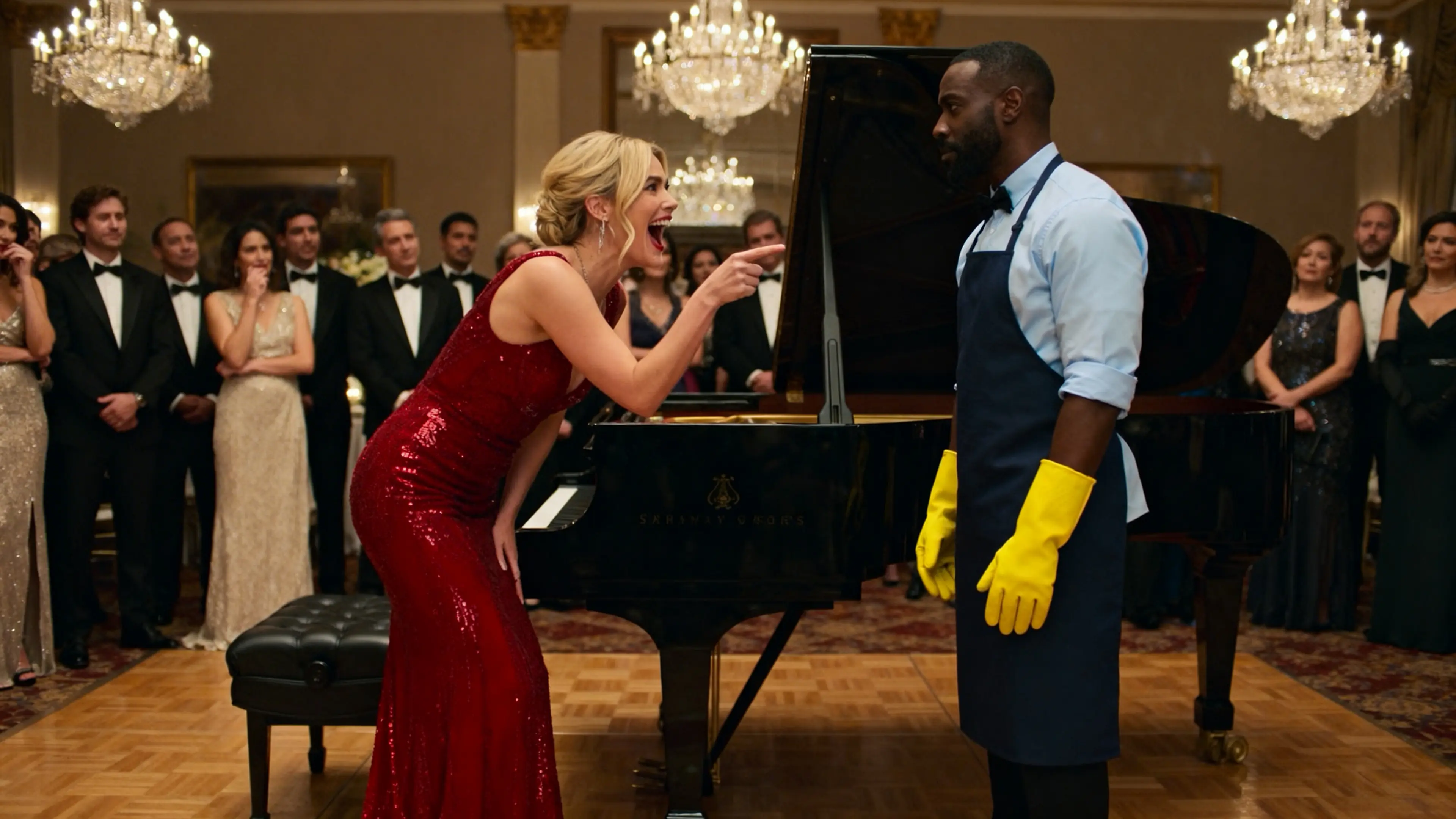
He didn't rise.
He let the room reset its heartbeat.
And in the front row, Victoria, the hostess who had tossed a marriage dare like a stone into a pond, felt every ripple come back to the shore where she stood.
She understood.
From here on, every word she spoke would have to pass through this silence.
The first piece was over.
The room had changed color.
And the control, what Victoria had thought was hers, was quietly sliding toward the piano.
The transformed silence hadn't yet faded when Marcus tilted his head, as if listening to the room one more time.
He didn't stand.
He simply rolled his wrists, reset his distance from the keys, and changed languages.
From the lull of Summertime to the clean architecture of the classics.
A sonata, the skeleton of discipline, came to life.
The opening theme was crisp and clear.
Allegro moto.
Marcus's left hand built a rhythmic wall with evenly rolled chords, mechanical in precision, but never overpowering.
His right hand drew a thin cantabile line, delicate yet sustained.
He used the pedal sparingly, releasing it exactly at the cut points so each movement revealed its structure instead of being cloaked in a fog of emotion.
In the transition, he staged a dialogue between the two hands.
A 3:2 cross rhythm, meshing like gears.
Every accent landed just enough to support the next phrase, never forcing it.
The room, so used to being served sensations, found itself unconsciously counting with him.
The man with the cigar lowered it from his lips, setting it carefully into the ashtray as if smoke might smudge the clean lines.
An older woman tilted her head, narrowing her eyes.
The reflex of someone who had once studied piano.
Checking the voicing.
In the back row, a young man lowered his phone, forgetting vertical mode entirely.
Perhaps the clip no longer seemed enough.
David Chen shifted half a foot, leaning in to catch more of the mid-range.
He noted the rare control.
Smooth legato on the fourth and fifth fingers.
Trills clean without stray notes.
The pianissimo to fortissimo climb without a gasp.
In the development section, Marcus carved the theme into fragments.
Rotated and reassembled them.
The arc of dynamics rising by intellect, not adrenaline.
David exhaled softly, almost to himself.
“Virtuoso.”
The word fell in two beats.
Cautious, then certain.
Marcus wasn't trying to steal hearts.
He was building a bridge.
Those who had come for sport understood halfway across.
They were standing before art.
The faint shifting of chairs subsided.
The guard who had stepped in to block him earlier lowered his shoulders.
For the first time that night, his eyes were not watchful, but following.
Victoria Whitmore sat upright, the smile on her face like an old mask.
With each phrase she felt the invisible dashboard in her mind—KPI, headlines, sentiment—lose signal for a few seconds before flickering back.
She glanced at PR.
“That's enough, isn't it?”
The other woman's eyes wavered.
“If we cut at the peak, we'll be crucified.”
Victoria bristled at a situation she didn't control.
She wanted to put down the period.
To bring the night back onto the outline she'd planned.
In the coda, Marcus let the arpeggios pass like a draft of wind.
Breaking on the dynamic stair just before a fortissimo, then refusing to step on it.
He returned to mezzo piano, closing the phrase with a cadence as clean as a boundary line.
This was the power of control.
Knowing where you could be loud and choosing not to be.
Another silence.
This time applause erupted instantly afterward.
Sharp and full.
Not the polite clapping of a gala.
This was recognition.
A few people half rose.
Then one whole row stood.
Prejudice hadn't vanished.
It had simply stepped back, glancing around for allies.
David Chen lowered his chin by exactly a centimeter.
A professional's gesture.
He angled slightly toward the waiting cameras.
“Professional standard.”
No waving hands.
No exaggeration.
A line of invisible text had just been signed and sealed.
A few reporters exchanged looks.
They had their pull quote.
Victoria felt control slipping away like sand through her fingers.
She stood in the natural pause, clipped the mic to her lapel.
“Thank you,” she began, voice smooth as glass. “A truly impressive performance. Now let's—”
Her words were drowned by a lone shout.
“More than another encore!”
The crowd, which she had steered from the start of the night, was now choosing its own path.
PR swiveled toward her.
“Let him do one more, Victoria.”
She pressed her jaw, thumb unconsciously rubbing the dried champagne stain.
“Back to work,” Victoria said quietly, mic off, aimed only at Marcus.
Her last attempt to snap the rhythm back.
Marcus looked at her for a beat.
Not defiant.
Not submissive.
Just looking.
The gaze wasn't hot, but it had an edge.
“You just said you'd keep your word.”
In the front row, a few guests turned to each other.
They had heard her enough, even without the mic.
Her face had said it.
An older woman, silent until now, spoke up clearly.
“We'd like to hear more.”
A heavyset man who had eagerly bet earlier nodded rapidly.
“Yes. More.”
The young man in the back turned his camera on again.
But this time to record music, not a stumble.
The guard glanced at his superior.
The latter shrugged and moved to the edge.
The room's center of gravity had shifted away from the hostess toward the man at the piano.
Victoria set the mic down.
Her smile returned, but thinner.
Almost transparent.
Inside, she heard a faint crack.
The image.
The shell she lived in.
Fracturing at the seam.
She worried about shareholders.
About tomorrow's headlines.
About dinner with the donor.
But at the same time an uninvited question came.
Why do I want to cut this short?
The schedule?
Or because I can't stand that someone who doesn't belong here just redefined the room?
Marcus swiveled his bench slightly, staying on stage.
He looked over the rows calling for more.
Not to collect approving eyes, but to gauge the breath.
He found David Chen.
They caught each other's gaze amid the murmurs.
David gave a small nod.
Another invisible signature.
Marcus placed his hands on the keys.
But before playing, he said just loud enough for the first rows to hear.
“Thank you. I won't make you noisier. I'll let the music do its part.”
He inclined his head toward Victoria.
A polite gesture without submission.
“I respect you. And I remember your word.”
He queued up the third piece in his mind.
One that would drain both his technique and stamina.
But he didn't rush.
Silence had just learned its job.
Let it work one more beat.
Phones lifted again.
But the angles had changed.
Now people were aiming for the ascent, not the fall.
At the edge, Gloria Johnson laid a hand over her heart.
A smile just beginning at her lips.
She saw the other servers standing a little straighter.
As if the spine of the whole evening shift had been realigned.
The guard who often blocked Marcus stepped back another half pace.
Not in fear.
But as if not to blur the outline taking shape.
Victoria sat down.
PR whispered the revised schedule.
“We'll call this a special set. After this next piece, you step in to thank him and announce the auction.”
Victoria nodded, eyes never leaving Marcus's hands.
She didn't know if she was hoping he'd stumble so she could reclaim control.
Or soar so she wouldn't have to hold it anymore.
Marcus lowered his wrists.
The opening theme of the next piece hadn't sounded yet, but the room was already leaning toward the piano.
Somewhere the feeling of sport had slipped from the grip.
What remained was art.
And the people standing before it.
No longer hiding behind their roles.
He closed his eyes for half a second.
Just enough to hear the clock inside click into place.
Then he opened them.
Struck the first note.
The room, like a sail catching the perfect wind, swelled.
And the night decisively shifted into a new orbit.
The very first note landed, and the entire room leaned toward the piano.
Marcus locked the door behind any lingering doubt.
No more lullabies.
No more separate architecture of discipline.
He chose an extreme technical piece—steep double-note passages, long octave leaps, razor-close hand crossings, shifting three-to-four-to-six polyrhythms, trading roles without pause.
This wasn't a piece meant to sound pretty.
It was a summit that demanded both muscle and nerve.
His left hand drove an ostinato, smooth as a belt drive.
His right hand strung staccato beads as precise as a sewing machine.
In the second section, he bent the theme into a left-hand trill—a difficult, rarely chosen move—while the right hand walked the high register like a tightrope.
The pedal was dotted only at phrase openings, lifted before any clouding could occur.
Even on repeated-note runs, he used wrist rotation instead of the arm, keeping the speed without breaking the sound.
Everything was control.
No strain showing.
The audience held its breath in the face of visible difficulty.
The man who had once joked about white keys and black keys drew his hand away from his glass.
The security guard who had blocked Marcus earlier was now unconsciously leaning forward.
Gloria Johnson gripped the edge of a table, the pulse in her wrist clear in each beat.
The PR woman looked up from her screen, abandoning an unsent text.
Laughter had slipped out of the room long ago.
What remained was attention.
Victoria Whitmore tried to erect a mental fence quickly.
This was her event.
This was her story to tell.
If necessary—cut.
But the music belonged to no fence.
It took its own route through the chandeliers, through the cameras, past the KPI formulas.
In the coda, Marcus pushed a tremolo octave to the lip of forte, then didn't break through.
He reined it in, detoured into a short glissando, returning the phrase to piano like a graceful stop command.
The break was so smooth that the whole hall felt as if it slid half a step further.
Silence.
One beat.
Two.
Then an explosion.
A thick, unified standing ovation erupted.
The front row stood.
Then the back.
Chairs clattered.
Glasses chimed.
But no one cared.
Phones rose like a forest.
No longer hunting for a fall, but holding on to a moment.
At the stage's edge, David Chen clapped half a beat slower than the rest, as if to measure it precisely.
Then he spoke just loud enough to be caught by someone's recording mic.
“At a very high professional level.”
Marcus remained seated, hands loose.
He didn't bow yet.
He gave the room back to itself.
The commotion belonged to them.
Victoria took the mic.
“Thank you,” she began.
But the clapping didn't drop.
One group of guests shouted, “Encore!”
Another called, “Marcus!”
She tried again, her voice smooth.
“We—”
This time the applause surged like a wave.
Not hostile.
Just not hers in this moment.
PR whispered at her shoulder.
“Don't cut it now.”
Her phone buzzed constantly.
Internal messages.
Social media tags.
An email from legal counsel.
Avoid binding statements. Marriage is a personal legal matter.
From mid-hall, a man's voice rang out.
“You said you'd marry him if he played better than a pro!”
Another followed.
“Keep your word!”
Several cameras pivoted up to her face, stage lights catching the rise and fall of her collarbone with each breath.
She remembered exactly the words:
“I will keep my word.”
Words Marcus had made her repeat.
They felt like a lock now clasped around her wrist.
Not a legal shackle.
A moral one.
In her head, two dashboards crashed into each other.
Reputation.
Shareholders.
Donors.
Lawyers.
Marital clauses.
On one side.
A room full of witnesses.
A respected critic's professional level endorsement.
And a video already on fire.
Legally, she knew the joke meant nothing.
Marriage couldn't be coerced.
She could dismiss it as hyperbole.
But in the court of public ethics, she was cornered.
Marcus rose just as the clapping dipped a notch.
He didn't walk toward the mic.
He bowed slightly—enough to honor the room standing.
Then he looked straight at Victoria.
No demand.
No pressure.
Just the reminder in his gaze.
The words are on your side.
David Chen stepped half out of his row, speaking at a clip-worthy volume.
“From a professional standpoint, he just performed at a level I'd gladly put my name to in print.”
No more.
No less.
It was exactly the stamp that tightened the moral lock.
A few donor faces turned to each other.
They knew Chen's words carried weight.
PR nudged the mic toward Victoria.
“We talk about keeping one's word and supporting talent. Flip the narrative.”
Her phone lit up again.
An investor asking:
What's going on?
A journalist requesting a statement.
Corporate counsel texting:
Do not confirm intent to marry.
Victoria flashed back to her teens, the first time she was told:
“Don't let anyone steer you. Keep your hands on the wheel.”
Now the music was steering.
“We'll pause here,” she tried.
But another corner of the room answered:
“No—more!”
The crowd wasn't rude.
They were united.
And that unity—through applause, through the critic's signature—was demanding she face her own words.
Marcus lifted his hand, signaling for quiet one more moment.
He said just enough.
“I don't need a wedding.
I need people to keep their word.”
The line reframed the debate.
Out of marital law.
Back into the ethics of speech.
Something everyone understood.
Something everyone could judge.
An older woman, clear-voiced with authority, called out:
“You can keep your word another way—but you have to keep it.”
Several heads nodded.
A way out cracked open.
No forced marriage.
But no broken promise either.
Victoria swallowed hard.
She wasn't cruel.
She was trained to win.
And winning, in her dictionary, meant never losing control.
In this moment, she had to learn a new word.
Right.
Not the right move.
The right thing.
A second standing ovation rose.
This one for the night's redefinition.
Even the security guard clapped.
Offbeat.
But genuine.
Gloria dabbed the corner of her eye with the edge of a napkin.
David Chen pocketed his phone as if submitting testimony.
At the edge of the hall, an elderly lady squinted.
“I know him.”
Her neighbor leaned in.
“I think he used to be at the conservatory.
Marcus Reed.”
The words threaded into the taut fabric of the night.
A cut that would drop the next act.
Revealing his identity.
Revealing his past.
Victoria heard conservatory and felt her neck tighten.
If the story turned into forgotten prodigy, every eye would swing back to judge her.
Not just for a cruel joke.
But for abuse of power.
She set the mic down and took a long breath.
Before her was no longer a gala.
It was an ethics trial.
And the jury, already standing, was staring right at her.
Marcus returned to the piano, resting his hands on the lid as if closing the file on his performance.
He didn't take the mic.
He let the silence do the next job.
Forcing the room's power holders to hear the sound of their own breathing.
The room stayed still for one more beat.
As if to confirm that from here on, every word would carry weight.
It was in that silence, freshly reset to give weight to words, that an older woman's voice rose softly from the edge of the hall.
“I know him.”
Heads turned.
She stepped forward half a pace and adjusted her glasses.
“Marcus. Marcus Reed.”
The name slipped free of the buddy / you label and dropped into the room like a latch clicking shut.
A few people mouthed it back to themselves, tasting a returned identity.
“He performed at the city theater when he was twenty-two,” she said firmly. “That encore—I remember it perfectly.”
A silver-haired man in gold frames nodded.
“Yes. The music press called him a new talent.”
A younger guest pulled out his phone and typed quickly.
The screen lit up with an old photo.
A young man in a black suit bowing before a piano.
David Chen narrowed his eyes, digging through his professional memory.
“I read that review,” he said slowly. “And I remember a master class. My teacher mentioned your name.”
He turned to Marcus, nodding slightly, as if confirming a thread that had never truly broken.
Victoria Whitmore's breath stuttered half a beat.
She looked to PR.
The other checked her phone and whispered,
“Old photos are surfacing. #MarcusReed just popped.”
Victoria's own phone buzzed.
An email from legal.
No public statements on marriage.
A text from an investor.
What's going on?
But the one line she couldn't sidestep was the name.
Marcus Reed.
It rolled steadily in her mind, pushing aside words like KPI, sentiment, ROI.
The space opened around Marcus.
He stood straight, dipping his head slightly, as if apologizing for being recognized.
Gloria Johnson stepped half a pace from the edge, her hand gripping the corner of a napkin.
She hesitated.
This wasn't something to parade before a crowd.
But she had just watched him turned into a punchline.
She raised her voice enough to carry.
“If we're talking about Marcus, let me tell the rest.”
The room quieted instinctively before a house voice with years behind it.
“Marcus's mother was sick for a long time,” Gloria said plainly, adding no tears.
“They lived on two shifts. Hers and his.
When her condition worsened, the medical bills came like a storm.”
She paused, searching for the next words.
“His first piano—the one he'd saved for through scholarships and side jobs—was sold to pay hospital costs.”
A woman brought her hand to her mouth.
A man slowly set his glass on the table.
Gloria looked at Marcus as if asking permission.
He nodded, eyes closing for a beat.
She continued.
“He left the conservatory. Took night cleaning jobs to pay rent, pay debts, survive.”
She exhaled slowly.
“And music…”
Gloria searched for the word.
“Music became tied to the smell of antiseptic. To white sheets. To the sound of monitors.
He locked it away.”
David Chen added quietly, professional but warm.
“Talent doesn't vanish. It buries itself when it has no nourishment.”
He looked around, placing the phrase where non-musicians could understand.
Gloria lowered her gaze, then lifted it again.
“And this isn't just about poverty.”
She clipped the words.
“Someone once told him after an audition: We need someone who fits the hall. Hair should be tidier. Don't play with so much color. Your demeanor needs to be more professional.”
She didn't exaggerate.
Those words were polite and dangerous for that very reason.
“Another time,” she continued, “a guard blocked him at a stage door and made him use the service stairs, even though he had an invitation in hand.”
A small gasp escaped from the third row, then sank.
Some guests looked at each other.
Their own words to their staff suddenly appearing in letters before them.
The barrier here wasn't brick.
It was etiquette wired into the mind.
Marcus heard his name repeated in the room.
Marcus.
Not buddy.
Each time was a small hammer tapping old paint.
He drew in a deep breath, held it, then let it out.
He didn't want tonight to become his private tragedy in public.
But Gloria wasn't telling a sad story.
She was naming the problem.
The polished system that had pushed him to the margins.
Victoria's mind flashed to the checklist she'd sent internally.
Staff stay out of the frame.
Use service elevator.
Don't stand in the lobby during guest check-in.
She wanted to defend herself.
That's procedure, not discrimination.
But behind that thought came another, quieter one.
Who writes the procedure?
She looked at Marcus.
And unbidden saw the simplicity in his stance contrasted with the complexity of the glass casing around her own life.
David Chen gave a small nod to Gloria, a thank-you for naming it plainly.
He added the professional credential.
“At the conservatory he topped the piano class two semesters in a row.”
He paused.
“I have an old note from a professor. Deep touch. Wide ear. Pedal control rare at his age.”
He didn't mention the times Marcus lost funding because he didn't fit the face of the program.
The phrase was too sharp to throw now.
But the attentive had already connected it when Gloria said fit the hall.
A middle-aged man frowned.
“That still happens today.”
Another sighed.
“It never stopped. Just speaks another language.”
Shame—rare at a gala—was now present.
Not loud.
But heavy.
Victoria lifted the mic, then set it down again.
She knew anything she said now would be filtered through the moral lens just raised.
She glanced at PR.
The other shook her head.
Don't defend.
Listen.
It was advice unfamiliar to someone who lived by steering.
But tonight silence was again in the right place.
Gloria closed, her voice steady.
“He doesn't need anyone's pity.
He only needs to be called by his name and not be blocked from doors that should already be open.”
She turned to Marcus and smiled.
“Tonight, you opened one yourself—with music.”
Marcus nodded, eyes damp but steady.
He looked around the room.
At people who had laughed earlier.
Now sitting upright.
At the guard who had blocked him.
Now slightly bowing his head.
At Victoria.
Her face blank for a rare second, like someone seeing her true reflection.
“I didn't leave music because I stopped loving it,” Marcus said, speaking about himself for the first time tonight.
His voice was low.
Clear.
“I left because every note I played took me back to the hospital room.
I needed to do something simple.
Pay rent.
Pay debt.
Survive.”
He paused.
“Tonight I remembered why I learned to play.
Not to get applause.
But to be a person.”
The line clicked a second lock in the room.
Recognition was no longer about skill.
It became agreement that before them stood a whole human being.
At the hall's edge, the woman who had begun the recognition said softly,
“We've lost you for too long.”
David Chen replied as if entering it into the record.
“From now on, write it right.
Marcus Reed.”
Marcus nodded, a faint smile appearing.
Victoria Whitmore stood in the middle of waves moving against her.
She knew the game had changed.
No more cut at the PR beat.
No more rewriting the narrative with a few neat lines.
Before her was a man who had reset the measure of dignity.
And behind her, in the phone still buzzing, was a world demanding she keep her word in its true sense.
The night from here would not return to its old structure.
And the next act—media storm, pressure, closed-door conversations—was already standing just behind the door that had been called open.
The room had barely settled after Marcus spoke when the first phones began buzzing louder than the jazz band ever had.
At first it was just a few screens lighting up in the front row.
Then another.
And another.
Within seconds the glow of notifications spread across the hall like a silent chain reaction.
A young guest near the stage whispered, almost to himself, “It’s trending.”
Someone beside him leaned over.
“What is?”
He turned the screen around.
Two words were climbing rapidly across every platform.
#MarcusReed
And beneath it, another phrase beginning to catch fire.
#KeepYourWord
Across the room, the PR director felt her stomach drop.
She glanced at Victoria’s phone.
It was vibrating nonstop on the podium.
Mentions.
Tags.
Journalist requests.
Short video clips were already circulating.
Marcus at the piano.
The moment Victoria repeated the promise.
David Chen’s comment: “Professional level.”
Within minutes, thousands of strangers were watching the same scene that had just unfolded inside the ballroom.
Only now it belonged to the internet.
A young woman near the back gasped.
“Oh my God.”
“What?”
“Someone posted the full clip. It already has two hundred thousand views.”
Victoria felt something unfamiliar creeping into her chest.
Not fear.
Loss of control.
For years she had mastered the art of shaping a narrative before it reached the public.
Press releases.
Carefully framed photos.
Approved interviews.
Tonight the narrative had escaped before she could touch it.
Across the hall, David Chen checked his own phone.
He frowned slightly.
Then he looked back up at Marcus.
“The story’s out,” he said quietly.
Marcus shrugged gently.
“I didn’t come here for the internet.”
David nodded.
“I know.”
Near the bar, two donors whispered urgently.
“If this goes viral…”
“It already has.”
“What will she do?”
Victoria heard the murmurs rising around her.
She forced herself to breathe slowly.
The numbers in her head started calculating instinctively.
Public opinion.
Reputation.
Corporate fallout.
Investor confidence.
But the formulas no longer aligned neatly.
Because this wasn’t just a scandal.
It was a moral story.
And moral stories travel faster than any press strategy.
Her PR director leaned in close.
“We have three options.”
Victoria didn’t look at her.
“Say them.”
“First, you say it was a joke taken out of context.”
Victoria’s jaw tightened.
“Second?”
“You frame it as a charity commitment instead of marriage.”
“And third?”
The PR woman hesitated.
“You keep your word.”
The phrase hung between them like a bell still vibrating in the air.
Across the room, Marcus stood quietly near the piano.
He wasn’t looking at the phones.
He wasn’t watching the crowd.
He was simply resting his hand on the instrument as if it were an old friend.
Gloria Johnson approached him slowly.
“You didn’t expect this, did you?” she asked.
Marcus shook his head.
“I expected to play.”
She smiled sadly.
“Sometimes that’s enough to change a room.”
Marcus glanced toward Victoria.
“You think she’ll keep it?”
Gloria folded her arms thoughtfully.
“She might keep it differently than people expect.”
At that moment the ballroom doors swung open.
Three reporters stepped inside, clearly having rushed from outside the building.
Security tried to stop them.
But the phones had already done their work.
The story was no longer private.
One of the reporters called out,
“Ms. Whitmore! Is it true you promised to marry the pianist if he outperformed a professional?”
The room froze.
All eyes turned toward Victoria.
Her phone buzzed again.
This time the screen showed a headline already spreading across news feeds.
Billionaire Gala Turns Into Viral Showdown After Waiter’s Piano Performance
Underneath the headline, a still image of Marcus at the piano.
And her standing beside him holding the microphone.
The reporter raised his voice again.
“Do you plan to keep your promise?”
Victoria looked out across the ballroom.
At the donors.
At the cameras.
At Marcus.
And for the first time in years, she realized the decision in front of her couldn’t be solved by strategy alone.
It required something she rarely practiced.
Honesty.
She slowly stepped back to the microphone.
The crowd quieted instantly.
Even the reporters stopped moving.
Victoria Whitmore took a long breath.
“I said something tonight,” she began carefully.
“And the world heard it.”
Her voice didn’t tremble.
But the room could feel the weight behind it.
“When I made that promise, I thought it was harmless.”
She glanced briefly at Marcus.
“I didn’t expect someone to prove me wrong so completely.”
A few quiet chuckles rippled through the audience.
Victoria continued.
“But a promise is still a promise.”
The reporters leaned forward.
Phones lifted higher.
Victoria raised one hand slightly.
“However…”
The word echoed softly across the room.
“Marriage isn’t a spectacle for a ballroom or the internet.”
She paused.
“But keeping your word matters.”
She turned toward Marcus.
“So tonight I’m keeping mine.”
A wave of murmurs spread through the crowd.
Marcus tilted his head slightly.
Curious.
Victoria spoke clearly into the microphone.
“Marcus Reed.”
“You proved something tonight that this room—and frankly, this entire city—needed to be reminded of.”
She gestured around the hall.
“Talent doesn’t belong to status.”
“Dignity doesn’t belong to wealth.”
“And doors shouldn’t close simply because someone stands on the wrong side of them.”
The crowd listened in silence.
Victoria reached into her pocket and removed a small envelope.
Inside was a thick document.
“I’m establishing a foundation tonight,” she announced.
“Marcus Reed will lead it.”
The room stirred.
“A foundation dedicated to opening doors for musicians who were pushed out of opportunity.”
She looked directly at him.
“And the first concert of that foundation…”
She smiled slightly.
“…will be yours.”
For a moment Marcus didn’t move.
Then slowly he walked toward the microphone.
The entire ballroom watched.
He looked at Victoria.
Then at the crowd.
Then back at the piano.
Finally he spoke quietly.
“I never wanted revenge.”
He glanced around the room.
“I only wanted someone to listen.”
David Chen smiled faintly from the front row.
“They did.”
Marcus nodded.
“Yes.”
And somewhere beyond the walls of the ballroom, across thousands of glowing screens, the internet kept sharing the same moment.
A waiter.
A piano.
A promise.
And a room full of people learning that dignity could still change the ending of a story.