The Second Life of Lions — Finding Freedom After Rescue.
Life stories 02/12/2025 23:06
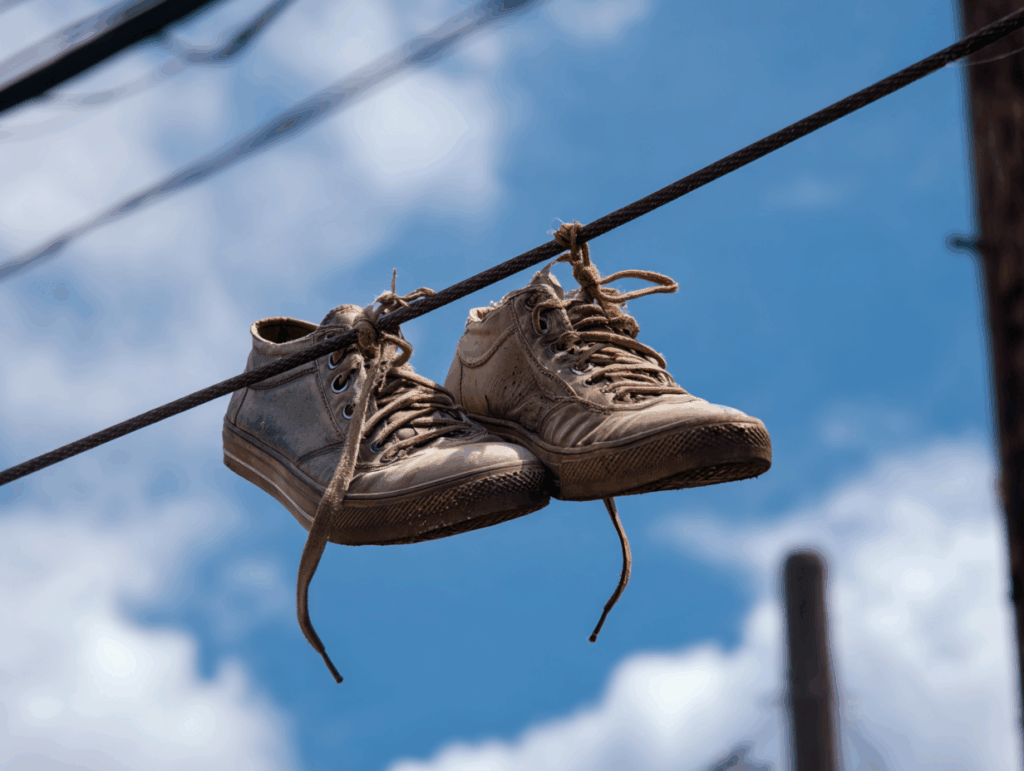
If you’ve ever walked through a neighbourhood and spotted a pair of sneakers dangling from a power line, you might’ve shrugged and thought, “Just kids fooling around again.” For years, I assumed the same. As a child, the sight felt random — a mix of mischief, old shoes, and youthful energy tossed into the air.
But growing older has a way of reshaping what once seemed ordinary. The more I learned about the stories behind those suspended sneakers, the more I realized they carry far more meaning than I ever imagined.
What makes this phenomenon fascinating is that it isn’t tied to one clear explanation. Instead, it’s a patchwork of interpretations shaped by culture, geography, and time. Investigations, community reports, and local folklore all suggest different meanings depending on where you live.
A popular belief, especially in certain urban areas, is that shoes thrown over power lines mark territory for gangs or indicate nearby drug activity. A Reader’s Digest article highlights this view:
“One of the more popular theories about shoes on power lines is that they’re part of a system by which gangs mark their territory.”
WBEZ Chicago explored the topic as well, uncovering a wide range of explanations:
“Shoes on a wire: Untangling an urban myth… people said the shoes signify where to buy drugs; they memorialize victims of gun violence; or they represent a crew marking their block.”
But those aren’t the only interpretations. Some believe these hanging shoes serve as memorials for people who have passed away — a symbolic gesture of remembrance. Others see it as a rite of passage: graduating high school, leaving town, finishing military service, or shedding a former identity. Even Wikipedia’s entry on shoe throwing mentions these traditions.
And, of course, plenty of explanations are far more innocent: kids being bored, friendly dares, or simply a creative way to retire a worn-out pair of sneakers. As one writer noted, “the most common reason is that there isn’t really one.”
Growing up, I walked past power lines almost every day — heading home from school, hanging out with friends, or running errands. I remember seeing those shoes swinging slightly in the breeze, their shadows stretching long across the pavement. Back then, I barely gave them a second thought.
But now, I view them differently. Each pair feels like a tiny cultural artifact — a marker of a memory, a ritual, or a story suspended in midair. Is it a memorial? A dare? A symbol? Or just a pair of forgotten sneakers tied up by boredom? In truth, it could be any of these things.
What strikes me most is how a single, everyday object — a shoe — can hold so many layered meanings. Our environment is full of these quiet symbols, stories we rarely pause to read.
The idea that shoes on power lines mark gang territory or drug-dealing hotspots is often repeated, but the evidence behind it is surprisingly thin.
WBEZ’s investigation found that while many people believe in the theory, experts are skeptical:
Sociologists and community workers said that although the belief persists, many consider it an urban legend. One scholar noted, “No one is going to put what they’re doing out there in that type of way to set themselves up to be arrested.”
iHeart-WBZ News also reported:
“The most common reason is kids just being kids. Retired police have said it might just be bored teenagers seeing who can toss their pair the farthest.”
So while the gang/drug explanation is dramatic — and often repeated in movies or TV — it’s not reliably supported across cities.
Another interpretation that feels more grounded is the idea of memorials. In many communities, tossing a pair of shoes up to a power line is a tribute to someone who has passed away, particularly someone young or taken too soon.
In other cases, the shoes represent transitions — graduating, moving away, or marking the end of a chapter. One story from Michigan described students throwing their shoes after finishing college, leaving behind a symbolic piece of who they were.
And then there’s the simplest explanation: fun. Kids daring each other, testing their aim, or seeing whose shoes will hang the longest. Someone once described it perfectly: “It’s like graffiti for kids without spray paint.”
Interestingly, hanging sneakers used to be far more widespread than they are now. In Chicago, for instance, city workers removed more than 1,100 pairs per year between 2008 and 2014 — but by 2014, that number dropped dramatically to around 111 pairs.
Why the decline?
Fewer exposed power lines in modernized neighborhoods
Increased cleanup efforts by cities and utility companies
Shifting youth culture and evolving traditions
The sneakers haven’t disappeared entirely — but the ritual isn’t as prominent as it once was.
These days, whenever I come across a pair of sneakers dangling from a wire, I pause for a moment. I wonder: Was this a tribute? A celebration? A quiet farewell? Or just two kids seeing who could throw higher?
It reminds me that our surroundings are full of stories, and even the most ordinary things can hold meaning. A dangling sneaker doesn’t just mark a place; it tells a story — sometimes loud, sometimes subtle, but always worth noticing.
Not everything in life has one fixed interpretation. The same pair of shoes can symbolize grief in one neighborhood, joy in another, and simple mischief somewhere else.
And maybe that’s the beauty of it: meaning often hangs quietly above us, waiting for someone to look up.