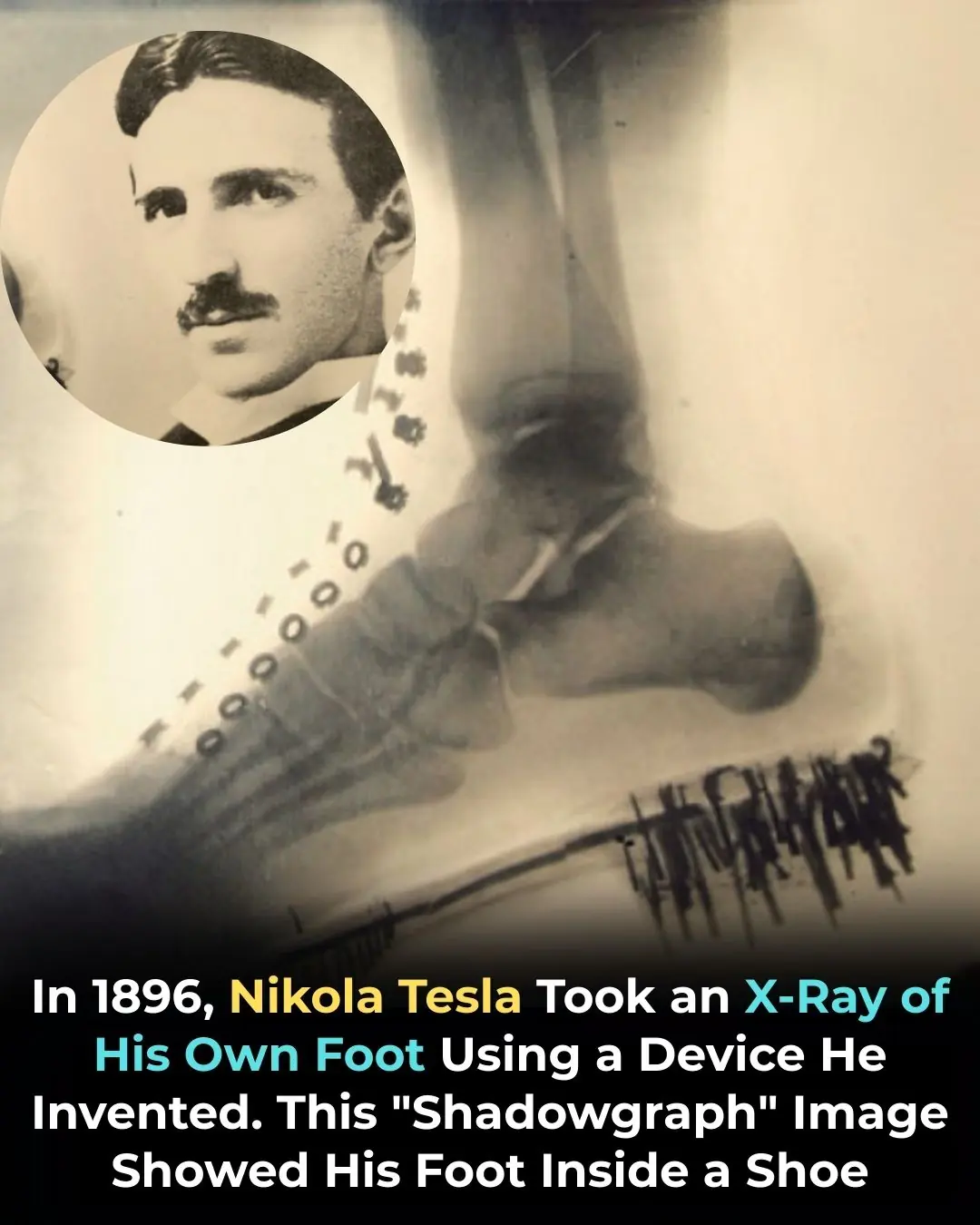
Nikola Tesla X-Rayed His Own Foot in 1896 — Pioneering the Future of Medical Imaging
Facts 09/12/2025 23:39
In a groundbreaking experiment, physicists at the Massachusetts Institute of Technology (MIT) have recreated the iconic double-slit experiment with unprecedented precision. This new version of the classic quantum physics experiment replaces traditional physical slits with single ultracold atoms arranged in a lattice held together by lasers. This innovative setup allowed researchers to track how individual photons interacted with their neighboring atoms, providing new insights into the delicate balance between light’s particle-like and wave-like behaviors.
The team’s approach to the double-slit experiment was unique in that it allowed them to precisely control the "fuzziness" of the atomic positions in the lattice. By manipulating this variable, they could directly influence how much information was gathered about the path of each photon. This precision experiment enabled them to observe how the amount of path information affected the resulting interference pattern, revealing an essential feature of quantum mechanics: as more information was gathered about the photon’s path, the interference pattern gradually disappeared.
This finding is a direct confirmation of quantum theory, which suggests that the act of measuring the path of a particle will disrupt its wave-like interference pattern. The results of this experiment also serve to directly disprove a century-old prediction made by the famous physicist Albert Einstein, who believed that light could exhibit both particle and wave characteristics simultaneously under certain conditions.
The groundbreaking experiment was published in Physical Review Letters, marking a significant milestone in the field of quantum mechanics. It provides compelling evidence that supports Niels Bohr’s 1927 argument about the nature of quantum observation: when the path of a photon is measured, its wave signature is erased. This phenomenon is a fundamental aspect of quantum theory that has been the subject of much debate over the years.
Lead researcher Wolfgang Ketterle, a Nobel laureate in physics, described the experiment as the most "idealized" version of the double-slit experiment ever conducted. He believes that the precision and clarity of their results finally put to rest one of the most famous and contentious debates in the history of physics. The experiment does not only validate long-standing quantum principles but also opens the door for future research on the complex interplay between observation and quantum phenomena.
By utilizing ultracold atoms and laser-based lattices, MIT physicists have provided a new, highly controlled environment for studying quantum mechanics. Their work has resolved critical questions in the field, offering a deeper understanding of how observation influences quantum systems and further solidifying the validity of quantum theory. This experiment not only honors the work of pioneers like Bohr but also sets the stage for new discoveries in quantum mechanics that could eventually lead to advancements in technology such as quantum computing and quantum cryptography.