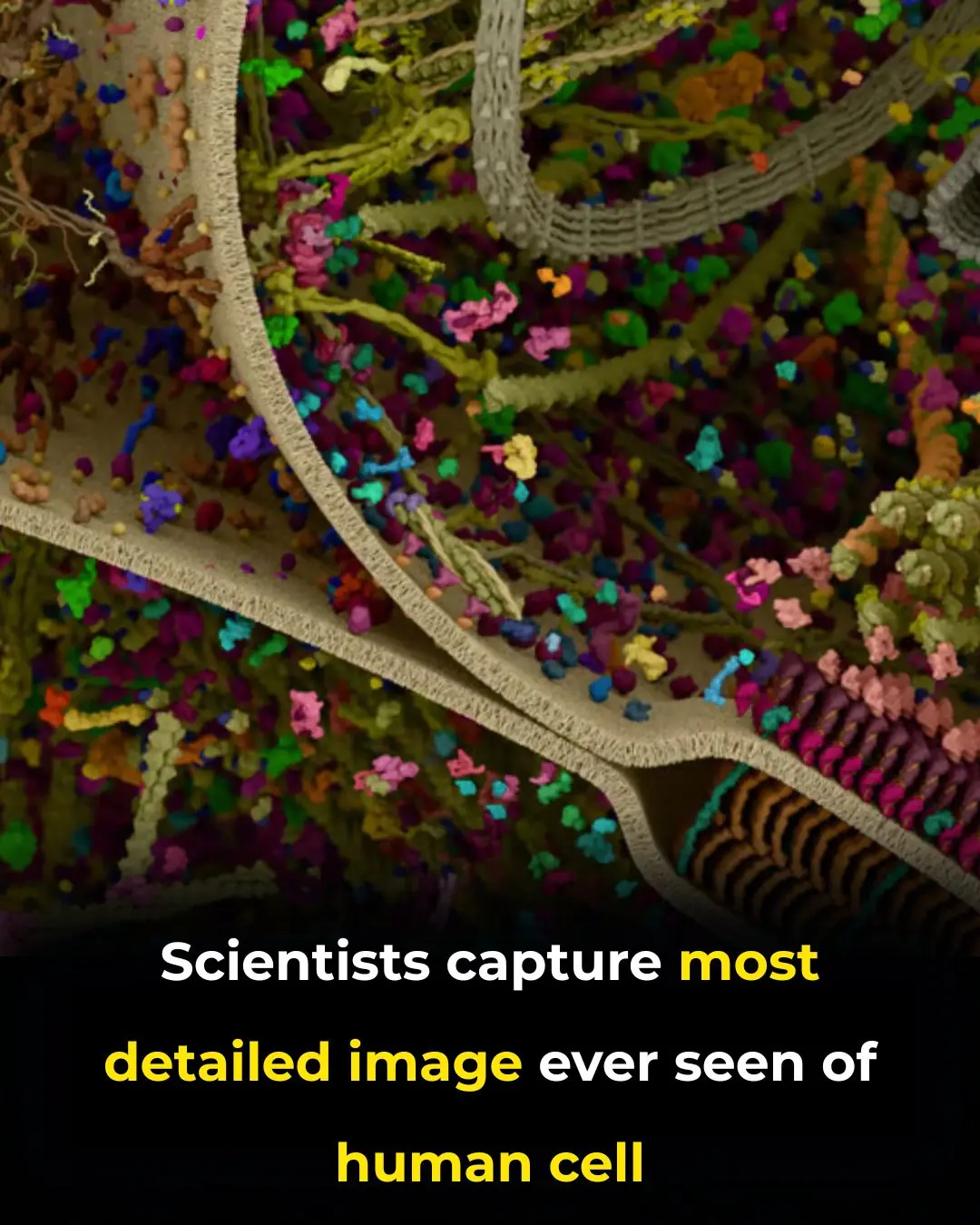
Revolutionary Breakthrough: Scientists Capture the Most Detailed 3D Image of a Human Cell
Facts 09/12/2025 23:39
In 1896, just months after Wilhelm Röntgen's discovery of X-rays, the brilliant inventor Nikola Tesla took it upon himself to build a high-voltage imaging device and test it by x-raying his own foot. What followed was a haunting "shadowgraph" image, capturing not only the bones of his foot but also the metal eyelets of his shoe, marking a significant moment in the history of medical imaging.
Tesla, known for his groundbreaking work in electrical engineering and technology, was not one to shy away from pushing the limits of new discoveries. After hearing of Röntgen's accidental discovery of X-rays in late 1895, Tesla quickly recognized their potential and immediately set to work on creating his own version of a high-voltage X-ray machine. This was an era when understanding of X-rays was in its infancy, and protective measures for radiation exposure were not yet a concern.
Tesla’s motivation wasn’t just curiosity; he sought to explore the potential applications of X-rays, particularly in the realm of medical imaging. His self-experimentation with the technology led to the creation of one of the first detailed radiographs in history, predating the more commonly known medical X-rays by several years. The "shadowgraph" Tesla created was one of the earliest clear images of bones captured using X-ray technology.
Tesla’s involvement in X-ray experimentation was not without its risks. During his tests, he began to notice the harmful effects of radiation exposure, such as skin burns and irritation. These signs, observed long before the dangers of radiation were widely understood, led him to warn about the potential health hazards associated with prolonged exposure to X-rays. Tesla’s early recognition of these dangers marked him as a visionary, as he was among the first to highlight the need for protective measures in X-ray technology—a concern that would not become standard practice until decades later.
While Wilhelm Röntgen is widely credited with the discovery of X-rays and the initial photographic images of bones, Tesla's work in refining and applying the technology played a crucial role in the development of modern medical imaging techniques. His contributions were not limited to theoretical work; he actively worked on improving the technology and bringing it closer to practical use. Tesla’s innovations in high-voltage devices and electromagnetic principles provided foundational knowledge that would influence the future of medical and scientific imaging.
Although Tesla’s early experiments did not result in the immediate widespread application of X-ray technology in medicine, his pioneering work undoubtedly laid the groundwork for future advancements. Tesla was a true visionary—a scientist and inventor willing to take immense personal risks in the name of progress. His experiments with X-rays not only expanded the possibilities of modern technology but also pushed the boundaries of what could be achieved in science and medicine.
Nikola Tesla’s willingness to experiment with groundbreaking technology, even at the expense of his own safety, showcases his relentless pursuit of knowledge and innovation. His work with X-rays was just one of many instances where he placed himself at the forefront of discovery, constantly challenging established norms and shaping the future of science and technology.
Tesla’s legacy lives on in numerous fields, from electrical engineering to wireless communication, and his contribution to the development of medical imaging remains an important chapter in the history of science.