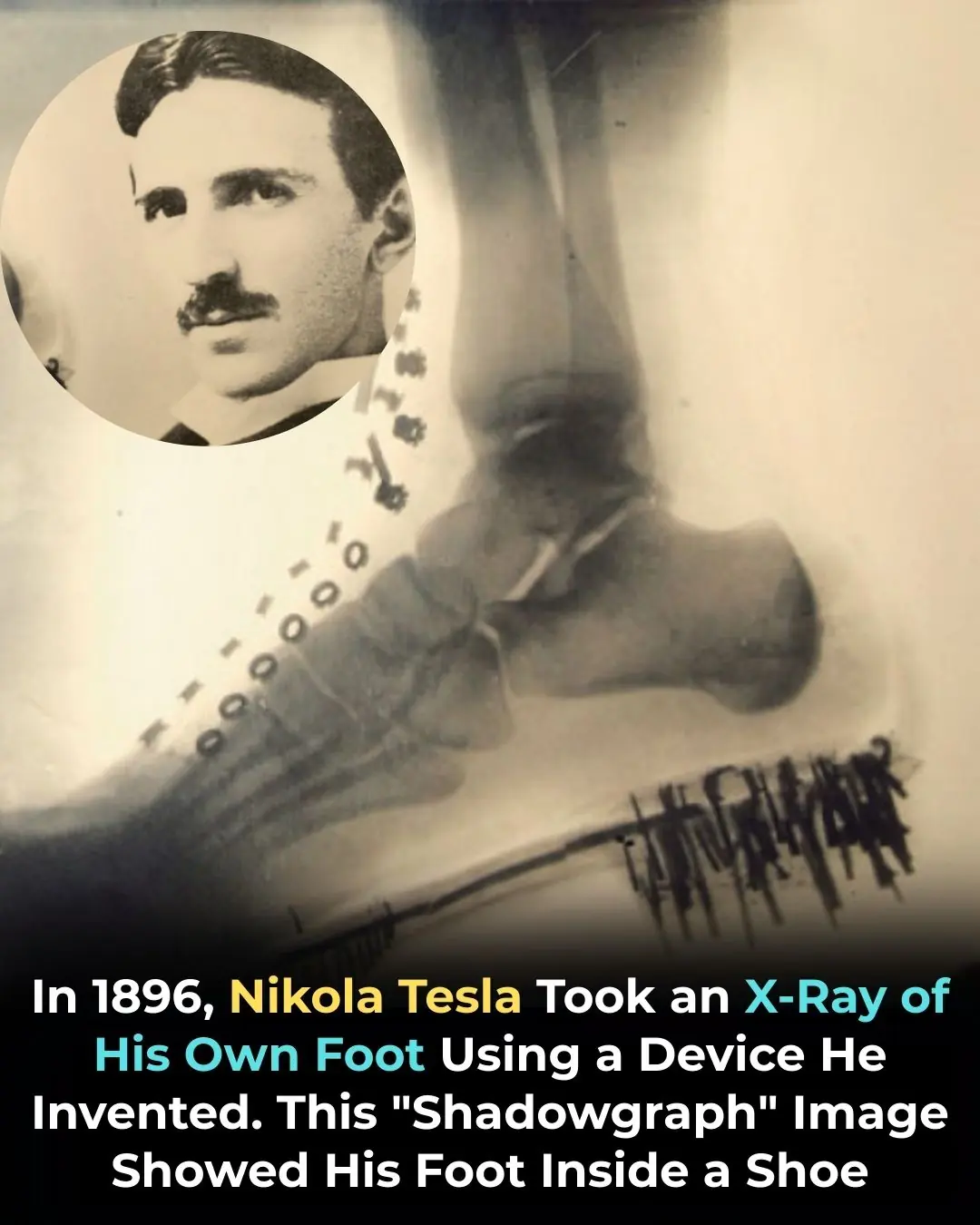
Nikola Tesla X-Rayed His Own Foot in 1896 — Pioneering the Future of Medical Imaging
Facts 09/12/2025 23:39
You’ve likely seen the viral image of a clear, bubble-like mask that claims to “block AI facial recognition from every angle.” While the mask itself is real, the bold claim made about its ability to render you invisible to facial-recognition systems is far from accurate.
👉 The mask was created by Dutch designer Jip van Leeuwenstein as part of his art project, "Surveillance Exclusion," which was developed at the Utrecht School of the Arts. The mask is designed to resemble a clear lens that distorts the shape of your face, bending light in a way that causes your features to appear stretched and warped when viewed by a camera.
To human observers, your face and expressions remain fully visible, but to certain algorithms, the distortion could potentially make detecting or identifying you more difficult. The idea behind the mask is to challenge the growing presence of automated surveillance technologies and raise questions about privacy.
However, here's the critical point to understand 👇
🛑 There is no large, independent, peer-reviewed study that proves this mask can reliably defeat modern facial recognition systems under all conditions, such as varying camera angles, lighting situations, or across different types of AI technology.
Over the past decade, facial recognition technology has advanced significantly. Today, deep-learning systems are capable of mapping dozens of unique facial landmarks, effectively creating a “face fingerprint” that can be used to identify individuals with high accuracy. After the COVID-19 pandemic, companies adapted their algorithms to better detect and identify masked or distorted faces. In many tests, these systems now achieve accuracy rates above 90% for masked faces, meaning that the mask would not offer foolproof protection.
Furthermore, even if you were able to fool one system, modern AI tools and tracking methods go beyond facial recognition. Advances in surveillance now rely on additional data points, such as gait analysis, body shape, voice recognition, phone data, and GPS location. Facial recognition is only one part of a much larger puzzle that can be used to track individuals across multiple platforms and contexts.
So, what exactly is this mask?
✅ It is a thought-provoking piece of artwork that critiques automated surveillance and sparks necessary conversations about privacy and security in the age of AI.
❌ It is not a scientifically proven, foolproof method to protect you from being identified by facial recognition technologies at all times, under all circumstances.
For those concerned about privacy, experts suggest focusing on practical measures, such as:
Supporting and advocating for laws and regulations that limit the use of facial recognition technology in certain contexts
Using digital tools like image-cloaking software to obscure personal details before uploading photos online
Being mindful about the personal data and images you share on the internet
The mask itself is undoubtedly an interesting design, and it certainly serves as a conversation starter about the intersection of art, technology, and privacy. But as for being a magical anti-AI invisibility shield? Not quite.
Would you still wear it as a statement against surveillance?