Logan stood in the Meridian Grand lobby, his maintenance uniform carrying traces of oil. He held his radio in one hand, eyes moving across the room in a slow, practiced sweep, a habit he had spent three years trying to forget. Alexandra walked in, CEO of Vertex Capital, tailored suit, an entourage two steps behind. She glanced at him the way someone notices a misplaced chair.
Then, in front of Carter, her bodyguard, arms crossed at her side, she let out a small, unhurried laugh. What would a maintenance man know about security? Nobody in that room knew the answer. What happens when the man they laughed at turns out to be the only one who can protect everyone there?
The morning started the way most of Logan’s mornings did, quietly and without ceremony. He clocked in at six, took the service elevator to the fourth floor, and began working through his checklist with the same steady attention he gave to every task, whether it was replacing a faulty light fixture or calibrating a pressure valve in the mechanical room. Meridian Grand was one of the city’s oldest five-star hotels, and old buildings had moods. Logan had learned to read them.
A door that stuck slightly at the hinge on a humid day. A section of marble flooring near the east corridor that carried sound differently than the rest. He cataloged these things automatically, the way a person catalogs the layout of a room they have walked through every day for three years.
He had been at Meridian for exactly that long, three years, four months, and eleven days, though he never counted, or so he told himself. The job suited him in the way a well-fitting coat suits a man who no longer wants to be noticed. The pay was modest, the hours were predictable, and no one at Meridian Grand asked questions about who you were before you arrived. That last part mattered most to Logan.
He was in the main ballroom by 7:15, checking the emergency lighting circuits along the east wall. The Grand Ballroom had been booked solid for the next eighteen hours. Vertex Capital, one of the country’s most aggressive acquisition firms, had taken the entire floor for a product launch event. Decorators had arrived the night before.
The caterers were scheduled for ten. Logan had been through the checklist for the space twice already, but he had asked Isaac, the hotel’s head of security and his direct superior on matters of building infrastructure, to let him do a third pass before the crew arrived. Isaac had given him a look, the kind that said he understood without needing to be told why. He had simply nodded and said, “Be finished before eleven.”
Logan was always finished before eleven.
He was on his knees near the southeast corner, checking the backup power panel with a voltage meter, when his colleague Marcus stopped at the doorway. Marcus was a large, easygoing man who had worked at Meridian for eleven years and considered himself an authority on hotel gossip. He leaned one shoulder against the doorframe and crossed his arms.
“You know you could swap with Danny for the afternoon shift,” he said. “Go home early for once.”
Logan said without looking up, “I’m fine.”
Marcus studied him for a moment. “Event day always gets chaotic. Management already sent two internal memos about keeping distance from the VIP party.”
Logan finished noting the voltage reading on his clipboard. “I’ve worked event days before.”
Marcus pushed off the doorframe and left without another word. Logan read the compliance memo from Isaac on his phone before returning to the panel. Standard language: maintain professional boundaries, do not initiate conversation with guests unless directly addressed, keep maintenance work out of sight during VIP movements.
He pocketed the phone. In the ballroom around him, the vast space sat still in waiting, all polished floors and folded linens and tiered lighting that someone had spent a considerable amount of time arranging. Logan stood, took one slow look at the room from the center of the floor, and his eyes moved through it the way they always did.
Not as a maintenance worker scanning for broken fixtures, but as something older than that, something that lived in the muscle and bone of him and had never quite gone away. He noted the service entrance on the west side, still propped open by a rubber stopper. He noted the camera at the northwest corner, its angle slightly off from where it should have been pointed.
He noted a man in a catering uniform standing near the third pillar from the right, not doing any of the things a catering staff member typically did at that hour. He filed all three things away, said nothing, picked up his toolbox, and went back to work.
The convoy arrived at 11:02, three black SUVs moving with the kind of coordinated spacing that spoke of habit. These were not rentals hired for the occasion, but a regular arrangement, a routine. The lead vehicle pulled slightly ahead and stopped first. The third vehicle’s occupants exited before the middle one’s doors opened.
Carter came out of the middle SUV’s front passenger seat before Alexandra’s door was opened from the outside, positioning himself at the rear left corner of the vehicle in a single fluid movement that covered the most probable approach angle from the lobby entrance. It was textbook. It was polished. And it was executed with the confidence of a man who had never had cause to question whether it was enough.
Alexandra stepped out. She was fifty-one years old and carried herself the way certain women of significant power do, not with aggression, but with an absolute absence of uncertainty. She wore a charcoal suit with a single strand of pearls, and she moved through the lobby of Meridian Grand as though she had already assessed it, already approved it, and had moved on to thinking about something more interesting.
Her assistant, Diana, fell into step one pace behind her right shoulder, tablet open, stylus moving. Carter positioned himself at her left. The lobby staff greeted her. Alexandra did not register them, not out of deliberate rudeness, perhaps, but out of something in some ways worse, a complete and practiced absence of attention.
She said something to Diana in a low, clipped voice, and Diana tapped three things on her tablet and said, “Already adjusted,” before Alexandra had finished her sentence. This was their rhythm, a compressed, interlocking efficiency that had taken years to build and now looked almost like telepathy.
Carter stood to Alexandra’s left and did what he always did in a new space. He read it. He was six foot two, broad through the chest and shoulders in the way of a man who had been trained rather than simply built, with calm, flat eyes that moved at a measured pace through the room.
He assessed threats by category: fixed position risks first, movement second, personnel third. His eyes swept the lobby staff, the bellhops, the concierge station, and the man in maintenance gray standing near the ballroom entrance with a toolbox. Carter’s gaze lingered on Logan for exactly two seconds. Ordinary toolkit, work uniform, no threat indicators.
His eyes moved on.
It was the kind of dismissal Logan had grown accustomed to. He did not hold it against the man. Carter was doing his job. The problem with that kind of professional shorthand, Logan knew better than most, was that it became a habit, and habits were the first thing that got you into trouble.
In the ballroom, the setup continued with the clockwork precision that only large-budget corporate events achieved. Diana moved through each section with her tablet, checking sightlines, confirming table placements, verifying that the rear projection screen was aligned to within a centimeter of specification. The technical crew had arrived at nine London time with the focused efficiency of people who had set up identical configurations in different cities for the past six months.
Alexandra walked the room once, said four things, and two of them required immediate adjustment. Then a younger member of the hotel’s event staff moved too quickly with a service cart, misjudged the turn, and clipped the edge of Logan’s toolbox, which was sitting against the wall near the power panel access door. The toolbox hit the marble with a flat cracking sound. Several tools scattered across the floor.
Every head in the room turned.
Logan crouched without hurry and began collecting the tools one at a time, placing them back into the box with the kind of quiet efficiency that did not draw attention and did not ask for help. The hotel staff member began to apologize. Logan raised one hand, not dismissively, just a brief gesture that said it was fine, and continued picking things up.
Alexandra had turned at the sound. She stood ten feet away, and for a moment she simply looked at him. Then something shifted in her expression, a fraction of disdain, the particular look of a person who has found evidence that a space does not meet their standards.
She said nothing, but the look was not nothing. Logan finished collecting the tools and closed the box. He returned to the panel and resumed his work. He did not look up, but his eyes, on their way back to the panel, moved once more to the man standing near the third pillar.
Still there, still not working, still watching the stage.
The pre-event walk-through began at 12:30. Alexandra moved through the room with Carter at her side while Diana coordinated the technical teams. The afternoon event was scheduled for two, a product launch attended by roughly two hundred guests, including several institutional investors and a substantial contingent of financial press.
There was a great deal riding on the next few hours, and Alexandra moved through the space with that weight behind her eyes, visible only if you knew to look for it. Isaac had asked Logan to remain in the ballroom during the technical preparation phase. The emergency lighting grid that ran along the west wall had shown a minor voltage irregularity during the morning check, and Isaac wanted someone on site to monitor it manually while the house lights cycled through their event configurations.
It was exactly the kind of task that required a person to stand near the power access panel, which happened to be positioned two meters from the VIP entrance corridor on the left side of the stage. It was this positioning that drew Alexandra’s attention.
She had just finished a discussion with Carter about the security placement for the afternoon, which entrances would be staffed, which sightlines Carter needed unobstructed, where the closest secondary exit was in relation to the stage. Carter had been in the middle of pointing out that the left side VIP corridor offered the best access route for Alexandra’s movements when he noticed Logan standing near the panel access door at the corridor’s end.
Alexandra followed his gaze.
“You,” she said, her voice carrying across the room without effort.
Logan looked up.
She walked toward him with a measured pace, not rushed, not hesitant, the kind of approach that had ended more than one negotiation before it began. She stopped eight feet away and looked at him the way she had looked at the misaligned projection screen, as something not quite in its correct place.
“What exactly are you doing there?” she asked.
“Monitoring the backup power circuit,” Logan said. “There was a voltage irregularity in the system this morning. I’m watching it during the lighting cycle.”
His voice was flat and precise, not defensive, not apologetic. Just the facts of the matter stated in the order they were relevant. Alexandra studied him for a moment. Then she turned to Carter and something happened in the space between them, a small shared act of dismissal performed in front of a room full of people.
“I paid for a five-star venue,” she said, speaking to Carter but making no effort to lower her voice. “And their security plan apparently involves stationing maintenance staff at the VIP entrance.”
She let out a short breath through her nose. “That’s reassuring.”
Carter’s mouth curved slightly. He said nothing, but his posture shifted, the subtle involuntary adjustment of a man who had just been given permission to relax his professional neutrality.
Around the room, people reacted in the silent language of spectators. Two of Alexandra’s technical staff looked at their equipment. One of the hotel’s event coordinators took a step backward. Diana, standing near the far wall, looked at the floor, then looked at the ceiling, then looked at her tablet.
Alexandra took one more step toward Logan. When she spoke this time, she spoke to him directly, slowly, as though she were explaining something to someone who had failed to understand it on the first attempt.
“There are jobs in the world that require a person to understand the space around them, to read a situation, to recognize when they are standing in the wrong place at the wrong time.”
She paused. Her eyes moved over him once more. The uniform, the toolbox, the patient stillness of him, and something like finality settled in her expression.
“That is clearly not your line of work.”
Carter nodded once, satisfied.
The room was quiet.
Logan looked at Alexandra. Not with anger, not with the hurried glaze of someone trying not to react. He looked at her for three full seconds, steady, even, the way a man looks at something he has categorized and filed away.
And then he turned back to the panel.
“The backup circuit will be ready before two,” he said.
That was all.
Alexandra waited a moment as though expecting something more. Nothing came. She turned away, said something to Diana about the audio levels, and continued through the room. Carter followed, but Logan noticed that Carter glanced back just once.
And the expression on his face was something different from the one he had worn ten minutes ago. Not concern, exactly. More like the look of a man who had just heard a sound he did not quite recognize.
After the walk-through moved to the main stage area, Logan completed the panel work methodically. Voltage was stable. The irregularity from the morning had resolved as he had suspected it would once the main grid warmed up. He noted it in his log, closed the panel door, and picked up his toolbox.
He should have gone back to the maintenance corridor. His work in the ballroom was done.
He did not go back.
He moved along the perimeter of the room instead, toolbox in hand, keeping to the edges of the space the way a man keeps to the edge of a street when he does not want to be noticed. He was watching the man near the third pillar.
In the two hours since he had first noticed him, the man had moved three times. Once to the far left service table, where he had stood for four minutes without touching anything on it. Once to the AV cable tray along the west wall, where he had stopped and looked at something that Logan could not see from his position. And now back near the third pillar, holding a service tray with the particular stillness of someone whose attention is somewhere else entirely.
He was wearing the catering uniform correctly. His ID badge was positioned at the standard height on the left lapel. His shoes were serviceable but unremarkable. Everything about him said catering staff, except for three things.
The first was his hands. Every twenty minutes or so, when he shifted the tray from one hand to the other, his right hand moved to his lower back in a brief automatic gesture, not scratching, not adjusting his shirt. The hand moved to a specific point and then returned, the way a hand moves to confirm that something is still in place.
The second was his eyes. They moved in a pattern. Most people in a busy pre-event space look at the activity around them. This man’s eyes followed the stage. Specifically, they followed the position of the podium. Again and again, his gaze returned to it with the fixed regularity of someone marking a target.
The third was his posture when Alexandra came near. Every other person in the room subtly adjusted when she passed close to them. A straightening of the spine, the unconscious deference that powerful people generate in rooms whether they intend to or not. This man did the opposite.
When Alexandra moved toward the stage for her final microphone check, his shoulders dropped. His weight shifted to his forward foot, and his jaw set slightly. Logan had seen that particular configuration of body language once before in a very different setting, in a very different city. He had learned to take it seriously.
He reached for his radio and pressed the channel to Isaac’s frequency.
“Isaac, Logan. I need you to run a secondary ID verification on your catering staff. There’s one individual, tall dark jacket, positioned near the third pillar from the stage right side, who doesn’t match standard service behavior patterns. I’d like him verified before the lighting check.”
There was a pause. Then Isaac’s voice came through, carrying the particular strain of a man managing too many things at once.
“Logan, the catering list has been fully confirmed by the event coordinator. Everyone was checked in at the service entrance.”
Another pause.
“Stay in your lane on this one.”
The line clicked off.
Logan lowered the radio. He stood in the room for a moment, feeling the particular weight of being the only person who could see something that no one else was looking for. He had felt this weight before. He had learned in the worst possible way what happened when he carried it for too long without acting.
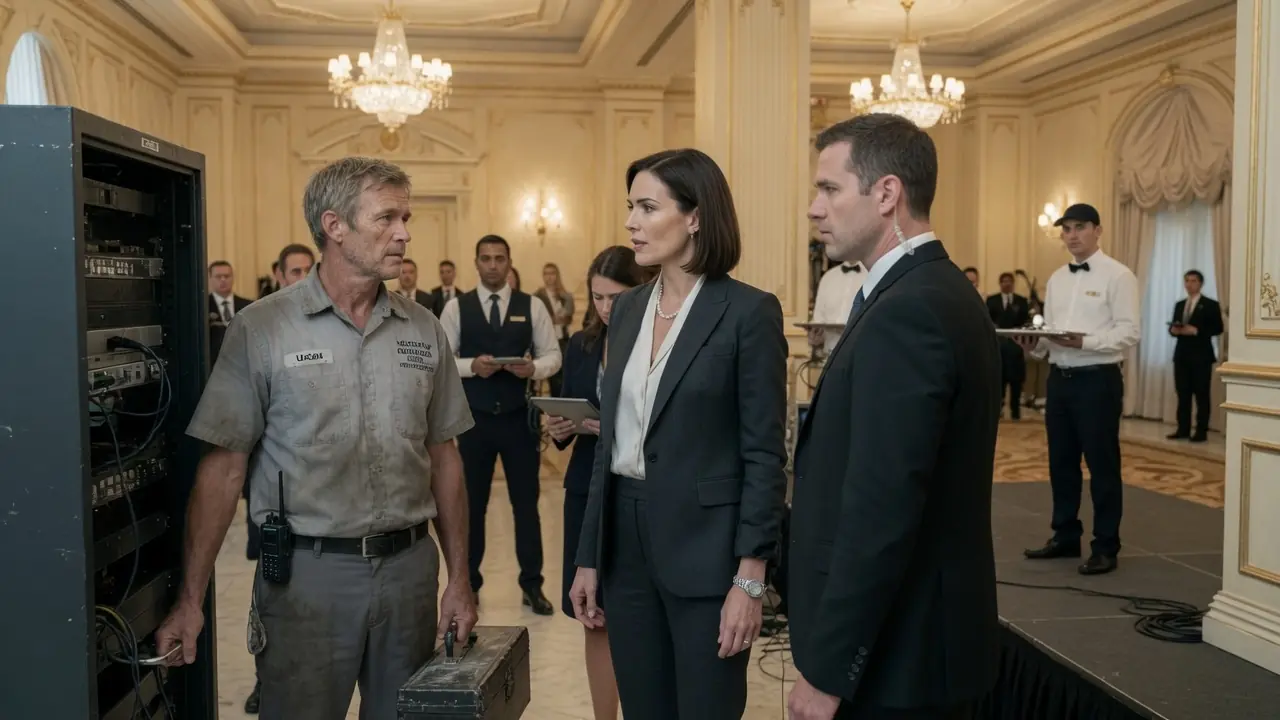
He set his toolbox down against the wall and walked toward the stage.
Alexandra was at the podium. She stood with the microphone lowered to her height, running the final sound check with the technical director standing at the main mixing desk twenty feet back. Carter was positioned at the base of the stage steps to her right. Diana stood in the wings to the left, tablet in hand, watching the room.
The man in the catering uniform had moved for the fourth time. He was now at the cable tray along the left wall. Twelve feet from the edge of the stage. Six feet from the junction box that controlled the main lighting grid.
Logan crossed the room at a steady pace. Not running. Running changed the atmosphere of a space. He came up beside the man and stopped, and when he spoke, he spoke quietly and without inflection.
“I’ll need to see your ID badge.”
The man turned. His eyes moved over Logan in a single rapid assessment. The uniform, the toolbox, the positioning. For a fraction of a second, his expression showed the particular calculation of someone deciding whether the situation was still controllable.
Then he decided it was not.
His right hand went to his lower back.
The moment the hand moved, Logan was already moving, not toward the man, but sideways, dropping his position and turning his body to clear the angle. What came out was not a firearm. It was a fixed-blade knife, short and narrow, the kind that could be hidden in a hollowed tool case and would not set off a standard metal detector at a service entrance if shielded properly.
Carter saw it from the base of the stage. He was already in motion before the knife was fully raised, crossing the space in three long strides, his eyes locked on the threat, his training driving him forward.
In the half second it took him to reach the position, he made a professional’s error. He saw a man in maintenance gray standing two feet from the threat and processed him as part of the threat picture. Carter hit Logan from the left at full force, driving his shoulder into Logan’s rib cage.
What happened next took three seconds.
In the first second, Logan absorbed the impact, not by bracing against it, but by moving with it, rotating his body in the direction Carter’s momentum was already traveling, using that rotation to slip his right arm under Carter’s and apply a wrist lock with his left hand simultaneously.
The lock was precise and complete. Carter’s arm was fully controlled. He could not advance. He could not pull free without fracturing his own wrist. He was, for the first time in his professional career, completely stopped.
In the second second, Logan released Carter, not throwing him, not forcing him down, but simply directing him sideways with the geometry of the lock, letting momentum carry him clear. In the same motion, Logan stepped forward, closed the distance to the man in the catering uniform, and executed a wrist control that stripped the knife from his grip with a single downward rotation.
The man did not let it go voluntarily. His hand simply had no choice. The knife hit the marble floor with a flat metallic click.
In the third second, Logan’s elbow found the pressure point just below the man’s right collarbone. The man’s legs buckled. He went down to one knee, then to two. His eyes were open, but his body was not responding to the signals his mind was sending it.
He was not unconscious. He would stand again within a few minutes.
He was simply no longer a problem.
Logan straightened.
The ballroom was absolutely silent.
On the stage, Alexandra had not moved. She stood at the podium with her hands at her sides, watching. Carter was on the floor to Logan’s left, sitting upright, looking at his own right hand with an expression Logan had seen before on the faces of people who have just had a fixed belief corrected at high speed.
Diana’s tablet was on the floor where it had fallen. The technical director was pressed against the mixing desk with both hands flat on the surface.
“Are you all right?” Logan asked.
The question was direct and without layers. Carter opened his mouth, closed it, nodded once, slowly.
Logan looked at the knife on the floor. He did not touch it. He stepped back from the man on the ground, put two meters between them, and reached for his radio.
“Isaac,” he said. “Ballroom. Call it in.”
The police arrived within nine minutes. The man was identified through his service entrance paperwork as having used a forged catering company badge, a discovery that would eventually trace back through a chain of transactions to a former business partner of Alexandra’s named Jason, who had lost his company, his investors, and the better part of his adult life to a contract dispute that Vertex Capital had won decisively two years prior.
He had spent the months since with a fixed and growing purpose. The paperwork, the planning, the patience, all of it had been oriented toward a single point on a stage in a hotel ballroom, a point that a maintenance worker had stepped in front of with twenty minutes to spare.
The ballroom was sealed while statements were taken. The event was postponed indefinitely. Outside in the corridor, Vertex Capital’s communications team made calls in low, rapid voices. Inside, the room slowly cleared to essential personnel.
Two officers, Isaac, Alexandra and her team, and Logan.
Carter stood near the north wall. He had declined the offer of a chair. In twelve years of professional close protection work, he had been tested, had restrained people, intercepted threats, handled situations that most people could not reconstruct clearly from memory afterward.
He had never been taken off the board, not once. And the gap between that history and the last three seconds was not something he could cover with experience or explanation. The man who had covered it for him had been wearing a hotel maintenance uniform, and Carter did not yet know what to do with that.
Diana had retrieved her tablet. She stood near the stage steps and did not open it. Alexandra sat in one of the audience chairs, a cup of coffee in front of her that she had not touched. She was watching Logan as he answered the officer’s questions, clearly, without filler, without seeking reaction.
He described what he had observed, the timeline of his observations, the specific behaviors that had indicated elevated risk. He described the radio call to Isaac. The officer wrote without interrupting.
When Logan finished, the officer looked at his notes and said, “You said you reported this approximately forty minutes before the incident?”
“Correct,” Logan said.
The officer wrote that down. Isaac, standing nearby, said nothing.
When the officer moved to speak with Carter, Logan picked up his toolbox and turned toward the service exit. On the west side, Alexandra spoke before he reached the door.
“Logan.”
He stopped, turned.
She was standing now, the coffee still untouched on the chair beside her. She stood in the middle of the otherwise empty half of the room, and for a moment she simply looked at him.
Not the way she had looked at him this morning, not with that assessing, categorizing distance, but with something considerably less comfortable for someone who had built a career on being the most perceptive person in any room she entered.
“When did you first notice him?” she asked.
Logan considered. “When your convoy arrived. He was positioned near the third pillar when I was doing the lighting circuit check at seven. He hadn’t moved into a natural work pattern in four hours.”
Alexandra absorbed this. “You watched him for four hours?”
“I watched him, and I reported it.”
He let that sit where it landed.
A pause.
“I said some things to you this morning,” she said. “I owe you an apology.”
“You don’t have to.”
“I do.”
Her voice was steady, but there was an edge in it. The edge of a person who is not accustomed to this particular position and is making themselves hold it anyway.
“I looked at you and decided what you were before you said a word. I said it in front of people.”
She paused.
“That was wrong.”
Logan looked at her. He held her gaze the way he had held it that morning. Without challenge, without submission. Just looking.
“I appreciate that,” he said.
He nodded once, and then he turned and walked toward the service exit, and she did not call after him again.
Alexandra was not a woman who left questions unanswered. By seven that evening, she had Diana and Carter working through what could be found, and by nine, she was sitting in the hotel’s business center reading what they had gathered. It was not much.
People who wanted to be unfindable were generally unfindable, but what was there was enough.
Carter had found the professional record first, or rather the outline of one. Logan had spent a decade as the lead protection specialist for a private security firm contracted exclusively to a single client, a major financial institution whose executive protection requirements operated at the level typically associated with heads of state.
The firm did not publicize its personnel. Its contracts were sealed, but Carter knew the name of the firm. Anyone in serious close protection work knew the name. The training program that firm used had produced fewer than thirty active specialists in a decade, drawn from backgrounds in military special operations, federal law enforcement, and intelligence work.
The techniques Carter had experienced firsthand in the ballroom that afternoon were consistent with what that program produced. Carter had attended one training session hosted by a junior instructor from that firm four years ago. The session had lasted two days. He still thought about it regularly.
Logan had led that team for ten years.
Diana had found a second piece, a court document from a civil suit, partially sealed, that referenced an incident at a private charity event in the city approximately three years prior. The incident had been recorded as an attempted assault, successfully neutralized. There had been no injuries to the principals.
The security lead for the event, unnamed in the accessible portions of the document, had filed a resignation effective the same week.
It was Isaac who filled in what the documents could not say when Alexandra finally asked him directly in the hallway outside the business center at close to ten that night. Isaac had known Logan before Meridian Grand. Not as a colleague, not as a friend, but as someone in the same professional world who occupied a position that Isaac, who had spent his career in hotel security, regarded with the particular respect of a man who understands the difference between his own level of work and the level above it.
When Logan had come to the hotel three years ago asking about the maintenance position, not the security department, the maintenance department, Isaac had recognized him and asked no questions. Because Isaac understood that Logan had not come looking for a way back into the world he had left. He had come looking for a door that went somewhere else entirely.
The incident three years ago had been contained, professionally speaking. The principals were unharmed. By every external measure, the operation had succeeded. But in the final moments, in the narrow window between the threat being identified and the threat being neutralized, there had been one specific moment when Logan had been on the wrong side of a ten-foot distance.
Not because of a failure of skill or training or judgment, because the scenario had developed along a vector that no preparation could fully anticipate. And the person standing in the gap had not been a client.
It had been his wife.
She had been there to meet him after the event. She had not been part of the protection detail, not part of any planning, not anyone’s responsibility except his in the most fundamental and human sense of the word. And in that moment, Logan had been twenty feet away securing an exit, doing exactly what his training required of him.
And the person who mattered to him most was in a place he had not been.
She survived. The injury was significant, but not permanent. She recovered over the course of several months, quietly, in the company of people who loved her. Logan had remained at her side through all of it.
But a marriage, unlike a body, does not always recover on the same timeline as the people inside it. What they had been to each other before that night, certain, anchored, trusting the architecture of the life they had built, could not be rebuilt from the same materials. She was not bitter. He was not cruel.
They had tried. And then, quietly and without assigning blame, they had stopped trying, and Logan had moved out of the house and into a smaller apartment. Shortly after that, he had walked into Meridian Grand with a resume that listed his previous work in terms vague enough to be accurate and incomplete enough to invite no further questions.
Alexandra sat with this for a long time after Isaac left. She thought about the man she had addressed in front of a room full of people that morning, the flat patience in his eyes, the complete absence of the reaction she had been, without fully realizing it, expecting to provoke. She thought about what she had said and the precision with which she had said it and the audience she had said it in front of.
She had made her point. She had made Carter complicit in it. She had made everyone in that room a witness to it. And the man she had said it to had been someone who had done things in his working life that she could not have done, who had carried weight that she would not have known how to carry, and who had chosen, after all of it, to wear a maintenance uniform in a hotel and do his job without performing it for anyone.
She was not given to sentimentality, but she was given to accuracy, and the accurate word for what she had done that morning was something she did not like to attach to herself.
Carter appeared at the door of the business center. He stood in the doorway without entering.
“You should know,” he said, “that what he did in the ballroom, that first movement, the lock, I’ve been trying to work out the mechanics of it for the last four hours.”
He paused.
“I can’t fully reconstruct it, and I’m very good at my job.”
“I know you are,” Alexandra said.
Carter nodded. He looked as though he might say something else, and then he did not, and he left.
The following morning, the ballroom was reset. Vertex Capital’s event team had spent the night rescheduling, and by nine, the space looked exactly as it had the day before. The police report described an attempted assault at a corporate event, suspect in custody, no injuries. Logan’s name was not in it.
He had asked Isaac to keep it that way, and Isaac had.
Carter found Logan in the sub-basement mechanical corridor at 7:30, before the event team arrived. Logan was running a pressure check on the HVAC system, crouched beside the main manifold with a gauge in his hand. Carter came down the stairs and stood at the bottom.
When Logan looked up, Carter crossed the floor and stopped two feet away. He did not speak. He extended his hand. Logan looked at it for a moment, then he stood and took it.
They shook once, firm, brief.
The handshake of two men who have reached an understanding through means that do not require explanation.
“You could have put me down,” Carter said.
It was not an accusation. It was a statement of fact, delivered with the straightforwardness of a professional making an accurate assessment.
“You were doing your job,” Logan said. “You read it wrong, but you moved right.”
Carter looked at him. “You’ve trained in that program.”
It was not a question.
Logan answered it anyway. “A long time ago.”
Carter nodded. He turned and went back up the stairs without another word. At the top of the landing, he stopped and said without looking back, “Good morning.”
“Good morning,” Logan said.
The event began at two. Diana had rebuilt the speaker schedule. Carter was stationed at the base of the stage steps, slightly more to the left than the previous day’s plan had indicated, an adjustment that placed him with a direct sightline to both the left service corridor and the main floor approach.
Anyone watching carefully would have noticed the shift. Carter noticed himself noticing it, which was its own kind of education.
Alexandra stood at the podium with two hundred faces in front of her. Investors, analysts, press, partners. Diana’s prepared remarks were on the teleprompter to the left of the stage. Alexandra had read them twice the night before and had agreed with their content entirely.
She did not use them.
She set both hands on the sides of the podium and looked out at the room.
“Twenty years in this business has taught me a great deal about how to evaluate something quickly,” she said. “How to walk into a room, assess what is there, and make decisions. I’m good at it. It’s part of why I’m standing here.”
She paused.
“Yesterday, I was reminded that fast assessment is a tool, and like all tools, it fails when applied to the wrong job.”
She did not explain further. She did not name anyone. She moved on to the content of the launch, and she delivered it well. And the room received it the way rooms receive things when the person speaking has their full attention in the right place.
The applause at the end was genuine. Diana, watching from the wings, had not opened her tablet once.
On the third floor, Logan was replacing a section of tile grout in room 314. The sound from the ballroom came up through the building in fragments. The muffled shape of applause, the rise and fall of a voice amplified through good speakers. He heard it the way you hear rain from inside a building, present, indifferent to you, continuous.
His phone showed one new message, an unknown number. He read it standing in the doorway of room 314.
I asked Isaac. He didn’t say much, but what he did say was enough. I think I understand what I was really asking you last night when you asked me why I was apologizing. I don’t have a clean answer yet. Thank you, not for yesterday, for the question.
Logan read it twice. Then he put the phone in his pocket and went back to the tile work.
He was not a man who needed to be seen clearly by the people who had misjudged him. He had learned that lesson before it cost him something irreplaceable, and he had carried it forward in the form that made most sense to him: a quiet life, a job that asked only for his attention and gave back the specific piece of work done correctly.
Three years ago, he had decided that the version of himself that existed in service to other people’s assessments of him was a version he could let go of. He had let it go, and every morning since, the letting go had gotten a little easier.
What Alexandra had said in that room had found its mark. He knew that. He was not made of stone and had never claimed to be, but the mark it left was smaller than she would have expected, smaller than she had perhaps intended, because the man she had aimed it at had already done the long, unglamorous work of knowing what he was worth without anyone else’s confirmation.
He pressed the grout carefully along the tile edge. The work was small and precise and required his full attention to do correctly.
He gave it his full attention.
In the ballroom below, the applause continued. Outside, the afternoon was clear and uneventful and moving at exactly the pace it needed to.