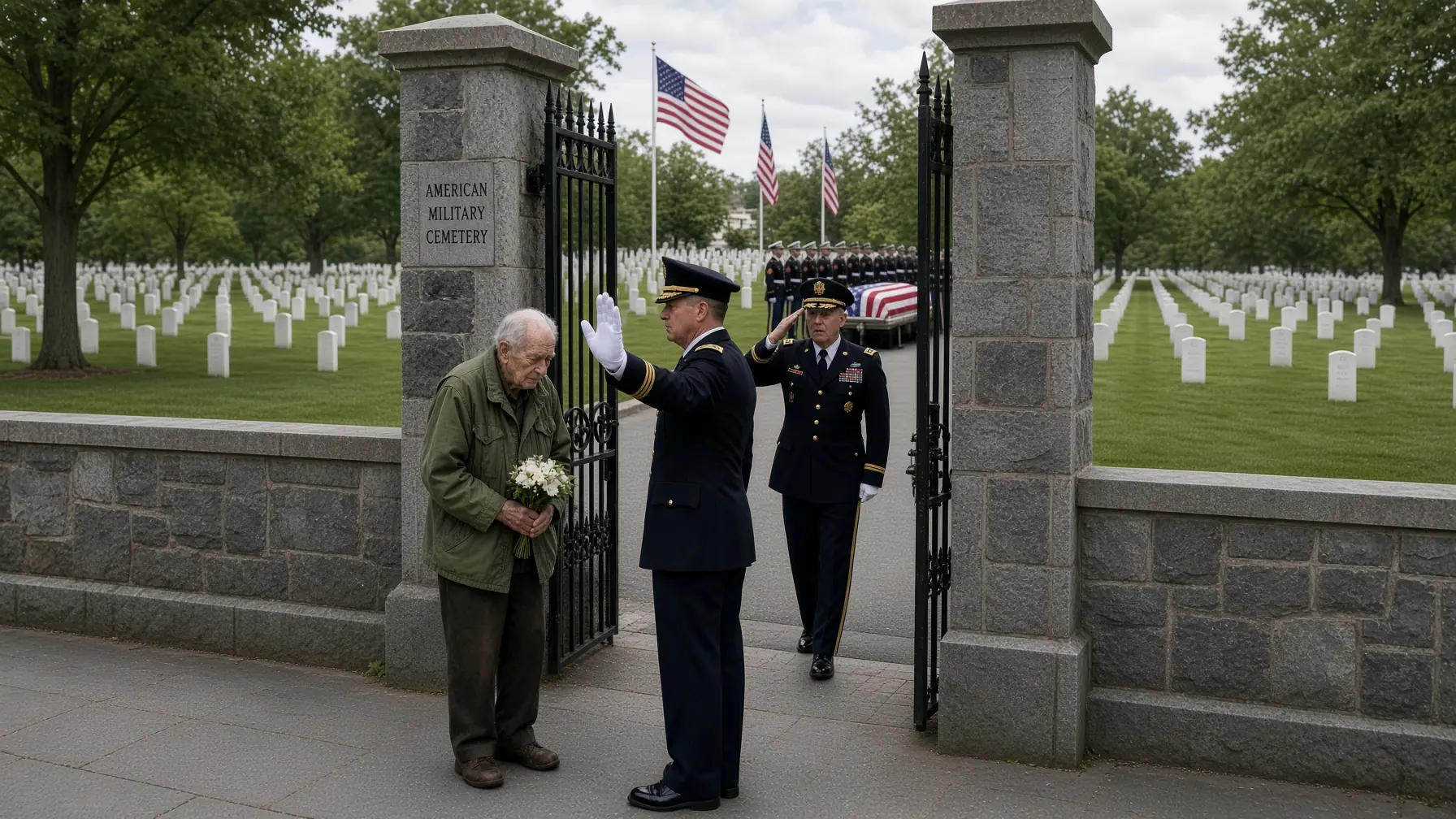
“Sir, this is a restricted service.”
The young guard said it without cruelty, but without interest either.
To him, the old man standing outside the cemetery gate was just another stranger in a faded uniform, another face from a war older than his own father, another person without the right badge on the right morning. Behind the iron fence, the ceremony had already begun taking shape in perfect military order.
Rows of chairs faced a flag-draped platform.
Uniforms gleamed under a pale Virginia sky.
Cameras waited beyond the press rope.
And outside the gate, Daniel Whitaker stood holding one white lily wrapped in brown paper.
He had taken two buses, one train, and a county shuttle to get there. His knees ached from the final walk up the hill. His left shoulder, the one that had carried pain for fifty-three years, throbbed beneath the old dress jacket he had pressed himself the night before.
The jacket was too loose now.
The brass buttons had dulled.
The fabric had faded from deep green to something closer to storm water.
But it was clean, straight, and worn with more dignity than half the polished uniforms inside the gate.
“I came to pay respects,” Daniel said.
His voice was low.
Not weak.
Just used sparingly.
The guard checked the tablet in his hand.
“Name?”
“Daniel Whitaker.”
The guard scrolled.
Then scrolled again.
“I don’t see you on the authorized list.”
“I didn’t expect you to.”
“Are you family?”
“No.”
“Press?”
“No.”
“Official military attachment?”
Daniel looked through the bars toward the gathering crowd.
“No. Not anymore.”
The guard shifted his weight.
Inside, the funeral of General Robert Harlan was about to begin. Four-star general. National security adviser. Decorated commander. A man whose photograph had filled newspapers all week beneath headlines calling him a patriot, strategist, warrior, and statesman.
Daniel had seen every headline.
None of them mentioned the nineteen-year-old lieutenant who had once trembled in jungle mud while mortar fire split the night open.
None of them mentioned the men who had dragged him out before history had a chance to know his name.
That was all right.
Daniel had not come for headlines.
He lifted the lily slightly.
“I served with him.”
The guard glanced at the flower.
Then at the old man’s worn boots.
“I’m sorry, sir. Without clearance, I can’t let you in.”
Daniel nodded.
He did not argue.
There had been a time in his life when he could have walked through worse gates with half a platoon behind him and no one foolish enough to ask for paperwork. But that time had passed, and Daniel had made peace with being unknown long before the country learned to forget him.
He stepped aside and stood near the stone wall.
The guard returned to his post.
The ceremony went on.
A military band tuned quietly near the canopy. Generals moved into formation with the smooth choreography of men who had spent their lives turning grief into order. A folded flag rested on a small table beside the urn, polished wood catching the morning light.
Daniel watched from outside the gate.
The lily shook in his hand, though he tried to keep it still.
The wind came down from the trees, carrying the smell of damp grass and fallen leaves. It tugged at his sleeve and pressed cold through the thin place near his collar. He had dressed for respect, not comfort.
Inside, men who had never heard of him took their seats.
Inside, speeches waited.
Inside, Robert Harlan was becoming a public memory.
Outside, Daniel Whitaker stood alone with the private one.
He was not angry.
That surprised even him.
There had been years when anger lived near the surface, when a wrong tone from a clerk or a cold stare from a stranger could open old doors in him. But age had burned much of that down. What remained was quieter and heavier.
He had come because Bobby asked.
That was still how Daniel thought of him.
Not General Harlan.
Not the man whose motorcade had crossed television screens.
Bobby.
A scared young officer from Ohio with mud on his face, blood on his sleeve, and a voice that shook the first time Daniel heard him call for help over a broken radio.
Daniel shifted the lily to his other hand.
At the far side of the ceremony, someone noticed him.
Colonel Evan Shore had spent the last six years as one of General Harlan’s aides. He knew the guest list. He knew the family. He knew every senator, secretary, deputy, and foreign military representative expected to attend. He also knew the names General Harlan spoke only when the room was quiet and the bourbon was already poured.
One of those names had been Daniel Whitaker.
Evan saw the faded shoulder patch first.
Then the posture.
Then the white lily.
The patch belonged to Sparrow Company, a reconnaissance unit from Vietnam that had officially existed only as a line in records people were still not allowed to read without clearance. General Harlan had mentioned it once, late at night in Kabul, after a ceremony where everyone applauded him too loudly.
“The bravest man I ever knew never let anyone pin a medal on him,” Harlan had said.
Evan had asked his name.
“Danny Whitaker,” the general replied. “If I ever go before him, make sure he comes. Even if he stands outside the gate, you bring him in.”
Now Evan stood near the front row, looking through the iron bars.
His throat tightened.
He turned to the man beside the urn.
General Thomas Vale, four stars on his shoulders, white hair cut close, jaw set against a grief he had no intention of displaying in front of cameras.
“Sir,” Evan said quietly.
General Vale did not look away from the platform.
“What is it?”
“He’s here.”
The general turned.
“Who?”
Evan nodded toward the gate.
“Whitaker.”
The change in General Vale’s face was small.
A civilian might have missed it.
A soldier would not.
He looked through the bars, and for a moment the ceremony, the press, the politicians, the folded flag, all of it seemed to fall away. His eyes found the old man by the wall, the faded uniform, the lily in his hand. General Vale inhaled once, sharply.
Then he removed his gloves.
“Hold the service,” he said.
The colonel blinked.
“Sir?”
“Hold the service.”
Before anyone could ask why, General Vale stepped down from the platform and walked toward the gate.
The band stopped.
The honor guard looked straight ahead, but their eyes moved slightly.
The family turned.
Reporters lifted cameras.
No one understood why the highest-ranking officer at the funeral had left his place and was walking away from the casket, away from the podium, away from the protocol everyone had practiced for three days.
Daniel did not notice at first.
He was watching the flag.
Then the gate opened.
The guard turned quickly, startled, as General Vale came through himself.
Daniel looked up.
For a second, he did not recognize the man.
Then time folded.
The four-star general standing in front of him became a twenty-two-year-old captain with blood on his cheek and terror in his eyes, the young man Daniel had dragged behind a crater wall while the ridge exploded around them.
“Tommy Vale,” Daniel said softly.
General Vale stopped three feet away.
He stood at full attention.
Then, in front of the secretary of defense, the press, the Harlan family, the honor guard, and every officer in the cemetery, he raised his hand and saluted.
Sharp.
Clean.
Unmistakable.
The young guard’s face went pale.
Daniel stared at the salute as if it had arrived from another lifetime.
“Don’t do that,” he murmured.
General Vale’s voice was thick but steady.
“Yes, sir. I will.”
Daniel lowered his eyes.
“I wasn’t on the list.”
“You were the list,” Vale said.
No one inside the gate moved.
General Vale dropped his salute, turned to the guard, and spoke without anger.
“This man enters before I do.”
The guard swallowed.
“Yes, General.”
Daniel shook his head once.
“I only came to leave the flower.”
Vale looked at the wilted lily.
“Robert left instructions.”
At that, Daniel’s face changed.
Not much.
Enough.
General Vale signaled to Colonel Shore.
The colonel came forward carrying a polished wooden box, both hands under it, face solemn. It was small. Too small for the weight it carried. The urn inside held the remains of General Robert Harlan, a man the country knew as a commander, but Daniel knew as a boy who had survived because somebody refused to leave him behind.
General Vale took the box and held it out.
“Robert asked that you carry him the final distance.”
Daniel did not reach for it at first.
The lily trembled harder.
“He asked for me?”
“He wrote it himself.”
Daniel looked past Vale toward the canopy.
“They remembered him.”
Vale’s eyes softened.
“We remembered you.”
That almost broke him.
Not the salute.
Not the ceremony.
That sentence.
Daniel took the box with both hands. The lily slipped against his wrist but did not fall. He held the urn close to his chest, and for a moment his old shoulders straightened under the familiar weight of carrying someone who could not carry himself.
General Vale turned toward the cemetery.
“Will you walk with me, Sergeant?”
Daniel looked at the open gate.
Then at the crowd.
Then down at the urn.
“I was never much for stages.”
“No,” Vale said. “But you were always there when it mattered.”
Daniel nodded once.
Together, they walked through the gate.
Inside, everything had changed.
The audience had risen without being told. Officers stood at attention. Veterans in civilian coats removed their hats. A few reporters lowered their cameras, understanding at last that this was not content to be captured, but a moment to be respected.
As Daniel passed the first row, an old man with a cane began to tremble.
His name was Harold Pike, former radio operator, Sparrow Company.
He had not seen Daniel in forty-eight years.
He rose slowly, one hand gripping the cane, the other lifting to his brow in a salute that shook but did not fail.
Then another old veteran stood.
Then another.
Men in their seventies and eighties, some bent, some scarred, some wearing patches under suit coats, one with an oxygen tube, all rising like ghosts called by a name only they remembered. Sparrow Company had been scattered across the country and across silence. That morning, for Robert Harlan, they had come.
And when Daniel Whitaker walked past carrying the urn, they saluted him.
Not because protocol required it.
Because memory did.
Daniel kept walking.
His eyes stayed on the gravel path ahead.
If he looked left or right, he feared the whole morning might dissolve.
The final steps to the platform felt longer than the walk from the bus stop, longer than any patrol road, longer even than that night in 1969 when mud tried to swallow him and gunfire tore leaves from the trees around his face.
When he reached the table, he placed the urn beside the folded flag.
Then he laid the white lily across the lid.
The flower looked small there.
Tired.
Human.
General Vale stepped to the podium.
He had been scheduled to read the official eulogy. Three pages, approved by staff, printed in a folder with the Department seal. He looked at the pages, closed the folder, and set it aside.
Then he faced the crowd.
“Ladies and gentlemen,” he said, “there are names history learns easily. Generals. Secretaries. Presidents. Commanders.”
His voice carried across the cemetery.
“But there are other names history survives because of.”
He turned toward Daniel.
“Sergeant Daniel Whitaker was one of those names.”
Daniel stood still beside the urn.
His hands hung at his sides.
His face revealed nothing, but his throat worked once.
General Vale continued.
“In 1969, outside Khe Sanh, Robert Harlan was a nineteen-year-old lieutenant cut off beyond the wire. I was a young captain who had no business surviving my first command. We were pinned under fire, wounded, and out of options.”
The wind moved through the flags.
“Sergeant Whitaker crossed open ground to reach us. He brought smoke, dragged two wounded men, and carried Harlan across terrain that should have killed all of us. He refused a medal. He refused photographs. He refused every attempt to turn what he did into a story about himself.”
The crowd was silent.
“Robert Harlan lived long enough to serve this country because Daniel Whitaker decided one scared lieutenant was not going to die in the mud.”
General Vale paused.
His voice lowered.
“And I stand here today because he made that same decision for me.”
No applause came.
Not yet.
The kind of truth being spoken did not ask for it.
Vale looked at the urn.
“General Harlan requested that Sergeant Whitaker carry him the final distance, not because it was ceremonial, but because it was honest.”
He closed his hand around the edge of the podium.
“We spend much of military life talking about honor. Today, we are looking at it.”
The silence cracked then.
Not with cheering.
With rising.
The secretary of defense stood.
Then the generals.
Then the family.
Then every soldier, officer, aide, journalist, and visitor beneath that gray Virginia sky.
One by one, salutes rose.
Daniel stared at the folded flag.
He did not return the salute.
He did not know how to receive so much recognition at once without feeling like he was stealing it from men who had never come home.
But General Vale knew.
He stepped beside Daniel and whispered, “Let them carry a little of it.”
Daniel closed his eyes.
Then opened them.
Slowly, carefully, he lifted his right hand.
The salute was not as sharp as it might have been decades ago.
His fingers trembled.
His shoulder resisted.
But it was complete.
And for the first time in more than fifty years, Daniel Whitaker allowed a country to see him.
After the service, people tried to approach him.
Senators.
Reporters.
Young officers.
Old veterans.
The Harlan family.
Daniel answered gently when he could and quietly moved away when he could not. He had lived too long outside applause to trust it fully. Praise came like weather, sudden and loud, and he knew better than to build a house from weather.
He found his way to a cluster of sycamores near the edge of the cemetery.
General Vale joined him after a few minutes.
Neither man spoke at first.
They watched as chairs were folded and carried away. The band packed their instruments. The honor guard moved with the careful quiet of men who understood they had served something larger than schedule.
Daniel looked down at his hands.
“I didn’t save him so he could become all that.”
“No,” Vale said. “You saved him because he was there.”
Daniel nodded.
“That’s all it was.”
Vale looked at him.
“That is never all it is.”
The words lingered.
Daniel reached into his jacket and pulled out an old envelope.
It was creased soft at the corners, the paper yellowed from years of being read and folded again. Harlan had mailed it three months before his death. Daniel had not answered. He rarely answered letters because letters asked a man to be reachable, and Daniel had made a life out of not being found.
He handed it to Vale.
The general shook his head.
“Robert wanted you to keep that.”
Daniel looked at the envelope.
“He wrote too much.”
“He spent fifty years not writing enough.”
That brought the smallest smile to Daniel’s face.
Inside the envelope was one paragraph, written in Harlan’s old slanted hand.
Danny, if I go before you, come if you can. If you cannot, I will understand. You never owed me anything. I owed you every morning I got after that night. I owed you my children, my commands, my old age, and every quiet sunrise I lived to see. You refused thanks because you thought duty did not need it. Maybe you were right. I am thanking you anyway. Bring me home if they let you. If they do not, stand outside and know I knew you came.
Daniel had read that last line on the bus.
If they do not, stand outside and know I knew you came.
He folded the letter and placed it back inside his pocket.
“He knew this would happen,” Daniel said.
Vale nodded.
“He knew institutions are better at honoring rank than recognizing debt.”
The afternoon reception took place under a white tent near the cemetery office.
Daniel would have avoided it if Vale had allowed him.
He tried twice.
Vale blocked him both times with the practiced calm of a man who had commanded divisions and stubborn old sergeants.
“You need to eat,” Vale said.
“I ate on the bus.”
“A vending machine honey bun does not count.”
“You always did talk too much for an officer.”
“And you always mistook care for interference.”
Daniel had no answer to that.
Inside the tent, the surviving men of Sparrow Company gathered around a small table away from the podium. They were old now. Time had bent them differently. One had lost hearing in one ear. Another carried an oxygen tank. Another’s hands shook so badly he gripped his coffee cup with both palms.
But when Daniel sat down, they became young for half a second.
Not in body.
In recognition.
“Danny Whitaker,” Harold Pike said.
Daniel looked at him.
“Pike.”
“You still ugly.”
“You got worse.”
The old men laughed.
It came out rough and sudden and startlingly alive.
For a few minutes, there were no cameras, no generals, no speeches. Only names, memory, and the strange mercy of being seen by people who remembered the version of you before the world broke and rebuilt itself.
They spoke of Bobby Harlan.
Not General.
Bobby.
How he had once tried to brew coffee in a ration tin and nearly poisoned them with soap. How he wrote letters home every Sunday even when no mail was moving. How he shook before his first firefight and never pretended afterward that courage meant the absence of fear.
Daniel listened more than he spoke.
That was his way.
At the far end of the tent, a young lieutenant watched the table.
It was the same lieutenant who had first questioned Daniel outside the tree line after the ceremony, before the salute, before the revelation. He approached carefully now, hat in hand, face red with shame.
“Sergeant Whitaker?”
Daniel looked up.
The young man swallowed.
“I was at the gate earlier. I asked for credentials.”
“You did your job.”
“I dismissed you.”
Daniel studied him.
The lieutenant looked like he wanted punishment because punishment would make the guilt cleaner.
Daniel did not give it to him.
“You saw an old man without a pass.”
“Yes, sir.”
“Next time, look twice.”
The lieutenant nodded.
“Yes, sir.”
“That’s all.”
The young man stood a moment longer, then saluted.
Daniel returned it.
This time, it felt less like ceremony and more like instruction.
Late in the afternoon, after the guests had gone and the cemetery returned to its ordinary quiet, Daniel walked alone to Robert Harlan’s grave.
The ashes had been interred beneath a new stone, simple and pale.
General Robert J. Harlan
Commander, Father, Friend
He Brought Others Home
Daniel stood there for a long time.
Then he lowered himself slowly to one knee, ignoring the sharp protest from both legs. From his pocket he removed a small paper packet. Inside was a pinch of red dirt from a place that did not appear on most maps and would not be named in the newspaper.
He sprinkled it at the base of the stone.
“Thought you’d want a little of the old mud,” he said.
The wind moved through the sycamores.
Daniel remained kneeling.
“You always hated lilies.”
A pause.
“I brought one anyway.”
He bowed his head.
“Rest easy, Bobby.”
When he tried to stand, a hand appeared beside him.
General Vale.
Daniel looked at it.
Then took it.
Vale helped him rise without making it feel like rescue.
For that, Daniel was grateful.
Vale held out another envelope.
“This was in Robert’s safe. He left instructions that it was to be given only if you came all the way to the grave.”
Daniel looked at the envelope.
“You generals ever learn to stop giving orders?”
“No.”
“That explains a lot.”
He took it.
The handwriting on the front was Harlan’s.
Danny.
Inside was a short letter.
Brother, you spent your whole life refusing to be thanked because you believed doing right was ordinary. Maybe it should be. But you made my life possible. Every command, every child, every gray hair, every quiet morning with coffee, every chance to become more than the frightened boy you pulled out of fire, all of it came after you. I could never repay it. So I have asked them to build something in your name, not for glory, but for the men who come home carrying wars no parade can see. Forgive me if that makes you angry. I know it will. Your friend, Robert.
Daniel folded the letter.
His jaw tightened.
“He always did have poor judgment.”
Vale smiled faintly.
“He said you would say that.”
“I don’t want a building.”
“He said you would say that too.”
Daniel slipped the letter into his jacket.
“What kind of building?”
“A veterans’ recovery center. Counseling. physical therapy. job training. housing support. Quiet rooms. Woodshop. Garden. A place for men and women who come home but do not know how to arrive.”
Daniel looked toward the headstone.
“That sounds like Bobby.”
“It will carry your name.”
“No.”
Vale sighed.
“Daniel.”
“No.”
“It is already funded.”
“Then put his name on it.”
“His foundation funded it. His name is already everywhere. This is his request.”
Daniel turned away.
“I don’t need the country carving my name into stone.”
Vale’s voice softened.
“No. But someone who feels forgotten may need to see it there.”
That stopped him.
The argument found the one door he had not locked.
Daniel said nothing for a long time.
Then he asked, “Can there be a workshop?”
Vale smiled.
“Already planned.”
“Good tools?”
“The best.”
“No ceremony speeches?”
“There will be speeches.”
Daniel frowned.
“I won’t attend.”
“Yes, you will.”
The following spring, the Franklin Veterans Recovery Center opened outside Charlottesville.
Daniel had objected to the name until the final paperwork made arguing useless.
It was a low stone building set near a line of trees, with wide windows, quiet rooms, a physical therapy wing, a small clinic, a woodworking shop, and a garden lined with benches for people who did not want to talk yet but needed somewhere safe to sit. A bronze plaque near the entrance listed no battles and no medals.
Only one sentence.
For those who carried others home, and for those still learning how to come home themselves.
Daniel stood at the edge of the crowd holding another white lily.
This one was fresh when he arrived.
By the time the ribbon was ready, the petals had begun to curl from the warmth of his hand.
Officials spoke.
General Vale spoke.
Robert Harlan’s daughter spoke, voice breaking when she said her father had spent his final months making sure the center would exist. A young veteran in a wheelchair spoke next, quietly, about waking every night convinced he was still in Afghanistan and how the center had given him a room where nobody told him to “just move on.”
Daniel listened from the side.
He did not sit on the stage.
He did not wave.
He did not step toward the microphones.
But people knew where he was.
They glanced at him with respect, then looked away because they somehow understood staring would be another kind of taking.
After the ribbon was cut, veterans entered the building first.
Not donors.
Not officials.
Veterans.
Some walked with canes.
Some with spouses.
Some alone.
Some with eyes that scanned every exit automatically.
Daniel watched them go in and felt something inside him loosen.
Not pride.
Pride had never interested him much.
Relief, maybe.
That was closer.
General Vale came to stand beside him.
“You still angry?”
“Yes.”
“About the name?”
“Yes.”
“About the speeches?”
“Yes.”
“About the fact that it matters?”
Daniel looked at him.
Vale smiled.
“I’ll count that as progress.”
They stood in silence while the crowd moved around them.
At the doorway, a young veteran stopped under the sign and ran his fingers over the carved letters.
Franklin Veterans Recovery Center.
Daniel did not know him.
The young man did not know Daniel.
But the young man touched the name like it belonged to someone who had made space for him, and that was when Daniel finally understood what Robert had done.
He had not built Daniel a monument.
He had built other people a door.
Years passed.
The story of the funeral became one of those tales told in veteran circles with quiet reverence.
An old man turned away at the gate.
A four-star general stopping the ceremony.
A salute in front of the nation.
The forgotten sergeant carrying the ashes of the general he once saved.
Some versions exaggerated.
Some placed Daniel in battles he had never fought.
Some gave him medals he never accepted.
Some claimed he said a speech so moving grown generals wept.
That part always made Daniel snort.
“I said about seven words that day,” he told Vale once.
“Seven more than usual,” Vale replied.
The real story was quieter.
A man came to say goodbye.
A guard followed a list.
A general remembered a debt.
A friend’s final wish pulled an old soldier through a gate he would never have opened for himself.
That was all.
And it was enough.
Daniel visited the center twice a month after that.
Never on announced days.
Never when photographers were expected.
He came in a plain coat, sat in the woodworking shop, and helped people learn how to shape wood without rushing it. He taught them how to sand with the grain, how to sharpen chisels, how to fix a bad cut without throwing the whole piece away.
Some men spoke while they worked.
Some women did too.
Some said nothing for months, then one afternoon told a story with both hands shaking.
Daniel never pushed.
He understood silence better than most therapists ever could.
One young Marine named Caleb Ortiz spent six weeks making a crooked chair.
Every leg came out wrong.
Every joint fought him.
He cursed enough to make the instructor leave twice.
Daniel stayed.
Finally, Caleb threw the chisel down and said, “It’s ruined.”
Daniel looked at the chair.
“No.”
“It’s ugly.”
“Yes.”
“It’s useless.”
“Not yet.”
Caleb stared at him.
Daniel picked up the chisel and handed it back.
“War makes bad cuts. You learn where to brace.”
Caleb did not cry.
Not then.
But the next week, the chair stood steady.
Crooked.
Ugly.
Useful.
Daniel liked it.
On the fifth anniversary of Robert Harlan’s funeral, General Vale brought Daniel back to Quantico.
The cemetery looked much the same.
Flags.
Stone.
Order.
Silence.
Robert’s grave had weathered into the ground now, less new, more belonging. Daniel stood before it with a lily in one hand and a small piece of wood in the other. Caleb Ortiz had carved it, a simple cross from walnut, uneven but strong.
Daniel placed it near the headstone.
“Your building works,” he said.
The wind moved through the trees.
“Still hate your speeches.”
Vale stood a few feet back, hands folded.
Daniel looked over his shoulder.
“Don’t say anything sentimental.”
“I wouldn’t dare.”
“You’re lying.”
“Yes.”
They stood there until the sun slipped lower and the shadows lengthened across the grass.
Before they left, a school group passed along the path with a guide. The guide pointed toward Harlan’s grave, then toward Daniel without knowing who he was, telling the students about service, sacrifice, and memory. One boy lingered near the headstone.
He looked at Daniel’s old jacket.
“Were you in the Army?”
Daniel looked down at him.
“Yes.”
“Were you famous?”
“No.”
“What did you do?”
Daniel thought about Khe Sanh.
About Bobby Harlan.
About Tommy Vale.
About letters, gates, ashes, salutes, and a building full of people trying to survive after surviving.
“I helped carry people,” he said.
The boy considered that.
“Like a medic?”
“Sometimes.”
“Was it hard?”
Daniel looked at the graves.
“Yes.”
The boy nodded, not fully understanding, but respecting the weight of the answer.
“My grandpa was in the Army,” he said. “He doesn’t talk about it.”
“Then sit with him anyway,” Daniel said.
The boy looked up.
“What if he doesn’t talk?”
“Then listen to the quiet.”
The guide called the boy back.
He ran to catch up.
General Vale watched him go.
“That was a speech.”
Daniel frowned.
“That was a sentence.”
“Progress.”
Daniel shook his head and walked toward the path.
Years later, when people asked Daniel what he remembered most about that day outside the cemetery gate, he did not mention the cameras. He did not mention the generals standing, the salutes rising, or the moment Robert’s urn was placed beside the flag.
He remembered the guard’s face.
Not with anger.
With understanding.
The young man had not known. He had followed the list because institutions teach people to trust lists. Daniel had spent a lifetime living in the spaces where the lists ended and the real debts began.
He remembered the lily trembling in his hand.
He remembered General Vale saying, “You were the list.”
He remembered the old men of Sparrow Company rising one by one, as if their bodies had been waiting fifty years to finish a salute.
Most of all, he remembered the weight of Robert’s ashes.
Not heavy.
Not physically.
But full of all the mornings that almost never happened.
Robert’s marriage.
His children.
His commands.
His gray hair.
His long life.
The speeches.
The funeral.
The center.
All of it had passed once through Daniel’s arms in the mud.
That was the strange arithmetic of war.
One decision in smoke could become fifty years of someone else’s life.
Daniel never believed that made him a hero.
He still hated the word.
Heroes were statues.
Heroes were speeches.
Heroes were men made clean enough for schoolchildren.
Daniel had been afraid.
He had bled.
He had cursed.
He had dragged boys through mud because leaving them was impossible.
If that was heroism, then it was uglier and more practical than people wanted.
Maybe that was why it mattered.
At the Franklin Veterans Recovery Center, the old lily from the funeral was pressed between two sheets of glass in a small frame near the woodshop door. Daniel had not approved it. Vale had done it behind his back, which explained a lot about generals.
Beneath it was a simple inscription.
He came to say goodbye.
A nation remembered to say thank you.
Daniel complained the first time he saw it.
Then he stopped complaining because he noticed veterans reading it before walking into the shop.
Some touched the frame.
Some stood quietly.
Some smiled like the words hurt and helped at the same time.
So he let it stay.
By then, he had learned something Robert Harlan had known before him.
Sometimes a thank you is not for the man receiving it.
Sometimes it is for everyone who needs proof that quiet service is not always buried forever.
On a cold morning years after the funeral, Daniel arrived at the center before sunrise.
The wind scraped along the trees outside, sounding almost like the wind that had moved across Quantico that day. The workshop smelled of sawdust, oil, and coffee. He set his hat on the bench and looked around the empty room.
Soon, people would come in.
Some carrying visible wounds.
Some carrying the kind that made ordinary days feel like patrols.
Some laughing too loudly.
Some speaking too softly.
Some not speaking at all.
Daniel would show them how to choose wood, how to mark a line, how to cut slowly, how to fix what could still be fixed.
He would not call it therapy.
They would not call it confession.
But something would pass between them anyway.
A way home.
He took the old letter from his coat pocket.
Robert’s letter.
The paper was softer now, folded and unfolded too many times.
Danny, if I go before you, come if you can.
Daniel read the line once more.
Then slipped it back close to his heart.
He looked toward the door as the first veteran arrived, a young woman with a cane, a guarded face, and eyes that checked the corners before anything else.
“You open?” she asked.
Daniel nodded.
“Coffee’s bad.”
She paused.
Then almost smiled.
“That a warning?”
“That’s a promise.”
She stepped inside.
The door closed behind her.
And Daniel Whitaker, the man once left outside a gate because no list knew his name, turned on the workshop lights in a building that carried it.
Not for fame.
Not for medals.
Not for applause.
For the ones still walking back from wars the country could not see.
For Robert Harlan.
For the boys in the mud.
For the old men who finally stood.
For every forgotten name waiting outside some gate with proof in their heart and no credential in their hand.
The world had not remembered him all at once.
It rarely does.
But it had remembered enough to build a door.
And every time that door opened, Daniel understood that his final walk had not ended at the grave.
It was still happening.
One person at a time.
One quiet room at a time.
One life carried a little farther home.