What is the true price of kindness for Bailey Morgan?
A 24-year-old waitress drowning in debt, kindness was a luxury she couldn’t afford, but one she gave away for free. She spent her days serving demanding billionaires at a high-end restaurant, smiling through their insults for a few dollars in tips. But one rainy evening, she gave her last bit of warmth, a hot bowl of soup, to a frail, silent old man who everyone else ignored.
His payment wasn’t in cash. It was a single heavy business card. On it, just one word: air. That one word would ignite a firestorm, unmasking the city’s elite and changing her life, and his, forever.
The alarm on Bailey Morgan’s phone was a tiny, grating sound, a digital scream that sliced through the pre-dawn gloom of her tiny studio apartment. 4:30 a.m. The numbers glowed a violent, unforgiving red. Bailey’s arm, heavy with a fatigue that was bone-deep, fumbled for the device. She silenced it, but the quiet that rushed in was almost worse. It was filled with the sound of the leaking faucet in her kitchenette, drip, drip, drip, and the low wheezing hum of the ancient radiator that cost her a fortune to run and barely offered a suggestion of warmth against the November chill.
She sat up, her spine cracking in protest. Every muscle in her body ached. It was a familiar, persistent pain, the kind that came from standing for 12 hours on unforgiving tile, balancing trays laden with food she herself could never afford.
Bailey worked at the Gilded Spoon, a name that sounded far more glamorous than her reality. The main dining room was indeed gilded. It was a place of white tablecloths, crystal glasses, and hushed, important conversations.
But Bailey worked in the annex, a more casual, high-volume bistro attached to the main building. It was the entry-level, high-turnover, low-tip section, and it was managed by the human equivalent of a damp dishcloth, Mr. Bryant.
She swung her legs over the side of the pullout sofa that served as her bed. Her feet hit the cold linoleum and she winced. On her nightstand, next to a mountain of overdue medical bills, was a framed photograph. In it, a woman with Bailey’s same blue eyes, but with a vibrant, beaming smile, was holding a younger Bailey on her hip.
“Morning, Mom,” Bailey whispered to the photo.
Her mother, Kathy, wasn’t here. She was three towns over in the extended care wing of St. Jude’s, a facility that was draining Bailey’s bank account and her soul. Kathy’s MS had progressed rapidly, and the cost of her care was a tidal wave that Bailey was desperately trying to outrun. Every shift, every table, every meager tip was for her.
Bailey’s routine was automated, a series of motions designed to conserve energy. Shower lukewarm to save on the gas bill. Hair pulled back into the tight regulation bun that Mr. Bryant insisted upon. Uniform, a black polo and slacks, inspected for the tiniest imaginable lint. Breakfast, a piece of dry toast eaten while standing, her eyes scanning the new bill from the pharmacy. $480 for a copay.
Her stomach clenched. That was a week’s worth of tips gone.
She grabbed her keys, her thin coat, and stepped out into the frigid, dark street. The bus ride was 25 minutes of rattling metal and the smell of stale coffee. She’d close her eyes, but she wouldn’t sleep, instead mentally rehearsing the dinner specials and praying that the Gilded Spoon’s notoriously fussy espresso machine wasn’t in the mood to act up.
She arrived at the annex at 6:15 a.m., 45 minutes before her shift, to do her opening side work. Mr. Bryant was already there, a short, precise man with a clipboard and a perpetual sneer.
“Morgan,” he barked, not looking up from his checklist. “The patio umbrellas, they’re not perfectly aligned. I can see it from here. Fix it.”
Bailey glanced out the window. It was 6:17 a.m., still dark and pouring rain. The patio was closed.
“Sir, it’s raining and the patio is—”
“Do I pay you to analyze the weather, Morgan, or to follow instructions?” he snapped. “A guest might see it. It looks sloppy. Fix it.”
“Yes, Mr. Bryant.”
She spent the next 10 minutes in the freezing rain, her thin uniform soaking through, wrestling with two heavy wet umbrellas until they were at a perfect 90° angle to the wall. By the time she came back inside, her hands were numb, and her teeth were chattering. But Bryant had already moved on, terrorizing a busboy for the way he was stacking lemons.
The day was brutal, a non-stop 12-hour blur of demanding customers, cold food being sent back, and Bryant’s incessant passive-aggressive critiques.
“Your smile is at 80%, Morgan. We require 100% guest engagement.”
“Table 7’s water glass was half empty for almost a full minute. That’s a failure of observation.”
“Your upsell on the wine was weak. You’re not just a server, you’re a salesperson.”
By 6:00 p.m., Bailey felt like a hollow shell. The dinner rush was in full swing. The annex was packed. She was juggling three tables of families whose children were methodically grinding crackers into the carpet, a first-date couple who couldn’t decide on anything, and a table of businessmen arguing loudly about stocks.
And then, at his usual table in the corner, sat the old man.
He’d been coming in for about two weeks, always at the same time, 6:00 p.m. He was frail, with a thin gray beard and clothes that, while clean, looked worn and outdated. He always sat at table 12, the worst table in the house, right by the swinging kitchen door. He never complained. He never made eye contact for long. And he always ordered the exact same thing: one bowl of the soup of the day, today hearty lentil, and a glass of water, no lemon.
The other servers actively avoided him. He was a camper. He’d sit for an hour nursing his soup and leave a single dollar bill as a tip every time. In a section where the average check was $75, his $6.99 bowl of soup was a waste of valuable real estate.
“Oh, great,” muttered a fellow waitress, Jennifer. “Your boyfriend’s here, Bailey. Try not to make your whole $2 tip in one place.”
Bailey shot her a tired look, but said nothing. She grabbed a menu she knew he wouldn’t read and a glass of water.
“Good evening, sir,” she said, placing the water down gently. “Good to see you again. Can I get you started with the hearty lentil soup?”
The old man looked up. His eyes were the most startling thing about him. They were a clear, sharp gray, and they didn’t look frail at all. They looked analytical.
He gave a short, stiff nod. “Thank you, young lady. Just the soup.”
Bailey keyed in the order. As she turned, Mr. Bryant was at her elbow.
“Table five. The Dere family just requested your section specifically,” he hissed, his face flushed with a rare, greasy excitement. “Do not, I repeat, do not mess this up. This is Brenda and Connor Dere. They’re friends with the owner.”
Bailey’s blood ran cold.
The Dere family, they were restaurant folklore. They were notoriously impossible to please, demanding, and they never tipped. They just complained until their entire meal was comped. And they always requested the newest or most stressed-out server, as if sniffing out weakness.
“Yes, Mr. Bryant,” Bailey said, her voice a flat, dead thing.
“And get that soup out,” he gestured to the old man’s table. “We need to turn that table. We have a wait list and he’s costing us money.”
Bailey nodded, grabbed her tray, and prepared for battle. She was about to step into the crossfire, and she had no idea the old man in the corner was watching her every move with the focus of a hawk.
Brenda Dere was a woman who wore her entitlement like a second, very expensive skin. Her blonde hair was shellacked into a helmet, and her fingers, adorned with several large, cold-looking rings, drummed impatiently on the table. Her son, Connor, a man in his late 20s who still had the petulant pout of a spoiled teenager, was slouched in his chair, tapping furiously on his phone.
“Bailey,” Brenda said, drawing the name out as if it tasted bad. “My water. It has a seed. A lemon seed. I specifically said no lemon. How am I supposed to drink this now?”
She pushed the glass forward with two fingers.
“My apologies, Mrs. Dere,” Bailey said, her voice smooth and practiced, a mask of professional calm. “I will get you a fresh glass immediately.”
“And he,” Brenda gestured with her chin toward her son, “needs his appetizer. He ordered the calamari 10 minutes ago. Is the chef fishing for it?”
“I’ll check on that right away.”
Bailey retrieved the water and rushed to the kitchen. The calamari order had been in for exactly four minutes. She grabbed the new water and returned.
“The calamari is just being plated now, Mr. Dere. It will be out in one moment.”
Connor didn’t look up from his phone. “Whatever. Just make sure it’s not chewy. I hate chewy calamari. And tell your manager to turn down that awful music.”
The awful music was quiet, inoffensive classical piano.
Bailey spent the next 45 minutes in a state of high-wire tension. Everything was wrong. The steak Connor ordered medium was too pink. She took it back. The kitchen fired a new one. The new one was too brown. Brenda’s salad had visibly wilted lettuce.
Mr. Bryant, sensing the disturbance, hovered nearby, his face growing paler with each complaint.
“Is there a problem with your service, Mrs. Dere?” Bryant simpered, gliding over to the table.
“A problem, Mr. Bryant? It’s a disaster,” Brenda announced loud enough for the surrounding tables to turn. “This waitress, Bailey, she’s clearly incompetent. She can’t get a simple drink order right. The food is taking forever, and her attitude is frankly sullen.”
Bailey stood frozen, tray in hand. She hadn’t been sullen. She had been silent.
“Mrs. Dere, I am mortified,” Bryant said, shooting Bailey a look of pure venom. “Bailey, apologize to the guests.”
Bailey’s jaw tightened. The words I have nothing to apologize for were on the tip of her tongue. But she saw her mother’s face in her mind. She saw the pharmacy bill. She swallowed her pride.
“My apologies, Mrs. Dere. Mr. Dere. I will do better.”
“See that you do,” Brenda sniffed, then turned to Bryant. “We will, of course, expect this ordeal to be reflected in our bill.”
“Of course. The entire meal is on the house,” Bryant said.
Connor finally looked up, a sly smirk on his face. “Good. And get her away from our table. Send Jennifer over. At least she knows how to smile.”
The humiliation was a physical, burning heat on Bailey’s face. Mr. Bryant grabbed her by the elbow and marched her toward the kitchen.
“You are a liability, Morgan,” he hissed, his fingers digging into her arm. “You just cost this restaurant $250. That’s coming out of your shift share. Now stay in the back and polish silverware until you’ve cooled off.”
“But my other tables—”
“They are no longer your problem. Jennifer will take them.”
Bailey stumbled into the kitchen, tears of rage and shame stinging her eyes. She hated them. She hated Bryant. She hated the Dere family. And she hated the smell of fried calamari.
She stood by the dish pit, scrubbing forks with a vengeance, her knuckles white. After what felt like an hour, but was ten minutes, Jennifer poked her head in.
“Hey, Bryant says you can come out now. Your boyfriend is asking for his check.”
Bailey took a shaky breath, composed her face, and walked back out. The Dere’s table was empty, thank God.
She walked over to table 12. The old man, Eastston, had finished his soup. His bowl was clean. He was sitting patiently, his hat in his lap. He had watched the entire horrifying exchange with the Dere family. He had seen Mr. Bryant grab her. He had seen her face crumble.
“My apologies for the wait, sir,” Bailey said, her voice still a little shaky. “Here is your check.”
She placed the small paper slip on his table. The total was $7.08 with tax.
The man didn’t look at the check. He looked at her. His clear gray eyes were sharp, and for the first time she saw an emotion in them, a cold, quiet anger.
“That was,” he said, his voice a low rumble, “unacceptable.”
Bailey was startled. “I’m sorry, sir.”
“The way they treated you. The way he,” the man gestured his head toward Bryant’s office, “treated you. Unacceptable.”
Bailey was floored. No customer had ever taken her side.
“Thank you, sir. It’s just part of the job sometimes.”
“It shouldn’t be,” he said gruffly.
He fumbled in his pocket and pulled out a worn-out wallet. He placed a $10 bill on the table.
“Keep the change.”
“That’s very kind, sir. But your tip—the $1—it’s fine.”
“The $10 is for the check,” he said.
He then reached into his other pocket from his coat. He pulled out something that looked nothing like his wallet. It was a sleek, dark gray card case. He opened it and pulled out a single, incredibly thick business card. It was made of heavy, textured card stock, a dark charcoal color.
He held it out to her.
“Sir, I can’t accept gifts.”
“It is not a gift. It is an invitation.”
Confused, Bailey took the card. She expected to see a name, a phone number, but the card was almost entirely blank. In the center, in simple embossed silver lettering, was a small elegant logo, a stylized R surrounded by a circle, and beneath it, a single word: air.
Bailey turned the card over. The back was blank. No name, no address, no number. Just air.
“I don’t understand,” Bailey said, looking at the old man. “Is this a joke? Are you—”
She trailed off, wondering if he was senile.
“You are a kind young woman, Bailey Morgan,” the old man said. And the fact that he used her name sent a shiver down her spine. He hadn’t just seen her. He’d been watching her. “You showed compassion when you had none to spare. You protected your dignity when it was under attack. And you did it all while being worried about Kathy.”
Bailey’s blood turned to ice.
“How? How do you know that name?”
The old man stood up, a little unsteadily, but his eyes were now blazing with an intelligence she hadn’t seen.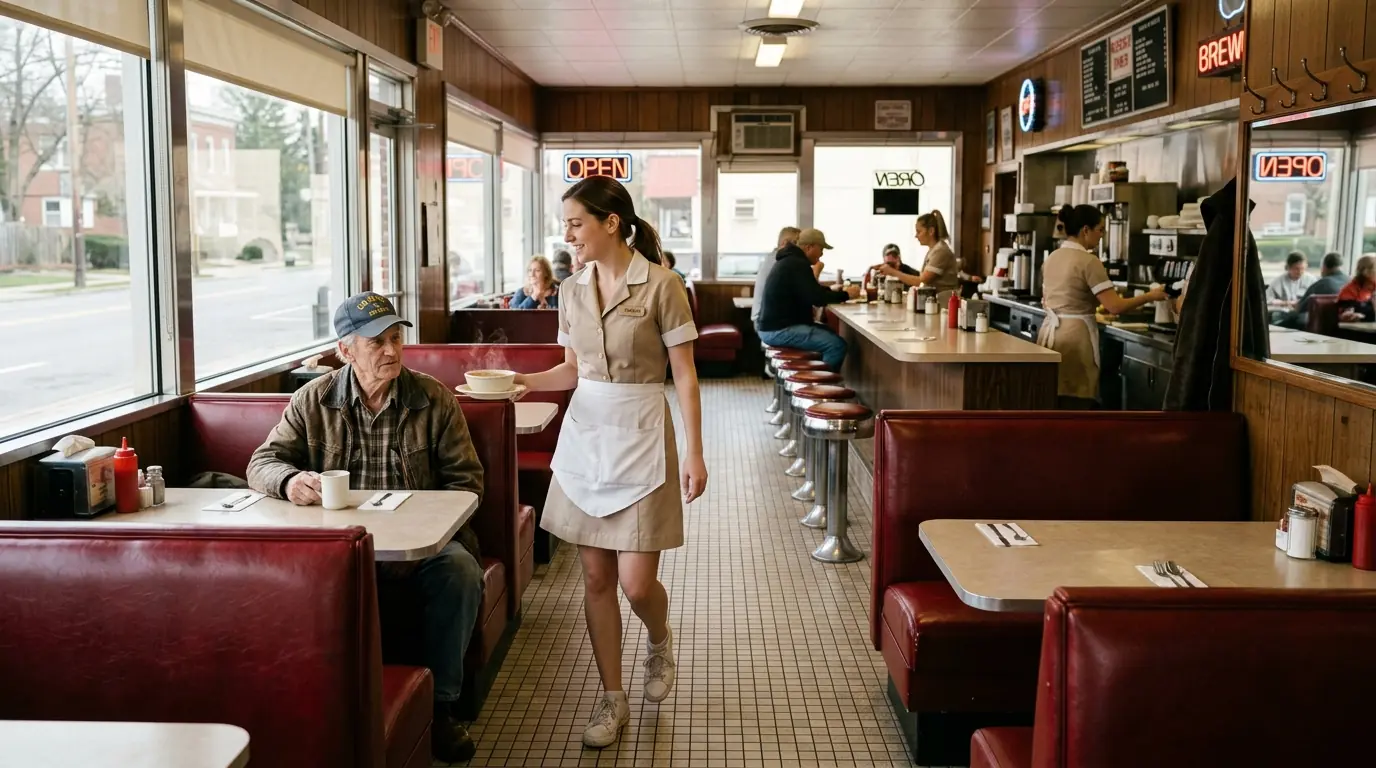
“I am a very thorough man. I do not like to see good people ground into dust by the undeserving.”
He pointed a thin finger at the card in her hand.
“That is not a title. It is a key, should you choose to use it.”
“Use it where? How?” Bailey pleaded, her mind reeling.
“The logo. Find the building that matches the logo. They will be expecting you.”
And with that, he put on his hat, gave her one last appraising nod, and walked slowly out of the annex.
Bailey was left standing by the empty table, the $10 bill for the soup on one side and the impossible heavy card in her hand.
“Morgan,” Bryant barked from across the room. “Stop daydreaming and clear that table. We have a four-top waiting.”
Bailey, in a daze, pocketed the card. She had no idea that the simple act of taking it had just tilted the entire axis of her world.
The next few days were a special kind of hell. Mr. Bryant, it seemed, had not forgiven Bailey for the $250 he’d been forced to comp. Her name was conspicuously absent from the weekend dinner shifts, the lucrative, high-tip shifts. Instead, she was scheduled for split doubles on Monday and Tuesday, the two slowest days of the week, and assigned the most undesirable side work.
“Morgan, the grout in the men’s restroom needs to be detailed,” Bryant said with a smirk, handing her a small brush and a bottle of bleach.
She spent two hours on her hands and knees, the acrid smell of bleach burning her nose, scrubbing tiles while her co-workers prepped for the lunch rush.
Jennifer, the waitress who had taken over the Dere table, breezed past, not meeting her eyes.
“Looks like you really ticked him off,” Jennifer muttered, pausing just long enough to apply a fresh coat of lip gloss. “Just apologize, Bailey. Even if you’re not sorry. Buy him a gift card or something. It’s not worth losing the good shifts over.”
“I didn’t do anything wrong,” Bailey said, her voice muffled by the stall.
“Doesn’t matter,” Jennifer replied, snapping her compact shut. “In this job, right is whatever the guy signing your check says it is.”
Bailey went home that night with $32 in tips and raw, bleeding knuckles. The $32 wouldn’t even cover the interest on her mother’s latest bill. She sat on her pullout sofa, the stack of red-stamped final notice envelopes mocking her from the coffee table. She felt a cold, hard knot of despair tightening in her chest. She was working herself to the bone, suffering daily humiliation, and she was still sinking.
Her fingers brushed against the pocket of her jeans where she’d kept the strange heavy card. She pulled it out.
Air.
Find the building that matches the logo.
What did she have to lose? Her dignity was already being scrubbed away with a grout brush.
She opened her cheap secondhand laptop. The screen flickered to life, slow and agonizing. She went to the search bar and tried to describe the logo.
Stylized R in circle logo.
The search results were a jumble of clothing brands and graphic design sites. She refined the search.
Stylized R in circle logo charcoal card.
Nothing.
She thought back to the old man. Eastston. He was well-spoken, even if he was dressed poorly. His eyes, they were intelligent. This wasn’t the rambling of a crazy person.
This was something else.
She squinted at the tiny embossed logo again. It was precise. An R. But maybe it wasn’t just an R. What if it was part of a name?
She thought about the wealthy clientele of the Gilded Spoon. The names she heard whispered. The businessmen who argued about stocks. What was the biggest name in the city?
She typed Harper.
The first result was Harper Holdings.
She clicked the link.
The website was minimalist, corporate, and screamed old money. The background was a deep charcoal gray. And there, in the top left corner, so small she’d almost missed it, was the logo, the stylized R in a circle.
Her heart did a painful, hopeful flip.
She wasn’t crazy. The old man was real, and he was connected to this.
Bailey fell down a rabbit hole for the next three hours. Harper Holdings wasn’t just a company. It was an empire. It was a private equity firm with a massive real estate portfolio. They owned skyscrapers, shipping lines, tech startups, and, as she discovered in a buried subfolder of their assets, a boutique hospitality division. This division owned a portfolio of high-end hotels and restaurants, including the Gilded Spoon.
Bailey had to put her head between her knees.
The old man, Eastston. He wasn’t just a customer. He was an owner. An inspector.
Why would he be dressed like that? Why would he be eating the cheapest thing on the menu?
She searched for Eastston Harper. The results that came back were sparse. There were no flashy interviews, no society pages. He was described as reclusive, a titan of old-world business, and notoriously private. The few photos she found were from a decade ago at a university dedication. In them, a powerful man in a flawless suit stared at the camera. He was younger, his beard was dark, and he was flanked by politicians.
But the eyes, they were the same. The same clear, sharp, analytical gray eyes that had watched her from table 12.
A new, colder fear replaced her excitement.
This wasn’t a test. This was a game, and she was a mouse. A billionaire, a reclusive billionaire, had been sitting in her section in disguise, watching her, and she had no idea what she had done, right or wrong.
And then she saw the articles about his family. The Harper tragedy. His wife, Juliet, had died 20 years ago. His son, a young man, had perished in a climbing accident five years after that. Eastston Harper had no family. He had no children. He had no heir.
Bailey looked at the card in her hand.
Heir?
This was impossible. It was a cruel joke. He was testing her. Or maybe he was looking for a replacement son. Her head was spinning.
She slammed the laptop shut.
It was too much.
She needed to see him. She needed to ask him what this meant. She didn’t have his number, but she had the address of Harper Holdings, a massive tower on the other side of town.
The invitation, he’d called it.
The next day, she called the hospital.
“Hi, I’m just checking on the status for Kathy Morgan.”
“One moment,” the receptionist said.
Bailey heard typing.
“Ms. Morgan’s account is currently $12,850 in arrears. We’ve sent several notices. We need to discuss payment options, or we will have to move her to a state-run facility.”
“No,” Bailey said, panic seizing her. “No, I’m working on it. I’ll have a payment this week. I promise.”
“We need a substantial payment by Friday, Miss Morgan, or our hands are tied.”
The line clicked dead.
Friday. That was two days away.
Her $32 in tips wouldn’t even make a dent. The grout-scrubbing shifts wouldn’t get her there.
The card felt heavy in her pocket. It wasn’t just an invitation anymore. It was her only life raft.
She put on her best, and only, non-work outfit, a simple dark blue dress, her worn-out flats, and her thin coat. She took the bus downtown, her stomach churning with a mix of terror and desperate, foolish hope.
The Harper Holdings Tower was not a building. It was a monument, a sheer cliff of black glass and steel that seemed to disappear into the low gray clouds.
Bailey felt her knees go weak.
Security guards in sharp black suits stood by the revolving doors. She took a deep breath and walked in.
The lobby was the size of a cathedral. It was all white marble, soaring ceilings, and a silence so profound it felt heavy. A single woman sat at a massive white quartz desk. She looked more like a model than a receptionist, with a flawless chignon and a headset that looked like a piece of jewelry.
Bailey, feeling small and shabby, approached the desk.
“Excuse me,” she said, her voice a small squeak.
The receptionist, Ms. Pierce, looked up. Her smile was polite, perfect, and utterly cold.
“Can I help you?”
“I’m here to see Mr. Harper,” Bailey said.
Ms. Pierce’s smile didn’t flicker.
“Do you have an appointment?”
“No,” Bailey said. “But he gave me this.”
Her hand was shaking as she held out the charcoal gray card.
The effect was instantaneous and shocking.
Ms. Pierce’s polite mask didn’t just crack, it shattered.
Her eyes widened. Her posture changed. She didn’t look at Bailey. She stared at the card.
She knew what it was, or more importantly, she knew what it represented.
She immediately grabbed her desk phone. She didn’t dial a number. She pressed a single black button.
“Sir,” she spoke into the phone, her voice now respectful, almost reverent. “She’s here. Yes, sir. The card? Yes, right away.”
She hung up and looked at Bailey with entirely new eyes. The coldness was gone, replaced by a flustered, terrified awe.
“Miss Morgan,” she said, her voice an octave higher. “My apologies. Please, this way.”
She stood and personally escorted Bailey, not to the main elevators, but to a small, unmarked silver door in the wall. She pressed her thumb to a scanner, and the door hissed open, revealing a small private elevator.
“The penthouse floor,” Ms. Pierce said, ushering her in. “He’s waiting for you.”
Bailey stepped into the elevator. The door slid shut, and she was alone, ascending in total silence with a word on a piece of cardboard that had just unlocked the most secure building in the city.
The elevator ride was silent, but it was not still. Bailey could feel the motion, a smooth, powerful, and terrifyingly fast ascent. There were no buttons for her to press, no floor numbers to watch. There was just the quiet hum of machinery and her own panicked reflection staring back at her from the polished steel walls.
She gripped the air card in her hand so tightly her knuckles were white.
What was she doing? She was a waitress with grout under her fingernails. She was about to meet a man who owned the sky.
The elevator slowed and, with a soft ding, the doors opened.
She was not in a hallway. She was in a room, a vast circular office that seemed to be floating in the clouds. The walls were glass, floor to ceiling, offering a 360° godlike view of the city below. The rain she had walked through earlier was now just a gray mist beneath her.
The furniture was sparse and elegant, a massive modern desk that looked carved from a single piece of dark wood, a few low-slung leather chairs, and shelves upon shelves of books. And standing by the window, not in his worn coat and flat cap, but in tailored gray slacks and a simple, incredibly expensive-looking black cashmere sweater, was Eastston Harper.
He looked different. He was standing tall, not stooped.
The frailty was gone, replaced by an aura of quiet, unshakable authority.
He wasn’t the man from the diner. He was the man from the photographs.
But his eyes, his eyes were the same.
He turned, and a small, sad smile touched his lips.
“Bailey Morgan,” he said.
His voice was not the frail mumble from the diner. It was the deep, commanding baritone of a CEO.
“I must apologize for the subterfuge. I’ve been wondering when you’d come.”
Bailey’s mind was blank. All the questions she’d rehearsed, all the panic and the anger, evaporated.
“You,” she stammered. “You own the Gilded Spoon.”
“I do,” Eastston said, gesturing to one of the leather chairs. “Please sit. You look terrified.”
Bailey sat because her legs had decided to stop working.
“Tea?” he asked, walking over to a sleek built-in counter.
“I—what?”
“Tea. I find it helps. I’m having an oolong.”
He poured a second cup from a glass pot without waiting for her answer and brought it to her. His hand was steady. Bailey took the cup. It was warm.
“How did you—why did you—”
“The card?”
Eastston Harper took the seat opposite her. He leaned forward, lacing his fingers.
“I have a great deal of money, Miss Morgan, more than any one person has a right to. But what I do not have is time. And what I have learned is that money attracts the very worst kinds of people. It’s a filter that unfortunately only allows the harpy, the dishonest, and the sycophantic to pass through.”
He sipped his tea.
“My wife, Juliet, she was the good one. She understood people. She used to say, ‘You can’t judge a person’s character by how they treat you, Eastston. You have to judge them by how they treat the person who can do nothing for them.’”
He looked out the window.
“After she—and then my son. After they were gone, I was alone with this empire. And it was filled with people like your Mr. Bryant. People who smile up and kick down. People like the Dere family, who use their status as a weapon to wound those they see as beneath them.”
“So,” he continued, “I started to walk. I’ve spent the last two years inspecting my properties, not as the CEO, but as the man who can do nothing for anyone. A frail old man with a $6.99 budget. I’ve been a hotel guest, a shopper, a diner. And the things I have seen, the casual cruelty, the dismissal, the impatience, it has been disheartening.”
“You were testing me,” Bailey said, the pieces falling into place.
“I was looking,” he corrected gently. “I was looking for one person. One person who, when faced with exhaustion and rudeness and personal desperation, still chose to be kind. You, Miss Morgan, were the first person in two years who, after being publicly berated and humiliated, still treated me with genuine, uncalculated compassion. You have no idea how rare that is.”
“The soup,” Bailey whispered.
“It wasn’t just the soup,” he said. “It was the way you spoke to me. It was the way you didn’t speak to Jennifer about me. It was the fact that you absorbed the cruelty of the Dere family without passing it on. You are a firewall. You stop the ugliness from spreading.”
Bailey felt a tear roll down her cheek. She wasn’t sure if it was from relief or a new, more profound exhaustion.
“So the card,” she said, holding it up. “What does it mean, air?”
Eastston smiled.
“I told you it wasn’t a title. It was a question. I was wondering if you were the one to inherit the values this company was supposed to be built on. I’m an old man, Bailey. I’m tired of fighting snakes. I need a new set of eyes.”
“And Kathy,” Bailey said, her voice breaking. “You said my mother’s name. How did you know?”
At this, Eastston’s face turned serious.
“When I identified you as a person of interest, I had my team do a discreet background check. I’m a thorough man. As I said. I know about St. Jude’s. I know about the MS, and I know about the $12,850 in arrears, and I know they gave you until Friday.”
Bailey stood up, her chair scraping.
“You investigated me. You sat there drinking your soup, knowing my mother was about to be—to be—and you did nothing.”
The anger was back, hot and sharp.
“Is this all just a sick game? Am I supposed to be grateful that you, the billionaire, found me?”
Eastston did not flinch. He stood as well, meeting her gaze.
“No,” he said, his voice firm. “You are supposed to be angry. You are supposed to be furious at a system that allows a woman to work 70 hours a week and still not be able to afford to keep her mother safe. At a man like Bryant, who holds your entire life in his hands over a misaligned umbrella. At a family like the Dere, who can destroy your livelihood for sport.”
He walked to his desk.
“I did not intervene because I needed to know who you were when the water was at your neck. Now I know.”
He pressed a button on his intercom.
“Ms. Pierce.”
“Yes, Mr. Harper.”
Her voice came crisp and immediate.
“Please execute three directives for me. First, contact the chief administrator at St. Jude’s. Inform him that the Harper Foundation is making a significant donation, and as part of that, I want Kathy Morgan moved to the private wing, the Juliet Harper Memorial Wing. Her entire balance is to be cleared, and all future care is to be billed directly to my private account, effective immediately.”
Bailey’s legs gave out again. She collapsed back into the chair, a sob escaping her throat.
“Second,” Eastston continued, his eyes on Bailey, “I want a full top-to-bottom audit team sent to the Gilded Spoon annex division. I want every single one of Mr. Bryant’s expense reports, shift schedules, and employee complaints from the last five years on my desk by morning, and send a security detail. He is to be relieved of his duties. He is not to step foot on the property again.”
“And third,” Eastston paused, “check the status of the Dere’s construction bid on the new Tower 4 project.”
Ms. Pierce’s voice was hesitant.
“Sir, that’s the nine-figure contract.”
“Correct,” Eastston said, his voice dropping to an arctic cold temperature. “I want you to personally call Mr. Dere Senior and inform him that due to a conflict of values, his bid is no longer being considered. His company is to be blacklisted from all future Harper Holdings projects permanently.”
He let go of the intercom button.
The office was silent again, save for the sound of Bailey’s quiet, shaking sobs.
Eastston walked back to her and knelt, like a king to a commoner, or perhaps just like a man to another human being. He offered her a linen handkerchief.
“This isn’t charity, Bailey,” he said softly. “This is a rebalancing, a correction. What Mr. Bryant and the Dere family did was not just rude. It was expensive. They just cost their companies hundreds of millions of dollars. Bad behavior in my world is a liability.”
He stood.
“Your mother is safe. Your job, at least that one, is gone. Which brings me to the air card.”
He picked it up from where she dropped it.
“I am not offering you a handout, Miss Morgan. I am offering you a job, a real one. I need someone to manage a new fund, a discretionary fund seeded with, let’s say, $50 million.”
Bailey’s head snapped up.
“What?”
“I’m calling it the Annex Fund. Its entire purpose will be to find and help people like you. People who are falling through the cracks, caregivers, service workers, students, people who are one medical bill, one bad manager, one cruel customer away from disaster. You will be its director. You will find them. You will make the corrections I should have been making all along.”
He handed her the card.
“You will be the inheritor of my mission, Bailey. Not my money. The money is just the tool. Your compassion, that is the asset.”
“I don’t know how to run a fund,” Bailey whispered, her world completely tilted.
“I know,” Eastston said, a real, warm smile finally reaching his eyes. “But you know how to be human. I can teach you the rest.”
The drive to the Gilded Spoon was a blur. Eastston had insisted Bailey be there.
“You don’t have to say a word,” he’d said as his private driver, a stoic man named Frank, opened the door to a sleek black Bentley. “But I believe closure is important.”
The car was silent, gliding through the same rainy streets Bailey had trudged along just hours earlier. It felt like a dream. She was sitting on buttery leather, her thin coat feeling ridiculous. The air card now in her bag, feeling as heavy as a gold brick.
When they pulled up to the annex, it wasn’t the discreet side entrance Bailey used. Frank pulled the Bentley right onto the curb in front of the main glass doors, blocking the valet lane. It was 7:00, the peak of the dinner rush. The restaurant was full.
Mr. Bryant saw the car. He saw the high-end, bespoke suit of the man who got out first. He clearly didn’t recognize Eastston. He just saw a whale, a high roller.
Bryant practically sprinted out the door, a sycophantic, practiced smile plastered on his face, an umbrella popping open in his hand.
“Good evening, sir. Welcome to the Gilded Spoon. Do you have a reservation? We are quite full, but I’m sure I can—”
Bryant stopped dead.
His eyes went from Eastston to the Bentley, and then to Bailey, who stepped out of the car after him, her face pale but set.
Bryant’s smile faltered, his brain visibly short-circuiting.
He looked from the bum he’d seen for weeks to the billionaire in the suit, who were the same man, to the waitress he’d been terrorizing.
“Morgan,” he sputtered. “What? What is this? What are you doing? You’re not on shift, and you—”
He said, turning to Eastston.
“You’re—you’re that old man from table 12.”
“I am,” Eastston said, his voice quiet, but carrying the cold weight of the boardroom. “Mr. Bryant, is it? We have a great deal to discuss.”
“I don’t understand,” Bryant stammered, his eyes wide with panic. “Bailey, what have you done?”
“She has done nothing,” Eastston said, walking past him and into the restaurant.
The entire dining room went silent.
Two men in dark suits, who Bailey recognized from the lobby of the tower, were already inside, standing by the host station.
“Mr. Bryant,” said the first security man, “my name is Mr. Helms. I’m with Harper Holdings Corporate.”
“Harper Holdings,” Bryant whispered.
“You are to come with us. Please gather your personal effects from your office. You will be escorted from the premises.”
The color drained from Bryant’s face.
“He what? Escorted? On what grounds? I’ve given 15 years to this company.”
“On the grounds of gross mismanagement, employee harassment, and multiple violations of the Harper Code of Conduct,” Eastston said, picking a wine glass off a nearby table and inspecting it for smudges. He found one and set it down with a look of profound disappointment. “And on a personal note, for making one of my best employees scrub a grout line on her hands and knees.”
Jennifer, who was holding a tray of cocktails, let the tray clatter to the ground. The sound of shattering glass echoed in the dead, silent room.
“Your employee,” Bryant looked at Bailey, his face a mask of horrified comprehension. “You—you’re with him.”
“Mr. Bryant,” Eastston said, “Bailey Morgan is not with me. Bailey Morgan is, as of an hour ago, the new executive director of the Annex Fund. She is my new colleague, and her first recommendation was a full operational review starting with you.”
“No,” Bryant yelled, his composure cracking completely. “This is insane. You can’t. That’s fraternization. She’s a waitress.”
“She was a waitress,” Eastston corrected. “And you were a manager. Helms, please.”
The two security men took Bryant by each arm. He didn’t fight. He was too stunned.
“My coat,” he mumbled defeated. “My office.”
Eastston turned and looked at the rest of the staff, who were frozen in place.
“My name is Eastston Harper. I own this restaurant, and as of today, things are going to change. Your hourly wages are being increased by 20%. You will all be receiving full health and dental benefits effective immediately. And Mr. Helms will be conducting one-on-one interviews with all of you tomorrow. Be honest.”
He then looked at Jennifer, who was staring at Bailey with a mix of terror and awe.
“You clean up this glass and then take the rest of the night off. Paid.”
He turned to Bailey.
“Are you ready?”
Bailey looked at the chaos she had, in part, created. She looked at the cowering staff, the confused customers, and the pathetic, slumped shoulders of Mr. Bryant as he was led away.
She felt a strange, cold pity.
“Yes,” she said.
The next day, Bailey woke up on her pullout sofa. For a second, she thought it was 4:30 a.m., that the alarm was about to scream, that the last 24 hours had been the most detailed, elaborate stress dream of her life.
Then her phone buzzed.
It was not her alarm. A text from a number she didn’t recognize.
Good morning, Ms. Morgan. This is Frank. Your car will be downstairs at 8:00 a.m. to take you to St. Jude’s. Mr. Harper thought you’d want to see your mother.
Bailey scrambled out of bed.
It was real.
She arrived at St. Jude’s and was met at the door by the chief administrator, the same man who she was sure had authorized the threatening phone call just yesterday.
“Ms. Morgan,” he said, his face a rictus of forced warmth, his hand outstretched. “A pleasure, a true pleasure. We are so honored to be recipients of the Harper Foundation’s new initiative.”
He personally escorted her up to the top floor, the Juliet Harper Memorial Wing. Bailey had never known it existed. It was not a hospital wing. It was a five-star hotel. The floors were carpeted. The light was soft. There was art on the walls.
“We took the liberty of moving your mother this morning,” the administrator gushed. “She has the corner suite. The view is lovely.”
Bailey pushed open the door.
The room was three times the size of her apartment. It was filled with sunlight, flowers, and a sofa for visitors. And in a high-tech, comfortable bed, propped up on pillows, was her mother.
Kathy was not in her usual threadbare hospital gown. She was in a soft new set of pajamas. Her hair had been brushed, and she was smiling.
“Bailey. Honey,” Kathy said, her voice stronger than Bailey had heard it in years. “You’re not going to believe this. A man came by, a doctor. He said he’s a top specialist from Johns Hopkins. He said—he said there’s a new treatment, a trial. And Bailey, he said they think I’m a perfect candidate.”
Bailey rushed to her mother’s bedside, tears streaming down her face, and hugged her. For the first time, they weren’t tears of fear or exhaustion. They were tears of pure, unadulterated relief.
“It’s all going to be okay, Mom,” Bailey wept into her shoulder. “It’s all going to be okay.”
While Bailey was with her mother, two other stories were playing out across the city.
At a sprawling, glass-walled construction headquarters, Mr. Dere Senior, a hard bulldog of a man, was in his office. He was screaming.
“What do you mean conflict of values?” he roared into his speakerphone at a trembling assistant. “It’s a construction bid. We’re not running for Pope. Get me Harper. Get him on the phone now.”
“He’s unavailable, sir,” the assistant squeaked.
“Then get me his board. Get me anyone. That’s a $150 million contract. Our entire quarter, our year was built on that.”
“Find out who conflicted with us. Find out who.”
He trailed off as his son Connor wandered into the office, a coffee in hand, looking bored.
“Hey, Dad. Is the celebration lunch still on? I was thinking that new steak place.”
“Get out,” Mr. Dere Senior whispered, his face a terrifying shade of purple.
“What? I was just—”
“Get out,” his father roared, sweeping a stack of blueprints off his desk. “You—you were at the Gilded Spoon last night, weren’t you?”
“Yeah,” Connor said, confused. “Me and Mom. We had that awful waitress. Why?”
“You idiot,” his father breathed. “You cost me—you—you—”
He couldn’t even finish. He collapsed into his chair, the phone still in his hand, a broken man.
The Dere construction empire had just hit a wall of solid Harper-brand steel.
And miles away, in a much less impressive office, Mr. Bryant was sitting across from a bored-looking HR representative from a temp agency.
“So,” the woman said, looking at his resume, “15 years at the Gilded Spoon. Impressive. But you were retired.”
She put the word in air quotes.
“It was a restructuring,” Bryant lied, sweating in his cheap suit.
“Right. And your reference, Harper Holdings Corporate, they just gave a do not rehire designation, which in this industry is a death sentence. Mr. Bryant, you know that.”
“It was a misunderstanding,” Bryant pleaded. “It was a waitress. She tricked him.”
The HR rep just sighed and closed his file.
“Look, I might have something. Entry-level. The graveyard shift at the Pancake Palace off the interstate is looking for a shift supervisor. It pays minimum wage. Are you interested?”
Bryant looked at the offer.
The interstate pancakes. Minimum wage.
He thought of the power he’d had, the fear he’d inspired, the way he could ruin a girl’s day with a single cutting remark.
He slumped in his chair.
“Yes,” he mumbled defeated. “I’ll—I’ll take it.”
Six months later, the pullout sofa was gone.
Bailey now lived in a bright, clean, two-bedroom apartment in a safe building, one of the affordable housing units owned and subsidized by Harper Holdings, a program she hadn’t even known existed. The second bedroom was for her mom, who was coming home next week. The experimental treatment had worked wonders.
Bailey, however, was not at home.
She was at her desk.
Her office was not on the penthouse floor with Eastston. It was on the 10th floor, in a bright, busy office filled with whiteboards and ringing phones. This was the headquarters of the Annex Fund.
In six months, under Eastston’s mentorship, Bailey had learned fast. She’d learned how to read a balance sheet, how to vet a proposal, and most importantly, how to spot a Bryant from a mile away.
She was now Miss Morgan, a woman with a small, dedicated team of social workers and auditors. Her first act had been to hire Jennifer, the waitress, not as a director, but as a client liaison. Jennifer’s firsthand knowledge of the service industry, and her quiet shame about not helping Bailey, had made her the perfect person to interview applicants.
“Morgan,” Jennifer said, poking her head in. “The 10:00 a.m. is here.”
“Send her in, Jen,” Bailey said, standing up.
A young woman, not much older than Bailey, walked in. She was visibly exhausted. She was wearing nursing scrubs and clutching a stack of papers.
“Ms. Morgan,” the nurse said, her voice shaking. “I don’t know if I’m in the right place. My name is Maria. I’m a CNA at—well, I was at Crest View. My son, he has asthma, and I had to miss three shifts because his nebulizer broke, and they fired me. And now the rent is due, and I—I saw a flyer in the hospital cafeteria.”
Bailey smiled the same warm, genuine smile she’d given a frail old man in a diner.
“You are in exactly the right place, Maria. Please sit. Tell me everything. We’re going to help.”
As Maria told her story, Bailey listened. She didn’t just hear the words. She heard the exhaustion, the fear, the injustice.
When Maria was finished, Bailey made two calls. The first was to an HR lawyer on her team to look into a wrongful termination suit against Crest View. The second was to her finance manager.
“Yes, I need to approve an emergency grant,” Bailey said, her voice clear and confident. “Two months’ rent plus utilities, and a new A-grade nebulizer. And Jen, get her a grocery card, a big one.”
The nurse burst into tears.
“I—I can’t. How can I repay you?”
Bailey walked around her desk and knelt, just as Eastston had knelt for her. She handed the woman a tissue.
“You don’t,” Bailey said softly. “You just—the next time you see someone who is struggling, you help them. You be their firewall.”
That evening, Bailey took the private elevator to the penthouse. Eastston was there, as always, looking out the window.
“How was your day, Bailey?” he asked.
“We helped a nurse and her son,” Bailey said, standing beside him, “and we flagged her former employer for a full labor practices audit. They’ve been docking pay for uniform rentals. It’s predatory.”
Eastston nodded, a proud smile on his face.
“Good. Good. A correction.”
“A correction.”
Bailey Harper. On her old desk in her new office sat the charcoal gray card, now framed.
Air.
Bailey finally understood. Eastston Harper hadn’t been looking for someone to take his empire. He’d been looking for someone to aim it. He’d given her the keys, not to his vault, but to his arsenal.
And she was just getting started.