The morning sky over Milbrook, Texas, was the color of an old wound, pale at the edges, deep red where the sun pushed through the clouds along the horizon. It was the kind of sky that made you feel something was about to happen, even if you couldn’t name what, even if you didn’t want to know.
A line of 12 motorcycles sat in front of the federal courthouse on Clement Street, their chrome catching the early light like a row of mirrors. They were parked perfectly side by side, exactly one foot apart. The kind of precision that doesn’t happen by accident. The kind that comes from men who were trained to care about such things even when the world stopped caring about them.
Reporters had gathered at the bottom of the courthouse steps. Three local news vans. A photographer from the Dallas Morning News, who had driven three hours before sunrise because his editor told him this was the kind of story people needed to see. He wasn’t sure what kind of story it was yet, but he had learned to trust his editor on things like that.
At the top of the steps stood a young woman. She was 28 years old, though she looked older that morning in the way people look older after they have carried something heavy for a very long time and finally set it down. Her hair was pulled back. Her jaw was lifted. There was a bruise along the left side of her face that no amount of foundation could fully hide, and she had stopped trying to hide it.
That was perhaps the most remarkable thing about her in that moment. Not the bruise itself, but the fact that she was no longer ashamed of it.
Behind her, filling the wide stone steps of the courthouse like a wall, stood 11 men in leather. Big men, quiet men, the kind of men most people crossed the street to avoid. They stood without speaking, without fidgeting, without looking at each other for reassurance. They simply stood there, and that was enough.
At the center of them was a man the others naturally formed around, the way iron filings arrange themselves around a magnet without being told. He was in his early 40s, broad through the shoulders, with dark hair going silver at the temples and a face arranged by years of weather and hard living into something that was not quite handsome and not quite harsh, but something in between that most people found difficult to look away from.
His name was Jake Callaway.
Most people who knew him called him Ghost.
A young reporter from the local Fox affiliate pushed forward, holding her microphone out with the nervous energy of someone who had rehearsed a question 20 times and was now afraid she had forgotten it.
“Sir, can you tell us why you’re here? Why did you and your club get involved in this? You don’t even live in Milbrook.”
Ghost looked at her for a moment, not unkindly. The way a man looks at someone who has asked a question that deserves a real answer.
“I just did what any man ought to do,” he said.
Then he looked away, back toward the courthouse doors, and the reporter understood that the interview was over.
Later, people would write about that line. They would put it on social media and argue about what it meant. Some would say it was simple. Some would say it was everything.
The woman standing beside Ghost, Sarah, the reporters would learn her name soon enough, turned and looked at him when he said it, just for a second. And in that second, something passed between them that the cameras caught but could not explain.
The courthouse doors opened, and whatever had brought them all to that morning, whatever road had led to those 12 motorcycles and that one young woman and that one quiet sentence, it had started 60 hours ago, 60 miles east, with a flat tire on Route 9 and a cup of coffee that nobody asked for.
Sixty hours before that courthouse morning, Jake Callaway was standing on the gravel shoulder of Route 9 in the 11:00 heat, watching one of his younger club members wrestle with a tire iron and thinking about his father.
He was thinking about his father because he had just gotten off the phone with him.
Clint Callaway was 68 years old and lived alone in a house outside Tulsa, Oklahoma, in a town so small it didn’t have a stoplight. His club brothers had called him Padre since his 20s, a name that had started as a joke about his rare patience and had stuck because it turned out to be true.
He had served in the Gulf War in 1991, come home with a bad back and a quiet manner that people sometimes mistook for coldness, and spent the next three decades working as a mechanic, raising two kids mostly on his own after their mother left, and becoming the kind of man whose presence in a room made other men sit up a little straighter without understanding why.
Jake had always admired his father. He had also, for most of his adult life, been afraid of disappointing him.
Not because Clint was harsh or demanding. Quite the opposite. Clint Callaway had a way of expressing disappointment through silence and patience that was somehow far more devastating than anger.
The call had been short. They usually were.
“Where are you?” Clint had asked.
“Texas. About 40 miles east of Abilene. We got a flat.”
“Texas is hot.”
“I know, Dad.”
A pause.
In that pause lived about 40 years of things between them.
“You coming home soon?”
“Few more days. Club business.”
Another pause.
Then Clint said, the way he always said things that mattered, quietly, without ceremony, as though he were commenting on the weather.
“A man is only as strong as what he refuses to look away from, Jake.”
“I know, Dad.”
“All right. Drive careful.”
And that was it.
Ghost had put the phone in his jacket pocket and stood there on the shoulder of Route 9, watching the heat shimmer rise off the asphalt, thinking about that sentence. The way you think about something that lands in your chest before your brain catches up to it.
A man is only as strong as what he refuses to look away from.
He had heard his father say it before. He would hear him say it again. But something about hearing it that particular morning, on that particular stretch of Texas highway, stayed with him in a way he couldn’t account for and wouldn’t try to.
Behind him, 11 motorcycles sat in a row on the gravel, their engines cooling with small ticking sounds in the heat.
The Iron Cross Motorcycle Club had been riding since before sunup, coming down from Amarillo, heading generally south and east without a firm destination. That was the nature of this particular run. No rally, no event. Just 11 men who needed road beneath them for a while for their own reasons, following a man who needed it most of all.
Ghost was good at knowing when his brothers needed to ride.
He was less good at knowing when he needed it himself.
The flat had happened just past the county line into Milbrook territory. The kid working the tire iron, they called him Ringo, 24 years old, with hands that seemed slightly too large for his body and a permanent expression of focused concentration, had declared the tire beyond saving.
They needed a replacement.
Milbrook was the nearest town.
“How far?” Bear asked.
He was standing beside Ghost, arms crossed, watching Ringo with the expression of a man who could fix the tire faster himself, but understood the value of letting younger men struggle through things.
Bear was 40 years old and built like a man who had been put together by someone who wasn’t interested in subtlety. He had a beard that had gone mostly gray and eyes that were an unusual pale blue, almost colorless in bright light, that people found either reassuring or unsettling depending on their conscience.
He had been Ghost’s second for six years. In that time, they had developed the ability to communicate a significant amount of information through very few words.
“Maybe five miles,” Ghost said.
“Town any good?”
Ghost looked up the road toward where Milbrook would be hidden behind a long, gentle curve.
“Don’t know it.”
Bear nodded.
“We find somewhere to eat, get the tire sorted, back on the road by two.”
It turned out to be a plan that got interrupted by something larger than itself.
Milbrook, Texas, was the kind of town that had been almost something once. You could see it in the bones of the place, the wide main street that had been built for more prosperous traffic, the facades of buildings that had received their last coat of paint sometime in the previous century, the grain elevator on the eastern edge that still functioned, but no longer dominated the skyline the way it once had.
The population had peaked at around 18,000 in the 1980s and drifted down to 12,000 or so since, in the slow, quiet way small American towns lose people. Not all at once, but one family at a time, following opportunity the way water follows the lowest point.
The Iron Cross rode into Milbrook at 11:47 in the morning.
Ghost knew the time because he always knew the time. It was a habit from his years as a Marine, the kind of habit that doesn’t leave you even after everything else from that period of your life has become complicated and difficult to look at directly.
He had served two tours, Fallujah in 2004, then a second rotation through Ramadi in 2006. He had come home from the second tour quieter than he had left, in the specific way certain kinds of combat leave certain kinds of men not broken, not visibly damaged, but rearranged somehow. The furniture of the self shifted to accommodate something that had no name and didn’t want one.
He did not talk about those years easily.
What he knew was that they had given him certain things that couldn’t be unlearned. An eye for threat assessment. An instinct for reading rooms and people and situations. An understanding that danger rarely announces itself loudly.
It comes in quietly, wearing ordinary clothes, living inside what looks like a normal afternoon.
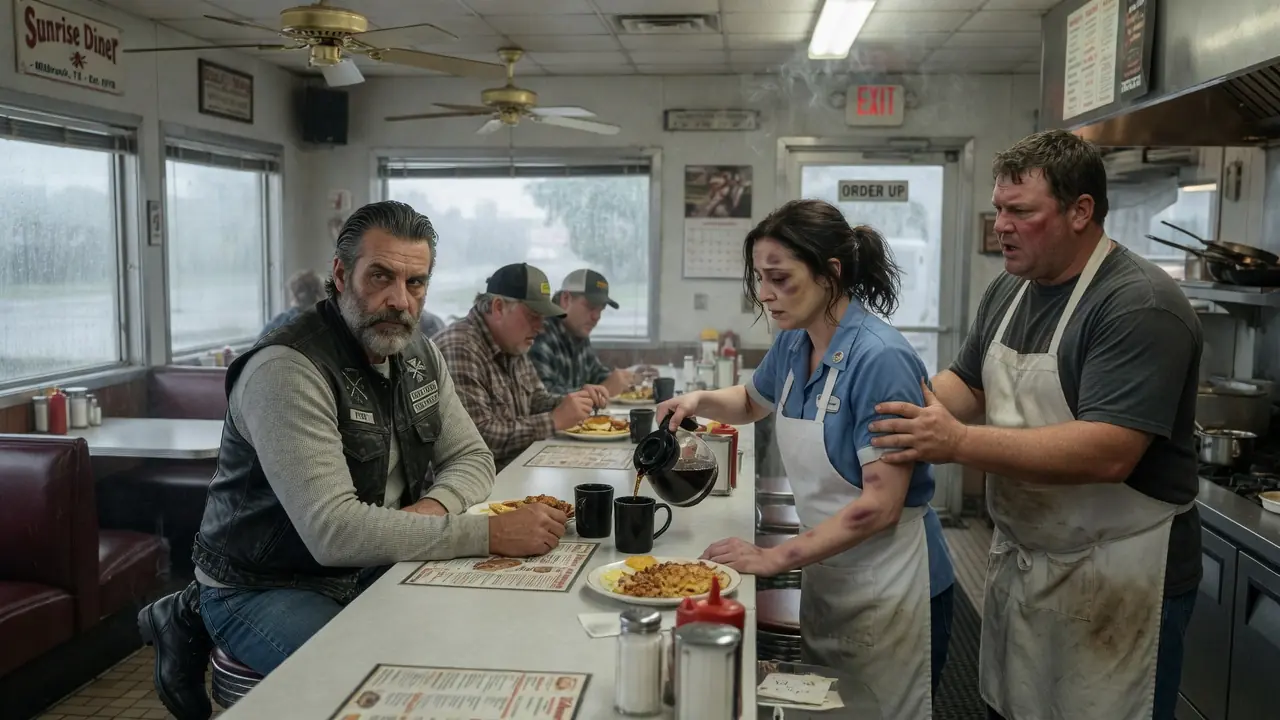
Main Street was quiet at noon. A hardware store. A pharmacy. A diner with a hand-painted sign that read: Sunrise Diner. Breakfast All Day.
Through the window, Ghost could see the interior. Red vinyl stools at a counter. Booths along the wall. Ceiling fans turning slowly overhead. The parking lot was half full of pickup trucks.
They pulled in.
Twelve motorcycles in a diner parking lot in a small Texas town produces a specific effect. Ghost had seen it hundreds of times. The people inside look up. The people outside find reasons to be somewhere else. For a moment, everyone recalibrates.
He didn’t mind it.
He had long since stopped expecting anything different.
They went inside.
The woman behind the counter was in her late 50s, with silver-streaked hair pulled back in a practical bun and the efficient manner of someone who had been running a diner for long enough that she could anticipate what a table needed before the people at it knew themselves. Her name tag said Ruth.
She looked at the 12 men coming through her door with an expression that moved quickly through surprise, weariness, and resignation before settling on professional courtesy.
“Morning,” she said. “Or nearly morning anyway. Sit anywhere that fits you.”
They took up most of the available seating.
The other customers, four truck drivers at the counter, a couple in a corner booth, an older man eating pie alone at the window, watched them settle in with the careful nonchalance of people pretending not to stare.
Ghost took the last stool at the counter.
He did this deliberately. He always positioned himself where he could see the most of a room. Back to the wall when possible, or in this case, back to the counter facing the interior.
Old habit, the kind that keeps you alive in certain environments and merely makes you seem watchful in others.
He ordered coffee, black.
He looked at the menu without reading it.
And that was when he noticed her.
She was moving between the booths along the far wall, carrying a tray with the practiced ease of someone who had done this work long enough that it no longer required her full attention.
She was young. He would later learn she was 28, with dark hair tied back and a face that would have been striking under any circumstances, but was currently arranged in a careful, held-back way.
The face of someone concentrating hard on keeping themselves together while making it look effortless.
She moved efficiently.
She smiled at the couple in the corner booth, the right muscles of her face doing their work without anything behind them joining in.
She laughed at something one of the truck drivers said with a laugh that had the right sound but the wrong timing. A half-beat too quick. The laugh of someone performing normalcy rather than experiencing it.
Ghost had seen this before.
Not in a diner.
In his sister’s kitchen six years ago, on a Tuesday afternoon when Lily had made him coffee and smiled in that same carefully constructed way, and he had looked at her and told himself what he was seeing was nothing. Told himself it was none of his business. Told himself she would ask him for help when she was ready.
He had been wrong about all three.
He watched the young waitress set down plates, refill coffee cups, collect an empty basket from the booth nearest the kitchen door. Ordinary motions.
And then the kitchen door opened.
The man who came out was in his mid-30s, thick through the neck and shoulders, with heavy hands and the kind of face that arranged itself naturally into an expression of minor grievance. He was wearing a cook’s apron, and he moved through the diner with the particular ease of someone who believes he owns whatever room he enters.
He said something to the waitress as he passed, his mouth barely moving, not intended for anyone else to hear.
The effect on her was immediate and physical.
She seemed to become smaller. Not dramatically, not in any way that most people in that room would have noticed because they weren’t looking for it. But Ghost was looking for it, in the way people who have been trained to read threat in the angle of a shoulder and the set of a jaw are always, on some level, looking for it.
Her shoulders dropped perhaps half an inch. Her chin came down. The held-back quality of her expression tightened into something more interior.
She did not look at the man after he passed.
She found something to straighten on the nearest table, and she straightened it with great attention. The way people attend to small tasks when they need to be somewhere with their hands.
Ghost looked down at his coffee.
He looked at it for a long moment.
When she came to refill his cup a few minutes later, she leaned slightly forward, and he saw it clearly for the first time along the line of her jaw on the left side, partially covered by foundation that was slightly too light for her skin tone.
In the noon light, a bruise. Not fresh. Three or four days old, he judged. Yellow at the edges, still dark at the center. The kind that had been worse before it started to heal.
She poured the coffee without looking at him.
He watched her wrist as she poured.
When the sleeve of her uniform shirt pulled back slightly, he saw the edge of something else. A shadow of discoloration, older, fading, the kind left by fingers gripping too hard.
He had seen this before.
He knew exactly what it was.
And he knew, with the certainty of a man who had learned this lesson in the worst possible way, that there was only one thing it meant.
His sister Lily had worn those same marks.
She had covered them the same way, with foundation a shade too light and long sleeves in warm weather and explanations that came too quickly when he asked.
He had believed those explanations because believing them was easier than what the alternative required.
He had visited her apartment, drunk the coffee she made, listened to her say she was fine, and driven back to his own life because he told himself she would reach out when she needed him.
She had reached out. Just not in the way he expected.
The call had come at 2:00 in the morning from a hospital in Houston, 18 months after the last time he had sat in her kitchen and told himself everything was all right.
By the time he arrived, four hours of driving with his hands tight on the wheel and his mind doing the thing it does when it cannot accept what it has been told, she was already gone.
Thirty-one years old. A daughter who was four. And a man in custody who had once offered Ghost a handshake at a family dinner, a normal handshake from a normal-looking man who had spent two years systematically destroying his sister’s sense of self before finishing the job in a single night.
Ghost had sat in that hospital hallway for a long time.
He had understood something in those hours that could not be unfelt once it was felt.
He had known.
He had seen it and looked away and chosen the easier interpretation because the harder one required him to do something difficult.
And that choice, that small sustained cowardice dressed up as respect for her autonomy, had cost Lily everything.
He had not forgiven himself for that.
He was not sure forgiveness was the right category.
Some things weren’t meant to be forgiven.
Some things were meant to be carried.
And the carrying of them was supposed to change how you move through the world.
He picked up his coffee cup.
He drank from it.
He set it back down.
Across the room, the man from the kitchen moved back through the kitchen door. As he passed the waitress again, he put a hand on the back of her neck, the fingers pressing in slightly, not gently. The motion of a hand reminding someone of something.
She went very still for a moment.
Then he was gone through the door, and she was moving again, efficient and careful, performing ordinary life with the concentration of a woman who had been doing it for a long time.
Bear settled onto the stool beside Ghost with the unhurried arrival of a large man who had learned to move without announcing himself. He picked up the menu, looked at it, set it down.
“The cook,” Ghost said quietly.
“Saw him,” Bear said. “And her.”
Bear was quiet then.
“You know as well as I do that once you go back in there tomorrow, we’re committed.”
He said it without judgment, without pressure. The way Bear said things that needed to be heard rather than things designed to change a mind.
“I’m not saying don’t. I’m saying make sure you know what you’re deciding.”
Ghost looked into his coffee.
“I know what I’m deciding.”
They ate.
The food was good. The kind of straightforward diner cooking that doesn’t try to be anything other than what it is, which is its own form of integrity.
The men around Ghost ate and talked in low voices, and the other customers gradually relaxed in the way people relax when the thing they feared turns out to be ordinary in its appetites, interested only in eggs and coffee and pie.
Ghost ate without tasting much of it.
He kept his attention distributed across the room in the way he had learned to do in environments where you could not afford to miss things.
He watched the waitress work.
He watched the way the other staff moved around her carefully.
He noticed the way people move around something fragile that they’ve been warned not to disturb.
He watched Ruth, the older woman behind the counter, and noticed something in how she watched the young waitress too. Not with the supervisory attention of a manager. With something else. Something more like the careful, pained attention of a person who is worried and has been worried for a long time and doesn’t know what to do about it.
He learned the young woman’s name was Sarah because that was what the other waitress called her when she needed something.
He watched Sarah carry a tray of plates to the window booth and smile at the older man eating pie. The smile this time was slightly more real. The older man said something that made her laugh, a genuine laugh, brief and surprised, like something that had escaped before she could stop it.
For just that second, something opened up in her face. Some quality of ease of self that was normally held very carefully under the surface.
Then she turned from the booth and it was gone again.
He was halfway through his second cup of coffee when the kitchen door opened again and the cook came out. This time he stopped beside Sarah, who was restocking a condiment rack near the end of the counter. He leaned close and said something. She nodded without looking at him. He said something else. She nodded again, and this time Ghost could see the effort of the nod, the deliberate steadiness of it, the held breath behind it.
Then the cook put a hand on her upper arm.
A casual gesture to anyone watching, the kind of thing a person might do without meaning anything by it.
Except the grip was too tight.
Ghost could tell by the way Sarah’s body absorbed it, the slight lean away from it that she immediately corrected, the careful schooling of her face to neutral.
Ghost was still watching when something came to rest on the counter beside his cup.
He looked down.
A paper napkin, folded once. The kind of fold that is casual enough to look accidental if the wrong person noticed it.
He looked up.
Ruth was at the far end of the counter, refilling a truck driver’s coffee. Her back was half turned, but as he watched, she shifted slightly, and for just a fraction of a second, her eyes moved to him, then away, then to the folded napkin.
Ghost picked it up.
He opened it in his lap below the counter’s edge.
Four words written in a hand that had been steady once and wasn’t entirely steady anymore.
“Please, she has no one.”
He looked at the words for a long time, long enough for Bear, who had a finely tuned sense for when Ghost’s stillness meant something, to glance over at him.
Ghost folded the napkin.
He put it in his jacket pocket against his chest.
He picked up his coffee cup and found it was empty.
They were in the parking lot 20 minutes later, sorting out the tire situation, when Ghost walked to Ringo.
“I need you to look someone up,” Ghost said.
Ringo had his phone out before the sentence was finished.
“The cook inside. Name’s Hargrove, first name Wade. Works here, probably lives in town.”
Ringo’s fingers moved.
Ghost watched the parking lot. The heat was substantial by now, pushing toward the mid-90s, the kind of dry Texas heat that doesn’t feel as dramatic as humid heat, but works on you steadily, like an argument made very patiently.
It took Ringo four minutes.
“Wade Thomas Hargrove,” Ringo said, reading from his screen. “Thirty-four. Milbrook address on Cedar Lane. Employed here, looks like for about three years.”
He kept scrolling.
“Married. Wife is Sarah Malone Hargrove.”
He paused.
“No priors. Clean record.”
Ghost nodded slowly.
“His family. Look for family.”
Another minute.
Ringo stopped scrolling.
“He’s got a brother,” Ringo said.
He said it in a different tone, the tone of someone who had found something he didn’t expect.
“Deputy Dex Hargrove, Milbrook County Sheriff’s Department.”
He looked up.
“Not just a deputy. He’s the department head for the domestic violence response unit.”
The parking lot was quiet for a moment, except for the sound of traffic on the distant highway and the mechanical clicking of cooling engines.
Ghost stood very still.
He thought about the napkin in his pocket.
Please, she has no one.
He thought about what it meant that every call Sarah might have made to 911, every report that might have been filed, every record of what was happening inside the walls of that marriage, all of it would have been routed through a department run by her husband’s brother.
He thought about Ruth’s eyes, the careful angle of that glance, the handwriting that had been steadier once, the particular quality of worry in a person who had been worried a very long time without being able to do anything about it, and who had decided, in whatever her calculation was, that a group of bikers from out of town were her best available option. Which told him something about the options she had been working with.
He put his hands in his jacket pockets and looked at the diner.
Through the window, he could see Sarah moving between tables. Even from here, from this distance, in this heat, through plate glass, he could see the quality of her movement. The care, the constant, exhausting care of a person who has learned that any small mistake can become the justification for something larger.
Bear came to stand beside him. He had seen Ringo’s screen over Ghost’s shoulder.
“The brother runs domestic response,” Bear said.
It wasn’t a question.
“Yeah.”
“So every call she might have made goes to him.”
A truck pulled out of the lot, crunching gravel, raising a brief curtain of dust.
They watched it go.
Ghost kept looking at the diner window.
Somewhere behind the plate glass and the ceiling fans and the red vinyl stools, Sarah Malone Hargrove was carrying a tray and performing ordinary life and being ground down by it one day at a time in a system that had been arranged to make sure nobody outside could reach her.
He thought about what his father had said on the phone three hours ago on the shoulder of Route 9.
A man is only as strong as what he refuses to look away from.
“We stay another two days,” Ghost said.
Bear was quiet.
“The tire’s sorted,” Ghost said. “We can find a motel. We stay two days.”
“Two days,” Bear said.
“Yeah.”
Bear absorbed this.
He had known Ghost for 12 years. He had ridden with him through things that didn’t lend themselves to easy summary. He had watched him in the years after Lily died, when the grief and the guilt had settled into him like sediment, changing the way he moved through the world without breaking him.
Bear understood, in the way you understand things about people you have known long enough, what this was really about. What it was really for.
He didn’t say any of that.
He just nodded.
“I already looked up a motel six miles east. Reasonable.”
Ghost almost smiled.
“Of course you did.”
They walked back toward the bikes.
Behind them, inside the diner through the glass, a young woman carried a tray across a room and navigated her small and dangerous world with the fierce, exhausted competence of someone who had learned to survive it alone.
She didn’t know yet that something had shifted.
She didn’t know that a man she had never spoken to had just made a decision. Not the decision to save her, because that wasn’t his to make, but the decision to stay, to see, to refuse this time to look away.
She would find out.
But not yet.
That night, Ghost sat outside the motel on a plastic chair in the warm dark that settles over Texas in summer like a hand pressed gently down.
The other men had gone in. He could hear voices and the sound of a television through the walls, someone laughing at something, the ordinary sounds of men at rest.
He had the napkin out.
He had taken it from his pocket and unfolded it, and he sat holding it in the dark, though he didn’t need to look at it anymore.
He had the words memorized.
Four words.
He had read longer things that said less.
Please, she has no one.
He thought about Ruth’s face when she handed it to him. The casual angle of that delivery. The years of practice behind making something look accidental. The way she’d been carrying that small folded piece of paper in her apron pocket, waiting for the right moment, the right person, the right something.
He had already decided.
He had decided in the parking lot, and the night had not changed it.
The only question left was how to do it right.
And that was a question for the morning.
He was good at waiting for mornings.
He had spent a lot of years practicing.
He went inside.
He lay down on the motel bed with his boots still on and looked at the ceiling.
In the jacket pocket over his chest, the napkin.
Four words pressed against his ribs like something that intended to stay.
He didn’t sleep for a long time.
When he did, it was the dreamless kind, which was as much as he ever asked for.
The second morning in Milbrook came in gray and close, the sky low and colorless, the way Texas skies get in the summer when rain is thinking about arriving but hasn’t committed yet.
Ghost was up before five.
He had slept four hours, which was usually enough, and he had been sitting on the plastic chair outside the motel room since 4:30, drinking coffee from a paper cup he’d gotten from the vending machine at the end of the walkway, watching the parking lot go from black to gray to the particular pale beige of early morning.
He was thinking about the diner, about Ruth and the folded napkin, about the way Sarah moved through a room that should have been safe for her and wasn’t.
He went to find Bear.
Bear was awake.
He was always awake early, a holdover from his years working construction sites that started at six, a rhythm that had outlasted the work itself. He was sitting on his bed with his back against the headboard, reading something on his phone, when Ghost knocked and let himself in.
“We need to talk about how we do this,” Ghost said.
Bear set his phone down.
“I figured.”
Ghost pulled the desk chair around and sat in the thin morning light coming through the gap in the curtain.
They looked at each other the way men look at each other when there is work to be figured out and they are both serious about figuring it out right.
“We go in loud and wrong, it makes things worse for her,” Ghost said. “Dex Hargrove hears that a motorcycle club is poking around his brother’s business, he’s going to lean on her before we can do anything useful.”
“Agreed.”
“So we go quiet. We spread out. Not together, not in formation. Two men at a time, different parts of town. We talk to people. Not about her. About the town, about Hargrove, about whatever comes up.”
Bear nodded slowly.
“Small towns talk when you know how to listen.”
“They do.”
“And you?”
“I go back to the diner.”
Bear looked at him.
“I’m not going to push her,” Ghost said. “I’m going to be there. That’s all. Sometimes that’s the whole thing. Sometimes just being somewhere and not leaving is the entire message.”
Bear was quiet for a moment in the particular way that meant he was deciding whether to say the thing he was thinking.
Ghost had learned to wait through these silences.
Bear’s second thoughts were usually worth having.
“She doesn’t know you,” Bear said. “She doesn’t know what you want. Right now, you’re just another man who’s been watching her. I know that’s going to be a problem before it’s an asset.”
“I know that too.”
Ghost leaned forward with his elbows on his knees.
“Which is why I’m not going to approach her. I’m going to let her approach me, if she ever does.”
“And if she doesn’t?”
Ghost looked at the gap in the curtain, at the stripe of pale morning light falling across the carpet.
“Then I figure out another way. But I don’t go in there and tell her what her life is. I don’t sit across from her and explain to her that she needs saving.”
He paused.
“I’ve done that before. It doesn’t work.”
He meant Lily.
He didn’t say it.
Bear understood.
“All right,” Bear said. “I’ll put six of the boys in different parts of town. Casual. We get a read on Hargrove, on his brother, on how things sit.”
Ghost nodded.
He stood up. He put his hand briefly on Bear’s shoulder, the wordless acknowledgement between men who had been doing difficult things together for long enough that ceremony was unnecessary.
Then he went to get ready for the day.
He was back at Sunrise Diner by 8:30.
He sat at the same stool at the counter, ordered the same coffee, and settled in with the patience of a man who knows that the most important things usually take longer than you want them to.
The morning crowd was different from the lunch crowd. Older, mostly ranchers and retired men who had been getting up early for so long that the habit had long since separated itself from any particular purpose.
They sat at the counter and in the booths with their coffee and their newspapers and their particular brand of unhurried conversation. The kind where silence is not uncomfortable. Where a man might say something and then not say anything else for five full minutes, and that is perfectly acceptable.
Ghost fit into this crowd more easily than most people would have expected.
He was good at stillness.
He was good at the particular masculine language of proximity without intrusion, of presence without demand, that older American men often speak without knowing they are speaking it.
Sarah was working.
She moved through the morning the same way she had moved through the afternoon the day before. Efficient, purposeful, navigating the room with the awareness of someone for whom nothing is truly ordinary.
She didn’t look at Ghost when she refilled his coffee.
He didn’t try to catch her eye.
Wade came out of the kitchen twice in the first two hours.
The first time, he went to the register, checked something, and went back.
The second time, he stopped beside Sarah while she was taking an order from a man in a John Deere cap, and he put his hand briefly on the back of her head, the fingers pressing in slightly.
It was the gesture of a man marking territory in public, making a statement he knew would be read correctly by the person it was meant for, and not at all by anyone else.
Sarah’s pen paused above her order pad for just a fraction of a second.
Then she kept writing.
The man in the John Deere cap noticed nothing.
Ghost noticed everything.
After the second hour, Ghost left.
He didn’t want to make his presence a pattern Wade would notice.
He drove east for six miles, found a quiet side road, pulled over, and sat with his engine off, listening to the silence for a while.
He did this sometimes when he needed to think without the noise of other thinking around him.
He was still sitting there when his phone vibrated.
Bear.
“Got something,” Bear said. “One of ours was at the Texaco talking to the mechanic there. Man named Gus. Been in Milbrook 40 years. Gus says the Hargrove family has been in this county for three generations. Wade’s people are known. Dex is known. Gus says, and I’m quoting, ‘Everybody knows what goes on in that house. Everybody’s decided it ain’t their business.’”
Ghost looked at the flat brown landscape around him. The emptiness of it. The heat beginning to build.
“That’s a decision people make,” Ghost said.
“Gus also says this isn’t the first time for Wade. Says he had a girlfriend before Sarah. A few years back. Girl named Melissa Crane. Local girl. She was with Wade for about a year, then she wasn’t.”
Ghost straightened slightly.
“Meaning?”
“Meaning she stopped being in Milbrook. Filed as missing persons. Dex handled it personally. According to Gus, case was open about six weeks and then it was just closed. Gus didn’t know the details. Said people asked questions for a while, and then they stopped. The way things go in small places when the wrong people are involved.”
Ghost sat with that for a moment.
Melissa Crane.
A woman who had been where Sarah was now and was no longer anywhere that anyone could find.
“Was there any—” Ghost started.
“No. Nobody ever found. No evidence of anything specific. She could have left. Gus thinks she left. But Gus also says Dex Hargrove closed that case off personally. Reviewed it and signed off on the closure. His own brother’s missing girlfriend.”
“How sure is Gus?” Ghost asked.
“Sure enough to say it out loud to a man he’d never met, which in a small town means pretty damn sure.”
He sat on that side road for another 10 minutes after he hung up.
He was thinking about the weight of what he had just learned. The way it had expanded the shape of the thing he was dealing with.
He had come into this thinking about a woman being hurt by a man.
That was already enough.
But this had depth to it.
History and a name, Melissa Crane, that stood for something that could not be undone and might still be accounted for.
He called Carol Whitfield from a pay phone outside a gas station.
She was in Dallas in the middle of something that she set aside immediately when he told her what he had.
Carol Whitfield had been the Iron Cross legal counsel for seven years. She was precise and unsentimental and extremely good at what she did. And what she did was understand the architecture of legal problems and find the load-bearing walls.
She listened without interrupting, which she always did.
“If the recordings are what you’re describing,” she said, “and if we can establish the systematic interference by the deputy, this belongs in a federal court. Not county, not state. Federal.”
“That’s what I’m thinking.”
“There’s a federal courthouse in the next county. Different jurisdiction from Dex Hargrove’s department.”
A pause.
“And if there’s anything in those recordings that relates to the Crane case, anything at all, you’re talking about a federal missing person’s inquiry. At which point, this becomes significantly larger than a domestic situation.”
“Sarah needs to make those calls,” Ghost said. “Not us.”
“Understood.”
Carol paused.
“I can be in Milbrook by tomorrow morning.”
“Don’t announce yourself. Come quiet.”
“I know how to come quiet, Ghost.”
He thanked her and hung up, then stood beside the pay phone for a moment in the afternoon heat, looking at the flat road leading back toward town.
He was beginning to believe they had a path. A real one. One that went around Dex rather than through him, through a system big enough that Dex’s particular local influence could not reach it.
He should have remembered what his years in the Marines had taught him about moments like that.
The moments when you think you can see the shape of how something ends are the moments when you are most vulnerable to what comes next.
The text came at 4:57 in the morning on the second full day.
Ghost was sitting outside his motel room with his second paper cup of coffee, not having slept more than two hours, his mind working through the architecture of a situation that had more walls than he had initially understood.
Three words from a number he didn’t recognize.
“Oak Street. Five.”
He looked at the message for a long moment.
Then he typed back:
“I’ll be there.”
He was there in 10 minutes.
Oak Street was quiet at that hour. The businesses dark. A single traffic light cycling through its colors for nobody’s benefit.
There was a small coffee shop on the corner, not yet open officially, but with a light on inside and the smell of something brewing coming through the door that had been left slightly ajar.
Sarah was inside, sitting at a corner table, both hands wrapped around a paper cup.
She was in a jacket despite the warmth, which he understood.
She looked up when he came in, and her expression was not frightened and it was not relieved. It was the expression of someone who had made a very difficult decision and was now on the other side of making it. And what lies beyond is not peace, but the next difficult thing.
He got coffee from a counter where a young man was working in the near dark of a kitchen, getting ready for a day that hadn’t quite started.
He brought the cup to her table and sat down across from her.
Neither of them spoke immediately.
This was all right.
He was good at waiting.
“I noticed you yesterday,” she said. “Before Ruth. Before anything. I noticed you when you came in.”
She looked at her cup.
“The way you sat. Most people sit with their back to the room. You sat the other way.”
“Old habit,” he said.
“Military?”
“Marines.”
She nodded slightly, as if this confirmed something she had been filing under unexplained.
“You noticed me too,” she said.
It was not a question.
“Yes.”
She looked at him directly then for the first time.
Her eyes were dark and very steady. And behind the steadiness, there was something he recognized as the particular tiredness of someone who had been strong for too long without enough reason to believe it was worth it.
“Why are you still here in Milbrook? You were passing through.”
“Flat tire,” he said.
“That was fixed yesterday morning.”
“Yes.”
She waited.
“I’ve seen what you’re living in,” he said. “I’ve seen it before on someone I loved.”
She was quiet.
Outside, a truck went past on the empty street, its headlights sweeping briefly across the coffee shop window.
“What happened to her?” Sarah asked.
“She died,” he said. “My sister. Her name was Lily. Her husband put her in the hospital, and she didn’t come out.”
Sarah looked at the table between them.
She looked at it for a long time.
“I knew,” Ghost continued, because this was the part that mattered, the part he had never said to anyone directly. “I knew something was wrong before it got to that. I saw the bruises. I heard the way she talked around things. I knew.”
He wrapped both hands around his coffee cup, feeling the heat of it.
“And I told myself it was her choice. I told myself I’d make it worse if I pushed. I told myself she would ask me for help when she was ready.”
He paused.
“She never got to be ready.”
Sarah’s jaw was tight. He could see the effort she was making to hold herself still.
“I’m not here to make your choices,” Ghost said. “That’s not what this is. Whatever you decide, to stay, to go, to do nothing, to do everything, that’s yours. It was always yours.”
He put his coffee cup down.
“I’m just telling you that somebody sees what’s happening, and that somebody isn’t leaving tomorrow morning. That’s all.”
The coffee shop was very quiet.
Sarah reached into her jacket pocket. She put something on the table between them.
An old phone, the kind that predated touchscreens by a decade. A flip phone with a cracked casing that had been repaired with electrical tape along one edge.
She kept her hand on top of it for a moment.
Then she moved her hand away.
“Eleven recordings,” she said. “The oldest is from 14 months ago. The newest is from three weeks back.”
She looked at him.
“I know what they contain. I know what they’re worth legally.”
Her voice was steady and precise. The steadiness of someone who had rehearsed saying a thing and was now saying it, and the rehearsal was working.
“I was a law student. UT Austin. I was 18 months from finishing my degree.”
She said this without self-pity, as a fact. The specific fact it was.
“I know how to build a case. I know what a judge needs to hear, and I know how to present it.”
She looked at her hands.
“What I don’t know is how to do it without Dex burying it before it sees a courtroom. Every time I tried to start this process, it ran through his office. Every time.”
Ghost looked at the phone on the table.
“I’m not asking you to fight my fight,” Sarah said. “I want to be clear about that. This is mine. I built this case. These recordings are mine. This is my life, and it’s going to be my hands that take it back.”
She met his eyes.
“What I need is someone who exists outside of what Dex controls. Someone he can’t get to the same way he gets to everyone else here. Someone who stands there and makes sure this doesn’t get buried again.”
She paused.
“Can you do that?”
The question sat in the air between them.
Ghost thought about Bear’s words that morning.
Make sure you know what you’re deciding.
He thought about his father on the phone.
A man is only as strong as what he refuses to look away from.
He thought about Lily at 31, and the plastic chair in that hospital hallway, and the understanding that had settled into him that night like something permanent.
“Yes,” he said. “I can do that.”
She nodded.
She picked up the phone, held it for a moment, then put it back in her pocket.
“Not yet,” she said. “I have more to add. I need a few more days.”
“Take what you need.”
She looked at him carefully.
“You don’t have to be noble about this. You don’t have to be a hero. I’ve had people want to be heroes before, and it made everything worse.”
He almost smiled.
“I’m not interested in being a hero. I’m interested in being useful.”
Something in her expression adjusted. Not softening exactly, but recalibrating. The way a person looks at someone when they have found them to be something different than they expected, and the difference is not unwelcome.
“Okay,” she said.
She stood up. She pulled her jacket straight.
“I have to get to work.”
At the door, she paused without turning back.
“His name is Wade,” she said. “Not Mr. Hargrove. Just Wade. I want you to know his name.”
“I know it,” Ghost said.
She left.
He sat with his coffee and watched the street through the window go from dark to gray to the first pale yellow of a Texas morning.
He thought about what it meant that she had told him that. Not the name itself. He already had the name. But the particular insistence of it. The claim she was making on the story even now. That Wade was a person with a name, not just a fact of her situation, and that naming him was part of how she intended to hold on to the fact that all of this was real and that she was the one telling it.
He respected that more than he could easily say.
The day that followed was the longest kind. The kind filled with the effort of appearing ordinary, while underneath, everything is moving and arranging itself toward some point that hasn’t arrived yet.
Stitch, a quiet and methodical man who had been a paralegal before he found the road, had managed to find an older woman who had worked at the county records office at the time of Melissa Crane’s disappearance. She was retired now, living on the edge of town with a fierce independence that came from having spent 30 years watching the way institutions work and developing a clear-eyed regard for their limitations.
She talked to Stitch for 20 minutes over her back fence.
Melissa Crane had been reported missing five years ago. She was 26 at the time. She had been in a relationship with Wade Hargrove for approximately 14 months. Her parents had reported her missing when she failed to appear at her own birthday dinner.
The call had been routed to Dex.
Dex had opened a file.
He had conducted what was recorded as a thorough preliminary investigation. He had interviewed Wade, who said Melissa had left him, that the relationship had ended, and she had decided to move somewhere new. He had interviewed neighbors, colleagues, friends. He had documented. He had filed.
And then, six weeks after the file was opened, he had classified the case as a voluntary adult disappearance and suspended active investigation.
The documentation was complete and professional.
The old woman from the records office said it was constructed by someone who understood very well what a completed and professional file looked like.
Melissa Crane had never been found.
Ghost sat with all of this in the parking lot of a gas station, on the phone with Stitch, listening and saying very little.
When Stitch finished, Ghost sat for another two minutes without speaking.
“She could have left,” Stitch said carefully. “Voluntary adult disappearances are real. People walk away from situations without telling anyone. It happens.”
“It does,” Ghost agreed.
“But?”
“But Dex closed his brother’s girlfriend’s missing person’s file himself, and there is no record of him recusing himself from the investigation on the grounds of conflict of interest. Which means either he didn’t think to, or he did think to and decided not to. And neither of those says anything good about what’s in that file.”
He understood it now in the way things become clear when you have enough pieces.
Dex had not been protecting Wade simply out of brotherly loyalty.
Dex had been protecting Dex.
If Wade fell, if Wade was arrested, if Wade was investigated, if anything in that marriage came under real federal scrutiny, the question of Melissa Crane would resurface.
Dex had personally buried that case. He had built, in the subsequent five years, a reputation for thoroughness and public decency, as if the reputation were a structure being constructed over something that needed covering.
If Wade went down, everything built on top of that foundation went down with him.
This was not a man protecting his brother.
This was a frightened man protecting himself.
And frightened men were predictable.
Predictability could be worked with.
Ghost drove back toward town feeling something he had been careful not to feel too early.
Something like the beginning of possibility.
He should have been more careful.
It happened at four in the afternoon on the second day, on the stretch of County Road between Milbrook’s eastern edge and the motel.
Ghost and Bear were riding together when the cruiser came from behind, lights and siren moving fast. Two cruisers and a third that had been sitting on a side road pulled out in front, boxing them in.
Ghost registered all of this in approximately two seconds and brought his bike to a smooth stop on the road shoulder.
He sat with his hands visible.
Dex Hargrove got out of the second cruiser.
He was trim and even-featured, with the careful presentation that people in public authority often maintain. The precisely ironed uniform. The measured walk. The face arranged into official neutrality.
He was the kind of man who had spent years curating how he appeared to the world because the appearance was the thing he was most invested in protecting.
He approached without rushing. He stopped at a distance calculated to be authoritative without being confrontational.
“Mr. Callaway,” he said.
He knew Ghost’s name.
He had done his own research.
“Step off the bike, please.”
Ghost stepped off the bike.
He kept his hands where they were visible.
Bear had done the same.
“There have been reports of drug activity associated with your group. We’re going to need to conduct a search of your vehicles.”
The search took eight minutes.
Ghost watched it.
He watched a deputy go through the saddlebags on Bear’s bike with practiced efficiency.
And he watched the deputy pause.
And he watched what the deputy took out.
A bag. Small and clear. The kind of thing that communicates its contents immediately and unmistakably.
“That’s not mine,” Bear said.
His voice was flat, not defensive. Stating a fact.
“Sir, I’m going to need you to step to the vehicle.”
Ghost looked at Dex.
Dex looked back with an expression that was almost kind. The expression of a man delivering bad news that he had arranged himself.
“I think,” Ghost said, speaking carefully and quietly, “that you and I both know what this is.”
Dex didn’t change his expression.
“Sir, I’m going to need you to step to the second vehicle. You’re being detained pending investigation.”
They took Ghost’s phone. They took Bear’s phone.
They put them in the back of separate cruisers.
Ghost sat in the back and watched through the window as deputies fanned out, and he understood from the body language of those still outside that instructions were being communicated outward to wherever the rest of Iron Cross was in and around Milbrook.
He understood what the instructions were without needing to hear them.
The Milbrook County holding facility was a low concrete building that smelled of floor cleaner and institutional coffee, and the particular patience of a place that has been waiting out people’s worst days for decades.
Ghost was put in a cell that was clean in the practical sense and spare, which was fine with him.
He sat on the edge of the narrow cot and looked at the wall and thought.
He thought methodically.
He went through what had happened step by step, the way you triangulate position on a map. He went through what Dex would do next. He went through what could be done, and from where, and by whom.
Carol Whitfield had not been in the vehicles with them when they were stopped. She had already left the parking lot when the cruisers appeared. Her name was not on anything visible.
Dex would not know about her yet.
The 11 other members of Iron Cross were in Milbrook, spread through the town. They had not been detained. Dex would be moving to handle that now, warning them off, giving them a deadline.
The message would be simple and old and effective.
Leave, or find reasons to stay that you will not enjoy.
Sarah was in her house on Cedar Lane.
She had her old flip phone in the kitchen storeroom behind a box of industrial cleaning supplies. The 11 recordings were intact. Everything she had built over 14 months was still there.
Dex did not know about it.
Wade did not know about it.
Ghost sat on the edge of the cot and thought about the architecture of what had been built against Sarah and the architecture of what she had built herself, and which structure was stronger.
He had an answer.
He had believed it since five in the morning in a coffee shop on Oak Street when a woman he had never met put a cracked telephone on a table and said:
“This is mine.”
He thought about something he understood more fully now, sitting in the cell.
Dex had not leaned this hard out of brotherly loyalty. The risk calculus was extreme. Dex had put his career, his freedom, his carefully maintained reputation on a very large bet. You don’t make a bet like that unless the alternative is worse.
Dex had personally buried Melissa Crane’s file. If Wade fell, that came with him.
This was self-preservation, not family loyalty.
And self-preservation made a man more dangerous, but also more predictable, because everything he did was driven by a single need that never changed.
Ghost looked at the ceiling.
He had been in harder places than a county holding cell. He had been in places where the walls were made of worse things than concrete, and the people outside them had worse intentions than Dex Hargrove, who was, when you remove the badge, a frightened man who had made a terrible decision and spent five years building a life on top of it.
He thought about what Dex had not done.
He had not reached Sarah.
He had reached Ghost.
And Ghost had been in this cell since four in the afternoon.
What had Sarah been doing since four in the afternoon?
He asked for his phone call.
The guard brought him the phone.
He thought for a moment about who to call, and then he dialed a number from memory that he never stored anywhere but his head.
It rang three times.
Then a voice, low and deliberate and patient as a long road.
“Hello?”
“Dad,” Ghost said, “I need to tell you where I am.”
There was a pause on the line. The kind of pause that isn’t silence, but thought.
“I’m listening,” Clint Callaway said.
Outside the holding cell window, the Texas sky was going dark, the sun pulling down behind the flat horizon in long bands of orange and red.
Ghost talked.
His father listened.
And somewhere in a house outside Tulsa, Oklahoma, an old Desert Storm veteran with a bad back and a pickup truck that had more miles on it than most people would consider responsible began, with the quiet and unhurried efficiency of a man who understands that certain things require getting up and going, to get up.
Clint Callaway drove through the night.
He had a 2003 Ford F-250 with 230,000 miles on it and a driver’s seat he had adjusted precisely once 15 years ago and never touched since.
He had a thermos of black coffee that he filled before he left, and a country music station out of Tulsa that faded into static somewhere around the Oklahoma border and that he didn’t bother replacing with anything else.
He drove in silence after that, which suited him.
He had always been comfortable in silence.
He had learned it in the desert in 1991, in the particular quiet of a war that moved fast and left things behind that took decades to name.
He drove because his son had called him from a holding cell in a county he’d never visited, in a town he’d never heard of, and had explained the situation in the careful and precise way Jake explained things when he was in the middle of them and needed to be understood clearly.
Clint had listened.
He had asked two questions.
He had said all right.
He had hung up and gotten his keys.
He did not consider not going.
That option simply did not present itself to him as an option.
Jake had called.
Jake was in a cell.
These two facts produced a single conclusion, which was that he needed to be in Texas by morning.
He was 68 years old, and his back hurt in a way that had been constant for so long that it had graduated from pain into simply being a condition of existence, like weather.
He drove anyway.
He stopped once for gas in the small hours of the morning, stood beside his truck in the warm dark of a Texas border town, drank the last of his thermos coffee, and looked up at the stars, which were very clear and very numerous out here, away from anything larger than a grain elevator.
He thought about Jake.
He thought about the boy Jake had been and the man Jake had become, and the distance between those two things, which was not the simple linear progression people imagined when they spoke about growing up.
The distance was complicated. It had bends in it.
Jake had navigated all of it without complaint and sometimes without wisdom, and always with a seriousness of purpose that Clint had recognized as his own, passed down in the way certain things pass between fathers and sons without being spoken. The way river water carries the specific mineral content of its source, even after it has traveled a thousand miles.
He thought about Lily.
He always thought about Lily when he thought about Jake, because they were bound together in certain ways that had nothing to do with birth order and everything to do with the particular shape of conscience they had both inherited from him.
Lily had seen things that needed fixing and tried to fix them from the inside, which was brave and had not been enough. Jake saw things that needed fixing and tried to fix them from the outside, which was also brave and had sometimes been enough and sometimes had not.
He thought about what Jake had told him on the phone, about the woman in the diner, about the recording she had been making for 14 months, about the system that had been arranged around her to make sure no one could reach her.
He had heard what his son was describing.
And he had also heard what his son was not saying, which was that this was about Lily, but was also not about Lily, and the difference between those two things was important and worth attending to.
He arrived in Milbrook at 5:40 in the morning.
He parked his truck outside the county holding facility. He sat in the truck for a moment, looking at the building.
Then he got out, walked to the entrance, and spoke to the night deputy through the glass in a tone that was not aggressive and not pleading and not anything other than what it was, which was a man stating plainly what he needed and why.
He was Clint Callaway. His son was Jake Callaway. He understood that there was a legal process, and he respected it. He also understood that his son’s attorney, Carol Whitfield of Dallas, had filed a motion at 11:00 the previous evening challenging the validity of the search and seizure, and he would like to know the current status of that motion.
The night deputy made two phone calls.
The second one lasted longer than the first.
Then he told Clint that the detainee would be processed for release within the hour.
Clint went back to his truck.
He poured the last cold inch of coffee from his thermos and drank it.
He waited.
Carol Whitfield had not slept either, though she had done her not sleeping in considerably more productive circumstances than a holding cell.
She had been at her laptop in her hotel room in Abilene from 9:00 the previous evening until 3:00 in the morning, building the motion that she filed electronically at 11:04, and which a federal duty judge reviewed at 2:15 in the morning and found sufficient to order a response from the Milbrook County Sheriff’s Department by 6:00 a.m.
What she had built was precise and thorough.
She had documented the chain of custody issues with the evidence taken from the motorcycles. She had documented the absence of probable cause for the initial stop. She had documented, most critically, the direct relationship between Deputy Dex Hargrove, the officer who had personally authorized and overseen the detention, and Wade Hargrove, the individual whose domestic situation was the acknowledged reason for the Iron Cross MC’s presence in Milbrook.
She had used the phrase conflict of interest four times, each time with specific statutory reference.
She had also, in a separate sealed filing that only the federal duty judge would see before it was acted upon, included a summary of what she knew about Melissa Crane and the closure of her missing person’s file and the specific role that Dex Hargrove had played in that closure.
She had included this not because it was directly relevant to the motion for release, but because she understood that when you are working around a structure built by a frightened man, it is useful to let the right people know quietly and in the proper channels the full dimensions of what the structure is built to conceal.
The charges against Bear were dropped at 6:17 in the morning.
Ghost was released at 6:31.
He walked out of the building into the flat early light of a Texas morning and saw his father’s truck in the parking lot, and his father standing beside it. Hands in the pockets of his work jacket, the empty thermos on the hood, looking at the horizon. The way a man looks at something he has been looking at long enough to have stopped seeing it and started simply existing in front of it.
Ghost walked across the parking lot.
He stopped beside his father.
They stood together for a moment without speaking, looking at the same horizon.
And in that moment, there was between them the full weight of everything they were to each other. Father and son. Old soldier and younger one. The man who had taught and the man who had learned. And the complicated truth that the teaching was never finished and the learning was never complete.
“You drove through the night,” Ghost said.
“I did,” Clint said.
“You didn’t have to do that.”
“I know.”
A pause.
“I wanted to.”
Ghost looked at his father’s profile. The gray of his hair, the deep lines around his eyes, the set of his jaw that had always looked to Ghost like resolution. Something decided and then simply maintained.
He thought about how old his father looked and how he had always looked exactly like this, as though Clint had been born already arrived at the essential form of himself.
“The attorney got us out,” Ghost said. “Carol Whitfield.”
“I know. I spoke to her this morning.”
Clint picked up the thermos from the hood, found it empty, put it back down.
“She told me what you’ve been doing here. What the woman in the diner has been doing.”
He was quiet for a moment.
“She’s been building that case for over a year.”
“Yes.”
“From inside that house.”
“Yes.”
Clint nodded slowly, giving it the respect of not rushing past it.
Then he said, “Jake.”
He said his son’s actual name. Not Ghost. Not the name the road had given him, but the name Clint had given him, which he reserved for moments that belonged to the two of them.
“You can’t carry Lily into every room you walk into.”
Ghost was quiet.
“I’m not saying forget her,” Clint said. “I’m saying she was Lillian. This woman is herself. And they are not the same person, and they are not the same situation.”
“I know that.”
“Do you?”
Ghost looked at the horizon.
The sun was fully up now. The sky pale and bright and enormous in the way Texas skies are enormous. Too big to look at directly. Too big to look away from.
“Yes,” he said. “I figured that out yesterday morning in that coffee shop.”
He paused.
“She told me she didn’t need me to save her. She meant it.”
“All right.”
“She needed someone outside the system. Someone Dex couldn’t reach.”
“And you provided that.”
“I tried.”
A breath.
“Until Dex reached me anyway.”
Clint was quiet for a moment, then he said, “But not her.”
Ghost turned to look at him.
“He reached you,” Clint said. “He didn’t reach her. You’ve been in that cell since yesterday afternoon.”
He looked at his son with the steady, unspectacular directness of a man who does not embellish.
“What do you think she’s been doing?”
Ghost stood still.
He thought about Sarah Malone Hargrove at five in the morning in a coffee shop with a cracked flip phone and 14 months of recordings and a legal mind that had never stopped working even when everything else about her life was being systematically dismantled.
He thought about what she had said.
I’m not asking you to fight my fight.
He thought about what Carol had said.
If we can get this to a federal court, this becomes something Dex Hargrove cannot touch.
He took his phone from his jacket pocket. They had returned it with his other belongings at processing.
And the first thing he saw when he turned it on was a text from Bear sent 40 minutes ago.
“She’s already gone to the courthouse. Carol went with her. You should get there.”
Ghost read this twice.
Then he looked at his father and something shifted in his face. Something Clint recognized because he had seen its early version 40 years ago in a young boy who had figured something out and couldn’t quite contain the figuring.
“She went herself,” Ghost said.
“People usually do,” Clint said, “when you give them enough room.”
Ghost moved toward the truck.
“Can you drive me? My bike is back in—”
“I know where your bike is. Bear told me.”
Clint picked up the empty thermos and put it behind the seat, then got in the truck with the unhurried efficiency of a man who had been getting in trucks for 50 years.
“Get in.”
Ghost got in.
The truck started on the first turn of the key, which it always did because Clint maintained his vehicles the same way he maintained everything else in his life, with consistent and undemonstrative attention.
They pulled out of the parking lot and onto the road, and the morning opened up around them, white and still, and full of the particular quality of a day that had not yet declared itself, that was still in the process of deciding what it intended to be.
The federal courthouse for the district was not in Milbrook. It was in the county seat 14 miles east, a town large enough to have a main street that still functioned, and a courthouse built in the 1930s with the architectural confidence of an era that believed in permanence.
It was red brick with white columns, surrounded by old oak trees that provided shade the building itself was too proud to ask for. And it had the quality of solidity that certain public buildings have when they have been used continuously for long enough that they have absorbed something of the weight of everything they have witnessed.
Clint’s truck pulled into the parking lot at 7:52 in the morning.
The building opened at eight.
There were already people on the steps.
Ghost saw the motorcycles first.
Nine of them, because two members had gone to retrieve Ghost and Bear’s bikes, and all of them had converged here by whatever chain of communication moves through a club when it knows where it is needed.
They were parked in a line along the curb with the precise spacing that didn’t happen by accident. The precision of men who were trained to care about such things.
His men were on the steps.
Bear was at the top, which is where Bear generally was when Ghost was not.
Bear saw the truck, watched it park, and his expression did not change because Bear’s expression rarely changed. But something in the set of his shoulders shifted fractionally in the way that meant things were all right.
Ghost got out of the truck.
He looked at the courthouse doors, still closed.
He looked at his men.
“She’s inside?” he asked Bear.
“Been there since seven. Carol got her an emergency hearing.”
Bear paused.
“Honorable Harrison Webb, federal judge. Twenty-two years on the bench. Desert Storm vet.”
Ghost glanced at his father, who was coming around the front of the truck with the empty thermos under his arm.
“Harrison Webb,” Clint said.
He said it in the tone of recognition.
“We served in the same unit for four months.”
Ghost looked at him.
“I called him last night,” Clint said. “Before I got in the truck.”
He said this without drama, the way he said everything, as a statement of fact offered for whatever use it might be.
He walked past Ghost and up the courthouse steps with the careful walk of a man whose back informs each movement and who has made his peace with that. And he found a place to stand in the morning sun at the top of the steps and looked out at the parking lot and the road and the flat Texas country beyond it with the patience of a man who has learned to wait for what matters.
Ghost stood in the parking lot for a moment, looking up at all of this. His father on the courthouse steps. His men in their leather. The morning light on the chrome of the bikes. The red brick courthouse with its white columns behind them all.
He thought about Route 9 60 hours ago and a flat tire that had seemed like an inconvenience and turned out to be the specific inconvenience that was required.
He thought about the four words on a folded napkin.
He thought about the weight of what had brought them all here. All the history of it. All the pain of it. The small and irreversible decisions that lead a life to a particular morning outside a particular courthouse.
He climbed the steps.
Inside, in a hearing room on the second floor that smelled of old wood and legal documents and the specific gravity of proceedings that matter, Sarah Malone Hargrove stood before a federal judge and told the truth.
She had prepared for this moment for 14 months.
She had constructed it piece by piece in stolen minutes and carefully maintained recordings kept in a cracked old phone in a kitchen storeroom behind a box of industrial cleaning supplies.
She had built it with the precision of someone who understood exactly what was required, who knew the evidentiary standards and the procedural necessities and the exact weight that each piece of documentation would carry in exactly this kind of room.
She stood straight. Her voice was steady. The bruise on her jaw was visible, and she did not touch it. And she did not apologize for it, and she did not explain it because it did not require explanation.
It was the evidence of itself.
She presented the recordings methodically with Carol Whitfield beside her and a court-appointed victim’s advocate named Deborah Ash on her other side, who had driven from the county seat at 6:00 in the morning when Carol called her.
Sarah identified each recording by date, by content, by the specific statutory violations it documented. She was thorough, and she was clear, and she did not waver.
Not once.
Not even when the playback of the most recent recording filled the hearing room with Wade Hargrove’s voice in a way that made the court reporter look up from her machine for a moment.
Judge Harrison Webb was 70 years old and had been sitting on this bench since the second Bush administration. He had the face of a man who had heard a great many things and responded to very few of them with visible emotion, because the administration of justice requires a particular kind of emotional discipline.
That does not mean the absence of feeling, but the proper channeling of it.
He listened to Sarah with the complete and level attention of someone who understands that listening is not passive. That it is, in fact, one of the most demanding things a person can do, and who has devoted a significant portion of his adult life to doing it well.
When she finished the formal presentation, he was quiet for a moment.
Then he said, “Miss Malone, I want to address something you included in your evidentiary package beyond the domestic matter.”
“Yes, sir,” Sarah said.
“The documentation relating to Melissa Crane and the closure of her missing person’s case.”
“Yes, sir.”
The judge looked at the documents before him.
“You are requesting a referral for federal review of that case.”
“Yes, sir. On the grounds that the investigating officer had a direct familial relationship with the primary person of interest and failed to recuse himself, and subsequently classified the case as a voluntary disappearance without adequate investigative foundation.”
A long silence.
“Miss Malone,” the judge said, “how long have you been sitting on this documentation?”
“The Crane material? Six weeks. I needed time to verify the records.”
“And you did this how?”
“The county records office keeps public copies of case filings. Some of what I needed was accessible through public records requests. Some was told to me by people who had direct knowledge.”
She paused.
“I’m a careful person, Your Honor. I was trained to be.”
The judge looked at her for a moment.
Then he looked at Carol Whitfield.
Then he looked back down at the documents.
He issued the emergency protective order at 8:47 in the morning, prohibiting Wade Hargrove from contacting or approaching Sarah Malone and requiring him to vacate the shared residence at Cedar Lane within 24 hours.
He issued the referral to the FBI field office in Abilene for a full investigation into the Melissa Crane case closure at 8:51.
He ordered an internal affairs review of Dex Hargrove’s conduct at 8:54.
Ghost was on the courthouse steps when Sarah came out.
He had been there for an hour, standing with his men in the morning that had turned warm and clear. The kind of morning that forgets it was ever troubled.
He had not gone inside.
He had understood that the courtroom was hers, and what happened in it was hers, and the right place for him was out here in the sun being visible and present and letting that be enough.
She came through the doors with Carol Whitfield on one side and Deborah Ash on the other. She stopped at the top of the steps and looked at the parking lot, at the motorcycles, at the 11 men standing in the sun with their leather and their silence and their particular way of occupying a space.
She found Ghost.
She looked at him the way she had looked at him in the coffee shop at five in the morning, with the steady directness of someone who has decided to see clearly and intends to keep deciding it.
There were tears on her face.
She did not appear to be aware of them or interested in addressing them, which Ghost understood as the behavior of someone for whom the tears are not the significant thing.
The significant thing was everything else.
She walked down the steps.
She stopped in front of him.
He didn’t say anything.
There was nothing to say that would not be less than the moment.
“It’s done,” she said.
“Yes,” he said.
She nodded slowly, taking in some breath, and the nod had in it the quality of something being confirmed not to him, but to herself. A private reckoning made in a public place.
“He’s in custody?” Ghost asked.
“He will be by this afternoon.”
She looked at her hands briefly.
“The Crane case, the FBI is opening a full investigation.”
Her expression shifted slightly. Something that was not quite grief and not quite relief, but lived in the territory between them.
He thought about Melissa Crane, 26 years old, who had been where Sarah was and who had not had 14 months in a cracked phone and the legal training and the specific extraordinary tenacity Sarah had.
He thought about what it meant that she had not gotten out and Sarah had, and all the human costs that lived in that difference.
“It matters,” he said, answering it. “It matters for her family.”
Sarah looked at him.
“Thank you,” she said, “for staying.”
“That’s all I did.”
“I know.”
She said it without dismissiveness, with full understanding.
That was the thing.
Behind Ghost, on the step above, Clint Callaway stood with his empty thermos and his old jacket and his bad back, in the particular quality of stillness that was entirely his own.
Sarah looked up and saw him.
She did not know who he was, but there was something in his face, the patient, unspectacular face of a man who had done hard things and made peace with most of them, that she responded to in the wordless way of people who are very tired and very relieved and have run out of capacity for pretense.
“Who is that?” she asked Ghost.
“My father,” Ghost said. “He drove through the night.”
She looked at Clint.
Clint looked back at her with an expression that was simple and complete and required nothing from her.
He nodded just once.
The small and total nod of acknowledgement that says everything it needs to say without a single word.
Sarah nodded back.
She pressed her lips together for a moment.
Then she turned to Carol Whitfield, who had papers that needed reviewing, and the business of the next hours began.
The deputies arrived at Sunrise Diner at 2:40 in the afternoon.
There were two of them from the county directly north. Not Dex’s county. Not Dex’s jurisdiction. Not Dex anything anymore.
They came in a plain car, which was either consideration or procedure, and they went directly to the kitchen door without stopping at the counter.
Ghost was on the front step when Wade came out.
He had not planned it that way. He had simply been standing where he was standing when the kitchen door opened and two deputies walked Wade Hargrove through the dining room and out the front entrance into the afternoon sun.
Wade’s eyes moved across the room the way a man’s eyes move when he is looking for an exit and finding only walls.
They landed on Ghost.
They stood like that for a moment.
Wade in handcuffs.
Ghost with his hands in his jacket pockets.
The afternoon between them, and the street, and the parked motorcycles, and the whole ordinary world of Milbrook going about its business.
Ghost didn’t say anything.
There was nothing to say that the moment hadn’t already said better.
He just looked at Wade Hargrove.
This man who had spent four years grinding a woman down to nothing inside the walls of a house in a town arranged to protect him.
And he let Wade see that he was being looked at clearly, completely, by someone who was not going to look away.
Wade looked away first.
The deputies walked him to their car. They put him in the back. The door closed.
The car pulled out of the lot with no particular hurry because there was nothing urgent about it anymore.
It was simply a thing being finished.
Ruth was on the step beside Ghost. He hadn’t heard her come out.
She stood with her arms crossed and watched the plain car until it turned the corner and was gone.
Her eyes were wet, and she did not bother with them.
Then she went back inside because there was still work to do and she had always been a woman who did her work.
Dex Hargrove surrendered his badge and service weapon at 4:00 that afternoon in the lobby of the Milbrook County Sheriff’s Department.
A deputy who had worked under him for nine years received them without looking him in the eye.
Ruth Delveio served breakfast on the house the next morning.
She opened the diner at the usual time, 9:00. And when the Iron Cross came through the door, all 12 of them, Ghost and Bear and Clint and all the others, she had already pushed two of the large tables together in the middle of the room. She had already started the eggs. She had the coffee going in both urns. She had the radio on low, something country and unhurried.
She didn’t make a speech.
She was not a woman who made speeches.
She was a woman who had run a diner for 21 years and understood that the way you acknowledge something important is to feed the people involved in it thoroughly and without fuss.
The diner filled up.
The regular morning customers came in and found the bikers already there, and found, after a moment’s recalibration, that they didn’t mind.
Something had shifted in the room.
Something had shifted in the town, even if no one had yet found the language for what it was.
The truck driver at the counter, who had eaten breakfast here every weekday for six years, said good morning to Bear, and Bear said good morning back, and they talked briefly and without any apparent awkwardness about the weather, which was going to be hot, and the road conditions east of town, which were fine.
Ruth brought Ghost his coffee without being asked.
She set it down in front of him and she did not say anything, but she put her hand briefly on top of his and then took it away and went back to the counter because there was work to do and she had always been a woman who did her work.
Ghost drank his coffee.
He sat at the long pushed-together table with 11 of his men and his father. And he drank his coffee and listened to the voices around him, the particular sound of a room full of people doing the ordinary work of a morning after an extraordinary thing has happened.
He thought about what it meant that ordinary things continued. That breakfast still needed making and coffee still needed pouring and the ceiling fan still turned and the radio still played something country and unhurried.
He thought it meant something important.
He had just not yet decided exactly what.
Clint sat beside him, working through a plate of scrambled eggs with the methodical appreciation of a man who had been awake for 30 hours and for whom food was currently functioning as both sustenance and comfort. He ate in silence, which was his natural state, but a comfortable silence. The silence of a man who is exactly where he intends to be.
After a while, Ghost said, “You know Judge Webb from the Gulf.”
“I do.”
“Did you know he was in this district?”
Clint took a moment to finish what he was chewing.
“I had a general idea.”
Ghost looked at his father.
“You had a general idea.”
“A man keeps track of people he served with,” Clint said.
He picked up his coffee cup.
“It seemed relevant information given the circumstances.”
Ghost almost laughed. He caught it before it arrived, but the quality of almost laughing was visible in his face.
Clint saw it, and something in Clint’s face did what Clint’s face rarely did, which was become briefly, fully warm.
In the corner booth, an old man who had been eating breakfast alone at the same table every morning for 30 years looked over at the long table of bikers and their father and the woman behind the counter, who was clearly not charging them for anything.
And after a moment, he did something that no one in the diner had planned for.
He stood up.
He was perhaps 75, in a worn work jacket with a VFW pin on the lapel, and he stood up and put his hand over his heart just for a moment.
Then he sat back down and resumed his eggs.
Bear saw it.
He put his fork down.
He looked at Ghost.
Ghost had seen it too.
He looked at the old man’s back, at the worn jacket and the VFW pin, and he felt something move through him that he did not try to name, because naming things sometimes makes them smaller.
Sarah came to the diner in the early afternoon with Deborah Ash, who was making calls and coordinating the practical elements of what came next. The residence, the documentation, the initial appointments that would begin to formalize her exit from a life she had been trapped in.
She sat in the booth nearest the window.
Ruth brought her tea without being asked.
She drank it and made calls and wrote things down and began, visibly and practically, the work of constructing a next chapter from the materials available.
Ghost sat at the counter and drank more coffee than was probably advisable and watched the afternoon go by through the window.
His men were in and out. There was talk of riding, of where they were headed next, the easy logistics of a club that is always in the process of deciding where to go.
He listened to this with one part of his attention and kept the other part on the window and the town outside it.
Later, Sarah came to the counter.
She had finished her calls.
She looked less like a person managing a crisis and more like a person on the other side of one, which produced its own particular exhaustion.
She sat beside Ghost, and Ruth brought her a piece of peach pie that she hadn’t ordered, which Ruth placed in front of her and then returned to the other end of the counter as though she had done nothing at all.
“I’m going to Austin,” Sarah said.
She was looking at the window, at the town outside it.
“As soon as I can arrange what needs arranging here. Probably a week.”
“You have family there?”
“I have a friend from school.”
A pause.
“She’s been asking me to call for four years.”
She looked at her tea.
“I’m going to call her.”
Ghost nodded.
“I’m going to finish the degree,” she said. “I had 18 months left. I’m going to finish it.”
She said this not with defiance, but with the quiet authority of a decision that had been made in the bone rather than the mind. The kind that had been waiting patiently for the space to be stated.
“And then I’m going to practice family law. Specifically protective orders and custody and domestic violence cases.”
She looked at him.
“I know what the system looks like from the inside of it. That’s worth something.”
“It’s worth a great deal,” Ghost said.
She looked at him for a moment.
Then she picked up her fork and ate some of the pie.
The simple ordinary motion of it, the eating of the pie Ruth had brought without being asked, contained something that Ghost found he needed to look at briefly and then away from.
Not because it was sad, but because it was the opposite of sad.
It was what a person looks like when they have come back to themselves. When the performance and the hypervigilance have finally been allowed to rest, and what is left is just a 28-year-old woman eating peach pie in a diner on an afternoon in Texas.
He let her eat.
He drank his coffee.
Outside, the afternoon continued ordinary and good.
They left Milbrook the next morning.
Ghost was up before the others, which was his habit, which would always be his habit.
He sat outside the motel in the first gray of the morning and drank his vending machine coffee and thought about the road ahead.
Not in terms of miles or destinations, but in the larger sense that the road always eventually becomes. The sense in which the road is not a path between places, but a way of being in the world that some people require and others cannot understand.
He thought about what his father had said in the parking lot.
You can’t carry Lily into every room you walk into.
He had said it as a kind of warning, and Ghost had understood it as one. And he had also understood that his father was right in a way that was more complex than a warning.
He had been carrying Lily, not just as grief, but as instruction. As the specific lesson of what happens when you see something clearly and choose not to act. He had carried her into every difficult room since.
He had carried her into this one, and he had needed to.
He had needed that weight to make him stay.
But weight carried for long enough changes the shape of the person carrying it.
And he had been in that shape for six years.
And he wondered in the early morning on the plastic chair outside the motel what shape he might take without it.
Not without Lily.
Without the guilt of her.
Without the version of her that lived in his chest like an indictment.
Clint appeared at 6:30.
He had the thermos refilled from the motel coffee maker, and he handed it to Ghost without a word. Then he leaned against the wall beside the door with his hands in his jacket pockets, looking at the parking lot where 12 motorcycles stood in the first light.
“You going home?” Ghost asked.
“Later today,” Clint said. “I want to eat breakfast first somewhere that makes decent eggs.”
“Ruth is good.”
“I know. I ate there yesterday.”
They were quiet for a while.
A car went past on the road.
The sky was beginning to consider becoming lighter.
“Dad,” Ghost said.
He said it quietly, the way a man says a word he has been saying his whole life and has only recently understood the full weight of. Not a title. A name. The only name that mattered in this particular moment between these two particular people.
“I keep thinking I should have done better with Lily.”
Clint didn’t respond immediately.
He had the patience of a man who understands that the sentence someone says is often not the one that needed saying.
“I think,” Clint said, “that you did what you knew how to do at the time. And when you knew how to do more, you did more.”
He looked at the motorcycles, at the morning.
“That’s all any of us can offer.”
Ghost was quiet.
“She would have liked this,” Clint said. “Not the way it sounds in a story. The real version. Sitting in a diner, watching, waiting, calling an attorney from a pay phone.”
A breath.
“Lily would have liked that you did all of it quietly.”
Ghost looked at his father’s profile in the early light.
He thought about Lily at 22, at 26, at 31, the full range of who she had been before the range ended. He thought about her laugh, which he could still hear exactly. That was the thing about the people you lose. You keep the specific sounds of them long after the broader outlines begin to fade.
“I know,” he said.
In his jacket pocket was the photograph.
He had been carrying it for six years in the inner pocket of every jacket he owned, in the precise position over his chest that was deliberate and had always been deliberate because the weight of it needed to be felt.
He reached in now and took it out.
It was a photograph from Lily’s 29th birthday, the last birthday before the last year. She was laughing at something off camera, her head turned slightly, her eyes bright with whatever she had been laughing at.
He looked at it for a long time.
Then he leaned forward and opened the center console of Clint’s truck, which was backed into the space beside him with the door unlocked the way Clint left his truck in places he trusted.
He put the photograph inside in the center console. Not folded and not hidden. Just placed. Just set down.
He closed the console.
He sat back.
Clint had watched all of this from the wall.
He did not comment on it.
He picked up the thermos from where Ghost had rested it, drank from it, and handed it back.
And that was the whole of what needed to be said about it.
The others began to emerge from their rooms at seven.
The noise of a morning moving from quiet to occupied. Boots on concrete. The creak of a metal door. Someone asking something about the day’s direction.
Bear came out last. Always last. Unhurried, with the expression of a man who had slept well and had no regrets about it.
They rode to Ruth’s for breakfast.
They ate the good food of a kitchen that had been doing this a long time and knew what it was doing.
Ghost ate and listened to his men and watched the morning come all the way in through the diner windows.
After breakfast, in the parking lot, Clint shook hands with Bear and with three or four of the others who had been around long enough to know him. He shook hands with the gravity of a man for whom a handshake is not a formality.
Then he turned to Ghost.
They stood facing each other for a moment.
Ghost put his hand out.
Clint took it, gripped it, and pulled him briefly forward into the kind of embrace that men of their particular generation and inclination allow themselves. Full and brief and without commentary.
“Drive careful,” Clint said.
“Yes, sir.”
Clint got in his truck.
He started the engine.
He rolled the window down and looked at Ghost for a moment.
“Jake,” he said.
“Yeah?”
“You stayed.”
Clint said that was the whole thing.
He pulled out of the lot.
Ghost watched the truck until it reached the end of the block and turned and was gone.
Then he turned to his bike.
The 12 motorcycles started in sequence, a sound that was very large in the morning and then organized itself as they moved onto the road, became directional, became the sound of something going somewhere.
They rode through Milbrook, down Main Street, past the pharmacy and the hardware store and the front of Sunrise Diner, where Ruth was visible through the window, already into the next part of her morning.
Ghost rode at the front as he always did, the road opening ahead of him in the flat Texas distance.
The sky enormous and clear.
The air warm and beginning to move.
He was not carrying less than he had been three days ago. The weight of what he knew, of what had happened to Lily, of what nearly happened to Sarah, of Melissa Crane, and the question that was only now beginning to be properly asked, none of that was lighter.
None of it was gone.
But it was organized differently.
He had put something in a center console, and he had not taken it back.
And the difference between carrying a thing in your chest and carrying it somewhere else was more significant than it sounded.
The first is grief that has become a wound that you keep pressing on to remember it is there.
The second is grief that has become memory that you keep because it is yours and it matters and it does not need to hurt in order to count.
Eighteen months later, on a Tuesday morning in Austin, Sarah Malone walked into the Travis County courthouse carrying a briefcase and her own name.
Not Hargrove.
Malone.
She had retaken the bar exam 11 months after leaving Milbrook and passed on the first attempt, which surprised no one who had known her before Wade and would have surprised no one who had watched her build a federal case from a cracked flip phone and 14 months of stolen minutes.
She practiced family law. Protective orders, custody disputes, domestic violence cases.
She had a small office on West Sixth Street with a waiting room that was always full and an assistant named Donna who had been doing this work for 20 years and who, on Sarah’s first day, had looked at her and said:
“You’ve been on the other side of this desk, haven’t you?”
It wasn’t a question.
Wade Hargrove was sentenced to seven years. He would serve four with good behavior, which was four years longer than he had ever been held accountable for anything in his life.
The Melissa Crane investigation took three months.
They found her remains in the fall in a dry creek bed 12 miles outside of Milbrook, on land that had belonged to the Hargrove family for two generations.
Her parents buried her on a Thursday in November in the town where she had grown up, in ground that had failed her and was now at least giving her back.
It was a small service.
People came who had not spoken her name in five years.
And the speaking of it again was both overdue and necessary.
Dex Hargrove was convicted on two counts of obstruction of justice and one count of evidence tampering. He received 30 months. He served 22.
The domestic violence response unit he had run was dissolved and rebuilt from the ground up under different oversight, and the new director spent her first week reviewing every case that had been closed under Dex’s tenure.
She found four that required reopening.
None of them were about the Hargrove family.
The Iron Cross MC rode a charity benefit in Milbrook the following spring, raising money for a women’s shelter three counties over that had been operating on donations and determination for 11 years.
They raised more in one day than the shelter had seen in the previous two years combined.
Bear organized it.
Ghost showed up, rode, and left without making a speech, which was exactly the right thing to do, and everyone present understood.
Ruth Delveio kept the diner open.
She hired a new cook.
The sign above the door still said Sunrise Diner. Breakfast All Day. Because some things about a place are the truth of it regardless of what happens inside.
The old man with the VFW pin came back every morning to his corner table. He still ate alone, and he still ate slowly, and he still occasionally looked over at the counter where a man in leather had once sat and drunk his coffee and paid attention to the things other people decided not to see.
He never spoke about it.
He didn’t need to.
It had meant something to him, which was enough.
Sarah sent Ghost a photograph.
It arrived by mail, which was deliberate. She was a person who understood that certain things deserved more than a text message.
It was her Texas bar admission photo, taken outside the courthouse in Austin on the day she was sworn in.
She was smiling.
Not the smile Ghost had seen in the diner, the one that worked the right muscles without reaching anything behind it.
A real one.
The kind that starts somewhere deep and moves outward.
The kind that gets to the eyes.
On the back, she had written:
“You stayed. That was the whole thing. SM.”
Ghost kept it not in his jacket pocket, not pressed against his chest where the weight could be felt.
He kept it in the inside of his helmet bag where he saw it every time he rode, which was most days, which was enough.
He rode east on Route 9 that first morning, leaving Milbrook the same road 60 hours older, and the miles went under him the way miles do, indifferently and completely.
Behind him, the town of Milbrook became smaller, then became a line of shapes on the horizon, then became nothing visible.
Just the country.
Just the sky.
Just the long improbable beauty of a morning that nobody planned for and everybody got.
He had not saved anyone.
He had stayed.
He had been a presence that said, I see what is happening, and I am not leaving.
Which was not salvation and was not heroism, but was sometimes, it turned out, the exact and specific thing that was needed.
Sometimes the thing that changes everything is not the grand gesture.
It is the refusal to make the small one.
The refusal to look away.
The refusal to pick up your keys and leave because it’s easier and it’s not your road and you have places to be.
He had places to be.
He was on his way to them.
The road was long and the morning was good.
And somewhere in Austin, a woman who had been surviving for four years was beginning, in the most practical and incremental and real way, to live.
In a center console in a truck on an Oklahoma highway, a photograph of a laughing woman rode in the dark, going north, going home, carrying what it had always carried, and also now something else alongside it.
The knowledge that it had not been meaningless.
That the lesson in it had been learned and applied and had mattered in the life of another person, which is the only kind of mattering that outlasts the person doing it.
Ghost rode.
The sun climbed.
The road went on.
And in a diner in a small Texas town that had almost been something once and was perhaps becoming something again, a woman named Ruth turned up the radio slightly and went back to work, because the breakfast crowd was coming in and there was coffee to pour and eggs to make and a room full of ordinary people who needed the ordinary things that ordinary mornings require.
And she had always been a woman who understood that the ordinary things, tended to carefully and without fuss, were often the most important things of all.