One freezing night in a dark Boston alley, a 10-year-old homeless boy was trying to stay warm in his tiny shelter when a faint, desperate cry cut through the wind. He stepped out and found an old woman trembling, barefoot, and terrified because she couldn't remember who she was. Worried, he gently led her into his shelter, gave her his only blanket, and stayed awake all night to keep her safe. But the next morning, a black SUV suddenly pulled up. Her billionaire son had found them, and what followed would change the boy's life forever.
The alley behind Mercy Street had no name, but Eli knew every crack in its pavement. 10 years old and small for his age, he'd spent most of his life here in this forgotten corner of Boston where the streetlights flickered and died, where the wind cut through like broken glass, where people walked past the entrance without ever looking in. Home was a tarp stretched between a dumpster and a chain-link fence held down by bricks he'd collected one by one, carried back in his small hands until they were heavy enough to keep the winter wind from tearing everything away. Inside, flattened cardboard boxes made a floor.
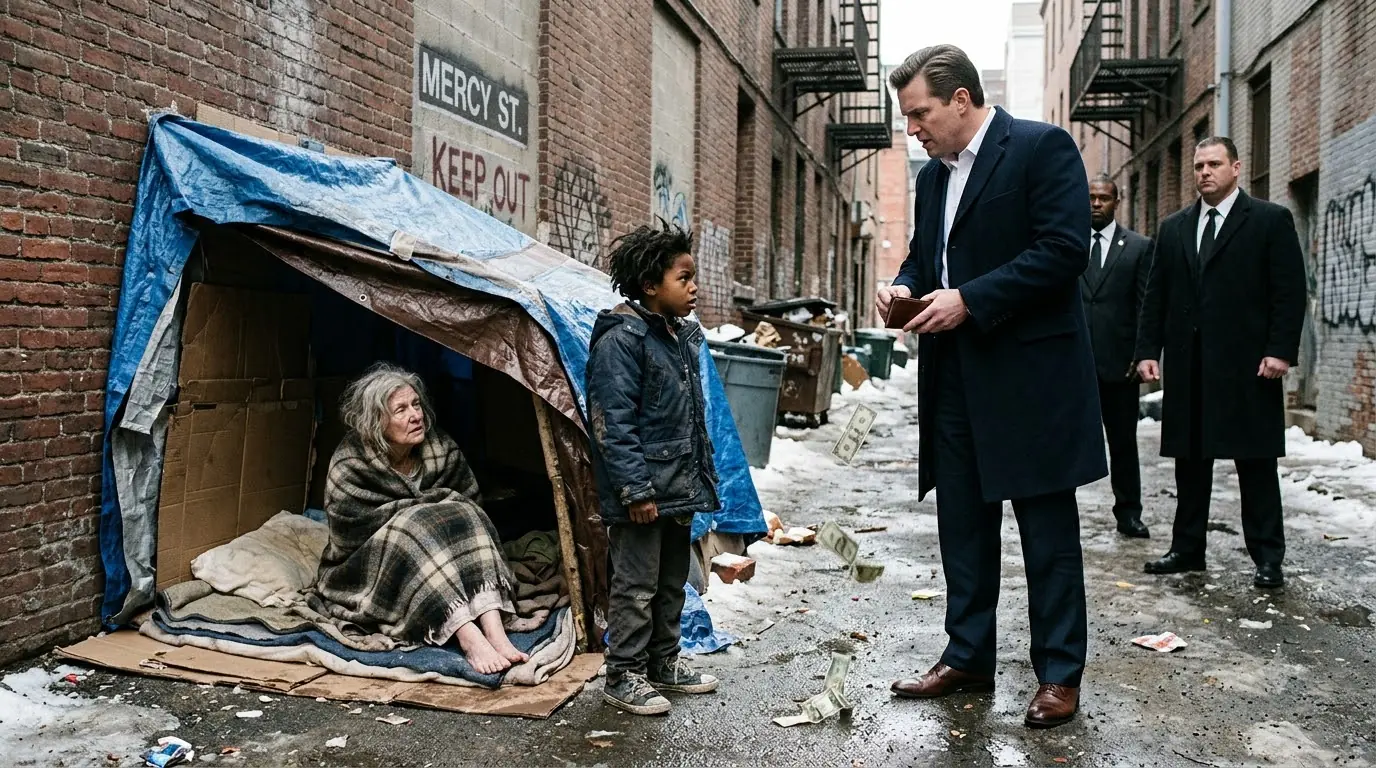
Not much, but softer than concrete when exhaustion finally pulled him under. He didn't remember his parents. Sometimes, late at night when sleep wouldn't come and the cold pressed in from all sides, he'd close his eyes and try to reach back into the darkness of his earliest memories, searching for a face, a voice, a moment of warmth, but there was nothing there, just empty space where a family should have been. The social workers had stopped looking for him after the third foster home sent him back. "Too quiet," they'd written in their reports.
"Too withdrawn." As if being quiet was a crime when you were 10 years old and had learned that speaking up only made things worse. At 7, he'd run from the last placement. At 10, he was still running, just staying in one place while he did it. December cold settled deep into his bones as he walked back from his daily route, his breath forming small clouds that disappeared into the frigid air.
Eli clicked on his flashlight and pulled out his greatest treasure, a sketchbook he'd fished from a recycling bin outside an art supply store. Its cover bent and water-stained, but the pages inside still good. Tonight, he drew a house like he did most nights. Small, just big enough for one person, maybe two. A door that locked from the inside, keeping the cold and the danger out.
Windows with curtains that would glow warm and yellow when the lights were on inside. A chimney with smoke curling up into the sky, lazy and peaceful, the way smoke rose from houses where families lived. He drew it carefully, precisely, like a prayer repeated until the words lost meaning, but the hope remained. His stomach growled, a hollow ache he'd learned to ignore. He'd eaten yesterday, half a sandwich found in a trash bin behind a deli, still wrapped in paper, probably safe.
That would have to hold him until tomorrow. "Just be strong," he whispered to himself, the mantra he repeated every night like a spell that might protect him. "Nobody's coming, so just be strong." Eli had wrapped his blanket around his shoulders and wedged himself into the corner of his shelter where the tarp blocked most of the cutting wind. The temperature had dropped below freezing, and he could see his breath even inside his makeshift home.
He hoped the tarp would hold through the night. The bricks were solid, stacked carefully, but wind like this had torn his shelter apart before, leaving him exposed and scrambling to rebuild in the dark. That's when he heard it. A small sound, almost lost in the howling wind. A whimper, or maybe a cry.
Definitely human. Eli crawled to the edge of his shelter and peered out into the darkness. The streetlight at the corner barely reached this far into the alley, its weak yellow glow swallowed by shadows, but he could make out a shape near the dumpster. A person, hunched over, moving in small confused circles like someone who'd lost something important but couldn't remember what. Every survival instinct screamed at him to stay hidden.
Adults meant danger. They asked questions. "Where are your parents? Why aren't you in school? What's your real name?"
They made phone calls that brought police cars with flashing lights and social workers with clipboards and promises that never lasted past the first week. Three foster homes had taught him that the system didn't save kids like him. It just shuffled them around until they fell through the cracks. But the sound came again, soft and lost and afraid. The kind of sound that meant someone needed help, and Eli knew what it felt like when no help came.
He stood up, blanket still wrapped tight around his shoulders, and walked toward the shape. As he got closer, he saw her clearly. An old woman in a nightgown, the thin fabric completely inadequate for a December night. No coat, no shoes. Her feet were bare against the frozen concrete, and she was turning in slow circles, her hands reaching out into the empty air like she was searching for something she dropped but couldn't see.
"Ma'am," Eli said quietly, stopping a few feet away so he wouldn't startle her. The woman jumped anyway, actually jumped like he'd fired a gun. She pressed her back against the dumpster, and her eyes went wide, wet with tears that caught what little light there was. "It's okay," Eli said, keeping his voice soft and gentle. "I won't hurt you.
I promise." "Where am I?" Her voice was thin and shaking, barely more than a whisper. "Where is this place?" "You're on Mercy Street in Boston."
She stared at him like he'd spoken a language she didn't know. "Mercy Street. Boston." The words seemed to have no meaning to her. "I don't know where that is."
A cold feeling that had nothing to do with the weather settled in Eli's stomach. "Do you know your name?" The woman's face crumpled inward. Her whole expression collapsed like a building falling down. She shook her head, and a sob broke from her throat, raw and terrified and completely lost.
"I don't remember. I don't remember anything. I was somewhere warm, I think, and then I was walking, and now I'm here, and I don't"She looked down at her bare feet as if seeing them for the first time. "I don't know how I got here." Eli understood being lost.
He'd been lost his whole life, but this was different. This woman had lost more than her way. She'd lost herself. "Come on," he said, unwrapping his blanket and holding it out to her. "You're freezing.
You need to get warm." The woman pressed herself harder against the dumpster, fear flickering across her face. "I don't have any money. I can't pay you for anything." Something tightened in Eli's chest.
"I don't want money. I just don't want you to freeze to death out here." She stared at him for what felt like a long time. He could see her trying to decide if she could trust him, if this strange boy in a dark alley was safe or dangerous. Then something in her expression softened, like she'd made a choice to believe in kindness.
She reached out with trembling hands and let Eli drape the blanket around her shoulders. Her hands were like ice. Not just cold, actually ice, like she'd been outside for hours. "My shelter is right over there," Eli said, pointing to his tarp. "It's not much, but it's warmer than out here.
You can rest there." He led her slowly across the alley, matching his pace to her shuffling steps. She moved like every movement hurt, like her body had forgotten how to work properly. When they reached his shelter, Eli held the tarp open and helped her inside, guiding her to sit on his cardboard floor. She settled down with the blanket wrapped tight around her and looked at his world.
The milk crate with his few possessions spilling out, the dead flashlight, the bent sketchbook with its water-stained cover, the coffee can of pencil stubs. Everything he owned laid bare. "You live here?" she asked, and there was something in her voice. Not pity, exactly.
Something worse. Understanding. Like she could see exactly how bad this was. "Yeah. All alone.
Yeah." She started crying then, but quietly, like she was trying not to bother him with her sadness. Tears ran down her weathered cheeks and disappeared into the darkness. Eli reached into his milk crate and pulled out a granola bar he'd been saving for tomorrow, his only food until he could panhandle enough for another meal. But she looked like she might break if she didn't eat something soon.
"Here," he said, holding it out to her. The woman took it with shaking hands. She stared at it like she'd forgotten what food was, like the concept of eating had temporarily left her mind. Then she looked up at Eli with eyes that were suddenly focused and clear. "Why are you helping me?
You don't know me. I could be anyone." Eli sat down across from her on the cardboard. "Because nobody helped me when I needed it, and I know what that feels like. I know what it's like to be alone and cold and scared and have everyone just walk past like you don't exist."