"Someone get that child back to the visitors' gallery. This is a symposium, not a daycare."
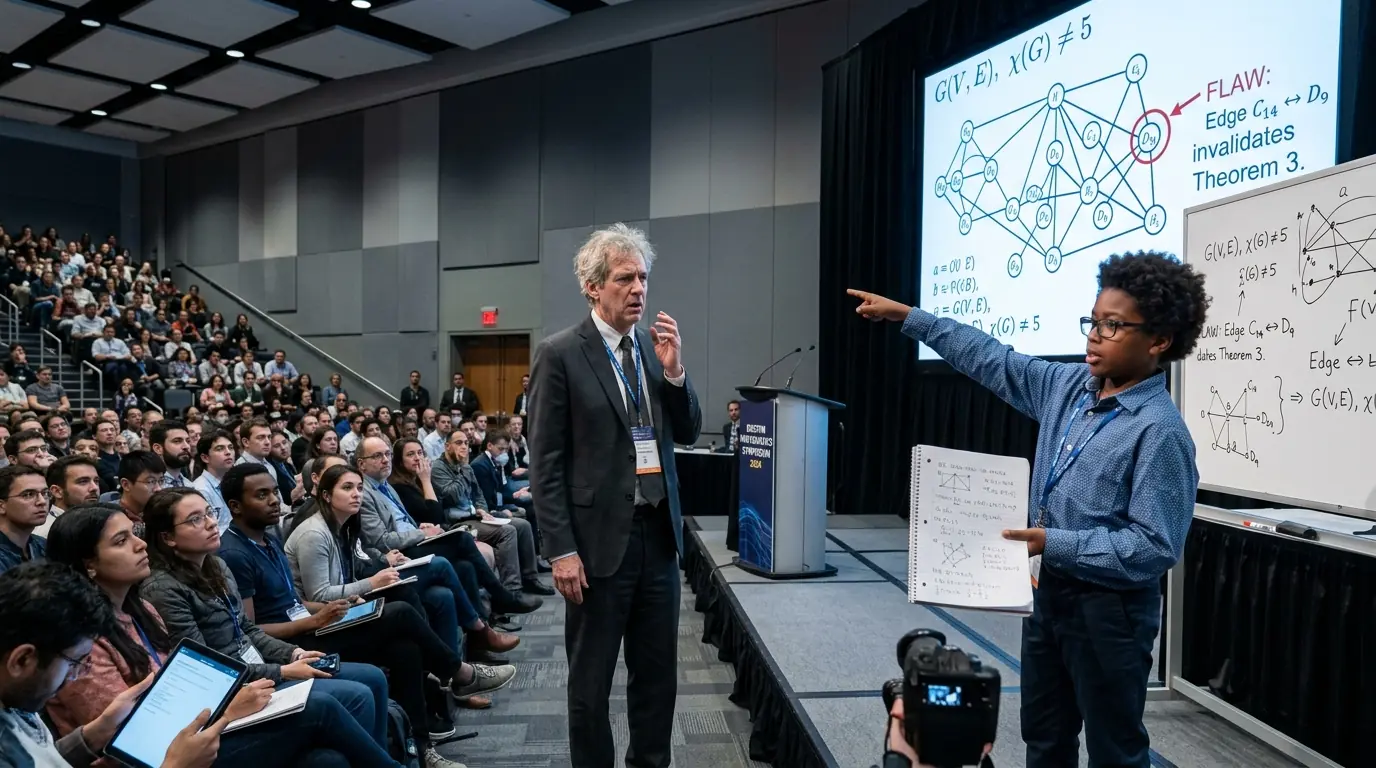 Dr. Lawrence Whitfield waves his hand like he is shooing away a fly. He does not even look at the small Black boy standing at the microphone."Did no one check credentials at the door? This forum is for serious researchers, not children playing mathematicians."A few people in the audience laugh. The boy's papers slip from his hands and scatter across the stage."I'm sorry, sir. I have a presentation scheduled. Number 47." His voice shakes—quiet, polite, the kind of voice that has learned to make itself smaller."Presentation from Booker T. Washington Elementary?" Whitfield squints at his tablet. "Is this some kind of outreach program?"More laughter now. The boy's face burns. What none of them know is that this terrified 10-year-old has just done something impossible—something no mathematician on earth has managed in thirty years.His name is Elijah Brooks, 10 years old: thick glasses that slide down his nose, a button-up shirt two sizes too big, borrowed from his cousin for today. Right now, he wants to disappear.The annual New England Youth Mathematics Symposium, Boston Convention Center: three days of presentations where the brightest young minds showcase their work. Except the bright young minds here all have a certain look, a certain background: Phillips Exeter Academy, Milton Academy, Boston Latin School—the kind of schools with Olympic-sized swimming pools and robotics labs that cost more than Elijah's entire school building.Elijah goes to Booker T. Washington Elementary in Roxbury: no advanced math program, no competition math team, just library books and YouTube videos and a notebook he bought with his own birthday money.Dr. Lawrence Whitfield sits at the judges' table like a king on a throne: 58 years old, tenured professor at MIT, department head. His signature is worth millions in research grants. One word from him can launch a career or end it before it starts. He has decided Elijah does not belong here, and he is not the only one."Excuse me, son. Are you lost?" That was the security guard at the entrance, three different times. Each time, Elijah showed his registration badge. Each time, the guard looked surprised, skeptical.In the bathroom, two boys from Phillips Exeter stood at the sinks in their tailored blazers. "Did you see that kid in the waiting room? What's he even doing here?" "Probably some diversity thing. You know how they are now." They did not bother to lower their voices. Elijah stayed in the stall until they left.The symposium runs on an unspoken hierarchy. At the top: students from families where both parents have PhDs, where dinner conversation includes words like "topology" and "eigenvalues," where summer means math camps at Stanford or MIT, not watching your little sister while your mom works double shifts.Elijah is presenting on the Hartwell conjecture, a problem that has haunted mathematicians since 1987. Dr. James Hartwell, a British mathematician, asked a simple question about coloring infinite graphs: can you color any planar graph with four colors so that no two connected regions share the same color, even when the graph extends infinitely?It sounds simple. It is not. For 38 years, hundreds of mathematicians have tried to solve it. Doctoral students have built entire dissertations around failed attempts. Tenured professors have published papers proposing solutions, only to have them torn apart by peer review. The Hartwell conjecture sits in that special category of problems that are easy to understand but impossible to solve.Dr. Whitfield himself has spent three decades chasing it: seven published papers, dozens of conference presentations, millions in research funding. He has not solved it either.Elijah does not know this yet, but six months ago, he found something: a pattern, a way of looking at the problem that no one else had tried. He spent his lunch periods in the library filling page after page with colored-pencil drawings of graphs—testing, checking, following the logic wherever it led. He thought he found an interesting observation, something worth sharing. He had no idea he had actually solved it.Back in Roxbury, forty people crowd around a projection screen at the community math center: kids from the neighborhood, parents who took off work, Dr. Sarah Okonkwo, who runs the center and who convinced Elijah to submit his work to the symposium in the first place. She sits in the front row, hands clasped tight. On the screen, they watch Elijah standing frozen on that stage while Whitfield dismisses him like trash.