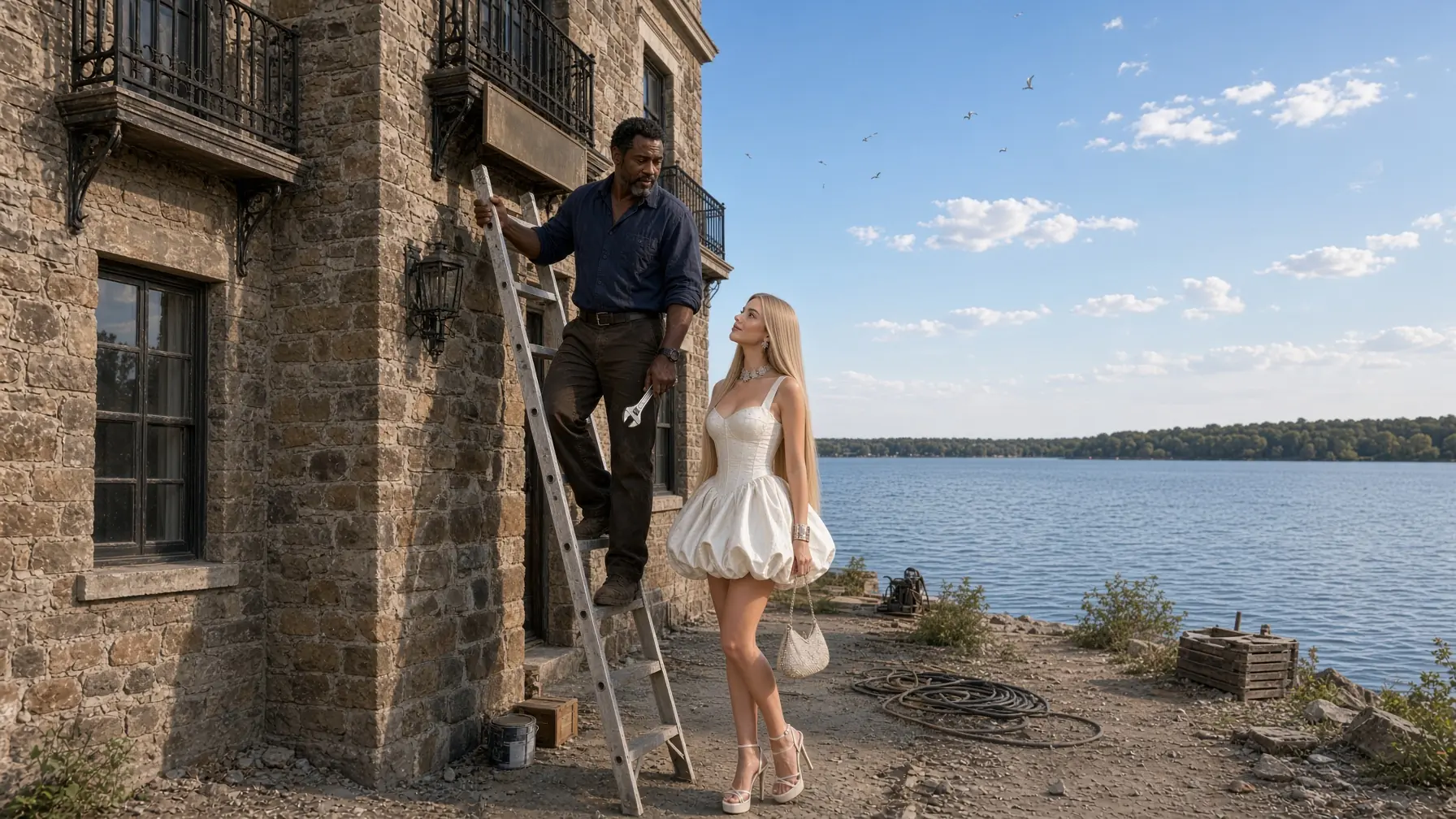
Graham Dorsey was 47 years old, standing on a ladder in the afternoon sun, screwing a brass sign back into the stone face of a building that had been asleep for nearly a decade. Below him, Leona Pierce stood with her arms crossed, watching with the quiet patience of a woman who had learned early that most things worth having required waiting. He made the mistake of looking down. "You know," he said, voice casual, the way a man speaks when he's trying to make something true feel smaller than it is. If I were 10 years younger, I'd probably ask you out." He expected her to laugh, or look away, or say something that let them both pretend it hadn't been said.
Instead, Leona tilted her head and met his eyes without hesitation. "If you asked," she said, "I'd say yes." Graham's grip tightened on the ladder. She wasn't smiling like it was a joke. She was smiling like she meant every word. Graham Dorsey had not planned to stay in Bell Haven.
When he came back 22 months ago, he told himself it was temporary. A few weeks to sort through his father's house, clear the gutters, maybe repaint the porch before putting the property on the market. That was the plan. Clean, simple, and short enough that it wouldn't require him to think too carefully about what he was leaving behind in Chicago, or what he had nothing left to come back to. He didn't put the house on the market.
Instead, he patched the roof himself, replaced the kitchen floor, rebuilt the back steps from salvaged cedar. And somewhere between the second month and the sixth, he stopped calling it temporary. Bell Haven was a lake town in the lower peninsula of Michigan, the kind of place where people waved from their driveways without knowing your last name, where the hardware store still kept a handwritten ledger, and where a man could go an entire week without anyone asking him how he was doing in the voice people used when they already knew the answer wasn't good. Graham appreciated that more than he'd expected. He was a structural engineer by training, or had been, before he and his partner sold the firm, and he discovered that without work to occupy every waking hour, the silence in his chest became something he could no longer outrun.
His His wife, Celia, had died 5 years ago. Not slowly, not with warning. A rupture in the night, and by the time the paramedics arrived, there was nothing left to do but stand in a hallway and wait for someone in a white coat to tell him what he already knew. He did not talk about Celia. Not to the neighbors, not to the men he worked alongside on the restoration projects he'd started taking around town, repointing the brickwork on the old pharmacy, replacing the rotting fascia boards on the Lutheran church, fixing fences, and porch railings for people who couldn't afford to hire a crew.
He worked. He came home. He read until he fell asleep. He woke up and did it again. It was not a full life, but it was a quiet one.
And quiet, at 47, felt like something he had earned the right to keep. Leona Pierce arrived in Bell Haven on a Tuesday morning in early April, driving herself in a rental car rather than sending someone ahead the way her board members had suggested. She was 35 years old, the CEO of Crestline Hospitality, a company with more than 1,600 employees, 14 properties across six states, and a reputation for acquiring distressed assets and turning them into something worth staying in. Harbor Elm Hotel was not a distressed asset by any reasonable financial measure. It was a liability.
Nine years closed, the plumbing partially seized, the east-facing balconies pulling away from their brackets, and the roof above the third floor corridor showing water damage that two different inspectors had described in reports that ended with the phrase, "Significant remediation required." The board had voted against the restoration. The numbers were not close. Leona had listened to the entire presentation, thanked the team, and flown to Bell Haven anyway. She did not explain herself at length, but those who had worked with her long enough understood. Harbor Elm was not an investment.
It was the hotel her grandmother had run for 31 years. The place where Leona had spent every summer until she was 14, making beds and folding napkins and learning, without anyone formally teaching her, that hospitality was not a service industry, but a particular form of attention. You noticed what people needed before they said it. You made the space feel like it had been waiting for them specifically. Her grandmother had been dead for 3 years.
The hotel had outlasted her by six. Leona intended to see it outlast her, too. She hired Graham through a referral from the town's building inspector, who described him as "The only person in Bell Haven I'd trust to tell me the truth about a structure." Graham came in on a Wednesday morning, walked the east balconies without speaking, took measurements and photographs, and produced a written assessment by Friday afternoon that was thorough, clearly organized, and entirely free of the softened language contractors sometimes used when they didn't want to deliver bad news. The balconies needed full bracket replacement. The roof required immediate attention in three sections.
The maid stairwell at the north end of the building was unsafe to use until the subfloor beneath it was examined and likely reinforced. He handed her the report and waited. Most clients, in his experience, pushed back. They asked whether it was really necessary, whether there was a cheaper option, whether he was being overly cautious. Leona read report in full, set it on the table, and said, "When can you start?" That was the beginning.
For the first 2 weeks, they were professional with each other in the way of people who are very good at maintaining appropriate distance. Graham arrived, worked, answered questions when asked, and left. Leona managed the contractors and the permit applications and the increasingly skeptical calls from her CFO, and did not linger near whichever section of the building Graham was working on that day. But, Harbor Elm was not a large hotel. 41 rooms, a dining room, a narrow lobby with a fireplace that still worked, and a porch that wrapped the entire south face of the building and looked out over the water.
In a space that size, two people who are both present and paying attention will eventually find themselves in the same room. It started with coffee. Leona had a habit of brewing a pot around 3:00 in the afternoon in the small room off the lobby she'd converted into a temporary office. One Tuesday, Graham was still working on the lobby ceiling when she came out with two cups and set one on the scaffold platform without comment. He climbed down and drank it.
She went back to her desk. The next day, she left a cup in the same place. He drank it again. By the end of the week, they had started talking, not about the hotel, though the hotel was always there, threading through every other conversation like a structure you'd learn to navigate without thinking. They talked about other things.
Leona asked him about the building he'd worked on before Harbor Elm, a stone mill on the north end of town that had been converted to a community archive. Graham described the process of stabilizing a foundation that had been slowly failing for 40 years, and something in the way he talked about it, the patience of it, the precision, made Leona set down her coffee and listen in a way she rarely permitted herself to do with people she'd just met. He asked her about the hotel, not the business, but the building itself. What it had felt like as a child, which rooms had been her favorites, whether the kitchen had always been positioned the way it was now. She answered without the careful professional framing she used in board meetings.
She told him about the summer she was nine, when she'd convinced her grandmother to let her repaint the numbering on the room doors with a fine brush. About the way the lake looked at 5:00 in the morning before any of the guests were awake. About the smell of the dining room after it had been cleaned for the night. Cedar and lemon and something underneath that she'd never been able to name. Graham listened without interrupting.
Leona noticed. Most people listened the way they waited for traffic, tolerating the pause before it was their turn again. Graham listened the way a man listened when the other person was saying something he actually wanted to hear. She told herself it didn't mean anything. She had a hotel to rebuild and a board to answer to, and no business letting her attention drift in directions that had nothing to do with either.
She told herself that for another week before she stopped believing it. The afternoon it changed. Graham was on a ladder at the front of the building, working the old brass sign back into alignment. The letters read Harbor Elm in raised relief, oxidized to a dull green at the edges, still solid beneath their weathering. He'd cleaned the mounting brackets the day before and replaced two bolts that had corroded through, and now he was making the small careful adjustments that were the difference between a thing that was fixed and a thing that was right.