Ruth Miller did not hear the motorcycles coming.
Everyone else on Maple Creek Road did.
The sound began somewhere beyond the old Baptist church as a distant vibration, low enough that several neighbors mistook it for construction equipment. Then the vibration multiplied, becoming a rolling wall of engines that moved steadily through the quiet Tennessee town.
One motorcycle appeared around the corner.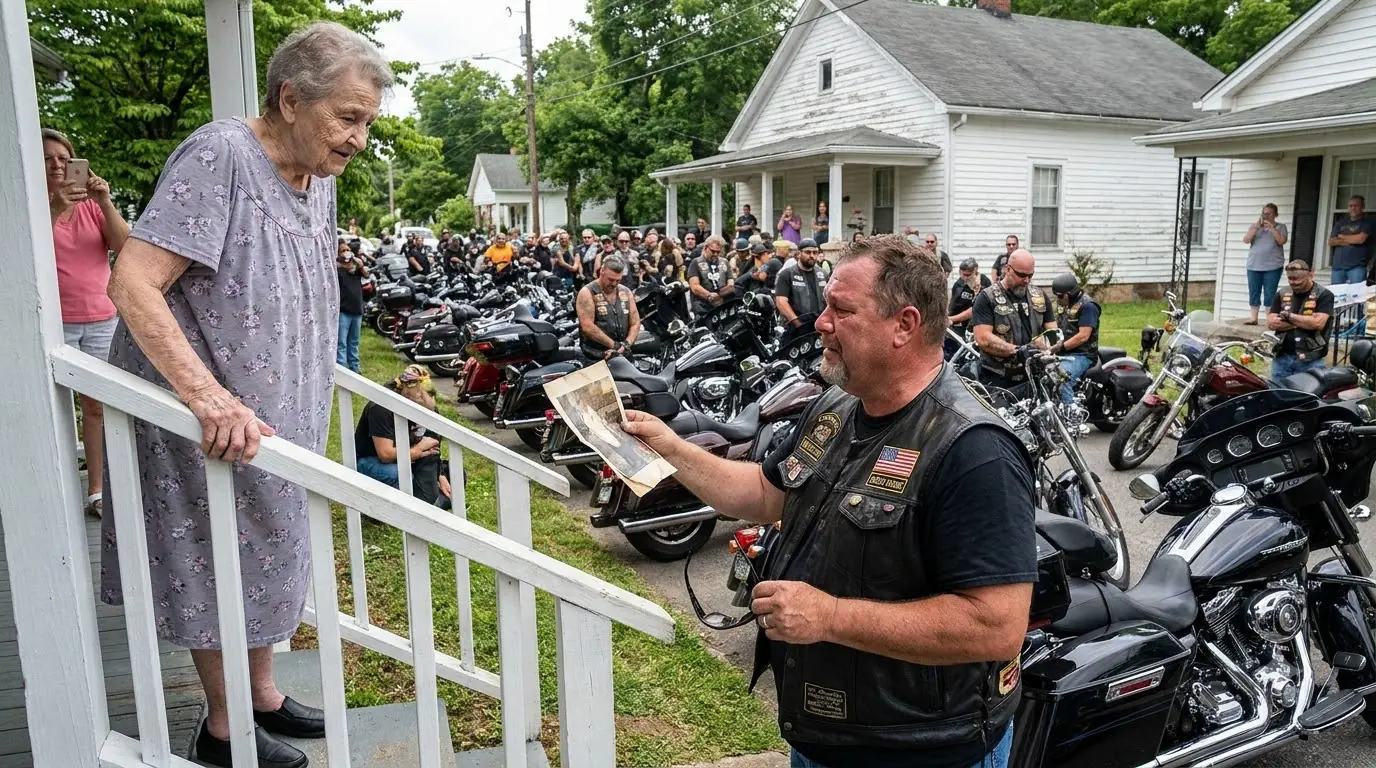
Then six.
Then twenty.
By the time the first riders reached Ruth’s block, nobody was counting anymore.
Curtains moved behind windows.
Front doors opened.
Children abandoned bicycles in driveways and ran toward their parents.
Phones appeared almost immediately.
The motorcycles came in two long lines, mostly black and chrome, stretching so far down the road that the final riders were still turning onto Maple Creek while the first were already slowing beside Ruth’s white house.
Nearly one hundred.
Nobody in the neighborhood had ever seen anything like it.
Mrs. Harper across the street stepped onto her porch holding a dish towel.
“What on earth?”
Her husband, George, came behind her.
“Stay inside.”
“I am outside.”
“Then go back inside.”
“No.”
That was the entirety of their emergency planning.
Three houses away, twenty-seven-year-old Noah Bennett started recording.
His sister slapped his arm.
“Maybe don’t point the phone at them.”
“Why?”
“Because there are a hundred bikers outside.”
“That’s exactly why.”
One elderly neighbor was already calling the local police non-emergency number.
Another walked toward Ruth’s house.
Everyone had the same thought.
Why Ruth?
Her home was the smallest on the block.
A narrow white clapboard house with a deep front porch, green shutters, hanging ferns, and a flower bed Ruth still tended herself despite needing a cane on bad days.
She had lived there almost forty years.
At eighty-three, Ruth had become one of those people who seemed woven into the neighborhood.
Children knew her because she kept wrapped peppermints in a bowl beside the door.
Postal workers knew her because she left cold water outside during summer.
Stray cats somehow knew her because every animal within three streets eventually discovered that Ruth Miller considered the phrase “do not feed” more of a suggestion than a rule.
She was small.
Soft-spoken.
White hair curled loosely around a deeply lined face that still carried an almost mischievous smile whenever someone underestimated her.
And she could barely hear.
Her hearing had declined slowly.
First conversations became difficult in restaurants.
Then church hymns faded.
Then the television required captions even at full volume.
By eighty, Ruth could hear certain frequencies with powerful hearing aids, but without them, much of the world reached her as vibration and movement instead of sound.
That Saturday afternoon, her hearing aids were on the kitchen counter charging.
So Ruth did not hear a hundred motorcycle engines rolling toward her house.
She did not hear neighbors shouting.
She did not hear George Harper calling her name from across the street.
She only felt something.
A faint tremor beneath the wooden porch.
Ruth looked down.
Her cane rested beside the chair.
The glass of lemonade on the porch table showed tiny circles moving across its surface.
She frowned.
Then slowly stood.
Across the street, George saw her.
“Ruth!”
She could not hear him.
Mrs. Harper hurried from her porch.
“Ruth, go inside!”
Ruth noticed movement and looked up.
That was when she saw the motorcycles.
Rows and rows of them.
Black leather.
Helmets.
Tattooed arms.
Chrome flashing beneath the Tennessee sun.
Her neighborhood had transformed in less than a minute.
Ruth did not retreat.
She gripped the porch railing.
The motorcycles gradually stopped.
Engines shut down one by one until only the final few remained.
Neighbors watched, waiting for whatever came next.
Then the riders separated.
A path opened through the center.
One man stepped forward.
He was enormous.
Six feet four inches, maybe more in his heavy boots.
A thick gray beard covered most of his lower face.
His hair was cut short and silver at the sides.
Old tattoos covered both arms, disappearing beneath a weathered black leather vest loaded with patches from places Ruth had never visited.
Arizona.
Nevada.
Utah.
Texas.
Colorado.
One patch near the bottom simply read:
BEAR.
He carried a matte-black helmet in one hand.
Dark sunglasses covered his eyes.
To the frightened neighbors, he looked like exactly the man no one wanted walking toward an elderly woman living alone.
Mrs. Harper reached Ruth’s walkway first.
“Ruth.”
Ruth saw her mouth moving.
She touched one ear.
“No hearing aids.”
Mrs. Harper exaggerated her words.
“COME. INSIDE.”
Ruth looked toward the approaching biker.
Then back at her neighbor.
“Why?”
Mrs. Harper pointed.
Ruth almost laughed.
“I can see him, Helen.”
“But—”
Ruth raised one hand.
Something about the man had caught her attention.
Not his beard.
Not the tattoos.
Not the hundred riders.
The way he walked.
His right shoulder dipped slightly lower than his left.
Barely noticeable.
Most people would never see it.
Ruth did.
Her fingers tightened around the railing.
The biker reached the front path.
Then stopped.
He looked up.
Ruth stared down at him.
For several seconds, neither moved.
Behind him, one hundred riders remained almost perfectly still.
The man removed his sunglasses.
His eyes were blue-gray.
Ruth’s breath caught.
There were wrinkles now.
Scars.
Decades.
But eyes were cruel things.
They could hold time when everything else changed.
The biker took one step toward the porch.
Ruth whispered something no one nearby understood.
Mrs. Harper leaned closer.
“What?”
Ruth ignored her.
The man reached the bottom step.
He looked far more frightened than Ruth did.
That shocked everyone.
His scarred hand trembled slightly around the helmet.
Ruth descended one step.
Then another.
Her knees complained.
The man instinctively lifted a hand to help her.
He stopped before touching her.
Ruth studied his leather vest.
Her gaze moved across patches.
Then stopped near his chest.
There, partly faded beneath thirty years of sun and rain, was a tiny hand-sewn patch.
Blue thread.
White border.
A crooked little star.
Ruth knew that star.
She had sewn it herself.
On a denim jacket.
For a seventeen-year-old boy who complained that his mother was ruining perfectly good clothing.
Her hand began shaking.
She reached toward the biker.
Her fingertips touched the patch.
The enormous man closed his eyes.
Ruth looked into his face.
Her lips trembled.
“Danny?”
The entire street became silent.
Even people who had been whispering stopped.
The biker opened his eyes.
Nobody behind him had ever heard someone call him Danny.
For decades he had been Wade.
Wade Callahan.
Bear.
Road captain.
Mechanic.
Brother.
Friend.
To Ruth Miller, none of those names mattered.
His mouth moved.
Ruth could not hear him.
He remembered.
Slowly, Wade raised both hands.
He signed the first words he had practiced repeatedly during the eight-hundred-mile ride.
It’s me.
Ruth stared.
Then covered her mouth.
Wade signed again.
I’m sorry.
Her eyes filled immediately.
She shook her head.
“No.”
Wade took another step.
Ruth reached down and touched his beard.
Her fingers moved slowly across his cheek as though trying to locate the seventeen-year-old face buried beneath the years.
“You got old.”
Several bikers behind Wade laughed softly.
Wade did too.
Ruth could not hear it.
But she saw his smile.
That was enough.
Then her expression broke completely.
“You’re alive.”
Wade nodded.
Ruth hit him.
Not hard.
Her palm landed against the center of his leather vest.
Once.
Then again.
“You’re alive.”
He nodded again.
Another slap.
“You stupid boy.”
Wade’s eyes filled.
Ruth hit his chest a third time.