Grandpa Gus stood in the barn doorway for almost thirty seconds without moving.
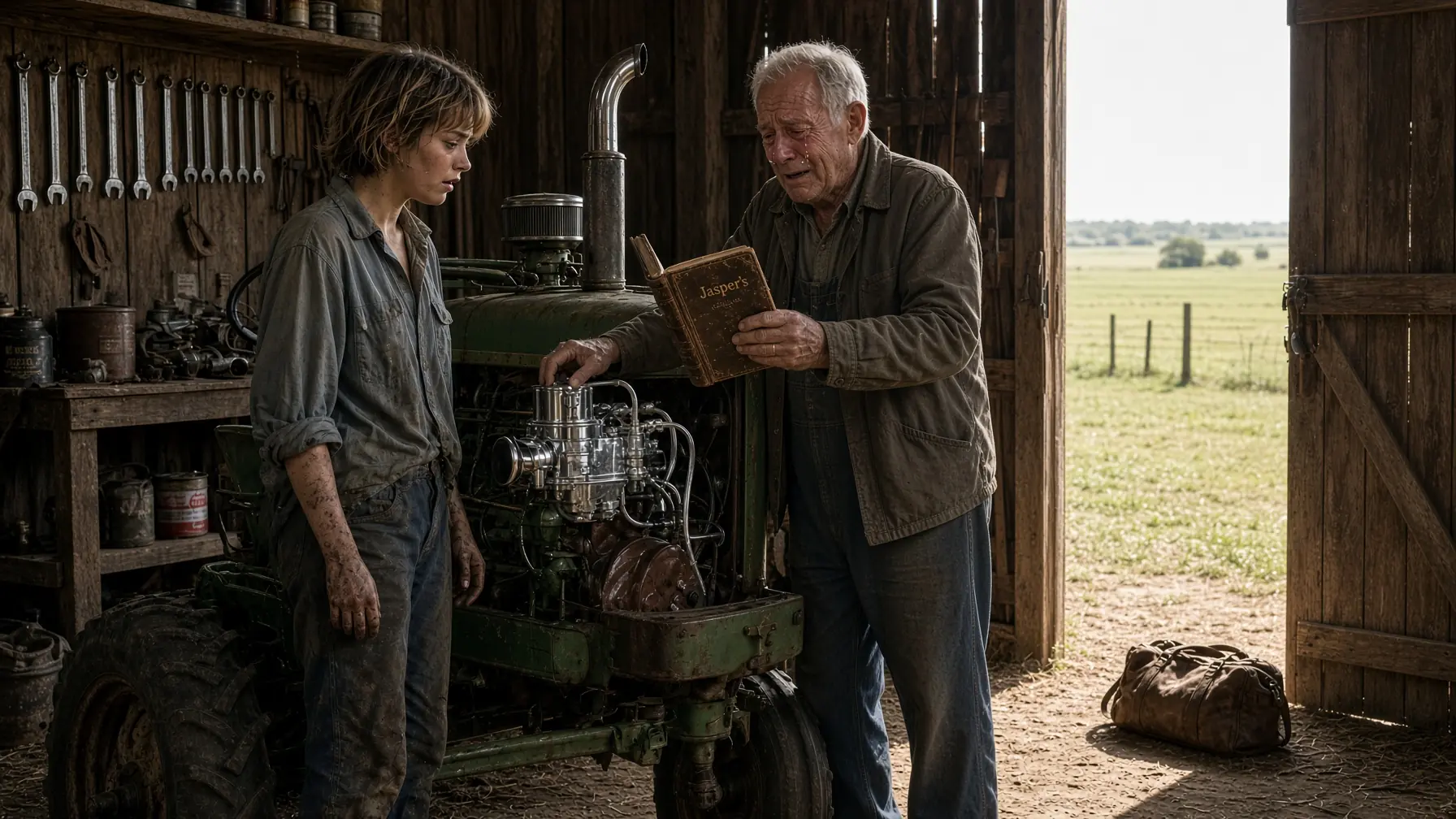
His overnight bag hung from one hand.
His weathered face had gone pale.
I stood beside our John Deere Model B with grease still buried beneath my fingernails, watching his eyes travel over everything I had changed.
The new carburetor.
The redesigned air intake.
The altered exhaust manifold.
The fuel lines routed differently from the way he had maintained them for twenty-one years.
He looked at the tractor as though I had not modified a machine.
As though I had dug up a grave.
Then his overnight bag slipped from his hand.
It struck the wooden floor with a dull thump.
“Goldie…”
His voice was barely there.
“What did you do to this tractor?”
I swallowed.
“I learned from Dad’s mistakes.”
Grandpa stepped forward.
His fingers trembled as he touched the new carburetor.
“I did it differently.”
His other hand disappeared into his coat pocket.
When it came back out, he was holding my father’s old leather journal.
The confidence I had been forcing myself to hold vanished.
Grandpa looked at the journal.
Then at me.
“You found Jasper’s notes?”
“Yes, sir.”
He closed his eyes.
When he opened them again, there were tears there.
That frightened me more than anger would have.
Grandpa Gus did not cry.
Not in front of people.
Not ever.
Then he said:
“Goldie, there’s something about your father you were never told.”
And for the first time since I had begun this whole impossible project, I understood that I might have been solving the wrong problem.
Three weeks earlier, I had believed our biggest problem was money.
The Hartwell farm sat on sixty acres of Kansas flatland where the horizon stretched so far you could almost watch tomorrow coming toward you.
Our farmhouse had once been white.
By 1967 the Kansas sun had turned most of the paint gray.
The barn still carried some of its old red, though the tin roof had rusted through at one corner where Grandpa kept promising he would patch it when there was time and money.
There was never enough of either.
The drought of 1966 had taken nearly forty percent of our crop.
By July 1967, we owed First National Bank of Oak Ridge $3,847.23.
The largest payment was due September 15.
Grandma Lorelei kept the exact number in a ledger inside the kitchen drawer.
She kept every number exact.
Feed.
Seed.
Fuel.
Taxes.
Doctor visits.
Medicine.
At the end of July, we had $127.50 in the bank.
That was the whole distance between us and nothing.
Grandma had diabetes.
Her insulin already cost us forty-three dollars a month.
Then my sister Iris came home one Sunday afternoon carrying worse news.
Iris was twenty and worked as a nurse at Mercy Hospital forty miles away.
She drove up in her Ford Falcon, came into the kitchen, and sat down without removing her shoes.
That was how I knew something was wrong.
Grandma poured iced tea.
Iris did not touch it.
“The hospital raised the insulin price.”
Grandma stopped.
“How much?”
“We need another two hundred dollars this month.”
Nobody spoke.
Grandma opened her ledger.
Her finger moved slowly down the columns.
Two hundred dollars might as well have been two thousand.
The arithmetic was equally impossible.
I watched Grandma’s hand tremble before she closed the book.
She noticed me noticing.
Immediately she smiled.
“We’ll manage.”
That was one of the lies adults told children because they thought fear became smaller if nobody named it.
I was fifteen.
Old enough to know better.
My full name was Marigold Hartwell.
Everybody called me Goldie.
I was skinny, five-foot-four, brown hair cut short because long hair and machinery were a dangerous combination, and I wore my dead father’s work shirts because the pockets were deep enough for tools.
At Oak Ridge High, that made me memorable for all the wrong reasons.
The other girls talked about Beatles records, dresses, boys, and cars.
I read Popular Mechanics.
I fixed bicycles.
Lawn mowers.
Small engines.
Anything somebody would allow me to take apart.
My father, Jasper Hartwell, had started teaching me when I was little.
I still remembered his hands guiding mine around a wrench.
“Don’t fight the bolt,” he would say. “Feel it.”
And another thing:
“Metal doesn’t care whether you’re a girl or a boy. It only cares whether you understand what you’re doing.”
He died when I was eight.
For seven years, the adults around me described his death using small, careful words.
Accident.
Tractor.
Quick.
Never enough detail to form a complete picture.
Grandpa Gus stopped talking about Jasper almost entirely.
The John Deere became sacred after that.
Grandpa had bought the Model B used in 1946 after returning from Europe.
He had driven it for twenty-one years.
Plowing.
Planting.
Harvesting.
Pulling wagons.
Running equipment.
Every evening at six, he went to the barn and checked it.
Oil.
Belts.
Grease fittings.
Hoses.
Fuel.
He treated maintenance like a religious obligation.
I could watch.
I could hand him tools.
But I was not allowed to work on the important systems myself.
Grandpa never explained why.
He only said:
“Leave the John Deere alone.”
I obeyed.
Until the summer of 1967.
That same Sunday Iris brought the insulin news, Weston Caldwell drove onto our property.
West was sixteen.
His father, Nathaniel Caldwell, owned four hundred acres on the other side of Oak Ridge.
Five tractors.
New barns.
Fresh fences.
A two-story house that looked like it belonged in a magazine.
Nathaniel even drove a black Mercedes to church.
West came from a family where machinery was replaced before it had a chance to become old.
He saw our Model B sitting inside the barn.
“My dad says tractors that old belong in museums.”
Grandpa kept repairing a fence post.
West grinned toward me.
“Though I guess Goldie wouldn’t know much about that.”
I stared at him.
He continued.
“Oh, right. You’re a girl. Probably don’t understand much about machinery anyway.”
My hands curled into fists.
Grandpa still said nothing.
West climbed back into his Jeep and drove away trailing dust.
I hated him for several hours.
Then I hated myself for caring.
That night, I could not sleep.
Around eleven, I heard voices in the kitchen.
Grandpa and Grandma.
Quiet.
I opened my bedroom door.
Grandpa said:
“Lorelei, we don’t have the money.”
“I know.”
“The bank note’s six weeks out.”
“I know, Gus.”
Then a long silence.
Grandma finally whispered:
“Maybe we should consider selling the farm.”
I had never heard her cry before.
Not like that.
No sobbing.
Just a few broken sounds she was trying desperately to keep quiet.
I closed my bedroom door.
Sat on the bed.
Something had to change.
We needed more income.
We needed more output from the equipment we already owned.
And somewhere underneath all of that was something more selfish.
I wanted to prove West wrong.
I wanted to prove every person who looked at me and saw a girl before they saw my hands was wrong.
Most of all, I wanted to prove my father had been right about me.
That was the dangerous part.
Because desperation and pride can sound almost identical when they are whispering inside your own head.
The next morning I climbed into the attic.
Most of Jasper’s belongings were stored in boxes nobody had opened since his death.
I searched until I found a leather journal.
His handwriting was instantly familiar.
Crop records.
Weather.
Expenses.
Machine notes.
Then I reached June 15, 1960.
Three weeks before he died.
The entry was about the John Deere.
Jasper had tried modifying the carburetor.
He believed that by changing airflow and fuel mixture he could increase power substantially.
The attempt had failed.