The rain had been falling on Cold Harbor since the small hours, thin and gray and steady, the kind that soaked into stone and stayed. It smelled of wet slate and coal smoke and the sour breath of the river three streets away. In the servants' passage of Blackmere House, the tallow candles guttered when the back door opened, and the smell changed for a moment to wet wool and cold iron and the copper tang of a bell that had been rung too many times before dawn.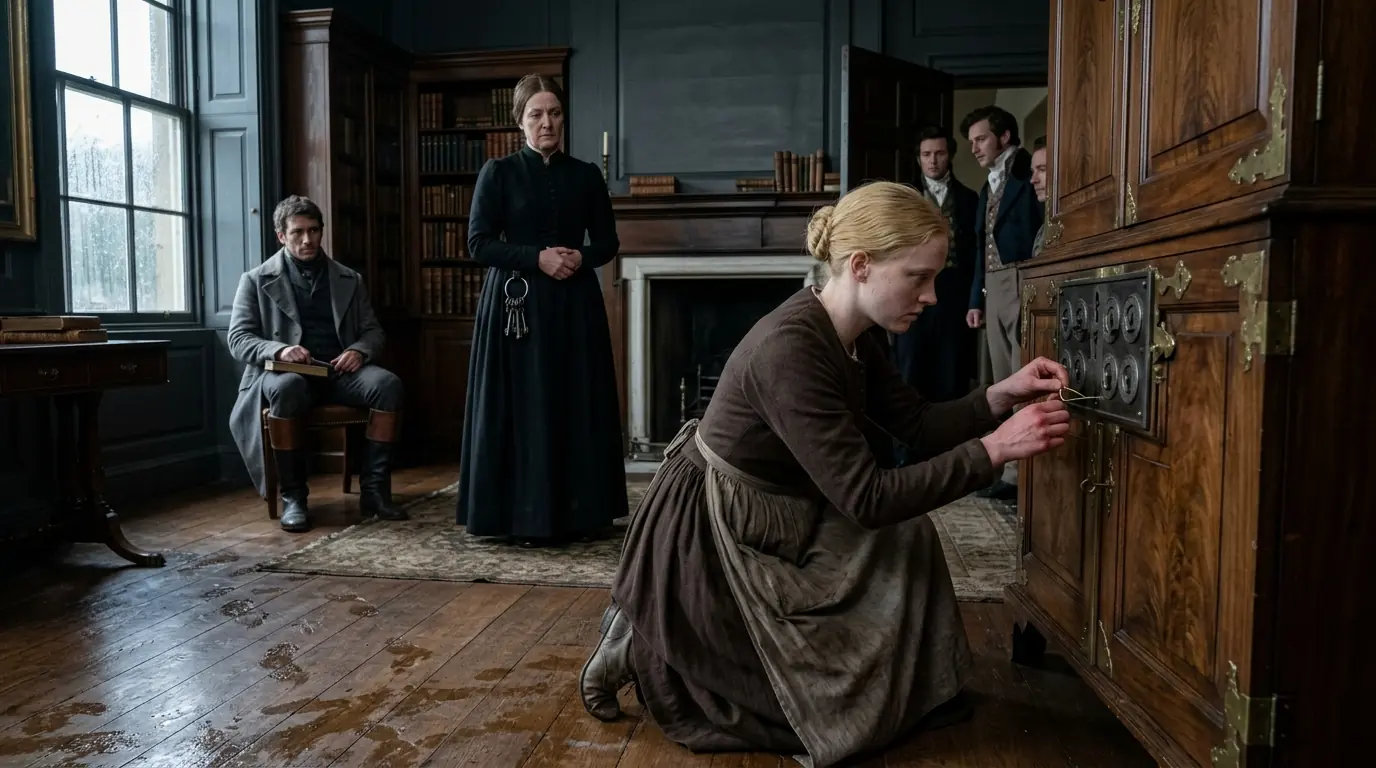
The bell had been rung 25 times before dawn. 25 lords in 25 carriages, some in their own coats, some in borrowed ones, all summoned by a single line on a single card sent out from Blackmere three weeks past.
The card had said only what the trouble was and what the reward would be. The trouble was a lock. The reward was a purse of 200 guineas and the standing gratitude of the house. The lords had come. They had gone. Not one of them had opened it.
Into the passage at half past six came a woman who had not been sent for. Her name was Hester Wren and she was five and twenty and she was the daughter of the woman who scrubbed the front steps. She was not pretty in any way a portrait could hold. She was thin and freckled and her hands were red at the knuckles from lye. And her hair, the color of wet straw, was pinned back so tightly it looked painful. She was the kind of woman a room forgot the moment she left it.
She had come only to bring her mother a hot brick for her feet because the steps were flooded and her mother's feet had been aching since Christmas. She was going to open the lock before the hour was out. She did not know that yet.
She stood in the passage with the brick wrapped in flannel against her ribs, and she watched the last of the lords go out into the rain. A tall man with a wet plume and a mouth like a paper cut muttering to his valet about a wasted morning. She stepped aside for him. She did not curtsy. She had been taught by her mother to stand where she was needed and no further. And a passage was no place for a curtsy that would only tangle the wet.
"Miss Wren."
The housekeeper had come up behind her. A small square woman in bombazine with a bunch of keys at her waist that did not this week matter. Her name was Mrs. Ambry and she had kept Blackmere for 18 years. And she had a dry warm voice that had comforted three generations of frightened housemaids.
"Your mother is in the still room," Mrs. Ambry said. "Bring the brick through. And then, if you will, look at the door."
"The door, ma'am?"
"The door in the west room. The one the lords have failed at. His grace has said any hand in the house may try. I am telling you it is any hand."
Hester looked at her. Mrs. Ambry looked back, plain and unblinking, the way a person looks who has decided a thing and is not going to be talked out of it.
"I am not clever, ma'am."
"I did not ask you to be clever. I asked you to look."
She brought the brick through first. Her mother was on the low stool in the still room with her stockings off and her feet in a basin of cooling water, and she did not speak when Hester knelt and slid the flannel-wrapped brick under her heels, only put a hand very briefly on her daughter's head. Hester stayed there a moment. Then she stood up and wiped her hands on her apron and followed Mrs. Ambrey through the green baize door into the front of the house where the carpets began.
The west room smelled of beeswax and old paper and men. Three tall windows let in the gray. Under the middle window stood a walnut cabinet as tall as a man with brass corners and a single door and no visible keyhole. On the door was an iron plate the size of a hand and set into the plate were seven small dials, each engraved with letters and numbers, and above the dials a slot the width of a coin. The lock had been made by a Frenchman in the last century for the fifth duke, who had died with the trick of it in his head and no note left behind.
Inside the cabinet, everyone had been told, were the deeds of six villages and the marriage papers of the present duke's dead mother and a small tin box that belonged by right to a child in Somerset who could not be given her name until the box was open. The child was the reason for the 25 lords. The child was seven. The child had been waiting since Michaelmas.
At the far end of the room, in a chair that did not match the others, sat a man Hester did not know. He was in a plain gray coat and boots that had been walked in. He was perhaps two and 30, hard-boned, a nose that had once been broken, eyes the color of the rain on the window behind him. He had a book on his knee that he was not reading. He looked up when she came in and did not stand and did not speak and did not smile.
"Mr. Haldane," said Mrs. Ambry, "is his grace's man of business. He has sat here since Tuesday."
"Sir," said Hester, and did not curtsy to him either.
He inclined his head. That was who.
She went to the cabinet. She had seen a puzzle like it once at the fair at Stapleford when she was 12. It had been on the table of a Dutch tinker and it had cost a penny to try and no one had opened it and the tinker had laughed at every child who bent over it. She had not laughed. She had watched the tinker's hands. The tinker had been drunk by four and had left his coat on the chair and Hester, who did not steal, had turned the little box over once in the dusk and had seen the trick from underneath, which was where the trick had always been. She had not opened it. She had put it back. She had gone home and told no one.
That was 14 years ago. She did not think of Stapleford now. She only looked.
The dials were stiff. The slot above them was clean. The plate was seated a hair proud of the wood and along its lower edge, where careless polish had not reached, ran a fine dark line that was not a shadow. She set her red-knuckled fingertip to it. The line moved. She did not speak. She knelt.
From her apron pocket she took the thing she carried always, which was a bent brass pin her mother had used for 30 years to fasten a shawl. She slid the pin along the dark line, and felt the plate lift a hair, a hair more, and then click quietly against its own weight and hang.
Behind the plate, where the seven dials had been the whole face of the trouble, was a second face. Three plain levers of black iron set in a row, each no bigger than a thumb. She heard the man in the gray coat draw a breath. She did not look at him.
She pressed the first lever. The cabinet said nothing. She pressed the second. It said nothing. She pressed the third, and inside the walnut something turned once with a small dry sound of a clock striking a single note, and the door of the cabinet swung an inch out of its frame and stopped.
She sat back on her heels. "There," she said, plain. "There it is."
For a long moment, no one spoke. The rain went on. A rook called once far off over the river. Mrs. Ambry had put a hand very lightly on the door frame and had not moved it. The man in the gray coat had closed his book.
"How?" he said, and stopped and began again. "How did you know?"