"Hey, what's that? No way, that's the new English teacher? They hired a Walmart greeter as our professor?"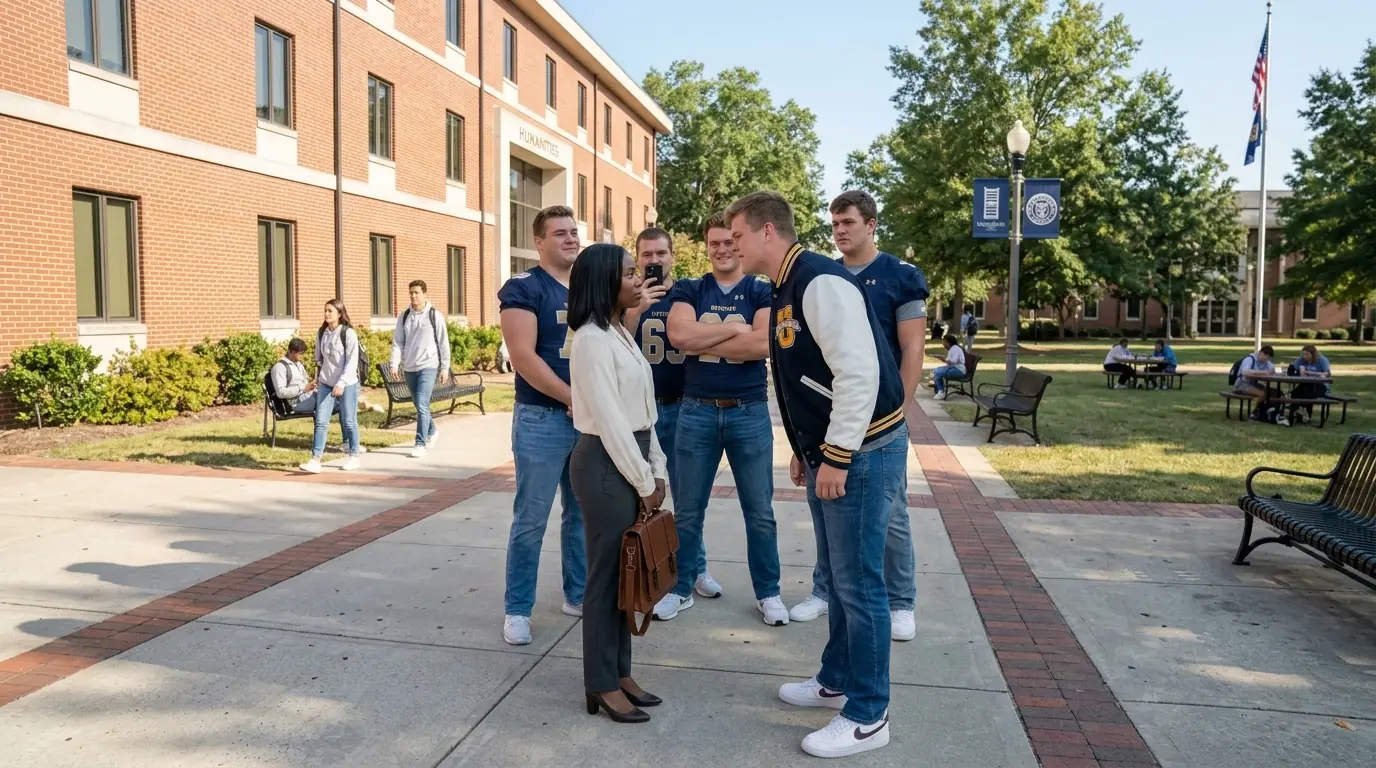
Five junior football players leaned against the wall like royalty as laughter bounced off the concrete. Dylan snorted and made a racist remark about what a Black woman could possibly know about teaching. Scott aimed his phone at her face and added another racist insult, while Reed mocked where he imagined she came from. The woman did not flinch. She tightened her grip on her satchel strap and said, "Good morning, gentlemen."
Brett Collins blocked her path. "Welcome to Ridgemont, darling. Let's see how long before you run home crying to mama." She smiled, barely, and walked right past him.
Brett watched her go, still grinning. He would not be grinning much longer, because when the truth came out, it did not just end their season. It ended everything.
That morning had started the way every morning started for Naomi Underwood. At 4:55 a.m., her eyes opened before the alarm. No snooze button and no second chances. Twelve years in the Marine Corps had burned that habit into her bones.
She swung her legs off the bed and planted both feet flat on the cold hardwood floor. Two seconds, one deep breath, then up. The apartment was small, a one-bedroom rental on the edge of town just off Route 9. Nothing fancy, with bare walls, a secondhand couch, and a kitchen that smelled like yesterday's coffee, but everything was in its place.
Towels were folded in thirds, shoes lined up by the door, and the bed was made tight enough to bounce a quarter off it. Old habits did not retire just because she had. On the mantel above the small television sat a folded American flag in a triangle case. Beside it was nothing but a faint dust ring where a photo frame used to be.
That frame was in the drawer now, face down beneath old bills and a bag of rubber bands. It held a photograph of a younger Naomi in Marine dress blues, jaw set, shoulders squared, three chevrons and crossed rifles on her sleeve. She did not display it anymore. That was a different life, a different woman, or at least that was what she kept telling herself.
In the kitchen, her daughter Denise sat at the small table eating cereal. She was eighteen, a freshman at the same university, with bright eyes, nervous hands, and her phone face down on the table as though she were trying not to check it. "You okay?" Naomi asked, pouring coffee into a plain white mug. Denise shrugged. "What if they don't like me?"
Naomi set the mug down and really looked at her daughter. "You walk in there like you belong. Because you do." Denise smiled, small but real. They drove to campus in Naomi's ten-year-old sedan with the windows down and the morning air thick with Carolina humidity and sweet with honeysuckle growing wild along the fences.
The radio played low, some gospel station Naomi never changed. Ridgemont State University sat on sixty acres of red clay and green grass, a mid-sized public school in a small, mostly white Southern town. Enrollment was just under six thousand. It was not Ivy League and was not trying to be, but it was fiercely and stubbornly proud of one thing above all else: football.
You could feel it the second you drove through the front gate. A forty-foot banner stretched across the entrance: Home of the Ridgemont Lions, back-to-back conference champions. The stadium loomed behind the main quad like a cathedral, bigger than the library and better funded, too. Trophy cases lined the athletics building, boosters' names were engraved on brass plaques, and a giant mural of a roaring lion mascot covered the wall of the student union.
The message was everywhere, carved into the bones of the campus. Football was king, and the players were royalty. Nobody touched them and nobody questioned them. When they crossed a line, which they did often, almost nobody said a word.
In the faculty lounge that first morning, a woman named Ruth Caldwell found Naomi. Ruth was fifty-eight and the only other Black faculty member in the entire humanities department. She had been at Ridgemont for eleven years and knew the terrain. She poured Naomi a cup of coffee without asking and sat down across from her.
"I'm going to tell you something nobody else will," Ruth said, keeping her voice low. "The football boys run this building, especially the juniors. They test every new professor. And if you look like us," she added, gesturing between them, "they test harder."
Naomi listened and nodded. Ruth continued, "Administration won't back you. Brett Collins' daddy sits on the board of trustees. Donated the whole athletics wing. You file a complaint, it'll disappear before the ink dries." Naomi asked, "So what do you suggest?"
Naomi looked at her coffee, then at Ruth, then out the window where the football stadium cast a long shadow across the quad. "Thank you, Ruth. I appreciate the honesty."
She did not say she would follow the advice. Ruth, who had been there long enough to read people, noticed. Across campus in the athletics building, Coach Vince Taylor was already at his desk. He was sixty-one, with a silver crew cut and a voice like gravel in a tin bucket.
On his desk, between a playbook and a stack of scouting reports, sat a framed photograph. A young man in Marine dress blues stood at attention on graduation day. Beneath the photo was a handwritten note: Thanks for believing in me, Dad. Caleb. Coach Taylor's only son, Caleb Taylor, was currently deployed overseas, and nobody at Ridgemont connected that photograph to the new English professor down the hall. Not yet.
Naomi's first class was a Tuesday morning Introduction to English Composition in Room 214 on the second floor of the humanities building. Fluorescent lights buzzed overhead above twenty-six students in plastic chairs bolted to small desks. The room smelled faintly of dry-erase markers and stale air conditioning. Naomi arrived fifteen minutes early, set her materials on the desk, opened her laptop, and placed a stapled syllabus at every seat.
Her pens were arranged parallel to the edge of the desk. Marine habits. Everything was squared away before the first boot hit the ground. Students trickled in, some smiling politely, some refusing to look at her, and a few whispering to each other before glancing back down at their phones.
Then the back row filled up. Brett Collins walked in first, letterman jacket slung over one shoulder and baseball cap turned backward. He dropped into the last seat, stretched his legs into the aisle, and pulled out his phone without looking up. Dylan Moore sat beside him, then Reed Hamilton, Scott Dawson with his camera app already open, and finally Travis Adams, who slid into his seat quietly with his eyes on the floor.
Five of them formed a wall of entitlement across the back row. Naomi waited until the clock hit 9:00, then stood.
"Good morning. My name is Ms. Underwood. I'll be teaching this course for the semester." Her tone was warm but firm.
She outlined her expectations. Show up on time, participate, meet deadlines, respect the room, and expect no special treatment. "This class runs on mutual respect," she said. "You give it. You get it."
From the back row came Brett's voice. "So what exactly qualifies you to teach us?" He leaned back with his arms crossed, not angry but amused, like a cat watching something small try to run. The room went quiet. Twenty-one students looked at Naomi, and five looked at Brett.
Naomi did not miss a beat. "Twelve years of leadership experience and a state teaching credential. Any other questions about my resume, Mr. Collins?" A few students shifted in their seats. Someone in the front row exhaled through their teeth.
Brett's smirk flickered for half a second. He was not used to being addressed by his last name or to someone holding his gaze without flinching. He recovered fast, shrugged, looked at Dylan, and grinned. "Leadership experience," he repeated with air quotes. "Sure thing, ma'am."
The room laughed, not all of them, but enough. Naomi let the silence settle. Then she picked up the syllabus stack and began handing papers out row by row as if nothing had happened. But something had happened, and everyone in that room knew it.
Over the next two weeks, the campaign began. It was not loud and it was not violent. It was calculated, the kind of cruelty that left no bruises but tried to break someone from the inside out. Dylan started first.
Every class, Dylan talked over Naomi. It was never shouting, only constant low chatter with Brett, loud enough to disrupt and quiet enough to deny. When Naomi asked him to stop, he raised his hands with a smile. "My bad, Professor. Won't happen again." It always happened again.
Scott came next. He recorded Naomi in every class, his phone propped against his water bottle with the camera aimed at her face. He did not post the footage yet. He was collecting it, building an archive, waiting for her to slip, raise her voice, or say something he could twist.
After class one day, Naomi saw a group-chat notification flash on Scott's screen as he walked past. The chat was called Operation Diversity Hire. She did not react, but she noted the date and time in a small notebook she kept in her desk drawer. Reed used a different approach, choosing subtle physical intimidation.
He made no contact. Instead, he arrived early and sat in Naomi's chair. When she walked in, he stood slowly and smiled wide as though he were doing her a favor. "Oh, sorry, Professor. Thought this was the lounge."
Other times, Reed stood in the doorway when she tried to enter, taking up the whole frame with his shoulders. Naomi had to turn sideways to get past him. He watched her squeeze through and said nothing. He only smiled.
Brett's move was the boldest. At the end of the second week, he submitted his first essay assignment. The page was blank except for one sentence handwritten in black marker across the center: This class isn't worth my time. Neither are you. Naomi held the paper for a long moment, placed it in a manila folder, wrote the date on the tab, and filed it in her desk.
She was building a case the way she had been trained to do for twelve years, documenting every incident, every act of insubordination, and every failure of character. Precise, patient, thorough. On a Friday afternoon, she walked into the office of Department Chair Eleanor Whitfield. Whitfield was fifty-three, wore wire-rimmed glasses, and had a smile that never quite reached her eyes.
Her office smelled of lavender air freshener and stale ambition. Naomi placed the manila folder on Whitfield's desk. Inside was a written log of fourteen incidents across ten days, including Dylan's disruptions, Scott's recordings, Reed's doorway games, and Brett's blank essay with the handwritten insult. "I'm formally reporting a pattern of targeted harassment from five students in my Tuesday-Thursday section," Naomi said. "The details are documented."
Whitfield opened the folder, skimmed the first page, and closed it. "Ms. Underwood, I understand this can be frustrating, but these are student athletes in the middle of conference season. Brett's father is very involved with the university. Very generous." She paused and chose her next words carefully.
"My recommendation would be to build rapport with them. Find common ground."
"Common ground?" Naomi repeated. Whitfield nodded. "Yes. Sometimes the best approach is flexibility." Naomi looked at Whitfield, then the folder, then the framed photograph behind Whitfield showing the department chair shaking hands with Garrett Collins at a fundraiser gala, both smiling wide.
"Thank you for your time, Dr. Whitfield." Naomi picked up the folder and left. Nothing changed. The harassment did not stop, and if anything, it got worse because now the players knew she had complained and nothing had happened.
Brett became louder, Dylan became bolder, and Scott's phone never stopped recording. Naomi kept doing what she had always done. She graded fairly. Brett's second essay came in with actual writing, four hundred words of sloppy arguments, no thesis, and two plagiarized paragraphs pulled straight from Wikipedia.
She gave him a D-minus. The next afternoon, Brett waited outside her office, leaning against the wall with his arms crossed and his jaw tight. The hallway was empty, and late-afternoon light slanted through the windows. "You need to change that grade," he said without greeting.
"I graded your work according to the rubric," Naomi replied, unlocking her office door. "If you'd like a better grade, write a better essay." Brett stepped closer, not touching her, only moving near enough to make the air between them feel thin. "You don't know who you're messing with."
Naomi turned and looked straight up at him. He had at least eight inches on her. She did not step back and did not blink. "And you don't know who you're talking to."
The words landed like a slap. Brett's jaw clenched and his eyes narrowed. For one second, doubt flickered behind his confidence, something he had not felt in a long time. Then it disappeared.
He straightened and forced a smile. "We'll see, Professor. We'll see." He walked away with his hands in his pockets, whistling. Behind him, Travis Adams stood at the end of the hallway and had seen the whole thing.
Travis said nothing, but his face told a different story. His lips were pressed tight and his eyes uneasy. That night, Brett called his father. By 9:00 the next morning, Department Chair Whitfield had called Naomi in again.
"Mr. Collins, Garrett Collins, has expressed concerns about your grading standards," Whitfield said, folding her hands on the desk. "He feels his son is being singled out. Perhaps you could reconsider." "No," Naomi said.
The word sat in the room like a stone dropped into still water. Whitfield blinked. "Ms. Underwood, I'm just trying to keep the peace." Naomi stood, picked up her bag, and looked Whitfield directly in the eye.
"With all due respect, Dr. Whitfield, peace built on silence isn't peace. It's permission." She walked out, and the door clicked shut behind her, quiet and final. Whitfield sat alone while the lavender air freshener hummed and the stadium lights outside warmed up for Thursday's game.
Two more weeks passed. Naomi kept teaching, grading, and filing every incident in the manila folder with the same care she brought to everything else. But Brett Collins was not done. People who had never been told no did not always back away when someone finally stood their ground. They escalated.
This time, they went after Denise. It started small with a comment in the dining hall. Denise sat alone at a corner table eating a turkey sandwich and scrolling through her phone, three weeks into her freshman year and beginning to believe she might actually belong at Ridgemont. Then Brett walked by with Dylan.
He did not stop or even look at her. He simply said, loud and casual, "No wonder the standards are dropping. They're importing whole families now." Dylan laughed, a sharp sound that echoed off the tile walls. A few heads turned, but nobody said anything.
Denise's hand froze over her sandwich. Her stomach dropped, and she stared at her plate until they were gone. The harassment did not stop there. That same week, an anonymous Instagram account appeared with no profile picture, followers, or biography, only posts targeting Denise.
One meme used a stock photo of a confused woman in a college lecture hall with a caption mocking affirmative action. Another used a photograph someone had taken of Denise in the library without her knowledge, mid-yawn and eyes half closed, with a caption saying she did not belong. A third used a racist animal comparison beside her full name. There was no subtlety and no plausible deniability.
The account had no followers, but screenshots spread through group chats. Within forty-eight hours, half the campus had seen them. The effect on Denise was immediate and devastating. Her roommate stopped talking to her without explanation, putting on headphones and facing the wall whenever Denise entered.
Her study group quietly removed her from the group chat. Denise found out only when she texted a question about the midterm and received the notice that she was no longer a member. At lunch, tables that had room suddenly did not, open seats became "saved," and conversations died when she approached. She ate alone every day at a corner table, head down and earbuds in, pretending she could not feel the stares pressing against her back.
She lasted nine days before telling her mother. They sat in the apartment one evening under the faint buzz of the kitchen light. Denise stared at the table and picked at a hangnail, her voice flat and small, like someone trying very hard not to cry.
"They made an account about me, Mom. With memes. Everyone's seen them. Nobody talks to me anymore. Nobody even looks at me."
Naomi sat very still with a coffee mug in her hand. The surface of the coffee trembled slightly because her hand was shaking, not from fear, but from something older and deeper. Her jaw tightened. For one brief moment, an expression crossed Naomi Underwood's face that had not been there since Parris Island.
Then it was gone, controlled and locked behind the quiet, steady mask she wore like armor. "I'll handle this," she said softly. The next morning, Naomi filed a formal bullying complaint with the Dean of Students office. It included screenshots, timestamps, the anonymous account's handle, and a timeline of the social isolation that followed.
The response came three days later as a form email. "Thank you for your report. The matter has been forwarded to the appropriate office for review. No further action is required on your part at this time." There was no follow-up, no investigation, no phone call, and no meeting. The system had spoken, and its answer was silence.
Then came the afternoon that changed everything. It was Thursday at 4:30 p.m., and the humanities building was emptying out. Footsteps faded down stairwells and doors clicked shut one by one. The hallway lights had switched to their dim evening setting, casting yellowish shadows across the linoleum.
Naomi sat in her office grading midterm essays with the door open, desk lamp on, and a red pen in her hand. The only sounds were pen scratching paper and the distant hum of the ventilation system. Then she heard footsteps, heavy and multiple, coming down the hallway without hurry. They were the confident steps of people who believed the building belonged to them.
She did not look up yet. Brett appeared in the doorway first and knocked twice on the open door in mock politeness. "Hey, Professor. Got a minute?" Behind him came Dylan, Scott, Reed, and Travis, all five filing in one by one as though they had rehearsed it.
Dylan closed the door. The click of the latch was the loudest sound in the building. Brett dragged a chair from the corner with a long scrape and sat in the center of the room, legs spread wide and arms on his knees, relaxed and confident. "We need to have a real conversation about your attitude, Ms. Underwood."
Scott was already recording, his phone propped against his thigh and camera tilted toward Naomi. Reed stood by the window with his arms folded, blocking the only natural light. His shadow fell across Naomi's desk like a curtain. Dylan leaned against the door, not exactly guarding it but not moving away, either.
Travis stood in the back corner with his arms at his sides and his eyes fixed on the floor. He had not said a word. Brett began talking slowly and deliberately, every word carrying something uglier than anger.
"People like you come and go around here, Ms. Underwood. Every couple semesters, they bring in someone new. Diversity initiative. Equity program. Whatever buzzword HR is pushing that year."
He leaned forward. "And every time, that person leaves. Some last a semester. Some don't make it past midterms. The smart ones figure it out early and save themselves the embarrassment."
He paused, letting the words hang like smoke. "You've been here, what, a month? And already you've got complaints piling up. Students unhappy. Parents calling. Your department chair asking serious questions about your performance."
Dylan chimed in from the door. "Rate My Professor gave you a 1.2, by the way. That's got to sting." Brett smiled.
"See, Professor? This isn't personal. This is just how things work here. Ridgemont, and you..."
He gestured at her from head to toe with a slow, dismissive wave. "You don't fit." Reed stepped forward, placed both palms flat on Naomi's desk, and leaned close. "Your daughter doesn't fit, either," he said quietly. "Just so we're crystal clear."
The room went cold. Naomi had not shifted in her chair, uncrossed her hands, or touched the red pen beside the stack of essays. Her breathing remained slow and even, the breathing of someone trained to stay calm in rooms far more dangerous than this one. She looked at Reed, then Brett, then each of them one by one.
"Are you finished?" she asked. Her voice was low and even, not quite a whisper, but close. Brett blinked, then gave a short, hollow laugh.
"Yeah, we're finished. Question is, are you? Because this is your chance to walk away clean, Professor. Take the hint. Save your dignity."
Naomi unfolded her hands, placed them flat on the desk, and stood slowly. "I'm going to say this once. You have ten seconds to leave this office." Brett grinned. "Or what? You'll give us an F?"
Naomi looked at Scott's phone, the red recording light still blinking, then back at Brett. "No. I'm going to let you keep recording, because every second of this, you're making my case for me." The grin cracked just a fraction. What none of them realized was that Naomi's phone had been recording since the first knock on her door.
It sat in her open desk drawer with the voice memo app running silently, capturing every word. Outside in the hallway, Ruth Caldwell had stopped mid-step when she heard the door close. She listened for three seconds, then turned and walked quickly toward Coach Taylor's office in the athletics building. Her heels barely touched the floor.
Ruth did not knock on Coach Taylor's door. She opened it. Taylor looked up from his desk with his reading glasses halfway down his nose and a highlight reel paused on his laptop. The moment he saw Ruth's face, the glasses came off.
"What's wrong?" he asked.
"Your players," Ruth said, breathing hard. "All five of them. They're in Naomi Underwood's office right now. Door closed. I heard what they were saying, Vince. It's bad."
Taylor was on his feet before she finished. He did not grab his jacket or his phone. He simply moved, fast and deliberate, sixty-one years old and crossing the campus like a man half his age. Ruth had to jog to keep up.
The humanities building was nearly empty. Their footsteps echoed through the stairwell, sharp and urgent. Second floor, down the hall, Room 214B, Naomi's office. The door was closed, and Taylor could hear Brett's voice inside, low, smug, and unhurried.
Taylor did not knock. He grabbed the handle and pushed the door open so hard it struck the wall behind it. Every head in the room turned. Five football players stood around Naomi like wolves circling a campfire.
Taylor's face changed from concern to fury in less than a second. "What the hell is going on in here?" His voice filled the room, the same voice that had commanded football fields for three decades and could make two-hundred-forty-pound linemen flinch. Brett scrambled to his feet and the chair scraped backward across the floor.
Dylan stepped away from the door as if it had burned him. Reed pulled his hands off Naomi's desk so fast he knocked over a cup of pens. Scott lowered his phone slowly, but not before Taylor saw it. "We were just talking, Coach," Brett said, quick and smooth. "Just having a conversation with our professor."
"A conversation?" Taylor repeated. He looked at Dylan by the door, Reed by the desk, Scott's phone, and Travis frozen in the corner. Then he looked at Naomi and stopped. The anger on his face shifted into something older, something like recognition surfacing through deep water.
He stared at her. Naomi looked back, calm and still, hands at her sides. "Wait," Taylor said, his voice dropping. "Underwood? Naomi Underwood?"
She did not move. She simply held his gaze with the stillness that came from years of standing at attention while chaos raged around her. Taylor's hand went to his mouth and his eyes widened. "Staff Sergeant Underwood? You're Caleb's drill instructor."
The room stopped breathing. Brett looked at Dylan, Dylan at Reed, Reed at nobody. Travis finally raised his eyes from the floor. Coach Taylor pulled out his phone with hands that were actually trembling and swiped through his photos.
He turned the screen toward the five players. A high-resolution photograph taken under bright South Carolina sun showed Parris Island on graduation day. Caleb Taylor stood at attention in Marine dress blues, pride carved into his expression. Beside him stood Naomi in her own dress blues, three chevrons and crossed rifles on her sleeve.
It was the same woman, the same steady eyes and unmovable calm. The woman they had just spent half an hour trying to break. Brett's face lost every ounce of color, and his mouth opened without producing a word. For the first time in his life, Brett Collins had absolutely nothing to say.
Dylan stepped backward and bumped into the wall. Reed stared at the photograph, then Naomi, then the photograph again as though his mind were refusing what his eyes confirmed. Travis looked sick. Coach Taylor lowered the phone.
His voice shook when he spoke, not with anger now, but with something deeper. "This woman made my son into a man. Caleb was lost before he shipped out. Directionless, angry, headed nowhere good. She broke him down and built him back up. She helped turn him into a United States Marine."
Taylor swallowed hard. "And you five cornered her in an empty office and tried to run her out of this school." Nobody spoke or moved. The ventilation system hummed overhead like a held breath.
Naomi reached into her desk drawer and lifted her phone. The voice memo app was still running, and the timer read thirty-four minutes and sixteen seconds. "I want to be very clear," she said. "I didn't come here to intimidate anyone. I came here to teach."
"But I have dealt with situations more dangerous than five students in an office, and I have documented every single incident since my first day at this university." She looked directly at Brett. "Your father sits on the board of trustees. That means you should understand better than anyone what accountability looks like." Brett said nothing, and his hands were shaking.
"Now get out of my office." The players filed out in silence, single file and heads down. Not one looked back. Coach Taylor stayed in the doorway with one hand on the frame and red-rimmed eyes.
"I'm sorry," he said quietly. "I didn't know you were here. If I had known..." Naomi answered, "You're here now. That's what matters."
Naomi did not wait until morning. That same night, she sat at her kitchen table with her laptop open while Denise slept in the next room. The apartment was silent except for the soft click of keys as she compiled everything.
She attached the thirty-four-minute, sixteen-second voice memo, the manila folder containing six weeks of incident logs, screenshots of the anonymous Instagram account targeting Denise, and a formal request for hallway camera footage showing all five players entering her office and closing the door. She addressed the email to Dr. Harold Preston, president of Ridgemont State University, with copies to the Title Compliance Office and the Office of Student Conduct. She did not copy Department Chair Eleanor Whitfield.
The subject line read: Formal report: Pattern of racial harassment and intimidation. Documented evidence attached. Naomi pressed send at 11:43 p.m. By 9:00 the next morning, her phone was ringing.
Dr. Preston's office launched a formal investigation before lunch. Compliance officers arrived at the humanities building by afternoon. Security pulled the hallway camera footage by 3:00, and it was clear as daylight: all five players walking in and Dylan closing the door. By 4:00 p.m., all five students were suspended effective immediately.
No classes, no practice, no games. The news hit like a bomb because Ridgemont was two wins from the conference championship. Its starting quarterback, best wide receiver, and three key defenders had disappeared from the roster overnight. Boosters panicked, and local sports radio picked up the story within hours.
Then Garrett Collins made his move. He arrived in a black Mercedes without an appointment, walked into Preston's office, and refused to sit. "Do you understand what you're doing? I've donated more to this university than most of your faculty will earn in a lifetime. You're throwing away the season because some new hire got her feelings hurt?"
Preston leaned back and let Garrett finish. Then he pressed play on his laptop. Brett's voice filled the office: "People like you come and go around here. You don't fit. Your daughter doesn't fit either."
Preston paused the recording and looked at Garrett over his glasses. "Your son is on tape making racially motivated threats against a faculty member in a closed room. I'd recommend finding him legal counsel, not calling in favors." Garrett's mouth opened, closed, then opened again. Nothing came out.
He stood gripping the back of a chair with white knuckles, then left without another word. Two days later, the apology letters arrived. Brett's came first, typed, double-spaced, and clearly written by a lawyer.
Every sentence scrubbed away responsibility. "I regret if my words were perceived as offensive. I value diversity and inclusion. I look forward to moving past this misunderstanding." Naomi read it once, set it on the corner of her desk, and said nothing.
Then Travis Adams arrived alone. No lawyer and no letter. He knocked softly, the way someone knocks when they are not sure they deserve to be heard. "Ms. Underwood, can I talk to you?"
Naomi nodded. Travis stepped into the same room where, three days earlier, he had stood in the corner while his teammates tried to tear her apart. His eyes were red and his voice cracked.
"I knew it was wrong. Every second of it," he said.
"I just stood there. I didn't say anything. I didn't walk out. I just let it happen." He wiped his eyes with the back of his hand.
"I'm sorry. I'm really sorry."
Naomi looked at him for a long time. The silence stretched between them like a bridge being tested for weight. "That took courage, Travis. Real courage. Don't waste it." He nodded, turned, and left without another word.
The next day, Coach Taylor called a full team meeting. The locker room smelled like sweat, rubber, and old tape. Fifty-two players sat on metal benches with cleats untied and helmets between their feet. Nobody spoke.
Taylor stood at the front with his arms at his sides and his face carved from stone. "I'm forfeiting Saturday's game." The room erupted in protests and scraping chairs. Taylor raised one hand, and silence returned.
"I don't coach bullies. If this is who you are, take off my jersey, turn in your pads, and walk out that door. Because I would rather lose every game this season than win a single one with men who don't know the difference between strength and cruelty." Nobody moved. Nobody said a word.
The investigation did not stop with five suspensions. It cracked the whole thing open. During the first week, the university's compliance team pulled three years of records from the Office of Student Conduct. What they found was not merely a pattern. It was a system.
Brett Collins and his circle had been reported before, multiple times by multiple people. Dr. Amelia Grant, a twenty-nine-year-old adjunct professor who had resigned mid-semester the previous year, submitted a fourteen-page written statement. She described months of disruption, mockery, and intimidation.
She described filing three formal complaints and being told each time to find common ground and build rapport. She described the morning she entered her office and found the word QUIT scratched into her desk with a car key. That was the day she decided she could not take another day. Nobody had investigated, followed up, or asked why she packed her office and drove home.
Two former students came forward next. Both were Black and had attended Ridgemont during Brett's freshman and sophomore years. They described being targeted and mocked in hallways, excluded from study groups, and receiving racist messages that were screenshot and shared. Neither had reported it because, as one said, "Who were we going to tell? The people protecting them?"
The compliance team traced the anonymous Instagram account that had targeted Denise. University IT pulled the IP address, and it led directly to Dylan Moore's dorm-room laptop. The device still contained the original image files in a folder labeled Project DU. Denise Underwood, her initials, filed like a project and treated like a campaign.
The deepest cut came from inside the administration. Investigators pulled Eleanor Whitfield's email records and found six formal complaints filed over three years, all involving Brett Collins or members of his circle. Every complaint had been received, read, and buried.
No investigations had been opened and no disciplinary referrals made. In Whitfield's sent folder were three emails to Garrett Collins updating him about complaints before they were officially processed. In one, she wrote, "I've handled it. The matter won't go further. Let's discuss at the gala."
Whitfield had not merely failed to act. She had actively suppressed evidence of harassment to protect a donor's son. The story broke locally first when a twenty-six-year-old reporter for the Ridgemont Courier named Sarah Ellison received a tip from a campus staff member. Her article ran under the headline: Silence for Sale: How a University Covered Up Years of Racial Harassment to Protect Its Football Program.
The story went regional by the end of the week and national by the following Monday. CNN picked it up, then NBC, then the Associated Press. The headlines changed from outlet to outlet, but the core remained: a decorated Marine veteran turned teacher had been bullied by five football players while the administration looked away because the ringleader's father wrote the checks.
Caleb Taylor gave an interview from his base stateside. He sat in uniform with his hands folded and his voice steady but tight with emotion. "Staff Sergeant Underwood is the reason I'm the man I am today," he said.
"When I showed up at Parris Island, I was angry and directionless. I didn't think anyone believed in me. She changed that. She broke me down and built me back up. The fact that anyone would disrespect her is unthinkable to me."
The clip was viewed four million times in forty-eight hours. Veterans organizations issued public statements of support, teachers unions called for systemic reform, and civil rights groups demanded accountability not only from the students but from every administrator who had enabled them. The consequences came down hard.
Brett Collins was expelled from Ridgemont State University. He also faced criminal intimidation and bias-motivated harassment charges, received two hundred hours of community service, two years of supervised probation, and mandatory counseling. Every college football scholarship offer he had received was rescinded.
Dylan Moore was expelled and faced separate consequences for cyberstalking and online harassment tied to the anonymous account. The IP evidence from his laptop was irrefutable. His parents hired a defense attorney, but the evidence remained. Scott Dawson was also expelled.
The footage on Scott's phone, which he had recorded as a trophy and proof of dominance, became one of the case's central exhibits. His own camera documented the conduct he believed would humiliate Naomi. Reed Hamilton was expelled as well, with disciplinary and legal consequences following. His father issued a statement calling the situation a misunderstanding, but the evidence had already changed how people heard that word.
Travis Adams was suspended for the remainder of the semester but not expelled. His voluntary cooperation, remorse, and willingness to testify earned him leniency. He was required to complete a restorative justice program and write a public letter of accountability. He wrote it by hand, six pages long, and the university posted it on its website.
Department Chair Eleanor Whitfield was terminated for gross negligence and breach of responsibility. Her teaching credentials were placed under formal review. She left campus without speaking to the press. Garrett Collins was removed from the Board of Trustees after an ethics investigation confirmed that he had pressured Whitfield to suppress complaints.
Dr. Amelia Grant filed a civil lawsuit against Garrett and the university for constructive dismissal and failure to protect. The case settled out of court for an undisclosed sum. The university announced sweeping reforms, including mandatory anti-discrimination training for staff and students, an independent oversight committee for harassment complaints, and a new anonymous reporting hotline staffed by an outside firm. No single administrator would be allowed to bury a report again.
Ridgemont asked Naomi Underwood to help design the new training curriculum. She said yes. Three weeks later, Caleb Taylor came home. He drove to Ridgemont State on a Tuesday afternoon, parked in the visitor lot, and crossed the quad in his service uniform, pressed and polished with every crease sharp.
He found Naomi's office with the door open. She sat grading papers with a red pen, at the same desk under the same lamp. Naomi looked up as Caleb stepped inside and stopped in the center of the room.
He clicked his heels together, shoulders back and chin high, and saluted her. Naomi rose slowly, stood straight, and returned the salute with crisp precision, twelve years of muscle memory flowing through her arm. They held the salute for three seconds.
Then Caleb broke into a wide, real smile, the kind that cracked open everything both of them had been holding in. Coach Taylor stood in the doorway and said nothing. He did not need to. His eyes said everything.
A student passing by captured the moment on her phone. The photograph of a Marine in dress blues saluting his former drill instructor in a college office was posted that evening. By morning, it had been shared more than two hundred thousand times.
Naomi Underwood remained at Ridgemont State, in the same office with the same desk and the same red pen. But the room felt different. The air was lighter, the door stayed open, and students actually walked through it. They were not only her students, but athletes, freshmen, upperclassmen, and people she had never taught.
They came during office hours to talk about grades, life, and what it meant to stand your ground when the world was telling you to sit down. Naomi became faculty adviser for the university's new Student Equity Council. She designed the anti-discrimination curriculum every incoming freshman completed during orientation. She did not ask for a ceremony or a plaque.
She got something better. She got respect, the kind not given by title but earned through fire. Denise Underwood finished her freshman year with a 3.6 GPA. She joined the debate team in the spring semester and made varsity by the end of it.
Denise became the student representative on the university's new oversight committee, the youngest member by four years. She still ate lunch in the dining hall, but now she picked the table. There was always room. Travis Adams graduated the following year quietly, with no fanfare.
He enrolled in a community college closer to home and volunteered on weekends with a mentorship program for at-risk youth. Before leaving, the campus newspaper asked what he had learned at Ridgemont. He thought for a long time before answering. "I learned that silence is a choice, and it's never the neutral one."
Brett Collins completed his probation, two hundred hours of community service, and mandatory counseling. His football career was over before it truly started. The scholarship offers never came back, and the scouts who once watched him throw spirals under Friday-night lights forgot his name.
The last anyone had heard, Brett was working at his uncle's used-car dealership outside Charleston, washing inventory on weekday mornings and answering phones in the afternoon. It was a long, quiet fall from the throne he thought was permanent. Dylan Moore transferred to a community college out of state, and Scott Dawson's family moved. Reed Hamilton's name occasionally surfaced in local court records in smaller contexts, with the same troubling patterns repeating in smaller rooms.
Garrett Collins sold his house in Ridgemont six months after being removed from the board. The athletics wing still bore his name on a brass plaque by the entrance until the university voted to remove it. The plaque came down on a Wednesday morning. Nobody protested.
Coach Vince Taylor retired at the end of that season. At his farewell dinner in the gymnasium he had paced for thirty years, someone asked him to name the most courageous person he had ever known. He did not hesitate.
"Naomi Underwood," he said. "She walked into a place that didn't want her, and she stayed. Not because it was easy. Because it was right." The room stood and applauded.
Naomi sat in the third row. She did not stand. She only nodded once and wiped the corner of her eye with her thumb. That evening, she went home to a quiet apartment while Denise was out studying with friends, real friends this time.
Naomi walked into the bedroom, opened the top drawer, reached beneath the old bills, and pulled out the photograph she had hidden on her first day in town. A younger version of herself looked back in dress blues, three chevrons and crossed rifles on her sleeve, eyes steady and jaw set. Naomi carried it to the mantel and placed it beside the folded American flag.
She stepped back and really looked at it for the first time in years. Denise came home later that night, saw the photograph, and stopped in the doorway. "Mom, you put it up?"
Naomi smiled. "I spent a long time putting that part of me away. But it turns out she's the reason I'm still standing." The apartment was quiet after that, but it was no longer the quiet of hiding. It was the quiet of someone who had finally made peace with every part of herself that had carried her through.