The bag went onto the asphalt at nine minutes to two in the morning. Everything in it went with it.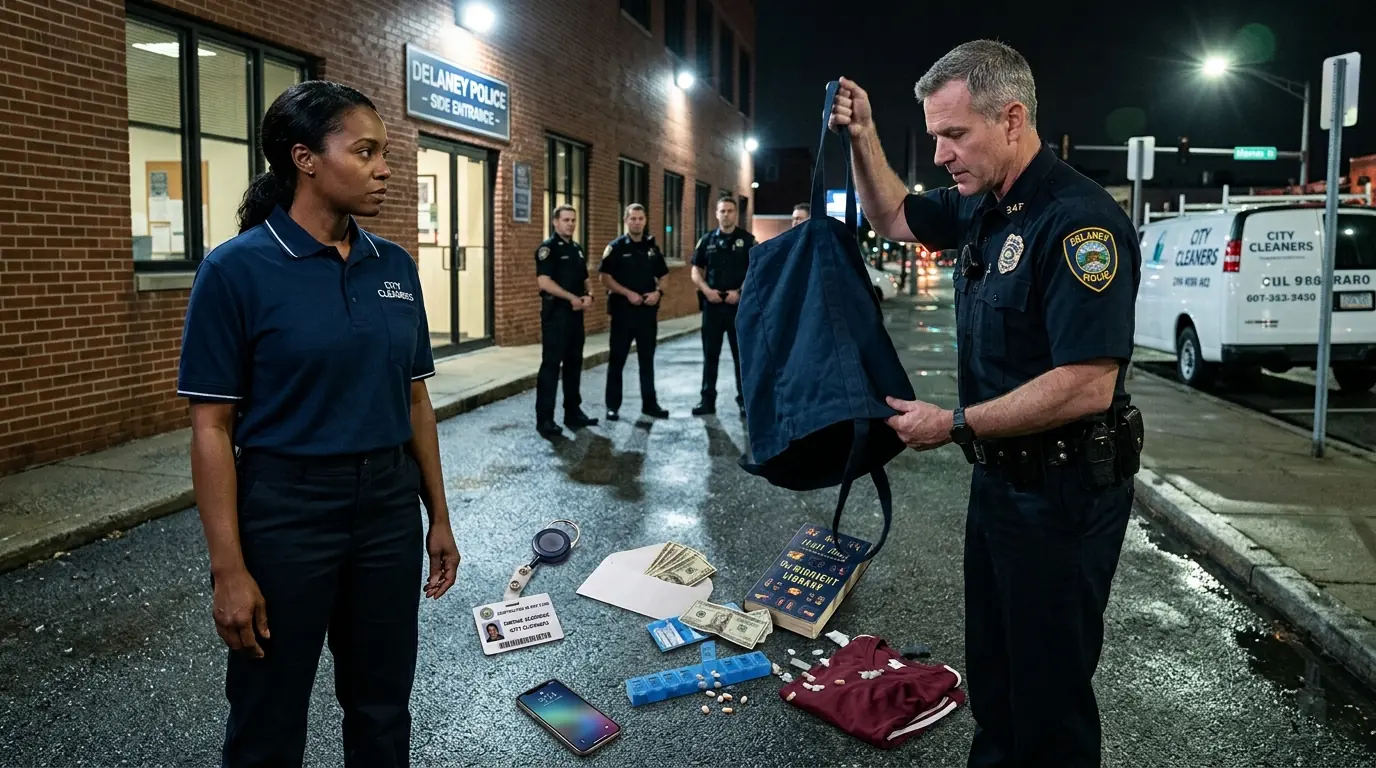
Sergeant Grady Vance turned it upside down and shook it out the way you empty a vacuum canister. Five officers stood in a half circle under a sodium lamp and watched a woman's whole life scatter across wet pavement.
"Building alarm, side entrance, female subject leaving with a bag," he said, loud enough for the two men across the street. "So, let's see what's in the bag."
Simone Aldridge did not raise her voice. "There is a key card, $410 in wages, my mother's pill organizer, and my daughter's gym uniform. And I can open that door for you right now with the card you're standing on."
Nobody picked up the card.
Six hours. That was how long until eleven of her people clocked in across four buildings. The woman who signed their paychecks was standing with her hands flat on a brick wall while a pill organizer broke open in a puddle, and her phone rang on the ground with her daughter's name lighting up the screen.
Eleven hours earlier, Simone Aldridge had been standing in a conference room in a different part of that same city with a laminated floor plan in her hands, explaining to four men in suits why their overnight cleaning contract was costing them $9,000 a month too much. She was 38 years old. She had started Aldridge Facility Services eleven years earlier with one van, one industrial vacuum, and a contract to clean a dental office on weekends. She had built it, one building at a time, into a company with 41 employees and a portfolio that included two office towers, a regional hospital annex, a school district's four elementary buildings, and, since the spring, the municipal complex on Delaney Street that housed the city's second district police station.
She cleaned the precinct. Her people vacuumed that squad room. Her people emptied those wastebaskets, wiped down that break room, and mopped the floor of the corridor outside the interview rooms four nights a week between 1:00 and 5:00 in the morning. Every single one of them had passed a criminal background check administered by that same department, because you do not get a key card to a police building without one.
Simone Aldridge's own fingerprints were on file in that building. She had submitted them personally in March in the lobby at a plastic table, and a civilian technician had rolled each finger onto a scanner and told her the weather was finally turning.
Nobody who mattered that night had any idea. That is the thing about the cleaning business. She has said it in about nine different ways to about nine different reporters since; it comes out the same every time:
"Nobody looks at us," she says. "That's the whole job description. If you notice us, we've done it wrong. You want the room to look like nobody was ever in it. And then you spend eleven years being the person nobody was ever in the room with. One night, somebody finally looks at you, and what they see is a suspect."
She had not planned on being on Delaney Street at 2:00 in the morning at all. She had a supervisor for the overnight rotation, a woman named Perita Chung, who had been with her for six years and who did not need supervising. But at 11:40 that night, Perita had called from a hospital parking lot to say her son had gone in with a broken wrist. Simone had said the thing she always said, which was, "Go. I've got it."
She had put on the same navy polo shirt her crews wore, with the company name stitched over the pocket in white thread, and driven downtown. She had worked the shift herself: four hours, two floors of the municipal building, the corridor, the break room, and the small kitchen where somebody had left a container of chili in the microwave for what smelled like several days.
At five to two, she had let herself out the side entrance on Delaney—the one the cleaning crews always used because the front doors locked at 10:00 and only the desk officer could buzz you through. The side door alarm had a fault. That fault was in her own maintenance log; it was in the building manager's log, too. It had been reported in writing in September and again in October, both times by a 24-year-old member of her crew named Denita Ruffin, who had also written in the second report that she had been stopped and questioned by officers on that sidewalk twice while waiting for her ride at the end of a shift. The second time, she had been asked to empty her pockets.
That second report was the reason Denita Ruffin lost two shifts. Not because Simone did anything; Simone never saw it. It went to the building's facilities office, which is where crew reports go. A facilities coordinator named Bev Trow had read the words stopped and questioned by officers, had decided without any malice at all that this was a personnel matter rather than a building matter, and had emailed the cleaning company's general inbox to ask whether the employee in question was comfortable working overnight in that location.
The general inbox was monitored by an office manager who read the question and did the "helpful" thing, which was to take Denita off the Delaney Street rotation for two weeks and put her on a daytime school building instead. Days paid less. Denita Ruffin lost about $260. Nobody in that chain ever intended a single unkind thing, and that is precisely how it works.
Simone found out about all of it eleven days later. She has said that the eleven days is the part she cannot forgive herself for, that she has stopped trying to. But that was later.
At five to two in the morning, the side door alarm on Delaney Street chirped once, as it always did with the fault. Then it did the other thing it sometimes did, which was to register as a forced-entry event in a monitoring system three states away. A dispatcher in that system followed the script on her screen and called the local police to report an alarm at a municipal building with a subject exiting.
Four minutes later, there were three cars on Delaney Street, then a fourth.
Simone Aldridge was standing at the curb with a canvas tote bag on her shoulder, looking at her phone, which had two missed calls from her daughter on it. Nia Aldridge was seventeen, had a math test in the morning, could not sleep, and knew her mother worked nights.
The first cruiser came up the block with its light bar on and stopped diagonally six feet in front of her. She put the phone in her pocket. She put both hands out at her sides, palms open, fingers spread. She did that before the door of the car opened.
She has been asked about that reflex more times than she can count. "I'm a Black woman standing outside a police station at two in the morning with a bag," she says. "I didn't decide to put my hands out. I've been putting my hands out since I was nineteen. That's not a decision. That's a habit somebody installed in me."
Sergeant Grady Vance got out of the second car. He was 49. He had 21 years on that department, 16 of them on the overnight tour. He had a reputation among the other sergeants for being what everybody called "old school"—a word that does a tremendous amount of work.
"Ma'am, come away from the building."
"I work here."
"Come away from the building."
She came away from the building: four steps, hands still visible.
Officers Petey D. Ross and Ronan Kilbride came around the far side. Officer Tate Winslow, who was 28, came up on the sidewalk. And the fourth car brought a two-year officer named Alicia Moreno, who parked at the corner, got out, and did not say a single word for the next 26 minutes—a thing that has followed her ever since.
Five officers. One woman in a navy polo shirt.