"$500,000, right here, right now, if that old, dilapidated guitar outplays my band." Garrett Ashford said it loud enough for everyone in the Pinnacle Room to hear. Three hundred heads turned. He was pointing at Miles Porter, a black man in the doorway, flannel shirt, work shoes, a guitar case sealed shut with tape. "What, deaf or too scared to run home and cry to Mommy?" The hall erupted. Miles didn't move.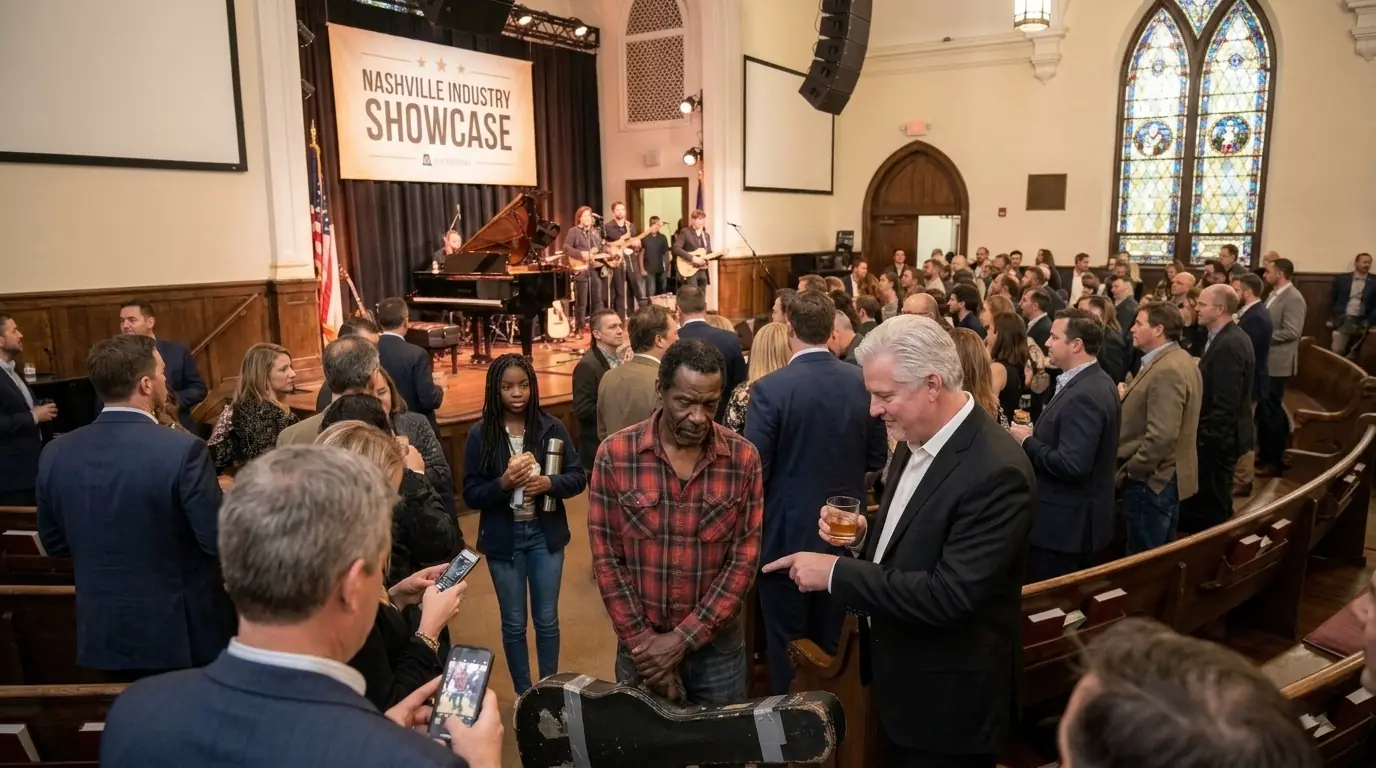
"I'm only here to play music, sir." Garrett stepped closer, tapped the guitar case, leaned down. "You stink like rubbish, kid. That thing isn't even worth the wood in my dog's kennel." He spat at Miles's feet. Miles said nothing, just tightened his grip on the case. What happened next was something Garrett Ashford would have traded anything to take back.
A few hours earlier, the same city had looked like a different world. Nashville, Tennessee, late October.
On Broadway on a Friday night, the sound was unmistakable. Neon buzzing, honky tonk bass bleeding through every door. Tourists in brand new cowboy boots that haven't touched dirt once. The smell of barbecue and spilled beer hanging in the air like perfume. That's Nashville if you've got money.
Walk three blocks east, past the last bar that still serves food. Turn left on Jefferson Street and the music changes. No speakers, no stage lights, just a man, a guitar, and a cardboard sign propped against a closed-down barbershop. Songs, $1 or a smile. That man was Miles Porter, forty-eight years old, sitting on a milk crate.
His guitar, a 1979 Gibson J45, looked like it had survived a war. Finish worn to bare wood. Strap button held on with duct tape. One tuning peg replaced with a bolt and a prayer. But when Miles played, none of that mattered.
His fingers moved like water over stone. Smooth, patient, finding every groove. Blues, gospel, folk, Motown, whatever the street asked for. He played five hours a day, sometimes six. On a good day, $40 or $50.
On a bad day, just enough for bread and bus fare for his daughter. Kora Porter, sixteen, a junior at Maplewood High, straight-A student, the kind of kid who read college brochures the way other kids read magazines with hunger. She wanted to study engineering. She'd circled three universities in a guidebook she checked out from the library so many times the librarian stopped scanning it. She needed $1,200 for a college entrance exam prep course.
The deadline was six weeks away. Miles had saved $314 in a coffee can under the kitchen sink. Every night, Kora asked how his day went. Every night, Miles said, "Getting closer." He wasn't getting closer. They lived in a one-bedroom above a laundromat on Buchanan Street.
The machines rattled the floor until midnight. Hot water worked Tuesdays and Thursdays if you were lucky. Miles slept on the couch so Kora could have the bedroom. He'd folded the same three flannel shirts so many times the creases had creases. But here's what nobody on Jefferson Street knew.
Miles Porter wasn't a guitarist. Not really. He was born in Memphis. His mother, Lorraine, played organ at Greater Grace Baptist Church, the kind of playing that made old women close their eyes and grip the pew. Miles sat on her lap during rehearsals before he could walk.
By 5, his hands found the keys on their own. By 10, he could play anything he heard once. Chopin, Stevie Wonder, gospel hymns that don't have sheet music because they live in the blood. By 14, Miles Porter was the best pianist in Shelby County. Self-taught, ear-trained, his high school music teacher, a Berklee graduate, sat in the back of the auditorium during Miles's sophomore recital and didn't move for 40 minutes.
Afterward, he said one sentence. "I can't teach you anything." At 18, Miles received a full scholarship to the Nashville Conservatory of Music for piano performance. Four years, everything paid. He never got there. Three weeks before classes, the conservatory cut funding to its diversity outreach program.
He married a woman named Lorraine. Yes, the same name as his mother. She was a nurse's aide, kind, steady, the sort who laughed at things that weren't funny just to fill the silence when he came home broken. They had Kora in 2010. For a while, it was enough.
Then Lorraine got sick, ovarian cancer, stage three. By the time they caught it, 14 months of treatment, she fought. God, she fought. But the bills fought harder. When she passed, she left behind a daughter, a husband, and $162,000 in medical debt.
Miles sold everything. The car, the furniture, the upright piano his mother had given him. The one thing he swore he'd never let go. He let it go. That was six years ago.
He hadn't touched a piano since. Eleven years in total, counting the years before Lorraine died when work and bills and survival pushed music to the edges. But his fingers didn't forget. Kora noticed. At the kitchen table, reading the paper, her father's left hand would move, pressing invisible keys on the wood, tracing chord shapes from songs only he could hear.
He didn't know he was doing it. She recorded him once playing guitar on the street. Watching the video back, she caught it. His right hand between strums would flutter quick, almost invisible, a reflex, a language his body refused to stop speaking. Now, there was one person in Nashville who knew what Miles Porter really was.
Eleanor Voss, sixty-eight, retired piano faculty from Juilliard, moved to Nashville after her husband passed, volunteered at a community center on Jefferson Street. Every Tuesday and Thursday she walked past Miles's corner. She always stopped, always listened, always dropped a 20 into his case, folded once, tucked under the coins so the wind wouldn't take it. Six months earlier, she heard something that stopped her cold. Miles was retuning between songs and humming. Rachmaninoff, Opus 23, No. 5.
Every note perfect, every phrase shaped like it was being played on a concert grand, not hummed on a sidewalk. Eleanor stood there for a full minute before Miles noticed her. They talked. She learned his history. She nearly wept on the street.
And Eleanor Voss was not a woman who wept easily. After that day, she told him the same thing every time she passed. "You're wasting a Steinway hand on steel strings." Miles would smile, shake his head, and keep playing. Now, back to tonight. 6:30.
Miles was on his corner, three songs into his evening set, when a black Lincoln Town Car pulled up in front of the Pinnacle Room, the converted church two doors down. Garrett Ashford's showcase. Invite only. 300 industry people, open bar, a $4 million sound system, and on stage, a Steinway Model D grand piano used as nothing more than a decoration. Miles glanced at the car, kept playing.
Someone in Garrett's entourage heard him, paused, listened, said something to Garrett, and Garrett, three bourbons deep, ego running hot, looked at the black man on the milk crate and saw what he always saw. An opportunity to remind someone where they belonged. "Bring him inside," Garrett said. "I want everyone to see this." Two men walked over. One smiled, not kindly.
"Boss wants to hear you play inside. Come on." Miles hesitated, looked at his guitar case, looked at the glowing door, thought about Kora. $1,200, six weeks. He stood up, picked up his case, and followed them in. The man who had invited a stranger inside to humiliate him was Garrett Ashford.
Garrett Ashford, fifty-four years old, founder and sole owner of Ashford Sound Records, office on Music Row with gold and platinum records covering every wall, floor to ceiling. Three Grammy-winning acts discovered under his name. Nashville Magazine once called him the most powerful ear in country music. He framed the article, put it behind his desk, made sure every single artist who walked in saw it before they sat down. He had a way about him.
His silver hair was slicked back, and his custom suits never came off the rack. He wore a Rolex Daytona that he checked even when he was not wondering about the time, and he had a low, slow, almost friendly voice that could make someone feel like the most important person in the room right up until the moment he destroyed them. His business model was simple: he owned everything—publishing rights, likeness rights, touring revenue, and masters.
You signed with Garrett Ashford. You belonged to Garrett Ashford. Those who pushed back got buried in legal fees they couldn't afford. Those who stayed learned to smile when he spoke and keep quiet when he didn't. But here's what people didn't talk about.
Garrett wasn't born powerful. He was born in Harlan County, Kentucky, a coal town with more churches than jobs. His father, Earl Ashford, was a session guitarist, or tried to be. He drove to Nashville four times a year with a demo tape and came home four times a year with nothing. Drank, got mean, died broke in a recliner at 51 with a guitar pick still in his pocket and a rejection letter on the kitchen table. Garrett was 14 when he buried his father.
And he made himself a promise that day he would never be the man on the wrong side of the door. He would be the door. That promise made him rich. It also made him cruel. Not in the movie way with speeches and dramatic pauses. Cruel in the quiet everyday way.
The way he'd look past a waitress like she didn't exist. The way he'd talk about artists while they stood close enough to hear. The way he believed truly deeply that showing people how small they were was a form of honesty. And tonight was his night. The Pinnacle Room, a converted church on 4th Avenue with 30-foot ceilings and stained glass windows that caught the stage lights like something holy. Garrett had rented the entire building for Ashford Sound annual showcase, the debut of Iron Current, his newest signed band.
Inside, Three hundred people, label executives, talent scouts, music journalists, influencers with press badges, and half empty champagne flutes. A quarter million dollar sound system that made the floor hum even when nothing was playing. Catering from the best restaurant in the Gulch. Every napkin embossed with the Ashford Sound logo. And center stage under a single warm spotlight, a Steinway Model D concert grand piano, 9 ft of hand polished ebony, 88 keys that hadn't been touched all evening.
Garrett kept it there for the look. He called piano music elevator noise. The Steinway was furniture to him, a beautiful useless prop. Craig Dunlap, Garrett's A&R director, early 40s, perpetually sweating through his collar, was running logistics, clipboard in hand, earpiece in, checking his watch every thirty seconds. Nine years with Garrett, long enough to know when to speak and when to vanish.
Travis Hall, lead guitarist and frontman of Iron Current, was warming up backstage with the easy confidence of a man who knows someone powerful has already decided he'll succeed. 26. Good-looking, talented enough, not extraordinary, but Garrett didn't need extraordinary. He needed controllable. 15 minutes to showtime.
The crowd was buzzing. The energy was right. And then Miles Porter walked through the door. Flannel shirt, work boots, guitar case sealed with tape. Looking around the room, the way a man looks at a place he knows wasn't built for him.
The conversations didn't stop all at once. They faded. Table by table, group by group, like a breeze dying down. People noticed the clothes first, then the guitar case, then the skin. A woman near the bar leaned into her husband and whispered something behind her glass.
A man in a blazer took a half step backward as if poverty might be contagious. Garrett walked in right behind him, grinning. He put a hand on Miles's shoulder. Not gently, not roughly, possessively. The way a man touches something he's already decided belongs to him.
"Ladies and gentlemen," Garrett announced, lifting his bourbon. "Before we get started tonight, I've got a little warm-up act for you." He squeezed Miles's shoulder. "I found this one outside playing for pocket change. He says he's a musician." Garrett paused, letting the word hang in the air. "So, let's find out."
The room laughed. Not everyone, but enough. Miles stood in the center of it all, holding his guitar case, and said nothing. What happened next wasn't a conversation. It was a show, and Miles was the exhibit.
Garrett guided him to the center of the room, hand still on his shoulder, and positioned him like a piece of furniture, right there, under the lights in front of Three hundred people holding drinks and judgments. "Go on," Garrett said. "Play something for us." Miles set down his guitar case, knelt, and opened it. The latches didn't click. They crunched.
The velvet lining inside had worn to gray cotton. He lifted the Gibson carefully, the way you'd lift something that owes you nothing but has given you everything. He started to play a simple blues progression, fingerpicked, quiet, the kind of thing that sounds like a man thinking out loud. Garrett let him play for about twenty seconds before he started talking over him. See, this is what I mean, Garrett said to the crowd, swirling his bourbon.
Everybody thinks they've got talent. Everybody thinks they deserve a stage. He gestured at Miles with his glass. But talent isn't sitting on a sidewalk begging for quarters. Talent is what's backstage right now, waiting to perform.
Someone chuckled. Miles kept playing, eyes on his strings. Garrett moved closer, stood right next to him, close enough that Miles could smell the bourbon and cologne. He looked down at Miles the way a man looks at a stain on his carpet. "Tell me something," Garrett said loud enough for the room.
"How much you make out there on a good day?" Miles didn't look up. $40, sometimes $50. $50. Garrett repeated it slowly like he was tasting something sour. He turned to the crowd.
$50. I spend more than that on lunch. More than that on a bottle of wine I don't even finish. Laughter louder this time. A few people near the front leaned into each other, grinning.
The kind of laughter that comes easy when you're not the one being laughed at. And you think? You actually think you can play music? Real music? Miles stopped playing, looked up, met Garrett's eyes for the first time.
"I know I can, sir." The room got quieter. Something in the way he said it, no anger, no challenge, just certainty, made people put down their glasses. Garrett didn't like that. The smile stayed, but the eyes changed. He tilted his head the way a dog tilts before it bites.
All right, then. He set his drink down, pulled out his phone, held it up so the screen faced the crowd. $500,000 right now. If this man and his little pawn shop guitar can outplay iron currents on that stage, he pointed to the stage, to the lights, to the quarter million dollar sound system that made his voice bounce off stained glass. My band, my stage, my crowd, my rules.
He looked at Miles. You win, I send it. You lose. You walk out that door and you don't come back to this block ever. The room shifted.
This wasn't a joke anymore. Phones came out. Screens lit up like fireflies. Someone whispered, "Is he serious?" He was serious. A young black man near the back called out, "Do it, man.
Take his money." An older woman shook her head slowly like she'd seen this before. A powerful man making a game out of someone who couldn't afford to say no. Nia Brooks, a local radio host covering the event, pushed through the crowd, phone held high. The red dot was on. She was already streaming.
Then the door opened. Kora Porter walked in. She was carrying a thermos of soup and a sandwich wrapped in foil, her father's dinner. She'd walked six blocks because Miles hadn't come home at his usual time. She followed the noise, the crowd, the glow spilling from the Pinnacle Room.
She saw her father standing in the middle of a room full of strangers in expensive clothes, holding his guitar, being stared at like a circus act. Her face didn't show embarrassment. Not this time. Something sharper. Something that looked a lot like fury.
She didn't say a word. Just stood by the door and watched. Miles saw her. Their eyes met. And in that look was everything.
Every night on the couch, every getting closer, every dollar in the coffee can. Every promise he'd made to a woman who wasn't here anymore. The room waited.
Three hundred people, phones recording, Garrett grinning, Kora watching from the door, and Miles standing in the middle of it all with a guitar worth less than the napkins on the tables said nothing. His hands were shaking. Not a lot, just enough that he could feel the tremor in his fingertips. The ones that had been pressing strings for eleven years, because pressing keys was a life he couldn't afford to remember. He thought about walking out.
It would have been the smart thing. Pack up the Gibson, keep his head down, go home, heat up the soup Kora brought, pretend none of this ever happened. That was the safe choice, the quiet choice—the choice he had been making for twenty years. But then he heard a voice, not in the room, but in his memory. Lorraine had been sitting on the edge of the hospital bed three weeks before the end, an oxygen tube beneath her nose, her hand too thin to squeeze but squeezing anyway.
She'd looked at him and said, ""Don't you dare let them make you small, Miles. Not even to keep the peace."" He'd nodded. He'd promised. And then he'd spent six years keeping the peace anyway. Now he looked at Kora, 16 years old, standing in a doorway, watching her father decide what kind of man he was.
If he walked out, what would she learn? That the world tells you to sit down and you sit. That you take the insult, swallow it, and call it survival. That the safest place for a dream is inside a coffee can under the sink where nobody can see it. He couldn't teach her that.
He wouldn't. Miles looked at the stage, not at Garrett, not at the crowd, at the stage. The Steinway sat there, 9 ft of polished ebony under a warm spotlight, untouched all night, waiting for someone. He hadn't played piano in eleven years. His fingers knew the shapes.
He could feel them tracing chords on the neck of his guitar without thinking. But the speed, the endurance, he didn't know if his body would remember or betray him. But he knew one thing. He wasn't going to stand here and be laughed at with a guitar. Miles set the Gibson back in its case, closed the latches, stood up.
The room went quiet. He looked at Garrett, calm, steady. No anger, no fear. "I don't need your guitar stage." His voice was low, but every person in the room heard it. "But if that piano works, name the song." Garrett blinked.
Then he smiled. "Any song. Dealer's choice. Make it count." Miles walked toward the stage. The crowd parted without being asked.
The walk from the center of the room to the stage was 30 feet. It felt like a mile. Every step Miles took, he could feel the eyes. Three hundred people watching a black man in a flannel shirt and work boots walk toward a Steinway Model D concert grand that cost more than everything he'd ever owned combined. Some were smirking.
Some were recording. A few looked away embarrassed. Not for themselves, but for him. A woman in a red dress whispered to the man next to her, "This is going to be painful to watch." The bartender paused midpour. A waiter carrying champagne stopped between tables.
Even the air seemed to thicken like the building itself was holding its breath. Garrett leaned against the bar, fresh bourbon in hand, already enjoying the show. He nudged Craig Dunlap. Watch this. Bet you he doesn't even know where middle C is.
Craig said nothing. He was watching Miles's hands. Miles stepped onto the stage. The spotlight was warm on his face, warm like sunlight, the kind he hadn't stood in for a very long time. He could see the crowd from up here.
A sea of well-dressed strangers, champagne flutes, and phone screens glowing softly in the dark. He could see Kora by the door, knuckles white around the thermos. He could see Eleanor Voss three rows back, hand pressed to her mouth, eyes already glistening. She knew. She was the only one in this entire room who knew.
Miles reached the piano. He stood beside it for a moment, looking at it the way a man looks at a house he used to live in. The wood gleamed under the spotlight, deep polished black, like still water at night. He ran his hand along the fallboard slowly, fingertips brushing the surface. He hadn't touched a piano in eleven years, and his hand was shaking.
But the shake wasn't fear. It was recognition. It was reunion. He sat down on the bench, adjusted it, pulled it forward an inch, then another. Someone in the crowd stifled a laugh.
A street musician adjusting a Steinway bench like he actually knew what he was doing. He placed his fingers on the keys and didn't press. Four seconds. He held them there for four full seconds, eyes open, breathing slow. The weight of every person in the room pressed down on his shoulders like a physical thing.
The room went silent. Not quiet, silent. The kind of silence where you can hear the air conditioning hum and the ice settling in a glass three tables away. No one moved. No one whispered.
Even Garrett stopped sipping. Then his left pinky pressed a single low C. The note filled the room like a bell in an empty church. Deep, round, resonant. It hung in the air for three long seconds before it faded into nothing.
And Miles began to play. He started with gospel. Simple, slow. A hymn his mother used to play at Greater Grace Baptist. The one with no name.
The one the congregation just called the Sunday song. Four chords, left hand steady, right hand carrying the melody like a man carrying a candle through a dark hallway. Careful, reverent, afraid the flame might go out. His right hand trembled. The first phrase came out unevenly.
A note landed late. Another pressed too soft. You could hear the rust—eleven years of silence sitting in his joints like cold metal that had not been worked. Someone in the crowd shifted in their seat.
A man near the bar shook his head and looked at Garrett as if to say, "See, just what we expected." Garrett smiled, leaned over to Craig. "Told you." But something was happening. Something small that only a trained ear would catch. The left hand steadied. The chord voicings deepened.
Not louder, but richer. Like a river finding its old channel after a long drought. A run appeared in the right hand. It was brief, just a flash of speed: six notes that cascaded down and disappeared back into the hymn before anyone could register what they had heard. The man who shook his head stopped shaking it.
Miles played the hymn for another thirty seconds. And with each bar, something was coming back. Not all at once, not perfectly, but the way a house warms up in winter. Slowly, room by room until you realize the cold is gone and you can't remember when it left. The gospel shifted.
A minor chord crept in. Then another. The hymn bent sideways, stretched, and became something else entirely. Blues. Miles's left hand started walking a steady, deep, rhythmic bass line that rumbled through the floor like a subway passing underground.
You could feel it in your chest before you heard it with your ears. The right hand broke free and started improvising. Trills that shimmered like light on water, bends that moaned like a voice too proud to cry. He quoted a Muddy Waters riff, turned it inside out, and rebuilt it as a jazz voicing that had no business coming from a man who hadn't touched keys in over a decade. The room changed.
You could feel it. A shift in the air, in the posture of every body, in every seat. Something was happening that wasn't supposed to happen. People stopped recording, not because they lost interest, because they forgot they were holding phones. Travis Hall was standing at the edge of the backstage curtain.
He'd come out to watch what he assumed would be a quick embarrassment. He'd been playing guitar professionally for twelve years, and what he was hearing from this man in a flannel shirt made his own hands feel like toys. He set down his drink. He didn't pick it up again. Eleanor Voss was crying.
Not sobbing, just tears running silently down her face. The way water runs down a window when the rain has stopped, but the glass hasn't dried. She'd spent 40 years at Juilliard. She trained pianists who played Carnegie Hall. And she was listening to the most gifted hands she'd ever encountered play blues on a Steinway in front of people who had laughed at him ninety seconds ago.
She mouthed two words quietly to no one. "There he is." Nia Brooks checked her stream. 200 viewers when she started. Now 3,000 viewers, with comments moving too fast to read. And Miles kept going.
The blues deepened, darkened. His left hand drove harder. His right hand climbed higher. And then, without warning, the whole thing broke open. He launched into a passage no one in the room had ever heard before.
Because it didn't exist until that moment. It was Rachmaninoff, the Opus 23 prelude Eleanor had heard him humming on the sidewalk six months ago. But it wasn't Rachmaninoff anymore. Miles had taken it apart and rebuilt it with gospel bones. The left hand thundered an octave run that spanned the entire bass register, low, massive, shaking the Steinway's frame.
The right hand floated above it with a melody that wove Russian Romanticism through the cadences of a black church on a Sunday morning in Memphis. Classical in gospel, Europe and Memphis, concert hall and street corner. All of it alive inside one man's hands at the same time. The room stopped being a room. It became a held breath, a collective suspension of every assumption that had been made about the man on that bench.
Miles played with his eyes closed now, sweat beading on his forehead, foot tapping, not for rhythm, but from joy. His flannel sleeves were pushed up to the elbows, and you could see the tendons in his forearms moving like cables beneath the skin. His fingers were a blur in the upper register, precise in the lower register, his left hand and his right hand carrying a second conversation that somehow made one perfect sentence. A woman gasped, not quietly. The kind of gasp that escapes before you can stop it.
A man in the back, a label executive who'd been scrolling his phone all night, stood up, then sat down, then stood up again like his body couldn't decide what to do with what it was hearing. Two people heading for the exit turned around and came back. Nia's stream hit 15,000. Then 20. Then 38,000 viewers watching a man they'd never heard of play a piano they didn't know he could touch.
Miles played for six minutes in total. The final ninety seconds were something no one in that room would ever forget. He built a crescendo that layered gospel call and response, left hand asking, right hand answering over a thundering Lisztian bass that made the champagne glasses vibrate on the tables. The music climbed and climbed, each phrase bigger than the last, each note more certain, until the sound filled every corner of the Pinnacle Room, the stained glass, the floorboards, the bones of every person in it. And then he stopped.
One final chord, both hands, full force. He held the sustain pedal down. The sound rang out huge, golden, alive, and then began to fade slowly. The way the last light of a sunset pulls from the horizon, inch by inch, note by note, Miles lifted his hands from the keys, placed them in his lap. The sound decayed into nothing, and for two full seconds there was absolute silence.
Not the awkward kind, not the confused kind, the kind that exists between lightning and thunder. When the world holds still because it knows what's coming. One person clapped, then another. Then the room detonated.
Three hundred people on their feet. Not a polite standing ovation, a violent one. The kind where people yell and stamp their feet and grab the person next to them. A woman near the front was crying into her hands. A man was shaking his head over and over, whispering something no one could hear.
Kora Porter, standing by the door, still holding a thermos and a sandwich in foil, was sobbing. Not sad tears, the kind of crying that happens when you finally see your father the way you always believed he was, the way you always knew he was, the way the world had refused to see him until this exact moment. Travis Hall stood backstage applauding slowly, genuinely. His arrogance dissolved. In its place was something he hadn't felt in years.
Humility. Nia's stream had reached 40,000 viewers. The comments had collapsed into a single repeating line. "Who is he?" Eleanor Voss didn't clap.
She sat in her chair, tears on her face, smiling. She didn't need to say anything. She'd said it all six months ago on a sidewalk. "You're wasting a Steinway hand on steel strings." Tonight, the Steinway had finally found its hand. The applause was still ringing when every eye in the room found Garrett Ashford.
He was standing by the bar in the same spot and the same suit, but everything else about him had changed. His phone was in his hand, screen dark. He'd stopped recording somewhere in the middle of the performance, though he couldn't have told you exactly when. His bourbon sat on the bar untouched, the ice long melted to nothing. His jaw was slack, not open, just loose, like the muscles in his face had forgotten what expression to hold.
Three hundred people were looking at him now, not at the stage, at him. The man who made the bet. The man who spat at a stranger's feet. The man who called a Steinway elevator noise while a street musician used it to shake the walls of a building he'd rented with his own money. The power in the room had flipped completely, irreversibly, and everyone could feel it.
Craig Dunlap leaned in close. His voice was barely a whisper, but it carried the weight of a verdict. "Garrett, the stream. Forty thousand people just watched you make that bet on camera." Garrett's face went white.
Not the white of anger, the white of a man who realizes the trap he's standing in is one he built himself. He had two choices. Pay the money in front of the room and the internet or refuse and let 40,000 witnesses turn him into the villain of every comment section for the next 6 months. Garrett set his jaw, straightened his tie, and walked toward the stage. The crowd parted for him the way it had parted for miles, but different.
When Miles walked through, people stepped aside out of curiosity. When Garrett walked through, they stepped aside out of judgment. He reached the foot of the stage. Miles was still sitting on the bench, hands in his lap, calm as still water, and for the first time all night, Garrett Ashford had to look up at someone. The stage was only 18 inches high, but it might as well have been a mountain.
Garrett opened his mouth, closed it, tried again. "That was..." He paused and swallowed. "Not what I expected." Miles looked at him. No anger, no gloating, no heat. Just the quiet, steady gaze of a man who had nothing left to prove.
"You expected nothing." His voice was low, almost gentle. "That's exactly why you lost." The room heard it. Every single word. A murmur rolled through the crowd. Not shock, not laughter, but something like recognition.
The sound people make when the truth lands clean. Garrett reached into his pocket, pulled out his phone. His hand was shaking. Not a lot, but enough that Craig noticed and looked away. He opened the app, typed the number.
$500,000. He turned the screen toward Miles, then pressed send. Miles didn't look at the screen. He just nodded. Once the room exhaled, Nia Brooks, still streaming, said five words into her phone.
"Nashville, you just witnessed something." 40,000 viewers agreed. Eleanor Voss rose from her seat. She didn't rush. She walked to the stage the way she walked everywhere, slowly, deliberately, like a woman who had seen enough of the world to know that the important moments deserve patience. She reached the stage.
Miles saw her. Their eyes met. She didn't speak. She just nodded. He nodded back.
The nod needed no explanation. It carried the gratitude of a man who had been believed in before he could believe in himself. Travis Hall found Miles backstage ten minutes later. He was leaning against a wall, guitar case at his feet, staring at his own hands like he was seeing them for the first time. Travis extended his hand.
Miles shook it. "I've been playing for twelve years," Travis said. "I'm going home to practice." Miles smiled. Not a big smile, the small kind. The kind that comes when a man realizes the world just shifted and he's still standing.
Miles and Kora left the Pinnacle Room through the back door. No press, no interviews, no victory lap, just a man carrying a guitar case and a girl carrying a thermos walking down Fourth Avenue in the cool October air. Nashville hadn't changed. Same honky tonk bass from Broadway, same distant car horns, same Friday night doing what Friday nights do. But something between a father and daughter had shifted quietly and permanently.
They walked a full block in silence before Kora spoke. "Mom would have screamed." Miles laughed. A real laugh—deep, sudden, the kind that shakes your whole chest. The kind Kora hadn't heard in years, maybe ever. "Yeah," he said quietly.
"She would have." They walked home up the stairs, past the laundromat into the one bedroom where the washing machines were already rattling for the night. Kora heated the soup. Miles sat on the couch, his couch, his bed, and pulled out his phone. He hadn't checked it since the transfer. $500,000.
Confirmed. He stared at the number for a long time, then set the phone face down on the cushion and closed his eyes. He didn't cry, but it was close. The next morning, Miles walked into the exam prep center on West End Avenue.
"I'd like to register my daughter for the college entrance prep course." "That's $1,200. Would you like a payment plan?" "No. The full amount today." The woman printed the receipt. His hand shook when he took it. Not from nerves, but from relief—from the weight of a promise finally lifting off his shoulders after six long years.
But that was just the beginning. With $500,000, Miles didn't just pay for a prep course. He secured Kora's entire future. Four years of tuition at a state university paid in full. No loans, no debt, no coffee can under the sink.
For the first time in her life, Kora Porter would walk into college knowing that the only thing between her and a degree was her own effort, not money, not circumstance, just her. The promise he'd made to Lorraine, whispered in a hospital room, carried like a stone for six years, was no longer a hope. It was done. The clip went viral three days later.
Nia Brooks's live stream, edited to nine minutes, hit 2.8 million views in seventy-two hours. The title read, “Street Musician Silences Nashville Producer with a Piano.” Shared across every platform, reposted by music pages, reaction channels, and news outlets across the country. Comments poured in by the thousands. Most said the same thing.
"How did nobody know about this man?" Eleanor Voss made a phone call, then another. Then a third. Two weeks after the showcase, Miles sat in the rehearsal hall of the Nashville Symphony, not as a guest, as an invited observer. The lead pianist asked him to play a passage from a Brahms concerto.
Miles read the sheet music for thirty seconds and played it from memory. The conductor leaned forward. "When can you start teaching?" Miles was offered a position, community outreach piano instructor for the Nashville Symphony's youth education program. Part-time, modest salary, full benefits, a badge with his name printed in block letters that he could clip to his shirt every morning. It wasn't fame.
It wasn't a record deal. It wasn't a mansion or a magazine cover. It was dignity, the kind you carry with you into a building where people know your name and are glad you showed up. He still played guitar on Jefferson Street every Saturday morning. It was the same spot, the same milk crate, and the same cardboard sign.
But three afternoons a week, he sat at a donated upright in the Jefferson Street Community Center and taught children how to find the keys. He started with the same four gospel chords his mother had once taught him. The ones that don't live on sheet music because they live in the blood. They lined up for lessons. Every week the line got a little longer.
Garrett Ashford did not suddenly become a good person. Pretending otherwise would have been a lie. What happened was smaller than redemption and more honest. The viral clip cost him leverage. Two artists on his label, emboldened by what they'd seen, hired independent lawyers to review their contracts.
One got released entirely. Industry blogs ran pieces about Ashford Sound publishing terms. The word “exploitative” appeared in print for the first time. Garrett was still rich, still powerful, still in his Music Row office with gold records on the walls. But the room was a little less silent when he spoke.
People had seen him cracked, not ruined, but exposed. And that changes the math. Not overnight, but permanently. Justice isn't always a single moment. Sometimes it's the first crack in a wall everyone thought was solid.
And sometimes that crack starts with a man on a milk crate who was brave enough to stand up. The final image belonged to a Saturday morning at the Jefferson Street Community Center. A donated upright piano in a room with fluorescent lights and folding chairs. Three kids in a half circle.
Miles sat on the bench with his sleeves rolled up, showing a little girl where to place her fingers. She pressed a key—the right one—producing her first correct note. Miles smiled, the same smile Kora described from an old family photo. The one from before the debt, the grief, the street corners. Some people spend their whole lives looking for a stage.
Some stages find you.