A thirteen-year-old boy slipped through the gate of a motorcycle clubhouse at midnight, armed with nothing but dog food and a makeshift leash. The bikers caught him red-handed, but instead of throwing him out, they stopped cold when he said, “He was my brother’s dog, my only friend.”
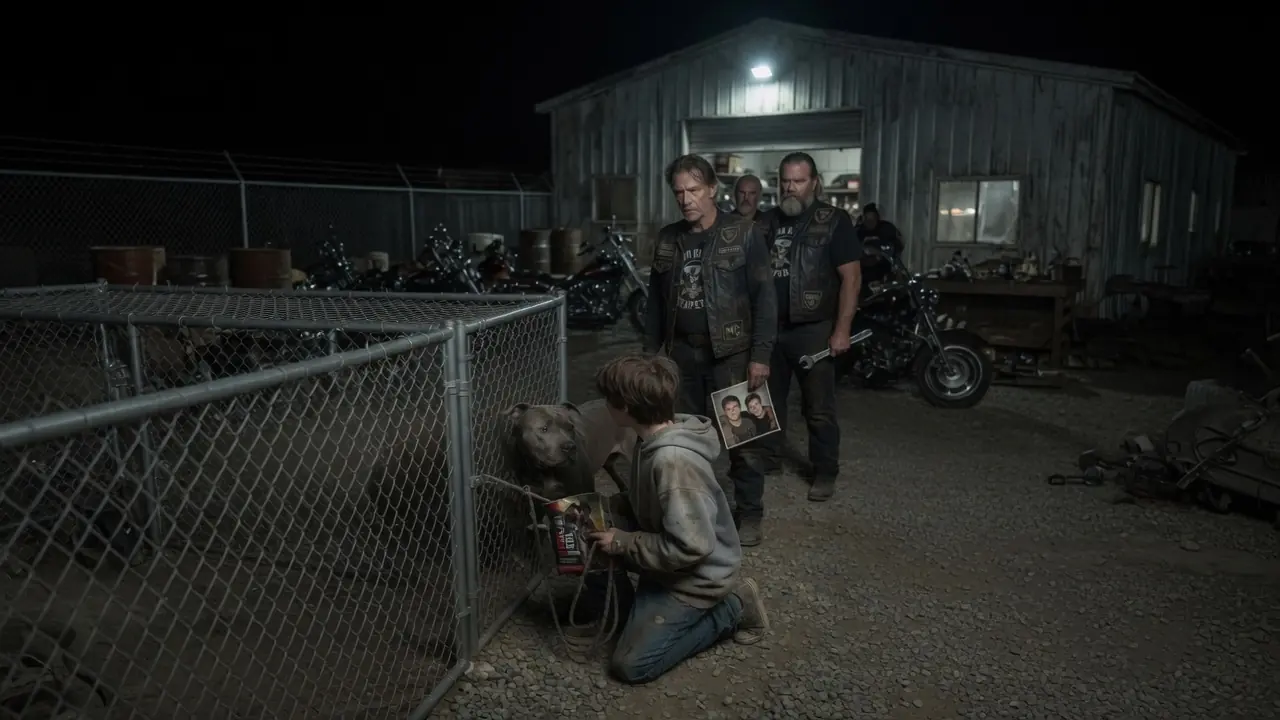
The chain-link gate groaned as Trey squeezed through the gap he had forced open with a bent screwdriver. Close to midnight, the Iron Reapers MC lot sat dark except for a single overhead light that buzzed and flickered over the main garage. His sneakers made no sound on the gravel.
He had practiced this approach three times over the past week, always chickening out at the last second. Not tonight. The bag of kibble rustled against his side, half open because he could not afford the kind with a zip seal.
The leash was a joke, a gray hoodie string he had braided together during a sleepless night at the shelter. But it would hold. It had to.
Jimmy was in the back kennel, the one near the oil drums. Trey had watched them move him there two days ago. The pit bull’s massive gray head lifted the moment Trey’s shadow crossed the fence line.
A low rumble started in the dog’s chest, then stopped. Jimmy’s eyes locked on his. The dog knew him.
“Hey, boy,” Trey whispered, fingers threading through the chain link. “Remember me?”
The growl stopped. Jimmy’s tail gave one hesitant thump. Trey’s hands shook as he worked the kennel latch.
Almost there. Almost.
“The hell you think you’re doing?”
The voice hit like a punch. Trey spun, his back slamming against the kennel. Four big guys emerged from the garage, leather vests catching the light, faces that gave nothing away.
The closest one, a bull of a man with a gray beard, held a wrench like a weapon. Trey’s legs wanted to bolt. His hands stayed on the kennel.
“I asked you a question, kid.”
“I’m not stealing.” The words came out steadier than Trey felt. “I’m getting him back.”
The bearded man laughed, but there was no humor in it. “That’s literally what stealing is.”
“He was my brother’s.” Trey’s voice cracked on the last word. He hated that. Hated the weakness. “And he’s all I got left.”
Nobody laughed after that.
One of the other men, younger, with a shaved head and a scar across his jaw, stepped closer.
“Your brother’s? What brother?”
Trey’s wallet was in his back pocket, a ratty thing held together with duct tape. His fingers fumbled with it, nearly dropping it twice before he pulled out the photograph. The edges were soft from handling, the crease down the middle threatening to split it in two.
He held it up.
The bearded man took it and tilted it toward the light. His expression shifted. Surprise. Maybe something softer underneath.
“Marco. You knew him?” Trey asked, the question coming out desperate.
“Kyle knew him,” the scarred man said quietly. “Hey, Kyle, get out here.”
Another figure emerged from the garage. This one was older, maybe mid-fifties, lean and weathered, with gray threading through his dark hair and eyes that had seen too much. He took the photo without a word and studied it for a long moment.
When Kyle looked up at Trey, something passed between them. A recognition that went deeper than features, though those were there, too. The same sharp jawline. The same way of standing like the world might knock you down, but you would get back up anyway.
It was not a question.
Trey nodded.
“Where have you been, kid? Marco talked about you all the time. But after he...” Kyle’s jaw tightened. “After Syria, we tried to find you. Social services said you’d been placed.”
“Placed.” Trey’s laugh was bitter. “Yeah. Three times. Then a group home. Then a shelter when I aged out of the program early.”
He gestured at Jimmy, who was pressing against the kennel door now, whining.
“Marco left him with Danny, right? But Danny moved to Portland last year, and nobody wanted to keep a seventy-pound pit bull. I heard he was here.”
The men exchanged glances. The bearded one, who had to be the club president based on the patch on his vest, rubbed his face.
“Kid walked across two neighborhoods at midnight with dog food and a shoelace leash,” he muttered. “That’s either stupid or dedicated.”
“Both,” Trey said.
Kyle almost smiled. Almost.
He handed the photo back, but his eyes never left Trey’s face.
“You want him back? He’s yours. But here’s the deal. Dogs need structure. Consistency. You show up here every day. Seven sharp. You walk him, feed him, train him properly, and while you’re at it, you learn something.”
“Learn what?”
“Whatever we teach you.” Kyle crossed his arms. “Your brother was good people. Best mechanic we ever had, and he hadn’t even finished his training. You’ve got his blood. Let’s see if you’ve got his work ethic.”
Trey looked at Jimmy, then at the men surrounding him. This was not what he had expected. He had expected fists, maybe cops, definitely getting kicked out.
Not this.
“Seven a.m.,” he repeated. “Every day. Okay.”
Kyle reached past him and opened the kennel.
Jimmy bounded out, nearly knocking Trey over. Seventy pounds of muscle and relief and recognition. The dog’s tongue found Trey’s face, his hands, anywhere he could reach.
Trey buried his fingers in Jimmy’s fur and felt something in him give way.
“Tomorrow morning,” Kyle said. “Don’t be late.”
Trey nodded, unable to speak around the tightness in his throat. He clipped the makeshift leash to Jimmy’s collar. Someone had at least kept that.
Then he started toward the gate.
“Hey, kid,” the president called. “What’s your name?”
“Trey.”
“Trey, welcome to the Reapers.”
The alarm on Trey’s borrowed phone went off at 5:30. He was already awake. Jimmy lifted his head from the foot of the air mattress.
The shelter supervisor had made an exception for the dog after Trey showed her the club’s handwritten note.
“Temporary arrangement,” she had said, like she did not believe it would last.
Trey believed it. He had to.
The walk to the lot took forty minutes on foot. Trey left at 6:15, Jimmy trotting beside him on the real leash Kyle had given him the night before. Thick nylon with a carabiner clip. Professional. The kind that said someone gave a damn.
The gate was already open when they arrived. Kyle stood near the garage entrance, coffee mug in hand, checking his watch.
“6:58,” he said. “Good.”
Trey did not mention he had been standing at the corner for three minutes waiting. He did not want to seem too eager.
Kyle handed him a push broom.
“Garage bay two. Sweep it clean. Oil dry goes in the red bin. Metal scraps in the blue. Jimmy’s bowls are by the sink. Fill the water. Half a cup of kibble. We’ll work on portions later.”
No good morning. No small talk. Just expectations.
Trey got to work.
Chrome and grease filled every corner of the garage. Motorcycles in various states of undress lined the bays, some stripped to frames, others gleaming and whole. The smell hit him immediately: motor oil, leather, welding smoke.
The kind of smell that clung to clothes and meant you had built something that day.
Sweeping should have been simple, but the oil stains were stubborn and the metal shavings hid in cracks. Trey’s arms ached by the time he finished bay two. Kyle appeared, ran a finger along the workbench, and inspected it again.
“You missed the corners.”
No anger in his voice. Just fact.
Trey swept again.
By 8:30, bay two was genuinely clean. Kyle nodded and pointed at a disassembled carburetor spread across a workmat.
“Parts washer’s in the back. Clean these. Don’t lose anything.”
The work was meditative. Each piece slid through the solvent. Years of carbon and gunk dissolved under trays. Careful scrubbing.
He laid them out in order the way Marco used to arrange his tools. Smallest to largest. Logical.
“You’ve done this before.”
Alex appeared beside him, a mountain of a man with forearms like tree trunks and eyes that missed nothing. His voice was gravel and cigarettes.
“My brother showed me little stuff. Lawnmowers mostly.”
“Lawnmowers.” Alex snorted. “Well, carburetors are just fancy lawn mower parts. You’re doing it right. Keep going.”
The other members drifted through as the morning stretched into afternoon. They did not ignore him, but they did not cuddle him either. Someone left a sandwich on the workbench. Turkey and cheese. No note.
Another pointed at the water station when Trey looked parched. Small gestures that said, “You’re here. We see you. Keep working.”
Jimmy spent the morning exploring, then claimed a spot in the corner where he could watch Trey work. The dog’s presence was a tether, a reminder of why any of this mattered.
Around two, Alex rolled an old minibike out from behind a storage container. The thing was a disaster. Rusted frame, no seat, engine caked in grime.
“Found this in an estate sale,” Alex said. “Figured it’s garbage. Unless someone wants to prove me wrong.”
He left it there ten feet from Trey’s workstation. A challenge without words.
Trey lasted maybe five minutes before he walked over. The frame was solid under the rust. The engine was seized, but not cracked. With work, a lot of work, it could live again.
“Thinking about it?”
Kyle had materialized behind him without a sound.
“Maybe.”
“Tools are in the red cabinet. You break something, you replace it. You need help, you ask. But the work, that’s yours.”
Trey ran his hand over the frame.
“Okay.”
The next week blurred into routine. Seven a.m. every morning, rain or shine. Even when his legs screamed from the walk, even when the shelter supervisor gave him grief about missing breakfast, he swept, cleaned, and learned.
The minibike became his project between tasks. Minutes here and there where he would disassemble another piece, soak it, study it. Alex started leaving schematics on the workbench. No explanation, just diagrams with parts labeled in careful handwriting.
Trey devoured them.
Kyle enrolled him in the alternative school two weeks in. The program had a welding track, a partnership with a local trade union. Trey’s hands were already steady from his work at the garage.
The instructor noticed.
“You’ve got good habits,” he said. “Someone teach you?”
“I’m learning,” Trey answered.
By week three, Jimmy had stopped sleeping in the corner. He had migrated to the couch in the clubhouse lounge. And on Friday nights, when Trey stayed late, the dog would curl against him, massive head in his lap.
The first time it happened, Trey’s hands stilled in Jimmy’s fur.
“He remembers you,” Kyle said from the doorway. “Dogs don’t forget their people.”
“I thought he’d forgotten. It’s been over a year.”
“Bonds like that stick.” Kyle sat down and handed Trey a soda from the fridge. “Your brother used to say that about the club, about Jimmy, about you. Said you were tougher than you looked.”
Trey could not look at him. “I don’t feel tough.”
“Tough isn’t about feeling. It’s about showing up when it would be easier not to.”
The minibike’s engine turned over for the first time on a Thursday morning. Trey had just finished reinstalling the carburetor, the one he had cleaned his first day. The sputter, cough, then roar made everyone in the garage stop and look.
Alex walked over, arms crossed, expression unreadable. He circled the bike once, twice.
“Not bad,” he finally said. “Needs a seat, paint, real handlebars, but the heart’s beating.”
Trey could not stop grinning.
“Don’t get cocky,” Alex added. “You’re not riding it yet. You’re thirteen, and this thing needs work before it’s road safe.”
But there was something in his voice. Pride, maybe.
That afternoon, Kyle dropped a small patch on Trey’s workbench. Custom embroidered, colors bright.
Legacy in progress.
“For your backpack,” Kyle said. “When you’re ready.”
Trey picked it up and turned it over in his hands. A different kind of patch. Something his own.
“Thank you,” he managed.
Kyle just nodded.
“Seven a.m. tomorrow, kid.”
“I’ll be here.”
The woman arrived on a Tuesday midmorning, clipboard in hand and doubt written across her face. Trey was elbow-deep in transmission fluid when Kyle’s voice cut through the garage.
“Trey. Office. Now.”
The tone said everything.
Jimmy sensed it too, rising from his spot and following close.
Miss Patricia Hendricks from Child Protective Services sat in the cramped office, her blazer too crisp for the surroundings. She looked at Trey the way people look at paperwork. The grease under his nails. The welding burn on his forearm.
Jimmy pressed against his leg.
“Trey, I’m here because your shelter supervisor filed a report. You’ve been leaving early every morning, sometimes not returning until evening. She’s concerned about your whereabouts and the people you’re associating with.”
Her eyes flicked to Kyle, then to the club photos on the wall.
“A motorcycle club is not an appropriate environment for a minor.”
“I’m learning a trade,” Trey said quietly. “I’m enrolled in school. I’m—”
“You’re thirteen years old with no legal guardian, spending unsupervised time with adult men in an environment that...” She glanced at her notes. “Serves alcohol and has members with criminal records.”
Kyle said nothing.
“We want what’s best for you, Trey. There’s a group home in the Northern District with structure, supervision, counseling services.”
“No.”
The word came out harder than Trey intended.
“I’m not going back into the system.”
“It’s not your decision to make.”
“Then whose is it?” Trey’s voice cracked. “Nobody asked what I wanted when they shuffled me around three times. Nobody asked if I wanted to lose my brother’s dog because foster families don’t take pets. You’re talking about what’s best for me like you know anything about my life.”
Miss Hendricks’s expression softened slightly, but her pen kept moving across the paperwork.
“I understand you’re grieving, but grief doesn’t make this situation appropriate.”
Kyle finally spoke.
“What would make it appropriate?”
“Excuse me?”
“You’re concerned about structure. The kid shows up here at seven every morning. Hasn’t missed a day in six weeks. He’s learning mechanics, welding, responsibility. He’s in school, an accredited program, by the way. So what’s actually inappropriate here? The leather vests?”
“Mr. Brennan, I’m sure you mean well, but—”
“I served with his brother. Army, two tours. Marco was killed in action, and this boy has been invisible to the system ever since. We’re not trying to replace his family. We’re trying to be what’s left of it.”
Miss Hendricks closed her folder.
“I’ll need to schedule a formal review. A judge will make the final determination. Until then, Trey remains in temporary shelter placement.”
She stood and handed Kyle a business card.
“The hearing is in two weeks. If you’re serious about guardianship, you’ll need documentation, references, background checks, home stability assessment.”
After she left, Kyle sat heavily in the desk chair.
“This is going to get messy.”
“I won’t go,” Trey said. “I’ll run before I let them.”
“You’ll do nothing stupid.” Kyle’s voice was still. “We fight this the right way. Legal. By the book.”
He pulled out his phone and started scrolling.
“I’ve got Marco’s service records, photos of your progress here. The school can provide attendance records.”
Alex appeared in the doorway.
“Heard the suit. What do you need?”
“Character witnesses. Clean records if you’ve got them. Anyone willing to stand in a courtroom.”
“I’m in,” Alex said immediately.
The others echoed agreement from the garage.
The next two weeks blurred. Kyle worked like his life depended on it, gathering documents, making calls, meeting with lawyers he could not really afford. The club took up a collection for legal fees.
Even the guys with records offered what they could. Time sheets showing Trey’s work hours. Testimony about his character. Proof of the structure Miss Hendricks claimed he lacked.
Trey kept showing up at seven. Kept working. It was the only thing that felt real.
The courtroom was smaller than he had expected. Miss Hendricks sat with another caseworker. Kyle had brought a lawyer, a sharp-eyed woman named Rita, who specialized in veteran family cases.
Behind them, the gallery filled with club members. A dozen men in leather vests, sitting quiet and respectful, but present. Undeniably present.
The judge was a Black woman in her fifties with reading glasses and an expression that gave nothing away. She reviewed the files in silence.
“Miss Hendricks, you’ve recommended placement in a supervised group home. Mr. Brennan, you’re requesting consideration as a guardian contact with the minor remaining in your care. Is that correct?”
“Yes, Your Honor.”
“Trey.” The judge looked directly at him. “This is your life we’re discussing. Where do you want to be?”
Trey stood. His voice came out steadier than he felt.
“With my dog. With people who knew my brother. With family.”
“The court appreciates sentiment, but I need to consider your safety and development.”
“I’m developing.”
Trey pulled the folded paper from his pocket. His latest welding test score. High nineties.
“I couldn’t do that in a group home. I couldn’t learn a trade or have Jimmy or know that someone actually cares if I show up.”
The judge studied the paper, then looked at Kyle.
“You understand the responsibility you’re taking on? A grieving teenager isn’t a hobby.”
“No, Your Honor. He’s family.”
She reviewed the documents again. Nobody moved.
“I’m granting temporary guardianship to Mr. Brennan with court supervision. Trey will remain in his care for six months with mandatory check-ins, continued school enrollment, and compliance with all conditions.”
She looked at Trey.
“This is a chance, young man. Don’t waste it.”
Trey could not speak.
Outside the courthouse, the club surrounded them. Back slaps for Kyle. Quiet nods for Trey. Jimmy, who had waited in Kyle’s truck, nearly knocked Trey over when he opened the door.
“You heard that, boy?” Trey buried his face in the dog’s fur. “We’re staying.”
Kyle’s hand landed on his shoulder.
“Seven a.m. tomorrow, kid. We’ve got work to do.”
Tomorrow felt real again.
Summer turned Phoenix into an oven, and the garage became an oven by noon. Trey did not care. He had moved into Kyle’s spare room three weeks after the hearing. A small space with a bed, a desk, and a window that overlooked the alley.
Jimmy claimed half the bed the first night and never gave it back.
The minibike sat in Kyle’s carport, now nearly finished. Trey had sanded the frame down to bare metal, primed it, and painted it a deep blue that reminded him of Marco’s old Chevy.
The seat was salvaged leather, stitched by hand with Alex’s guidance. New handlebars. New grips. New life.
“She’s beautiful,” Alex said one morning, running his hand along the tank. “Your brother would have been proud.”
Trey tightened the last bolt on the foot peg. “Think it’ll actually run?”
“Only one way to find out.”
The engine caught on the second kick. That familiar roar, cleaner now, stronger. Trey could not stop grinning.
“Not on the street,” Kyle warned from the doorway. “You’re still thirteen. But the lot’s got plenty of space.”
Trey spent the next hour doing careful loops around the clubhouse parking area, Jimmy barking encouragement from the sidelines. The bike handled like a dream. Responsive. Eager. Alive.
Each turn felt like flying.
By mid-July, Trey was not just working at the garage. He was teaching. A new prospect named Danny, no relation to the old Danny, had joined the club, young and eager but clueless about basic maintenance.
Trey found himself explaining carburetor function, demonstrating proper torque techniques, and correcting grip positions with the same patience Kyle and Alex had shown him.
“When did you become the expert?” Danny asked, genuinely impressed.
“I’m not. I just remember what they taught me.”
But he was, in a way. Six months had changed him. His hands knew what to do now.
The club noticed. Conversations that used to happen around him now included him. They asked his opinion on builds, let him troubleshoot problems, trusted his hands with their machines.
The kid who had snuck through the gate with dog food and desperation had become someone they relied on.
On a Saturday in August, Kyle called a meeting. The full club gathered, all present. Trey stood awkwardly near the back until Kyle waved him forward.
“Most of you know Trey’s story. Some of you served with his brother. All of you have watched him show up, work hard, and earn his place here.”
Kyle pulled a wooden box from behind the bar. Old. Refinished. With brass corners.
“Marco left this in storage before his last deployment. Asked me to hold on to it. Said I’d know when the time was right.”
He handed the box to Trey.
The wood felt warm in his hands. Inside, nestled in foam, were tools. Marco’s tools. Each one showed use, care, the patina of a working man’s life.
But it was the envelope taped inside the lid that made Trey’s breath catch. The handwriting was unmistakably Marco’s. Blocky. Practical.
If you’re reading this, it means I trusted someone enough to pass this on.
Little brother,
I don’t know where you’ll be when you get this, but I know who you’ll be. You’re tougher than you think. Smarter than anyone gives you credit for. Don’t let the world tell you what you’re worth.
Build something that matters. Build a life that’s yours. These tools helped me figure out who I was. Maybe they’ll help you, too.
Love you, kid. Always did.
M.
Trey could not see the words anymore. He could not stop the tears even if he had wanted to. Jimmy pushed against his leg, solid and present.
Kyle’s hand landed on his shoulder. Not pity. Just witness.
“Your brother was right about you,” Kyle said quietly. “You’ve built something here, something that matters.”
The club did not look away. They did not tell him to toughen up or swallow it down. They just stood there, watching him break and watching him heal.
Alex stepped forward with something in his hands. A patch larger than the one Trey wore on his backpack. The words were different this time.
Legacy in progress was still there, but above it, in smaller script:
Marco’s Brother. Iron Reaper Family.
“You’re too young for a full patch,” Alex said. “But this says you’re ours. Says you belong.”
Trey could not find words. He just held the patch tight.
That evening, after the others had filtered out, Trey sat on the clubhouse steps with Jimmy. The minibike was parked nearby. The toolbox rested beside him, and the patch was already sewn onto his jacket.
Kyle brought out two sodas and sat down without asking.
“You good?”
“Yeah.”
Trey meant it.
“I was thinking about what Marco wrote. About building something that matters.”
“You already are.”
“I want to keep going. Finish high school. Maybe go to trade school. Become a real mechanic. The kind Marco was.”
“The kind Marco was,” Kyle said carefully, “was the kind who showed up for people, who didn’t give up when things got hard. You’re already that kind, Trey. The mechanical skills are just details.”
Kyle looked away.
“He wrote me letters from Syria. Always asked about you. Wanted to make sure someone would look out for you if something happened.”
He cleared his throat.
“Guess he knew.”
They sat in comfortable silence as the sun dropped toward the horizon, turning the desert sky orange and gold. Jimmy dozed between them, content. The dog’s breathing was steady, deep.
Trey realized Jimmy had not had nightmares in weeks.
Neither had he.
Somewhere in the distance, engines roared. Club members heading out for an evening ride. The sound was familiar now. Comforting.
“Oh, seven a.m. tomorrow?” Trey asked.
Kyle smiled. “You even have to ask?”
Trey looked at the patch on his jacket, at the dog by his side, at the man who had chosen to be family when nobody else would.
He had come here trying to steal back a piece of his past. Instead, he had found thirty people willing to build his future.
And that minibike in the carport was just the beginning.
Trey walked into that clubhouse trying to steal back a piece of his past. Instead, he found thirty people willing to build his future.