By the third week of July, people had started slowing their trucks when they passed the Callahan place.
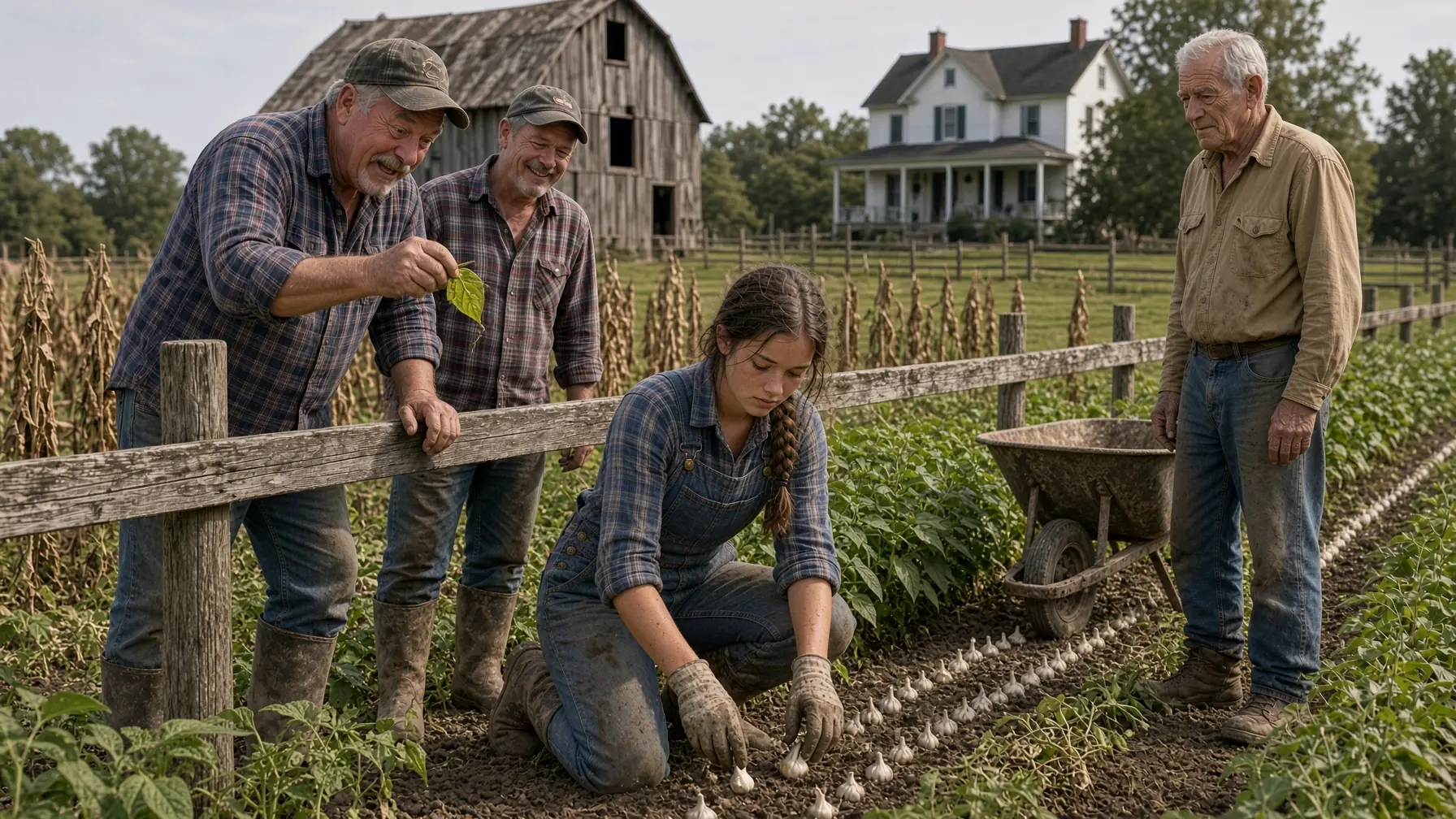
Not everybody stopped.
Most simply eased off the gas long enough to look across the ditch, past the sagging white farmhouse and weather-gray barn, toward the vegetable patch that ran along the eastern fence.
There, a thirteen-year-old girl spent nearly every evening kneeling in the dirt beside six strange green rows that seemed to have no business being where she had planted them.
Sadi Callahan heard the comments.
Some came from the feed store.
Some came across church parking lots.
A few were shouted through open truck windows by men who had spent longer farming than she had been alive.
“Building yourself a fence inside the fence, Sadi?”
“Planning to feed the bugs something different?”
“Walter know what you’re doing to his garden?”
She rarely answered.
That irritated people more than if she had argued.
Sadi would simply push her braid back over one shoulder, make another mark in the cheap spiral notebook lying beside her knee, and move to the next plant.
By then, half the gardens in that part of eastern Kentucky were already in trouble.
The spring had been unusually dry. June brought heat without enough rain, followed by two weeks of humidity that seemed to wake every insect in the hollows at once.
Bean leaves disappeared first.
Japanese beetles chewed them into lace. Aphids gathered under tender leaves in thick clusters. Cutworms took seedlings at the soil line. Flea beetles peppered young plants with holes until the leaves looked as though someone had fired birdshot through them.
At Wexford Feed & Seed, shelves that normally held insecticide through August were stripped bare by Thursday afternoons.
People bought whatever was left.
Sprays.
Dusts.
Traps.
Soap mixtures.
Neem oil.
Anything with a label promising fewer bugs tomorrow than today.
And still, garden after garden along the back roads came in thinner.
For some families, losing a vegetable patch was disappointing.
For others, it meant fewer jars on the pantry shelf in January.
Walter Callahan belonged to the second group.
He was sixty-eight years old and had worked the same sixty acres since before Sadi’s mother was born. The farm had never made him rich. It had made him stubborn, weather-aware, suspicious of debt, and capable of repairing equipment long after the manufacturer assumed it should have been scrap.
His wife, Eleanor, had died seven years earlier.
Sadi remembered her mostly in fragments.
Flour on her hands.
Peppermint candy in her apron pocket.
A voice humming while snapping beans.
And an old leather-bound ledger that still sat on the kitchen shelf beside a chipped ceramic rooster.
Eleanor had written everything down.
Rainfall.
Planting dates.
First frost.
Canning recipes.
Which hen stopped laying.
Which tomato survived blight.
Which neighbor borrowed the pressure canner and forgot to bring it back.
There were forty-three years of weather, mistakes, successes, and domestic complaints compressed into pages that had gone soft from use.
Sadi had started reading the ledger the previous winter.
Nobody told her to.
Walter certainly didn’t.
He barely noticed at first.
She would sit at the kitchen table after supper, turning pages slowly while he watched television or repaired a pocketknife beneath the yellow light over the sink.
To Sadi, reading Eleanor’s notes felt less like studying and more like listening through a wall.
Sometimes the entries were practical.
March 18 — peas up. Cold night. Covered with old sheets.
Sometimes they were funny.
Walter says the mule knows the gate latch. Walter is correct. Walter is also the fool who taught him.
And sometimes there were lines so brief that they seemed unimportant until you needed them.
That summer, Sadi found one of those.
It appeared between a chow-chow recipe and a note about a wet June sometime in the late 1970s.
One sentence.
A rough little drawing.
Nothing more.
Sadi read it three times.
Then she closed the book.
The next morning, she went into the root cellar.
Walter’s garden had already lost almost a third of its bean plants by then.
The tomatoes weren’t dead, but the leaves looked ragged and stressed. His squash had been replanted once. A second planting of green beans was just beginning to emerge, and Walter had started walking the rows twice a day.
He never said he was worried.
Sadi knew anyway.
She saw him turn leaves over and inspect the undersides.
Saw him rub a beetle between his fingers with unnecessary irritation.
Saw him stare at the shelf in the feed store where the insecticide should have been.
One Saturday morning, Sadi stood two aisles away while Walter asked the clerk when the next shipment was coming.
“Tuesday, maybe Wednesday,” the clerk said.
Walter looked at the price tag.
It had increased again.
He put the empty bottle he had been holding back on the shelf.
Outside, Dale Hargrove was leaning against his truck talking to Roy Mercer.
Dale farmed eighty acres farther down the road and had never discovered a silence he couldn’t improve by filling it.
“Callahan,” he called when Walter stepped outside. “You lose those beans yet?”
“Not all of ’em.”
“Give it time.”
Roy laughed.
Walter kept walking.
Then Dale noticed Sadi carrying a small mesh sack she had bought for fifty cents from a bin near the register.
“What’s she got?”
Walter glanced at Sadi.
“Ask her.”
Dale did.
Sadi kept walking.
That earned another laugh.
“Girl’s got a secret now.”
She did.
Or at least she hoped she did.
That evening, she dug the first trench.
It ran along the fence where Walter’s vegetable patch met the upper pasture, close to the tree line above Coldwater Creek.
She worked after chores.
The ground was hard enough that the hoe bounced if she struck too shallow. She switched to a narrow shovel and opened a long line through the dry soil.
Walter noticed from the porch.
He didn’t interfere.
Sadi planted what she had carried from the root cellar.
Small pieces from old saved stock.
Some fresh enough to feel firm.
Some smaller and drier than she liked.
She placed them in a single row about six inches apart, exactly the way she had seen Walter plant them when the crop was intended for harvest.
Then she watered the line and waited.
Two weeks later, almost nothing had changed.
The insects kept coming.
The new bean leaves were still being chewed.
Aphids still gathered under the tender growth.
Whatever Sadi expected her strange border to do, it wasn’t doing enough.
Dale Hargrove drove past one evening and slowed almost to a stop.
He leaned out the window.