“She said nobody would ever want me.”
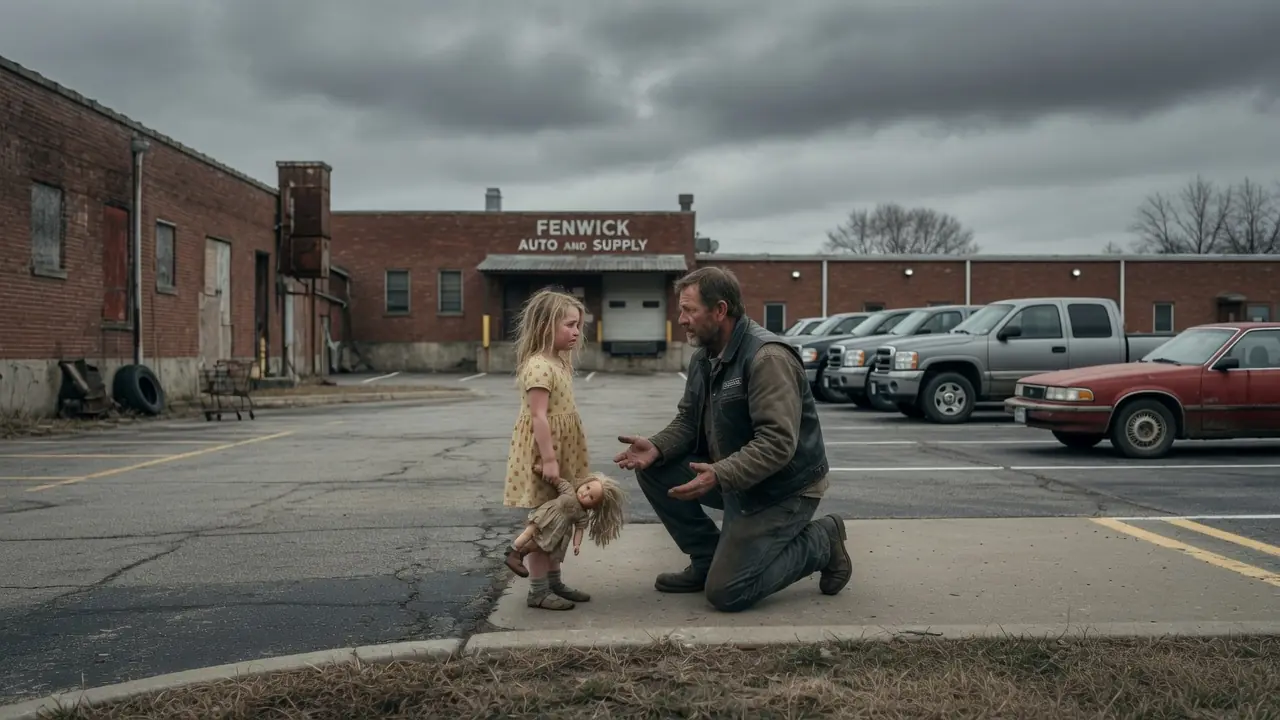
Those seven words came from a six-year-old girl in a yellow dress standing alone in a cold Indiana parking lot, holding a doll by one leg, looking at a man she had never met like she was calculating the exact price of being wrong one more time.
For nineteen months, Birdie June Calloway had tried to tell someone what was happening inside that house on Fenwick Mill Road. Three welfare reports. Three caseworkers. Three closed cases.
Each one shut down within days. Not because nothing was wrong, but because the woman causing the harm was better at paperwork than anyone who came to check. What Luther Cole found inside that house would make every one of those closed files feel like an indictment, not of one woman, but of a system that had every tool it needed and chose to file them away.
And somewhere in the middle of all of it, in a nine-by-seven room with a pullout cot and a washer that ran at 11:00 p.m., a six-year-old had been repeating a phone call to herself in the dark until she had every word memorized.
That is the story. And it does not end the way anyone expected.
It was a Saturday in mid-March, 4:47 in the afternoon, and Terre Haute, Indiana had that particular gray to it that the Midwest gets in early spring. The kind where winter has not quite left, but spring has not bothered to show up yet. Cold enough to see your breath. Dead grass in the lots. A sky the color of old concrete.
Birdie June Calloway had been outside for two hours and forty minutes. She was wearing a yellow dress with a small strawberry print, her favorite, though it was too small now, the hem sitting three inches above her knees in forty-one-degree weather. She had dressed herself that morning in the dark, quietly, the way she did everything in that house.
One sock had a hole at the toe. The other did not. She had noticed. She had put them on anyway because she had already decided sometime in those dark early morning hours that today she was not staying home.
She was carrying a doll with no left shoe, hair carefully brushed on one side only, the side she could reach. In the two hours and forty minutes since she had left, four separate adults had seen her face and made a decision.
The first two were women outside a nail salon, one strip mall over, maybe forty minutes into her walk. One of them crouched down and asked where her mom was. Birdie said, “My stepmom,” and started to explain.
The woman stood back up before Birdie finished her second sentence.
“Okay, honey, you need to go find her,” she said, and went inside.
She was not cruel about it. That was almost the harder part. She was not cruel at all. She just heard the word stepmom and decided it was not her problem.
Here is something most people do not realize about emotional abuse. It does not announce itself. It does not leave the kind of evidence that makes a stranger stop in a parking lot and think, something is very wrong here.
A bruised child gets a second look. A child in an ill-fitting dress on a cold day, speaking carefully, too formally for her age, looks to most people like a child having a rough afternoon. You have probably seen that child. You may have made the same calculation as those women. Most of us have.
The second one was a teenage boy behind a register at a convenience store. Birdie asked to use the phone.
He said, “I can’t let you use the store phone. Liability.”
Then he looked back at his screen. He was not wrong about the policy. He was wrong about applying it to a six-year-old who needed help. But he was seventeen, and seventeen-year-olds do not always know the difference between a rule and a wall.
The third was a man in a pickup truck in the auto parts lot. Birdie knocked on his window. He cracked it and asked where her folks were.
Birdie said, “I don’t want to go home.”
He said, “Look, I can’t get involved in family stuff,” and drove away. He saw her face. He made his choice.
The fourth one is the one that stays with you. It was a group of four women leaving a church auxiliary meeting, in the parking lot of First Methodist, about twenty minutes before Birdie found Luther. One of the women took Birdie’s hand warmly, asked her name, and asked where she lived.
And when Birdie said plainly and quietly, “I don’t want to go back there,” this woman, with the warmest of intentions, said, “Oh, sweetheart, I’m sure your family loves you very much. Sometimes home just feels hard. Why don’t we walk you back? It’s getting cold.”
She heard “I don’t want to go back there” from a six-year-old, and she decided the problem was the cold.
People who work in child advocacy have a phrase for this. They call it normalizing distress. It is what happens when an adult’s need to believe that the world is basically okay overrides a child’s clear signal that it is not.
It is not malice. It is not even negligence, exactly. It is the particular way that hope can become a kind of blindness. Four adults. Forty-one degrees. Two hours and forty minutes. And Birdie kept walking.
Luther “Razorback” Cole was leaning against the loading dock wall at Fenwick Auto and Supply on Wabash Avenue, reading a parts receipt, waiting for an order to be pulled. He had been there eleven minutes. He had nowhere urgent to be. He ran a small engine repair shop, nineteen years in.
You learn patience when you work on things that break down. He was not looking for anything. He was just a man at the end of a slow Saturday in his work jacket over his cut, reading a receipt in the gray afternoon light.
Birdie came around the corner of the building. She stopped when she saw him. She looked at his hands first. Then his face. Then she walked toward him.
Twenty-two feet of cold concrete in twenty-two seconds, pausing twice. She did not run. She moved the way she moved through all spaces, carefully, close to the wall, like a child who had learned that taking up too much room was a provocation.
She stopped at four feet and held the doll out, not giving it to him, just presenting it, the way you might present evidence. Then she said it.
“She said nobody would ever want me.”
Eight words. Past tense. She was not telling him about something happening right now. She was telling him something that had been done to her so many times that part of her had started to believe it.
The question underneath the words, the real question, was not, Can you help me? It was, Is it true?
Luther folded the parts receipt, put it in his pocket, crouched down to her eye level, one knee on the cold concrete, and looked at her face the way a man looks at something that matters. He did not reach for the doll. He did not touch her.
He gave her the one thing four adults that afternoon had withheld: his full, unhurried attention.
“Well,” he said, “whoever said that was dead wrong.”
He looked at the doll, specifically at the side with the carefully brushed hair.
“She’s got good hair,” he said.
Birdie looked at the doll, then back at him. Something shifted behind her eyes. Not relief yet. Not trust. Just a recalculation.
A six-year-old performing the same assessment that adults do in boardrooms and first dates and hospitals. Is this person safe? She decided to find out.
What happened in the next four minutes would become the foundation of a federal case. And it started with a child naming the colors of things.
She told him in layers. That is how children tell the truth when they have been taught that telling the truth has consequences. They test each piece before releasing the next one.
First: “My stepmom says I’m too much. She says I make everything harder. I sleep in the laundry room.”
Luther’s expression did not change. He had learned in fourteen years with the chapter, and before that in a courthouse where a family court judge read from a file about him, that keeping your face still is the most important thing you can do for a frightened person. His jaw tightened once. Then it released.
“How long?” he asked.
“A long time,” Birdie said.
Then, “Fourteen months.”
She knew the number. Six years old, and she was counting months.
Then the second layer.
“My room is her office now. My dog went away. She said Pepper didn’t like me, but I know that’s not true because Pepper used to sleep on my feet.”
The certainty in her voice on that last sentence, I know that’s not true, was the most heartbreaking thing Luther had heard in a very long time. Because she was right. She knew she was right. And she had been told she was wrong so many times that she had to hold on to that knowledge the way you hold something small and precious against a current that keeps trying to take it.
“Birdie.”
“Birdie,” he said it once, like he was filing it somewhere. “I’m Luther. I’m going to listen to whatever you want to tell me for as long as you want to tell it. Nobody’s rushing anything. You warm enough?”
She nodded. She was not warm enough. But she had been cold before, and cold was manageable.
Then she told him the third thing.
“I heard her on the phone. She said there’s money that’s mine, but she’s going to be in charge of it. She said I’m… what the word is. The word the therapist uses.”
Birdie paused and concentrated.
“Dysregulated.”
She said it carefully, syllable by syllable, the way she had memorized it. She did not know what it meant. She knew it was being used against her.
Luther was very still for a moment. There is a specific kind of fraud that happens at the intersection of family law and behavioral health, and it is more common than most people want to believe. A child is placed in therapy, which sounds like help. The therapist is selected by the abuser.
Session notes go to the abuser’s email. And over months, a paper trail builds that frames the child as emotionally unstable, behaviorally difficult, dysregulated. A clinical word that, in a family court filing, translates to: do not trust what she says.
Birdie did not know any of that. She knew the word made adults look at each other a certain way.
“How many days?” she asked Luther suddenly.
He looked at her.
“Days until what?”
“She said twenty-three days on the phone. I counted.”
Birdie looked at the ground.
“I think something happens in twenty-three days.”
“Twenty-three days.”
Luther stood up. He took off his riding jacket, the one over his cut, and set it around her shoulders. Not the cut, just the jacket. It reached her knees. She looked down at the weight of it for a moment, then back up at him.
“You’re not going back to that laundry room tonight,” he said. “And in twenty-three days, nobody is walking into any courthouse without knowing your name.”
He already had his phone out.
The call lasted forty-seven seconds.
“Virgil, it’s Luther.”
“Razorback, you good?”
“I need every brother within range at the chapter hall. Vigo and Clay. Tonight.”
A pause. Not for effect, but because what he was about to say needed the air to be clear first.
“I’ve got a six-year-old girl with me. She’s been sleeping in a laundry room for fourteen months while her stepmother builds a legal case to take her inheritance. The petition hearing is in twenty-three days.”
One beat of silence from the other end.
“Say no more. We’re coming.”
The line went dead, and that was it. No questions about proof, no discussion of legal risk, no one asking why Luther did not just call the police. Just a man who had spent decades understanding exactly what it meant when the system was not moving fast enough, and a chapter that had decided a long time ago that fast enough was the standard that mattered.
Virgil “Crowbar” Stokes was fifty-six years old and had been running the Vigo County chapter for eleven years. Every cop in the county knew his name and his rules. He was the reason two different precincts had called him personally over the years when they needed someone families would actually open the door for.
He was not friendly with law enforcement. He was respected by them. That distinction had taken years to build, and he maintained it with precision.
By 5:09 p.m., the call had gone out to both chapters. By 7:30, eighty-five motorcycles were staged outside the chapter hall on Wabash Avenue. Not at the house on Fenwick Mill Road, not in anyone’s driveway, not making noise on a residential street. At the hall.
Because this was not a confrontation. Not yet. This was a meeting where a father needed to hear the truth about his daughter for the first time. And the brothers understood that truth needed a room, not a road.
You might already be picturing this differently. Eighty-five Hells Angels, and your mind goes to what Hollywood told you that looks like. Chaos, noise, leather, and rage roaring up to a suburban house while neighbors call 911.
That is not what Virgil built. That is not what any of them came for tonight. What eighty-five men came for was one room, one father, and one truth that had been buried in a behavioral log for nineteen months.
Luther arrived at the hall at 7:15 with Birdie in the passenger seat of his truck. The jacket was still around her shoulders. The doll was in her lap. He had stopped at a gas station on the way and gotten her a hot chocolate and a small bag of crackers, which she ate with the focused attention of a child who does not always know when the next meal is coming.
She had not said much in the truck. She looked out the window and named colors quietly to herself. Gray sky, red light, yellow sign. A counting technique Luther had watched her use twice now whenever the world got too big. He did not interrupt it. He let her have it.
Inside the hall, five men were already at the table when Virgil introduced them to Birdie. She stayed close to Luther, which Luther expected, but she looked at each of them with that same quiet assessment she had given him in the parking lot. Virgil kept it short. These were the ones who needed to hear everything first.
Ironside, real name Earl Braddock, fifty-seven, former Vigo County sheriff’s deputy, sixteen years on the job before his knees and his conscience both gave out around the same time. He knew exactly which judge sat on family court trust petitions in this county and what kind of evidence made them pump the brakes on a filing.
He also knew the caseworker who had closed both of Birdie’s welfare reports, and he knew that caseworker’s supervisor. He knew the particular institutional pressure that made people close files faster than they should. He had seen it from both sides.
Specter, Marcus Wynn, forty-four, had spent nine years as a family services investigator before the caseloads and the politics of it broke something in him that he could not fix from the inside. He left. He kept his methodology.
When Specter read a behavioral log, he could identify within three entries whether the entries were observed or constructed. There is a specific pattern in fabricated records, a consistency that real life does not have, a tightness to the language that comes from someone who is building a case rather than recording one.
Gravel, Theodore Ames, fifty-two, had eighteen years as a child psychologist before he retired early and started writing. He was the one who would sit with Birdie tonight while the adults worked. He was the one she would eventually tell in full about the laundry room.
Dust Cloud, Jamie Park, thirty-four, handled documentation. He would photograph the house before Renata could stage it. He had done this before, and he was fast.
Knotwood, Raymond Osei, sixty-eight, club elder, drove to Indianapolis personally when the situation called for it. He was driving to Indianapolis tonight. He just did not know it yet.
Birdie looked at Knotwood for a long moment. Then she said to Luther quietly, “He looks like my grandpa’s doctor.”
Knotwood smiled.
“I’ll take that,” he said.
Twenty minutes later, while Gravel sat with Birdie in the back room over coloring books and the remaining hot chocolate, Luther sat across from Virgil at the long table and laid out everything he knew.
Then Virgil looked at Luther and said, “Tell me the part she didn’t say in front of everyone.”
Luther exhaled.
“There’s a trust education fund, her late grandmother’s money, one hundred sixty-three thousand dollars. The stepmother has filed a petition to be named trustee. Petition hearing is in twenty-three days. If she gets named trustee, she gets discretionary spending authority for education-related expenses.”
He put quotes in the air with two fingers.
“The father signed the petition paperwork eight months ago. He signed page four of a nine-page document that was presented to him as school enrollment forms.”
Virgil was quiet for a moment.
“How does a six-year-old know all this?”
“She heard a phone call six days ago. Stepmother talking to her sister. Laundry room door was cracked.”
Luther put both hands flat on the table.
“She memorized it. Word for word. Said she repeated it to herself every night in the dark so she wouldn’t forget. The way she memorizes colors.”
The room got quiet in the way that rooms get quiet when something lands with full weight.
Here is what most people do not know about how educational trusts work. And Renata Greer absolutely did know. A named trustee for a minor’s education trust in Indiana holds what is called discretionary spending authority over funds deemed education-related.
The definition of education-related can be interpreted broadly. Tutoring, enrichment programs, educational travel, school supplies. In practice, once you are named trustee of a discretionary trust, oversight is minimal unless someone specifically challenges a withdrawal.
And the behavioral paper trail already being assembled, the therapist’s notes describing emotional dysregulation, the welfare reports that had been closed, was constructing a portrait of a child whose word in a courtroom would carry less weight than it should. Renata had not just been cruel. She had been building a legal structure.
Ironside heard this and started writing.
“The welfare reports,” he said without looking up. “Who’s the caseworker?”
Luther gave him the name. Ironside put his pen down for exactly two seconds, then picked it back up.
“I know her supervisor,” he said. “And I know why the second report got closed as family engaging with services. Because when the family provides documentation of a therapy referral, the system treats that as progress. It’s not designed to ask whether the therapy itself has been co-opted.”
He looked at Virgil.
“The whole setup is sophisticated. This isn’t someone who got lucky. This is someone who understood exactly how the process works and designed around it.”
Specter leaned forward.
“I want to see the behavioral log.”
“We don’t have it yet,” Luther said.
“We will.”
Back in the side room, Gravel had been sitting with Birdie for forty minutes. He was not asking her questions. He was drawing, badly, on purpose, and letting her correct him, which she had been doing with increasingly confident opinions about the shape of his horse.
“That’s not what a horse looks like,” she said for the third time.
“I know,” Gravel said. “I never could get the legs right. You want to show me?”
She took the pencil and drew four legs with the focused precision of a child who takes accuracy seriously. Gravel watched her hands, noted the bitten fingernails, the deliberateness, the way she glanced at the closed door once before committing to the drawing, checking that it was still closed, that the world outside was still where she had left it.
After a while, she said without looking up, “Is Luther coming back?”
“He’s right outside,” Gravel said. “He’s not going anywhere.”
Birdie kept drawing.
Then: “She locks the pantry.”
Gravel waited.
“The snacks are in there. She has the code. I only eat what’s on my plate.”
Birdie looked at the horse she was drawing.
“I’m not supposed to be hungry, though. She says I eat fine.”
Gravel had spent eighteen years doing this, sitting across from children who were releasing truth in pieces, testing each piece before offering the next. He knew that the worst thing you could do was rush it, or react visibly, or let your professional understanding of what you were hearing show on your face.
Children read adults like books. They stop the moment they see the reader flinch.
“What else don’t you have in there?” he asked, gently, like it was a continuation of the drawing.
Birdie was quiet for a long moment.
“A window,” she said finally. “My room doesn’t have a window.”
At 8:47 p.m., Luther walked into the room where Cole Calloway was sitting. Cole Calloway was thirty-four years old and looked in this moment like a man who had just been handed a weight he did not know he had been carrying.
He had arrived at the hall an hour earlier. Virgil had called him directly, told him simply that there was something he needed to hear about his daughter, and that it was better to hear it here than anywhere else.
Cole had come because when a man like Virgil Stokes calls you and says, Come, you come.
He had sat. He had listened. He had been given the parts receipt version first, the surface level, the laundry room, the locked pantry. And you could see in his face the specific expression of a person whose world is being restructured underneath him while he is still standing in it.
But when Luther sat down across from him and told him about the trust petition, about the nine-page document he had signed on page four, about the courthouse hearing in twenty-three days, Cole Calloway put both hands over his face and did not move for forty-five seconds.
“I didn’t read it,” he said from behind his hands.
“I know,” Luther said.
“She said it was enrollment paperwork.”
“I know.”
Cole lowered his hands. His eyes were red.
“Is Birdie here?”
“She’s here. She’s safe. She’s drawing horses with one of my brothers.”
Something moved through Cole’s face then, not quite relief, because the full weight of what he was hearing had not settled yet. And relief requires a kind of resolution that had not arrived.
But something, the specific complicated expression of a father who had failed his daughter without knowing it, and was now sitting across from the evidence of that failure in the form of a man in a Hells Angels cut who had been paying closer attention than he had.
He did not have the language for what to say. Luther did not need him to.
“In twenty-three days,” Luther said, “nobody goes into that courthouse without knowing exactly what’s in those nine pages. And what we need to know is everything you know about Marcus Webb.”
Cole looked up.
“Who?”
And that was the moment Luther understood how deep it went.
Nobody on Fenwick Mill Road heard them coming. That was intentional. Eighty-five motorcycles, and Virgil had given one instruction before they left the hall.
“We are not a statement tonight. We are a presence.”
The difference, in his experience, was everything. A statement was noise. A presence was weight. You could dismiss noise. You could not dismiss eighty-five men who had done the math and decided a six-year-old’s nineteen months was worth a cold Sunday morning.
They came in from three directions and parked in the lot of a church two blocks from Fenwick Mill Road at 8:30 the next morning. Engines cut, one cluster at a time, until the only sound was the ticking of cooling metal and the distant bark of someone’s dog two streets over.
No one spoke above a low voice. No one positioned themselves dramatically. They just stood there in the early gray light in their cuts, steam rising from coffee someone had brought in a thermos, waiting for Virgil’s word.
You might imagine a moment like this differently. Eighty-five Hells Angels and a suburban street, and your mind assembles a particular picture. The one that gets on local news. The one where the neighbors call 911 before anything has happened because the image alone triggers the alarm.
That picture is wrong for tonight. And not because these men were performing restraint. They were not performing anything. They had simply been doing this long enough to know that a wall of bodies outside a house does not help the child inside it.
What helps the child inside it is the right people at the right door with the right paperwork. That is what Sunday morning looked like. Not a siege, a strategy.
Ironside had made three calls between midnight and 6:00 a.m. One to a family court attorney he had worked with twice before. One to Birdie’s school counselor, Mr. Delgado, whose home number he had obtained through channels he did not explain and did not need to.
And one to the supervisor of the caseworker who had closed both welfare reports. A call that lasted eleven minutes and ended with that supervisor agreeing to come in on a Sunday, which was not something she did, and which told Ironside everything he needed to know about how that conversation had gone.
Specter had spent the night reading. Not Renata’s behavioral log. They did not have that yet. What he had was Cole Calloway’s email, which Cole had given him access to at 10:00 p.m. the night before with shaking hands.
Fourteen months of household communications, school enrollment records, therapy coordination emails, the petition filing, all nine pages, which Cole had not opened since the day he signed page four.
Specter read everything twice. He made a list. The list was two pages long by morning, single-spaced. The key detail, the one that would matter most in court, was on page seven of the petition.
Renata had listed, under demonstrable need for trustee transition, three behavioral assessments from Birdie’s therapist. The therapist’s name was Dr. Anita Fowler, licensed, credentialed, operating out of an office in Terre Haute’s west side.
What Specter noticed was not the content of the assessments. It was the dates. Dr. Fowler had begun working with Birdie eleven months ago. The assessments had been written nine months ago, eight months ago, and six months ago.
And in each one, the language describing Birdie’s emotional dysregulation had escalated. Not because a child’s condition was worsening, but because someone had been providing that language to the clinician in framing emails before each session.
Specter knew because he had done this job from the inside. He had seen exactly how a sophisticated adult could shape a therapist’s perception of a child without ever technically lying.
You do not fabricate. You curate. You send the clinician your version of the child’s week before they see her. You describe the incident at school in terms designed to confirm a pre-existing diagnosis.
And you select a therapist who is competent but overworked, who does not have time to triangulate, and whose notes will be accepted at face value by a family court that receives three hundred filings a month.
He had the emails. All eleven of them. Pre-session context notes from Renata to Dr. Fowler, sent the evening before each appointment. Each one framing Birdie’s week in terms of difficulty, instability, and behavioral deterioration.
Dr. Fowler had not known she was being managed. Specter was fairly certain of that. It did not make the outcome less damaging for Birdie.
At 9:15 a.m., three people walked to the front door of 318 Fenwick Mill Road: Luther, Ironside, and a family court attorney named Sandra Okafor, forty-eight, who had driven from Indianapolis that morning because Ironside had asked, and because what he had described on the phone was the kind of case she had spent twenty years trying to prevent.
She carried a leather portfolio and wore reading glasses pushed up on her head. She looked on that front porch like exactly what she was. Someone who had read the petition and was not impressed.
Renata opened the door at 9:17. She was in a cream-colored robe, hair styled despite the hour, coffee mug in hand. The presentation of a woman who does not answer doors without her armor in place.
Her eyes moved across the three of them in the practiced way of someone who spends her professional life assessing what a room needs from her. The smile came up.
This is the moment worth understanding because it explains nineteen months of closed welfare reports. The smile was good. Not performed good. Warm, slightly confused, immediately sympathetic. The smile of a woman who was about to be very reasonable about whatever misunderstanding had brought these people to her Sunday morning.
“Can I help you?” she said.
“Mrs. Greer,” Ironside said, “my name is Earl Braddock. This is Sandra Okafor, family court attorney, and you know Luther. May we come in?”
The smile held.
“I’m sorry, what is this about? Is Birdie all right?”
“Birdie is safe,” Sandra said. “May we come in?”
One second. The smile’s edges tightened just enough. Just for that one second. Then she stepped back and opened the door.
What Dust Cloud documented in the next forty minutes while Sandra and Ironside sat in the living room with Renata was methodical. He was not searching for hidden weapons or dramatic evidence. He was photographing what was already visible.
The laundry room, exactly as Birdie had described it. Nine by seven feet. Washer and dryer on the left wall. A pullout cot against the right. One bare bulb. No window. A plastic storage bin under the cot holding Birdie’s clothes: three dresses, two pairs of leggings, underwear, two pairs of socks, a single blanket, and a fitted sheet.
And on the wall of the room that had once been Birdie’s bedroom, the room that was now a home office with a deadbolt, through the gap where the door had not quite latched, visible if you looked, was the corner of a child’s drawing in crayon. A yellow sun, still taped where Birdie had left it fourteen months ago.
He photographed all of it. He photographed the combination lock on the pantry cabinet, the home office door with its aftermarket deadbolt, the dining room set for two, the kitchen with a single placemat on the counter beside the refrigerator, Birdie’s eating spot.
Forty minutes. Two hundred fourteen photographs.
In the living room, Renata had moved through the first two phases of what she knew how to do. The charm offensive lasted approximately eight minutes. She was reasonable. She was concerned. She referenced Birdie’s therapy, the behavioral challenges, the difficulty of blended family transitions.
She mentioned her work with the PTA, the food bank board. She let her voice carry the warmth of a woman who had done everything right and was frankly a little hurt to find herself in this position on a Sunday morning.
Sandra let her finish. Then Sandra opened her portfolio, removed a single sheet of paper, and placed it on the coffee table facing Renata.
“Mrs. Greer, can you tell me what this email was for?”
It was one of the pre-session framing emails to Dr. Fowler. The one from eight months ago, the day before the second behavioral assessment. Renata’s own words, describing Birdie’s escalating instability and increased dissociation from reality, language that had appeared almost verbatim in Fowler’s assessment three days later.
Renata looked at the email. Her shoulders, which had been relaxed, practiced relaxation, the kind that costs something, tightened once.
“I was providing context,” she said. “Parents communicate with therapists. That’s normal.”
“It is,” Sandra agreed. “And the therapist’s notes from that session reflect your framing almost word for word. Can you explain that?”
The charm went up again, a different register now, more conciliatory, slightly more vulnerable. She had not done anything wrong. She was just trying to help Birdie get the support she needed. Cole was not always available to communicate with providers, so she had taken the lead.
“Mrs. Greer,” Ironside said quietly.
He had not spoken in eleven minutes.
“We have all eleven emails, and we have a database search from your shared family laptop. Fourteen searches for education trust discretionary spending limits, Indiana, over a period of three months.”
The legal threat came then, sharp, clean, immediate. She had an attorney. This conversation was over. Entering her home under false pretenses was harassment. The club would hear from her legal representation. She had relationships with people in this county who—
“You’re welcome to call your attorney,” Sandra said. “The FBI will want to speak with them as well.”
The word FBI landed in the room the way Ironside had expected it to land. Not like a threat, but like a door closing. The specific door behind which all the escape routes lived.
Renata went very still.
The third phase was the hardest to watch, which was the point of it. She had been stressed. She had been trying for nearly two years to hold a complicated household together while managing a child who had genuine behavioral challenges.
And yes, she knew how it looked. She knew the laundry room looked bad, but there had been reasons for that transition that she had not been given a chance to explain. And she had sacrificed so much of herself for this family, for Cole, for a child who was not biologically hers and who—
Luther had been sitting in the corner of that room for thirty minutes without speaking. He spoke now.
“I’m not interested in your reasons,” he said quietly. “Neither is she.”
Seven words. Absolute.
The silence that followed was not dramatic. It was the specific silence of someone discovering that the tools they have always used, charm, legal threat, sympathetic framing, have all been picked up and set aside by people who have seen them before.
The mask does not fall in those moments. It just stops being useful, which amounts to the same thing.
Renata asked once if someone could let her call her neighbor about her dog.
“Someone would need to go in to feed him,” she said, flat, almost calm. “He’s a creature of habit.”
She was thinking about the dog’s schedule while Sandra Okafor was on the phone with family court, while Dust Cloud was uploading two hundred fourteen photographs, while Ironside was giving a name to someone at the Vigo County DA’s office who had been expecting his call since 7:00 a.m.
The ordinary thing in the center of the extraordinary moment. That was the thing that would stay with Luther afterward. Not the charm offensive, not the legal threat, not the appeal to sympathy. The dog. The neighbor. The schedule.
As if the world she had constructed and the world she had taken from Birdie could both be put on hold while she sorted out her correspondence.
At 11:43 a.m., two officers from the Vigo County Sheriff’s Department arrived at 318 Fenwick Mill Road. They read Renata Lynn Greer her Miranda rights in the driveway, in the gray March light, in her cream-colored robe.
She did not cry. She asked once more about the dog. The neighbor was called. The dog was fine.
The charges, as filed that afternoon, were fraud upon the court related to the misrepresentation of the trust petition, financial exploitation of a minor, child neglect, and obstruction of a child welfare investigation stemming from the curated communications with Dr. Fowler.
Sandra had spent twenty years understanding how these cases worked and how they could unravel on a technicality. She filed carefully, with the evidence organized to survive every challenge Renata’s attorney would bring.
Bail was set at eighty-five thousand dollars. Renata did not make it. The trust petition hearing, scheduled for twenty-three days out, was stayed pending the criminal proceedings.
Birdie’s one hundred sixty-three thousand dollars remained exactly where it had always belonged, in a trust for Birdie, managed by a neutral party who had absolutely no interest in education-related discretionary spending.
Justice had been served. But justice was not the ending. It was only the beginning.
It was Specter who was at the chapter hall at 2:00 p.m., laptop open, working through the family court database on a guest login that Ironside’s attorney contact had authorized, pulling the petition filing documents one more time to flag the specific pages Sandra would need, when a notification appeared on Renata’s phone, which had been placed in an evidence bag on the table beside him, screen up, still unlocked.
It was a calendar alert.
Donna, confirm hearing prep / financial review. Tuesday, 4:00 p.m.
Donna. Renata’s sister. The one who had been on the phone six days ago when Birdie was memorizing words in the dark.
Specter looked at the notification for three seconds. Then he took a photograph of the phone screen, bagged it properly, and called Ironside.
“Donna Greer didn’t just know about the trust petition,” he said when Ironside picked up. “She was in the prep work.”
He had thought the worst was over. He was wrong, because the worst was not one woman. The worst was what that one woman connected to.
The war room assembled at 3:00 p.m. Six brothers, Sandra Okafor on speakerphone, and a whiteboard that Dust Cloud had dragged in from the storage room and set up against the wall opposite the window.
Dust Cloud opened his laptop and started pulling. What he found, layer by layer, narrated aloud as each piece came up, was the kind of thing that builds slowly and then hits all at once.
Layer one: Renata Greer’s personal financial history over the past three years. She had a real estate license and a functioning career, but her income did not explain the balance of her discretionary accounts, which showed deposits from sources that were not commission payments.
Irregular amounts. Four figures. Arriving every four to six weeks.
“That pattern,” Dust Cloud said, highlighting three rows, “looks like consulting fees. But there’s no consulting entity registered in her name in Indiana, Kentucky, or Ohio.”
Layer two: a name that appeared in Renata’s phone contacts under a business designation, RLG Holdings LLC.
Ironside typed it. The LLC was registered in Delaware, which told you almost nothing because Delaware is where you register things you do not want examined. But the registered agent’s name was a matter of public record.
The registered agent for RLG Holdings LLC was Donna Greer.
“She didn’t just know,” Specter said. “She was the vehicle. Renata runs the operation. Donna holds the shell company. The trust money, once Renata was named trustee, would have moved through RLG as educational consulting fees and been effectively untraceable within sixty days.”
Layer three came quietly. Dust Cloud had cross-referenced the LLC registration date. Fourteen months ago. Exactly when Birdie had been moved out of her bedroom and into the laundry room.
Against Renata’s browser history from the shared family laptop that Cole had provided, he found what he was looking for on page nine of the search history export.
A search eighteen months ago for Indiana education trust discretionary spending court challenge requirements. And three searches below it from the same week: Marcus Webb Indianapolis.
Dust Cloud looked up.
“Someone looked up Marcus Webb from this laptop eighteen months ago.”
The room got quiet in the way that rooms get quiet when something large is about to shift.
Ironside set his pen down.
“Pull everything on Marcus Webb,” he said.
Marcus Allen Webb, forty-one, had lived with Renata Greer for three years, 2018 to 2021, in a shared apartment on the north side of Terre Haute. The relationship had ended. Marcus had relocated to Cincinnati.
There had been a civil claim, settled out of court for twelve thousand dollars. Renata had not admitted wrongdoing. On paper, it was a relationship that ended the way relationships end. Money got complicated. Someone filed something. Someone else settled. And everybody moved on.
The folder that Dust Cloud found, not in the evidence they had pulled that day, but in a cloud backup of Renata’s email that Sandra had subpoenaed by 4:00 p.m., and which a family court clerk had managed to produce before 6:00, was not about moving on.
It was a folder labeled M. Webb Documentation. Forty-seven files created over a period of twenty-two months. The same structure as what she had built against Birdie.
Behavioral observations framed as concern. Communications to a shared therapist that Marcus had seen twice and then stopped seeing for reasons that now looked very different. A record of financial decisions, Marcus’s financial decisions, documented as instability.
An email to Marcus’s employer, written but apparently never sent, describing erratic behavior that was becoming a workplace concern.
She had been building the same paper trail against Marcus three years before she met Cole Calloway.
The difference was that Marcus had figured it out in time. Not completely. Not in time to avoid the thirty-eight thousand five hundred dollars she had moved out of their joint account in the final six months. But in time to leave. In time to file the civil claim. In time to be in Cincinnati when this case broke, and not in a grave.
Nobody spoke, Dust Cloud would say later when he was asked about that moment. The refrigerator hummed. Somebody’s motorcycle idled outside and then cut off. And every man in that room understood without saying a word that they were not just trying to save one little girl.
They were trying to stop something that had already been done before, practiced on, and refined.
Specter looked at the forty-seven files.
He said slowly, “She got better at it.”
That was the most frightening sentence in the room. Not that she had done it before. That she had learned.
Knotwood left for Indianapolis at 6:00 p.m. He drove, not rode, because the conversation he was going to have did not need the noise or the theater of a motorcycle. He drove a fifteen-year-old Buick with one hundred forty thousand miles on it and an air freshener shaped like a pine tree.
And he took I-70 north in the early dark. And he thought during those ninety minutes about Patricia Webb.
Patricia Webb, forty-four, was Marcus’s older sister. She had been waiting to tell someone for two years. She had warned Cole Calloway at the wedding. This was now confirmed. Cole had remembered it once it was put to him directly. And Cole had dismissed it as an ex’s family being bitter.
She had watched from a distance as Renata moved into that house and began the process she had already seen once before. And she had told herself that she had tried, and the trying had not worked, and that sometimes you run out of ways to help.
Knotwood knocked on her door at 7:48 p.m. She opened it and looked at him, this sixty-eight-year-old man in a road-worn jacket. Nothing threatening about him except the patches. And even those just looked, in the light from her porch, like a man who had been somewhere and come back.
“My name is Raymond,” he said.
Someone finally came.
Patricia Webb put her hand over her mouth. She stood in that doorway for a full ten seconds. Then she stepped back and let him in.
What she told Knotwood across a kitchen table, with two cups of coffee she had made because she needed something to do with her hands, filled the final gap in the case’s timeline and added a piece of evidence that Sandra would later describe as the document that changed the scope of everything.
Patricia had in her possession a letter. Marcus had written it during the civil claim proceedings when his attorney had suggested he document the full pattern of Renata’s behavior as a precautionary measure.
It was a thirteen-page handwritten account of every financial decision made without his knowledge. Every document placed in front of him to sign without full explanation. Every behavioral framing, the same word, the same word Birdie had memorized in the dark: dysregulated.
Marcus had never submitted it to court. The settlement had made it unnecessary. He had mailed the letter to Patricia for safekeeping because he trusted her with it, and because some part of him had understood even then that Renata Greer was not done.
The letter was dated April 14, 2021. Birdie was not born yet when Marcus wrote it. And the pattern it described, the paper trail, the co-opted therapist, the financial structure, the isolation from family, the strategic dismantling of a person’s credibility before any accusation could land, was the same pattern, rebuilt and refined, that Birdie had been surviving inside for nineteen months.
Knotwood drove back to Terre Haute with the letter in a sealed envelope on the passenger seat.
The man who had enabled it, not Renata, not Donna, was a local notary named Glenn Pratt, fifty-two, who had certified the trust petition signatures without properly verifying the nature of the document being signed.
Cole Calloway’s signature on page four of a nine-page petition was legally meaningless if the signatory had not been provided adequate disclosure of the document’s full content. Glenn Pratt had certified that signature.
Glenn Pratt had been doing Renata a professional favor. He had handled her real estate closings for four years. They were friendly, and she had presented the document as routine family paperwork. He had not asked questions. People who do notary work for friends as a favor sometimes do not.
Ironside brought him in at 9:00 p.m. Not to the chapter hall, to a back room at a diner two blocks from Glenn’s house, which was where Glenn had agreed to meet on the understanding that this conversation was better to have voluntarily than not.
Glenn Pratt was not a bad man. That was the difficult part. He was a man who had done a sloppy job on a professional certification because he had trusted someone he thought he knew. And the sloppiness had put a six-year-old child’s inheritance within twenty-three days of disappearing.
He broke inside in under eight minutes. He did not need the full approach, just the letter from Marcus Webb placed on the table in front of him and the quiet explanation of what the chapter now knew, and what the DA’s office was going to want to understand about the certification process.
“I didn’t know what was in it,” Glenn said. His hands were shaking. “She said it was routine. She said Cole had already reviewed it at home and just needed the signatures certified separately.”
“Was that standard procedure?” Ironside asked.
Glenn looked at the table.
“No.”
“Did you ask?”
“No.”
Ironside let that sit. He was not unkind about it. He had spent sixteen years in law enforcement, and he knew the difference between the person who creates the mechanism and the person who is weak enough to be used by it.
Glenn Pratt was the second kind. He would cooperate fully. His cooperation would be important, and its importance would be the thing he carried for the rest of his life. The knowledge that the only useful thing he had done in this situation was to tell the truth about how poorly he had done his job.
“This is what’s hard,” Luther said later to Virgil when they were alone for a moment. “It’s never just one person. It never is. It’s always the woman who walks back inside the nail salon, and the kid behind the register, and the notary who doesn’t ask questions, and the caseworker whose supervisor tells her to close files, and the therapist who accepts framing emails because she’s seeing forty clients a week and there’s no time to triangulate.”
“All of them separately telling themselves they didn’t do anything wrong, and none of them are lying. That’s the thing. None of them are. They’re all telling the truth, and somehow a six-year-old still ends up in a room with no window counting months.”
Virgil did not answer. There was not an answer. There was just the next thing.
The FBI agent arrived at the chapter hall at 10:30 p.m. Her name was Special Agent Carla Dumont, Indianapolis Field Office, Financial Crimes Division. She was in plain clothes, dark blazer, practical shoes, the particular kind of exhaustion that settles in the face of someone who has been working a case they could not close.
She introduced herself and her office in two sentences. Luther acknowledged this with a nod and did not extend his hand.
“I’m told you have something relevant to an open federal investigation,” she said.
“Depends on what you’re investigating,” Luther said.
She named RLG Holdings LLC. She named Donna Greer.
Luther looked at Virgil. Virgil looked at Ironside. The decision moved through the room without a word being spoken.
“How long has your office known about RLG?” Luther asked.
Dumont paused for exactly one second before answering.
“Eight months.”
“We got Birdie out in fourteen hours,” Luther said. “You had eight months.”
Dumont had no good response to that. She was not expected to. She had built a case carefully, legally, by the book. Subpoenas and financial warrants and carefully documented digital trails.
And while she built it, a six-year-old had been sleeping under a single blanket in a nine-by-seven room with no window. The system she operated inside had every tool it needed. It had simply needed more time than Birdie had.
That was not an excuse. Dumont knew it was not. She sat down.
What was laid on the table in front of her, one item at a time, was a physical sequence: the eleven pre-session emails to Dr. Fowler, the RLG Holdings registration with Donna Greer as registered agent, the trust petition annotated with Specter’s two pages of findings, Marcus Webb’s thirteen-page letter, Glenn Pratt’s signed statement from forty minutes ago, and Dust Cloud’s flash drive containing two hundred fourteen photographs.
Dumont reviewed each item. She took notes. When she reached Marcus Webb’s letter, she stopped writing. She set her pen down, leaned forward slightly, and read two full pages without moving.
“We had the financial trail,” she said finally. “We didn’t have the behavioral template. We didn’t know it had been done before.”
She looked up.
“If Marcus Webb’s letter is authenticated, it changes the scope of the charges significantly. It establishes pattern and premeditation across two separate victims over a period of years.”
“There’s one condition,” Luther said.
Dumont waited.
“Birdie gets a victim advocate assigned before the first interview. Nobody talks to her without her asking for the conversation.”
“That’s the job,” Dumont said.
She closed her folder and stood.
“Agent Dumont.”
She turned.
“You do right by her.”
A beat.
“That’s the job,” she said again.
The door closed. The room exhaled.
The system was not broken. That was the thing that was easy to misunderstand from the outside. A broken system could be repaired. This one worked exactly as designed, methodical, evidence-based, built to protect the rights of the accused even at the cost of the timeline that the victim needed.
Nobody engineered it to be cruel. It just turned out, sometimes, that cruelty fit very comfortably inside the gaps. The brothers had not replaced the system. They had bought the time the system needed to work and put the evidence into hands that the system would accept.
Fourteen hours of attention, legal precision, and documented facts in the service of twenty-three days that no longer needed to be survived.
The full scope, assembled by midnight and presented to the DA’s office at 7:00 a.m. Monday morning: two confirmed victims, Marcus Webb and Birdie June Calloway. A third potential victim identified from RLG Holdings payment records, a name Donna Greer had received payments from eighteen months ago, a name that Dumont’s team would spend the next six weeks following.
Total financial harm across confirmed victims: two hundred one thousand five hundred dollars. Marcus’s thirty-eight thousand five hundred dollars and the one hundred sixty-three thousand dollar trust, which had come within twenty-three days of being absorbed.
Timeline of operation: beginning in 2018, with a two-year gap between Marcus and Cole Calloway, during which Renata had apparently refined her approach.
Charges filed against Renata Lynn Greer: fraud upon the court, financial exploitation of a minor, child neglect, obstruction of a child welfare investigation, and, added Monday morning on Dumont’s recommendation, wire fraud for the use of digital communications in furtherance of the financial scheme.
Charges filed against Donna Greer: one count of wire fraud and one count of conspiracy to commit financial exploitation.
Glenn Pratt was referred for professional review by the Indiana Secretary of State’s office. His certification license was suspended pending investigation.
Three victims. Five charges. One behavioral template practiced and refined across seven years. And for nineteen months, a system designed to catch exactly this had looked at Birdie Calloway and closed the file.
Not because it could not see. Because the person who had built the trap understood the system better than the system understood itself.
Until Birdie walked up to a man in a parking lot and said eight words that a six-year-old should never have had to say.
The first thing Birdie asked on Monday morning was whether Pepper was okay. Not about the house. Not about her father. Not about Renata.
She sat at the table in the chapter hall’s back room with a bowl of oatmeal that Gravel had made. Plain, because he had not known her preferences, and then with brown sugar on top, because she had looked at the sugar bowl with the specific longing of a child who had learned not to ask.
And she said, to no one in particular, “Does anyone know where Pepper went?”
Gravel wrote the name down. He looked at Luther. Luther nodded once.
By Tuesday afternoon, Dust Cloud had traced Pepper, a three-year-old beagle mix rehomed fourteen months ago through a Terre Haute rescue organization to a family in Bloomington who had adopted him six weeks after Renata had surrendered him, citing allergies.
The family had two children and a backyard and had named him, inexplicably, Biscuit. They were called. They were kind people. They listened to the full situation.
They said they needed a few days to talk it over as a family, which was reasonable and which Dust Cloud respected and which Luther filed away under things that were not resolved yet, but would be.
That was how the resolution worked, not in one clean sweep, but in small specific problems addressed one at a time by people with the right tools.
The appointment was Tuesday morning, 9:00 a.m., Terre Haute Regional Hospital pediatric outpatient clinic. Gravel had arranged it through a contact he had maintained from his practice years, a pediatrician named Dr. Yolanda Marsh, forty-seven, who had been doing this long enough to understand what she was looking at when a six-year-old girl came in with bitten fingernails and dark circles and a resting weariness that did not lift even in a brightly decorated waiting room.
Gravel sat in the waiting room while Birdie was examined. He had brought a paperback, something neutral, a book about birds, and a bag with apple slices and two small chocolate chip cookies because he had thought ahead. He ate an apple slice. He read about the migratory patterns of the sandhill crane.
He waited.
Cole Calloway sat beside him. He had not slept. He was on his third coffee, and he was holding it in both hands like it was something he needed to keep from falling, which was accurate.
“She asked me this morning,” Cole said, not looking up, “whether she was going to have to go back.”
Gravel said nothing. Let the sentence breathe.
“I told her no.” Cole swallowed. “She looked at me and said, ‘You said that before.’ Not accusatory, just factual.”
He set the coffee down.
“She was right.”
“Yes,” Gravel said.
“How do I—” Cole stopped, started again. “How does someone fix that?”
Gravel looked up from the bird book. He was a man who had spent eighteen years understanding that the worst thing you can offer a parent in a moment like this is false acceleration. The promise that there is a thing you can do that makes the gap disappear.
There is not. There is only time and consistency and the slow accumulation of evidence that safety is real.
“You show up,” Gravel said, “every day. You don’t make her convince you. You make her wait for the proof, and then you keep providing it until she stops needing it. That’s the whole job now.”
Cole nodded. His jaw was tight. He did not say anything else. He did not need to.
Dr. Marsh came out forty minutes later. She looked at Gravel with the particular expression of a physician who has learned to be precise in the company of people who need precision.
“She’s underweight, not critically, but she’s tracking below the fifth percentile for her age. She shows signs of chronic stress response, elevated cortisol indicators, interrupted sleep patterns, some hair thinning at the hairline consistent with prolonged anxiety.”
She paused.
“She’s not injured. But her body has been running an emergency response for a long time, and it’s going to take time for that system to down-regulate.”
Another pause.
“You got her here when you did. That matters.”
She looked at Gravel directly, then at Cole.
“Thank you,” she said quietly, “for getting her here when you did.”
Cole Calloway had, in the days immediately following Renata’s arrest, a kind of reckoning that no one could do for him. He had signed a document on page four of nine. He had accepted a framing of his daughter as behaviorally difficult.
He had apologized to the wrong person on the wrong night in month eleven, while Birdie ate alone in the kitchen for the next three weeks. He had been managed systematically by someone who understood that a tired and trusting person is not that different from a document that needs a signature on page four.
He was not a villain. He was something more complicated and more common: a man who had loved his daughter and failed her simultaneously without knowing it was happening until it had been happening for nineteen months.
Sandra Okafor filed for emergency sole custody of Birdie on his behalf on Monday morning. The filing cited the evidence package assembled by the chapter and Dumont’s federal involvement. Family court moved, for once, and for reasons that had everything to do with the weight of documented evidence and nothing to do with what should have moved it earlier, with unusual speed.
Emergency sole custody was granted to Cole Calloway by Thursday afternoon pending a full custody hearing scheduled for six weeks out. Renata’s petition to be named trustee of Birdie’s education trust was formally withdrawn from consideration at the same hearing.
The neutral third-party trustee remained in place. Birdie’s one hundred sixty-three thousand dollars was exactly where it had always been.
The behavioral paper trail, the eleven pre-session emails, the three escalating assessments, and the behavioral log Specter had finally obtained and annotated were submitted to the Indiana Professional Licensing Agency’s Review Board for psychologists, with a formal inquiry into Dr. Fowler’s supervision practices.
Dr. Fowler, when contacted, cooperated fully. She had not known. The investigation would determine the procedural failures that had allowed a clinician to be managed without her awareness, and would result, four months later, in new professional guidelines for therapist-parent communication in contested custody and welfare situations in Indiana.
Guidelines that would carry Birdie’s case number in their drafting notes without naming her.
Wednesday evening, Cole’s kitchen, or rather the kitchen they had moved back into together, the house on Fenwick Mill Road temporarily emptied of the things that had made it feel like a trap, while Cole worked out a longer-term housing solution that everyone agreed should not be rushed.
Gravel had cooked. Nothing complicated. Pasta with butter and Parmesan, the kind of meal that a six-year-old will accept without negotiation. Green beans on the side because Dr. Marsh had been specific about nutrition and Gravel had listened.
Birdie sat at the dining room table. Not the kitchen counter. Not the placemat beside the refrigerator. The dining room table, which was a table with four chairs and a window that looked out onto a backyard where the dead March grass was beginning barely to show the first green of something trying to come back.
She ate without watching the door. That was the thing that took Cole’s breath. She ate with her full attention on the food and the table and the green beans she was considering with appropriate suspicion. And she did not glance once at the door.
She had been eating with one eye on every exit for nineteen months. And tonight she just ate.
The motor oil smell of Luther’s jacket was long gone from her shoulders. But there was something else in that kitchen. The particular smell of butter and warm pasta and a house that was being slowly and imperfectly reclaimed.
And it was the first time in a very long time that a kitchen had smelled like that to Birdie Calloway.
She ate two full bowls, then looked at Gravel and said formally, “The green beans were acceptable.”
Gravel bit the inside of his cheek to keep from laughing.
“High praise,” he said.
The house on Fenwick Mill Road was not, in the long term, the right answer. Too much had happened inside those nine by seven feet. Some walls accumulate what occurs within them, and the laundry room on the right side of that house had accumulated enough.
Cole had understood this without being told. He had started looking the day after the arrest. What he found, with help from a chapter member’s contact in Terre Haute’s west side, was a rental on Orchard Street.
Three bedrooms. A backyard. A window in the second bedroom that faced east, so the morning light came in early and soft.
The security deposit and first month’s rent, thirty-two hundred dollars total, had been covered by a collection taken up across the Vigo County and Clay County chapters, passed around in a hat at the chapter hall on Tuesday evening without announcement or ceremony.
It had taken six minutes to cover the full amount.
Ironside drove them to see it on Thursday after the custody hearing. Birdie walked through the front door first because Cole held it and gestured for her to go ahead, the way you gesture when you want someone to understand that the space is theirs.
She went through every room in order. She stopped longest in the second bedroom, stood at the window, looked at the east-facing backyard where an old oak tree stood bare-limbed but solid at the back fence, and where the morning light would come.
Then she turned around and said, “I could put my drawings on the wall.”
“You can put anything you want on the wall,” Cole said.
She looked at the wall for a long moment, making plans.
Then Knotwood, who had driven them in his Buick and was standing in the doorway with his hands in his jacket pockets, said, “We brought you something.”
He produced from a bag he had been carrying since Indianapolis a hairbrush, wood handle, soft bristles, a gift from the chapter, from Raymond Osei specifically, who had sat across from Patricia Webb’s kitchen table and understood, on the drive home, what Birdie had been doing in the dark with that doll.
Brushing the side she could reach.
Birdie took the hairbrush, held it for a moment, then said very quietly to Knotwood, “Thank you.”
“You’re very welcome, Birdie June,” he said.
It was Friday evening, and the immediate work was done. Specter came first. He shook Cole’s hand, crouched to Birdie’s level, and said, “You were very brave. The specific kind of brave that doesn’t feel like bravery because it was just the only option.”
He tapped the table beside her.
“That kind is the hardest kind.”
Birdie considered this.
“Okay,” she said.
Dust Cloud was next. He handed her a piece of paper, a printed photograph from among the two hundred fourteen he had taken of her drawings still on the wall behind the door of the room that had been taken from her. Her yellow sun. Her crayon. Still there.
“I thought you might want to know they were still up,” he said.
Birdie looked at the photograph for a long time, then folded it carefully and put it in the pocket of her dress.
Then Dust Cloud held out his phone, screen up, number on display.
“Anytime,” he said. “I mean it. Anytime at all.”
Knotwood, last, crouched down to her eye level the way Luther had done in the parking lot, one knee on the floor, full attention. He looked at her face for a moment.
Then he said, “I went to Indianapolis to talk to someone who had been waiting a long time for someone to listen. She’s okay now. She wanted me to tell you. You weren’t the only one. And you weren’t wrong.”
Birdie was quiet.
Then, “About Pepper?”
“About all of it,” Knotwood said. “Every single thing.”
He did not say anything else. He did not need to. He stood, nodded once to Cole, and walked to his car.
The light on Orchard Street was going golden in the late afternoon. The particular warm gold that Indiana gets in early spring when the gray finally lifts and the world looks like it has been given a second draft.
Birdie stood in the window of the second bedroom and watched the brothers leave, one by one, and named the colors quietly to herself. Gold light, brown bark, gray road, green beginning at the edges of the old oak’s branches.
Not because she was frightened, just because it was something she had always done. And some things you keep even after you do not need them for survival anymore.
But this story is not really about one woman and a trust petition. It is about what happens in the gap between the moment a child needs help and the moment the system catches up.
Three weeks after the arrest, on a Thursday evening, Luther drove to the Boys and Girls Club on Seventh Street, the way he drove there every Thursday. Parked in the same spot, carried the same canvas bag with his tools, let himself in through the side door where the staff had given him a key two years ago without ceremony.
He was halfway through a session on carburetor cleaning with four teenagers who had varying levels of interest and one who had genuine instinct, a fifteen-year-old named Deshawn, who asked the right questions without knowing they were the right questions, the way people do when they have a natural mind for a thing.
Then he looked through the window into the hallway and saw Birdie. She was there with Cole, who had signed her up for the after-school art program on Dr. Marsh’s recommendation. She did not know Luther was in the building.
She was standing at a long table in the art room across the hall, paintbrush in hand, working with focused precision on something Luther could not see from the window. She was wearing a new dress, blue, the right size, the hem at her knees, where it was supposed to be.
She was laughing at something the child beside her had said, not covering her mouth, not checking whether the laugh was safe. Just laughing, the full, brief, uncomplicated laugh of a child who has temporarily forgotten to monitor the room.
Luther watched for thirty seconds. He did not go in. He did not introduce himself or make it a moment. He just watched a six-year-old laughing at a paint table, doing exactly what a six-year-old is supposed to do, and felt the thing that lives alongside relief, the thing that is not quite grief but is adjacent to it.
The understanding of what it cost her to get here. The weight of the nineteen months that could not be returned, only worked around.
He went back to his table. Deshawn had gotten the carburetor reassembly about seventy percent correct and was defending his choices with impressive confidence.
“Close,” Luther said. “Try the second piece again.”
Deshawn tried the second piece again.
Later, in the parking lot, Luther sat in his truck for a moment before starting the engine. The night was cold still, late March in Indiana, spring still making up its mind.
He thought about his daughter, who would be twenty-one next spring. Thought about a family court file with his name in it and a word someone had put there that was not true. Thought about the specific cost of being dismissed by a system that is supposed to be paying attention.
Then he started the truck. He pulled out onto Seventh Street. The Boys and Girls Club lights were warm in the dark behind him. Somewhere in one of those rooms, a six-year-old girl had laughed without checking whether it was safe.
That was enough. That was the whole thing, right there. He did not look back. He just drove toward the next one.
Eight months later, in November, Birdie June Calloway started first grade at Emerson Elementary on Terre Haute’s west side, a different school in the district of the new house on Orchard Street with a new teacher and a new counselor who had been quietly briefed by Mr. Delgado before the year began.
Mr. Delgado had called the new counselor personally. He had said, “She’s going to be okay, but she’s going to need someone who listens the way you’d want someone to have listened the first time.”
The new counselor’s name was Ms. Obi. She kept colored pencils in a jar on her desk and a small rug in the corner of her office that she called the quiet corner.
On the fourth week of school, Birdie came in on a Tuesday afternoon and sat in the quiet corner for twenty minutes and named the colors of the pencils in the jar out loud to herself while Ms. Obi graded papers at her desk and said nothing.
Just let her be.
After twenty minutes, Birdie said, “I’m okay now.”
“I know,” Ms. Obi said. “Come back whenever.”
She came back every Tuesday. Not always because something was wrong. Sometimes just because the quiet corner existed and knowing it existed was itself a form of safety.
In October, the Indiana Department of Child Services had released a policy revision, the result of a formal review triggered by Birdie’s case, requiring that in any welfare investigation where one parent or guardian is both the reporter and the provider of counter-documentation, a secondary caseworker must be assigned to independently review the documentation before the case is closed.
The revision had been proposed six times in the previous decade and rejected on budget grounds. Birdie’s case, with its documented paper trail and its federal involvement and its forty-seven-file folder, had provided the argument that budget objections could not answer.
The policy would be credited in its drafting notes to a pattern identified in a Vigo County case from March of that year. Birdie did not know her case number. She knew that Mr. Delgado had called someone on her behalf, and that Ms. Obi kept colored pencils, and that the quiet corner had a small blue rug, and that first grade had a class hamster named Gerald, who ate sunflower seeds with both hands and made everyone laugh.
In November, Cole drove her to Bloomington on a Saturday. The family who had Pepper, Biscuit to them, had thought about it. They had talked to their children.
They had decided that the dog had been Birdie’s first, and that their children were old enough to understand what that meant, and that the right thing was to give him back.
Birdie sat on their front lawn in the cold November grass, and Pepper came through the door and crossed the yard at full speed, and hit her like a small warm missile. She went over backward laughing, both arms around his neck, face buried in his fur.
Cole stood at the fence and watched his daughter lie in the cold grass being thoroughly investigated by a beagle, and he did not try to stop the sound that came out of him. He just let it.
From the porch, Dust Cloud, who had driven down because he happened to be in the area, which was not quite true but was the version of the story everyone agreed to tell, watched without saying anything.
He would text Luther that evening a single photograph: Birdie on her back in the grass, laughing, dog on her chest.
Luther saved it to a folder on his phone. The folder was labeled Why We Ride. It had eleven photographs in it now. He added a twelfth.
Four years later, Birdie June Calloway was ten years old and in fifth grade at Emerson Elementary, which she now navigated with the confidence of someone who had decided, somewhere around second grade, that she was not going to be the smallest person in any room just because she was small.
She raised her hand in class. A lot. Her teacher that year, a tired and excellent man named Mr. Carver, had taken to calling on her second instead of first because if you called on Birdie first, the other students stopped trying.
On a Tuesday in October, there was a new girl in Ms. Obi’s waiting area. Birdie was there for her own weekly check-in. Not the desperate kind anymore, the maintenance kind. The kind where you sit with someone who knows your history and drink juice from a paper cup and talk about Gerald the hamster’s successor, Gerald the Second, and how fifth grade was harder than fourth.
When she came through the door and saw the girl, seven years old, small for her age, sitting with her knees together and her hands in her lap, looking at the floor. She was wearing a shirt that was slightly too big for her, the sleeves coming down past her wrists, and she had the particular stillness of a child who has learned that the safest position is to take up as little space as possible.
Birdie knew that stillness. She had worn it for most of the second year of her life that she could clearly remember. She stopped walking.
Ms. Obi was at her desk, just visible through the interior window, on the phone. The hallway was empty except for the two of them.
Birdie did not tell herself it was not her business. She did not decide someone else would handle it. She did not hear the word stepmom and conclude it was family stuff.
She sat down in the chair beside the girl, not too close, just beside her, and said nothing for a moment.
Then, “Do you know about the quiet corner?”
The girl looked up. She had the same assessing eyes, the same calculation running behind them.
Is this person safe?
“Ms. Obi has a corner with a blue rug,” Birdie said. “It’s for when things are too loud. You don’t have to say anything in there. You can just name things if you want. Colors or whatever.”
The girl looked at her for a long moment.
“What do you mean, name them?”
Birdie looked around the hallway.
“Like, the bulletin board is orange, the lockers are green, the rug in there is blue.”
She shrugged.
“It just helps. I don’t know why. It just does.”
The girl was quiet. Then, carefully, “My name is Abby.”
“I’m Birdie.”
Abby looked at the floor again. Then, in a voice that had been compressed down to almost nothing, “I don’t really want to go home today.”
Birdie had heard a version of those words before, from the inside. She knew exactly what they cost to say out loud to a stranger.
She did not stand up. She did not call for Ms. Obi. She did not do any of the things that the adults in a nail salon parking lot had done, or a church auxiliary meeting, or a pickup truck.
“Okay,” Birdie said. “You don’t have to yet. Ms. Obi is really good. She’s going to come out in a minute, and you can tell her whatever you want, or nothing, and either way, she’s going to make sure you’re okay.”
Abby looked at her with the particular expression of a child who has been told reassuring things before and has learned to measure them carefully.
“How do you know?” Abby said.
Birdie thought about that for a moment. Thought about a cold parking lot and a man who crouched down to her level and said, “Well, whoever said that was dead wrong.”
Thought about a jacket that reached her knees, a doll with one unbrushed side, a folder full of photographs, a phone number from a man with careful hands who said anytime and meant it.
“Because someone made sure for me,” Birdie said, “and now I’m going to make sure for you.”
She crossed the room.
Luther “Razorback” Cole turned forty-nine in April, which he celebrated by working a full day at the shop and then going home and eating leftover chili and watching whatever was on television without much interest. He was not a man who made a large event of himself.
But in May, two months after the Thursday at the Boys and Girls Club, he received a letter. It came to the shop, addressed by hand, care of the chapter. The return address was a post office box he did not recognize.
He opened it at the workbench with clean hands, which was a small courtesy he extended without thinking about it. Inside was a single sheet of lined notebook paper. The handwriting was even and careful, the handwriting of someone who had thought about what they wanted to say before writing it.
Dear Luther,
My name is Maya. I’m twenty-one. I don’t know if you’ll remember, but my dad is a member in the Elkhart chapter. When I was thirteen, some things happened that I’m not going to write about here, but the brothers got involved and it got handled.
I didn’t know what to say at the time because I was thirteen and also because I didn’t know if anyone would believe me about what it meant.
I’m in my third year of social work at Indiana State. I did my practicum at a family services office, and I came home one night after a really hard case and I thought about you and the others, and I thought I should write.
You probably don’t know how many there are, people like me, I mean. I think there are more than you know. I think a lot of us never wrote.
Thank you for answering.
Maya
Luther read the letter twice. Then he folded it along the original creases and set it on the workbench beside the part he had been cleaning when the mail came.
He looked at it for a moment. This letter from a twenty-one-year-old social worker who had been thirteen when someone answered and had spent eight years figuring out what to do with that.
He thought about his own daughter. She would be twenty-one next spring. He did not know where she was. He hoped with the particular hope that has no object to land on that someone had answered when she needed it.
He put the letter in the folder on his phone. The folder labeled Why We Ride now had twelve photographs and one letter.
He put his phone in his pocket. Picked up the part. Went back to work.
He had never told anyone in the chapter about the Boys and Girls Club. He still did not. Some things you do because they are the right thing, not because anyone is watching.
That was the whole lesson, actually. The one that had taken him forty-nine years and one parking lot and one girl in a yellow dress to fully understand.
You do it because someone will know. You do it because she needed you to. And then you do it again for the next one and the one after that, until the doing becomes who you are and the why becomes the same answer every time.
Because they needed someone to answer.
That was why they rode.
There is a kind of evil in the world that is very difficult to see because it disguises itself as concern. It files paperwork. It attends PTA meetings. It speaks warmly to caseworkers and schedules therapy appointments and produces documentation at exactly the right moment.
It understands the system well enough to use the system’s own processes as camouflage. And it relies, above everything else, on the assumption that the people around it will choose comfort over curiosity.
That when a six-year-old says, “I don’t want to go back there,” the adult who hears it will decide that the cold is the problem.
If you have ever been in a position to hear something and looked away, not out of cruelty, but out of the very human desire to believe that the world is basically okay, you already know this story from the inside.
Most of us have been the woman at the nail salon. Most of us have been the man in the pickup truck. Not because we are bad people, but because looking away is much easier in the moment than looking directly at something that will require something of you.
The thing Birdie Calloway needed was not a rescue operation. She needed one adult in two hours and forty minutes of walking to stay curious for thirty seconds longer than the story they were already telling themselves.
You do not need eighty-five motorcycles to change a story. You need to be the person who does not walk back inside.
Pay attention to the child who goes very still when an adult raises their voice. Notice the one who has stopped raising their hand. Ask the second question. The one past the comfortable answer.
You probably already know someone who needs you to stay in the room a little longer, to ask what you are almost asking, to believe what you are almost believing. You do not have to be certain. You just have to be unwilling to decide it is not your problem.
The sensory anchor is still there if you know where to look for it. A yellow dress. A doll with one carefully brushed side. A small girl who invented a grounding technique all by herself in the dark, naming the colors of things until the world got small enough to manage.
She has a real hairbrush now. She brushes both sides. And on Orchard Street, on a morning in early spring, when the light comes in east-facing and warm and the old oak in the backyard has gone fully green, Birdie June Calloway wakes up in a room with a window.
That is where the story ends. That is where she begins.