At 10:03 on a Tuesday morning, Rebecca Sloan pushed a leather portfolio back across a marble counter without opening it.
“Ma’am, this establishment serves qualified clientele only.”
The words carried farther than Rebecca intended.
Two private-banking associates standing behind her stopped pretending to organize client folders. A woman seated near the lobby windows slowly lowered her coffee. Near the entrance, a security guard turned his head toward the counter.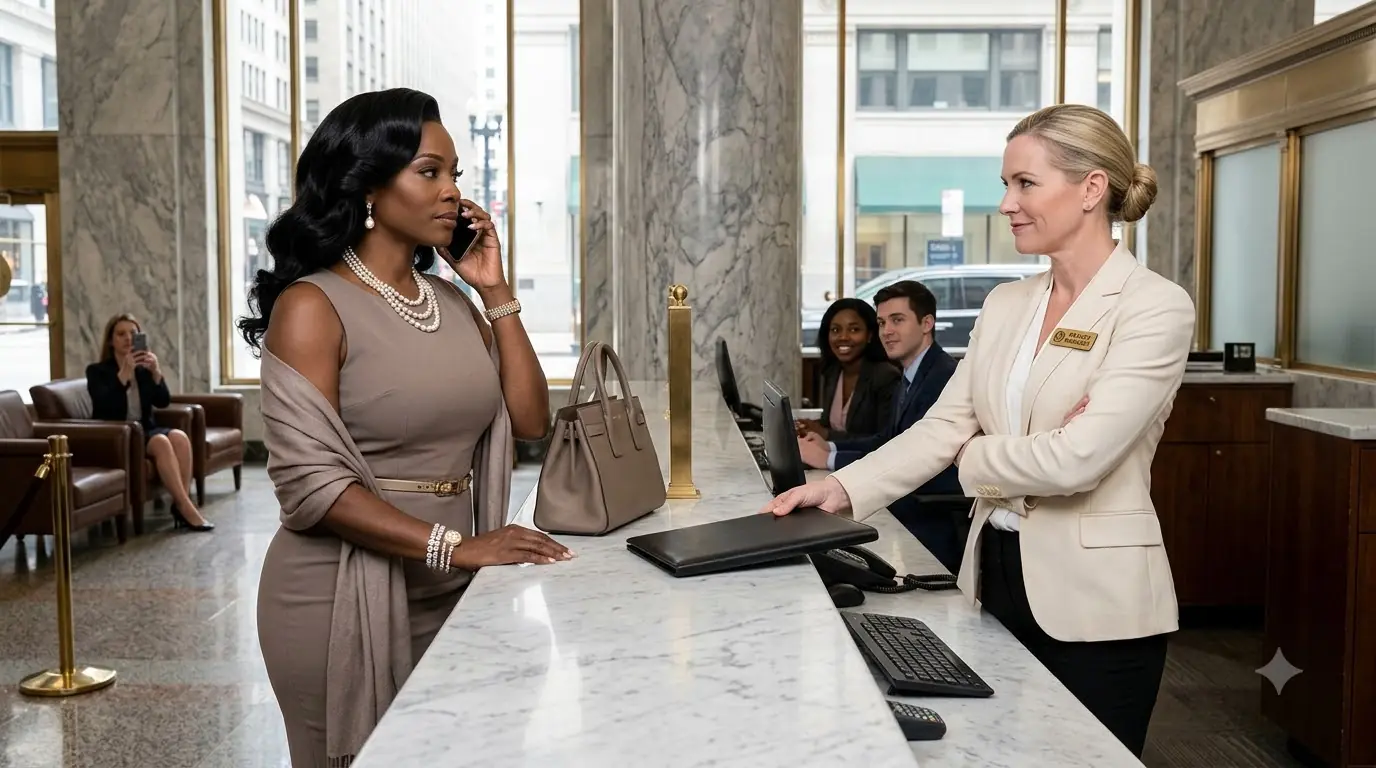
The Black woman standing opposite Rebecca did not react immediately.
That seemed to irritate Rebecca more.
Dr. Naomi Carter was forty-one years old, tall, elegant, and composed enough that strangers often mistook silence for softness. Her deep-brown skin glowed beneath the clean morning light pouring through the bank’s floor-to-ceiling windows, and her long black hair had been arranged into large polished waves that framed a face journalists once described as “impossible to read during negotiations.”
Naomi disliked that description.
Her face was not impossible to read.
Most people simply noticed what they expected before they bothered studying what was actually there.
That morning, she wore a fitted taupe dress, a matching shawl draped loosely around her shoulders, pearl-and-diamond jewelry, nude heels, and a narrow gold belt. Her handbag rested beside one leg. No assistant stood behind her. No security detail waited nearby.
Nothing announced why she had entered First National Bank’s flagship Chicago branch.
That had been intentional.
Naomi placed one hand on the portfolio.
“You haven’t opened it.”
Rebecca’s mouth tightened.
“I don’t need to.”
“You haven’t asked my name.”
“I have a lobby full of appointments.”
“I have one.”
Rebecca looked Naomi up and down again.
There it was.
The calculation.
Naomi had seen it in hotels, boardrooms, private clubs, investment conferences, universities, and once at a hospital where a donor coordinator had assumed she was a patient’s assistant despite her name appearing on the event program.
Age.
Race.
Clothing.
Who stood beside you.
How confident you appeared.
How much inconvenience someone thought you could create if treated badly.
People made these calculations constantly.
What changed from place to place was how well they hid them.
Rebecca did not hide hers well.
“Private banking appointments are verified before clients reach this desk,” she said.
“Then verify mine.”
Rebecca leaned slightly forward.
“Ma’am, I have been running this branch for twelve years.”
Naomi waited.
“I know exactly what kind of client is expected upstairs.”
One of the younger associates behind Rebecca looked toward the floor.
The other almost smiled.
Naomi noticed both.
She also noticed the customer sitting in the leather lounge near the windows raise her phone discreetly.
Interesting.
Naomi looked back at Rebecca.
“My appointment is at ten.”
“It is already after ten.”
“Because you’ve been explaining why you won’t check.”
Rebecca’s eyes hardened.
“I’m trying to save both of us time.”
Naomi picked up her portfolio.
“Whose time?”
Rebecca sighed.
Then spoke slowly, as if addressing someone who had become deliberately difficult.
“Clients using our executive private-banking services generally maintain substantial balances, investment relationships, or corporate accounts.”
Naomi said nothing.
Rebecca continued.
“This is not a retail teller branch.”
“I’m aware.”
“Then perhaps another location would be more appropriate.”
Naomi tilted her head.
“Appropriate for what?”
Rebecca’s patience snapped.
“For whatever business you have.”
The lobby had become quieter.
Not silent.
The bank was still operating.
Phones rang.
Printers hummed.
The revolving doors turned.
But attention had gathered around the marble counter.
Naomi looked toward Rebecca’s gold name badge.
REBECCA SLOAN — SENIOR BRANCH DIRECTOR
She memorized it.
Then reached into her handbag.
Rebecca’s expression changed slightly, perhaps expecting identification.
Naomi removed her phone instead.
“Who are you calling?” Rebecca asked.
Naomi unlocked the screen.
“Someone who can verify my appointment.”
Rebecca laughed.
Actually laughed.
“No phone call is going to change our standards.”
Naomi looked at her.
“You’re probably right.”
That answer confused Rebecca.
Naomi tapped one saved contact.
BOARD OFFICE.
The call connected after one ring.
“Executive office.”
“This is Naomi.”
The voice on the other end changed instantly.
“Dr. Carter. Good morning.”
“Good morning, Daniel.”
Rebecca’s smile remained.
She could not hear the response.
Naomi continued.
“I’m downstairs.”
Pause.
“Yes, Chicago flagship.”
She looked directly at Rebecca.
“No, apparently I don’t have an appointment.”
Rebecca’s smile faltered.
Naomi listened.
“No, don’t send security.”
Another pause.
“I’d like the regional president, HR, compliance, and whoever currently supervises this branch.”
Rebecca stared.
Naomi’s tone remained conversational.
“Yes.”
“Five minutes is fine.”
She ended the call.
Rebecca folded her arms.
“You understand that impersonating an executive contact can result in removal from the property.”
Naomi slipped the phone back into her handbag.
“I understand many things.”
Rebecca pointed toward the entrance.
“I’m going to give you one opportunity to leave voluntarily.”
Naomi looked toward the security guard.
He had not moved.
Good.
Then she looked back at Rebecca.
“I’ll wait five minutes.”
Rebecca reached for the desk phone.
That was when the elevator doors opened.
Three men and two women stepped out.
The first man was Daniel Foster, general counsel to First National Holdings.
Beside him walked Clara Whitfield, head of human resources.
Behind them came Michael Rosen, regional banking president, Priya Shah, chief compliance officer, and an administrative assistant carrying a tablet.
Rebecca’s hand stopped above the telephone.
Michael saw Naomi.
His pace quickened.
“Dr. Carter.”
Rebecca froze.
Michael crossed the lobby and extended his hand.
“Welcome to Chicago.”
Naomi shook it.
“Thank you.”
Daniel Foster smiled professionally.
“We weren’t expecting you downstairs.”
“I noticed.”
Nobody laughed.
Rebecca looked from Naomi to Michael.
Then to Clara.
Then back.
The realization came gradually.
Not because the facts were difficult.
Because her mind was rejecting them.
Michael turned.
“Rebecca, have you met Dr. Naomi Carter?”
Rebecca’s mouth opened.
Nothing came out.
Michael continued.
“Dr. Carter is incoming chief executive of First National Holdings.”
Still silence.
“And chairman of Carter Meridian Capital.”
Rebecca’s face drained.
Three weeks earlier, Carter Meridian Capital had completed a controlling acquisition of First National’s parent company.
The transaction dominated financial media for days.
Rebecca had attended two internal briefings about it.
She knew the incoming CEO’s name.
She had apparently never bothered remembering her face.
Michael added the final sentence.
“She is also the group’s new majority controlling shareholder.”
The younger associate behind Rebecca dropped a pen.
It struck the marble counter loudly.
Naomi looked toward Rebecca.
Five minutes earlier, Rebecca had told her she did not belong in the lobby.
Now the lobby belonged, in a very real financial sense, partly to Naomi.
Rebecca swallowed.
“Dr. Carter…”
Naomi waited.
“I… I didn’t realize.”
“I know.”
Rebecca looked toward Michael.
“There’s been a misunderstanding.”
Naomi’s expression finally changed.
Not much.
“A misunderstanding about my appointment?”
“Yes.”
“You never checked it.”
Rebecca looked trapped.
Naomi continued.
“A misunderstanding about my identity?”
“I apologize.”
“You never asked my name.”
The lobby had gone completely silent now.
Naomi looked toward the unopened leather portfolio.
Then at the employees behind Rebecca.
Then toward the customer still holding her phone.
“Michael.”
“Yes?”
“Is there a private conference room?”
“Of course.”
“I’d like Rebecca there.”
Rebecca exhaled faintly.
Naomi continued.
“And those two associates.”
Their smiles disappeared.
“Also security.”
The guard looked startled.
“And preserve every camera angle covering this lobby from nine-thirty onward.”
Priya Shah was already taking notes.
Naomi picked up her portfolio.
“One more thing.”
Michael waited.
“I want the last three years of service complaints involving this branch.”
Rebecca went still.
“And all complaints closed as customer misunderstanding, inappropriate conduct, identity-verification failure, suspicious-activity concern, account suitability, or staff discretion.”
Priya looked toward Naomi.
“That could be substantial.”
“Good.”
Naomi turned toward the elevator.
“I didn’t come here to fire one person because she embarrassed me.”
Rebecca seemed to breathe again.
Then Naomi finished.
“I came here to find out whether she felt safe doing it because this branch taught her she could.”
Nobody moved for a second.
Then the investigation began.
Three weeks earlier, when the acquisition closed, Naomi had told the First National board that she planned to visit branches anonymously.
Several directors objected.
Not because they disliked the idea.
Because they considered it unnecessary.
“You’ll get distorted information,” one said.
“Staff will eventually recognize you.”
“Then I’ll learn how long recognition takes.”
Another director suggested secret shoppers.
Naomi already used them.
But secret shoppers answered specific questions.
Were customers greeted?
Were documents handled correctly?
Were disclosures made?
Were products explained?
Naomi wanted to understand something less measurable.
Culture.
She had spent eighteen years studying how institutions failed.
Her doctorate was in organizational economics. She had worked at a major investment bank, founded Carter Meridian Capital at thirty-two, and built the firm around acquisitions of institutions with strong underlying businesses and weak governance.
She believed numbers revealed outcomes.
Behavior revealed causes.
First National looked healthy on paper.
Profitable.
Stable deposits.
Strong commercial relationships.
But three things bothered her during due diligence.
Employee turnover in certain urban branches was unusually high.
Customer complaints showed large geographic variations that executives could not adequately explain.
And several branches generated suspiciously strong private-banking conversion rates while serving diverse neighborhoods.
That final number sounded good.
Naomi distrusted numbers that sounded too good.
Conversion rate could mean excellent service.
Or aggressive screening.
Or customers being redirected, discouraged, or pushed away before they entered the official measurement system.
Chicago flagship was one of those branches.
Naomi selected it first.
The private conference room sat on the third floor overlooking LaSalle Street.
Rebecca entered with Clara Whitfield and Priya Shah.
The two associates followed.
Their names were Melissa Grant and Jason Cole.
Naomi sat at the head of the table but did not remove her shawl.
Michael Rosen stood near the windows.
Daniel Foster remained by the door.
Rebecca looked frightened now.
Not arrogant.
Naomi found that transformation deeply unsatisfying.
Fear after power appeared was not evidence of respect.
It was evidence of self-preservation.
Naomi opened her portfolio.
Inside were no investment statements.
No corporate documents.
Only a printed appointment confirmation.
She slid it across the table.
10:00 a.m.
DR. NAOMI CARTER
EXECUTIVE REVIEW — CHICAGO FLAGSHIP
Rebecca read it.
Her eyes closed.
Naomi asked:
“Would checking the appointment system have shown this?”
Rebecca swallowed.
“Yes.”
“Would asking my name have allowed you to check?”
“Yes.”
“Did I give you any reason to believe I represented a security threat?”
“No.”
“Did I behave aggressively?”
“No.”
“Was I improperly dressed?”
Rebecca hesitated.
“No.”
Naomi leaned back.
“Then explain the decision.”
Rebecca looked toward Clara.
Clara said:
“Answer Dr. Carter.”