Before the lemonade stand, most people in Owensboro knew Caleb Dawson only as Gravel.
Nobody asked why.
They saw the shaved head, the gray beard, the tattoos crawling up both sides of his neck, and the scar that split one eyebrow clean through. They heard his Harley rolling down Second Street before sunrise and decided the name must have come from something violent.
It had not.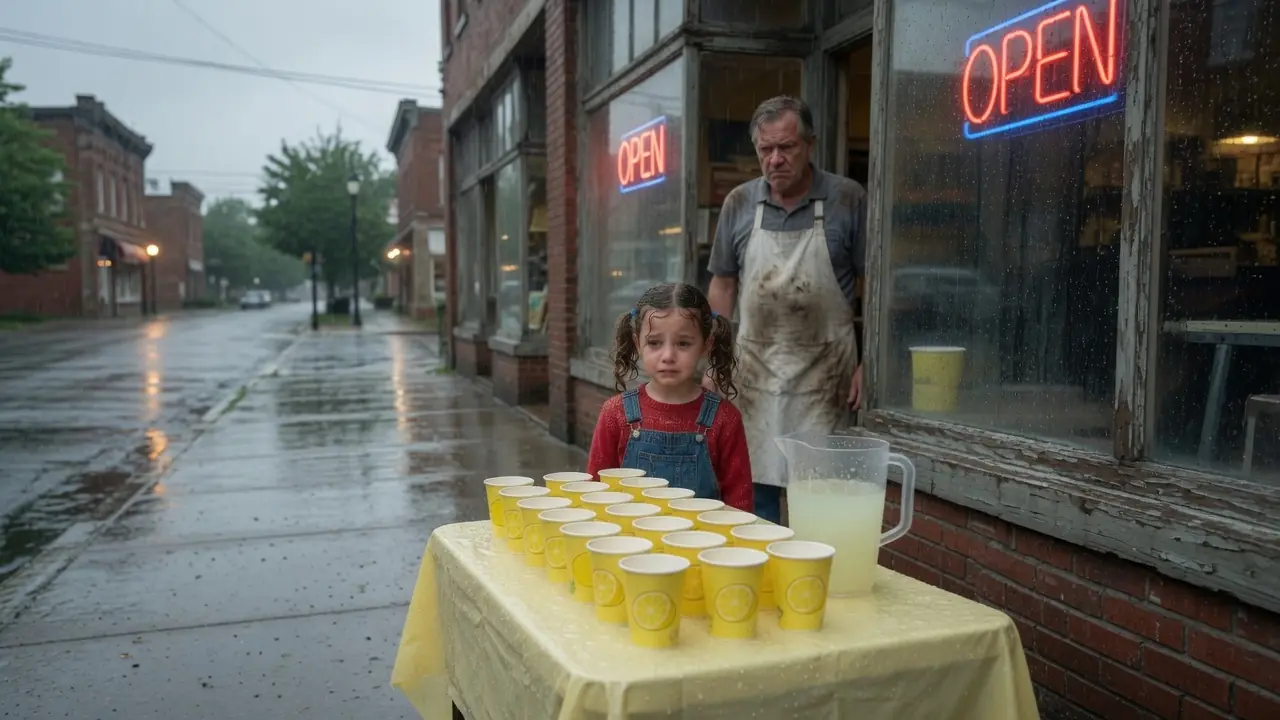
He got it from road work.
For eighteen years, Caleb had poured asphalt, welded guardrails, patched bridges, and hauled crushed gravel in heat that made the highway shimmer. The name stuck because he always came home with dust in his boots and little pieces of road in the cuffs of his jeans.
But strangers preferred their darker stories.
They saw his leather vest and filled in the rest.
I knew more than most because Caleb, his wife, and their little girl lived above my bakery for almost two years.
My name is Ruth Marlow, and I own Marlow’s Sweet Table on the corner of Third and Maple. The apartment upstairs was supposed to be storage, but after my husband died, I cleaned it out and rented it cheap to people who needed a door that locked and a landlord who did not ask questions like a bank.
Caleb and Hannah Dawson arrived one December evening with three duffel bags, a box of chipped dishes, a crib mattress, and a little girl wrapped in a pink blanket.
Maisie was fourteen months old.
Hannah carried the baby.
Caleb carried everything else.
He had lost his job when the bridge crew shut down for the season and never reopened. Their landlord in Henderson sold the house out from under them. Two days later, the engine in their truck gave up on the side of Route 60 like it had been waiting for the worst possible moment.
They crossed the Ohio River with fifty-three dollars and a motorcycle Caleb refused to look proud of owning.
The Harley was the only valuable thing they had left.
I told Hannah as much while Caleb was outside tying a tarp over their belongings.
“You could sell that bike and breathe easier for a while,” I said.
Hannah looked through the bakery window at her husband standing in the sleet, one hand on the motorcycle seat, the other rubbing at the back of his neck.
“That bike belonged to his brother,” she said.
I went quiet.
“Died in Afghanistan,” she continued. “Caleb won’t say it that way because he thinks grief sounds better when it’s shorter.”
“Still,” I said carefully, “rent is rent.”
Hannah reached under her sweater and unclasped a small gold pendant from around her neck.
It was an oval locket, dull from age, with a hinge that did not quite close straight. Inside were two tiny photographs. One of Hannah’s mother as a young woman, and one of Hannah missing both front teeth, smiling like life had not shown its teeth yet.
“My mother gave me this,” she said.
Then she placed it in Caleb’s palm that night and told him to pawn it.
He argued.
She won.
Hannah was soft-spoken, but nobody who knew her ever confused that with weakness.
The locket paid for groceries, a deposit on the apartment, medicine when Maisie caught a lung infection, and two tires for a truck they eventually fixed because Caleb needed something with a bed for work.
He promised Hannah he would get the locket back after his first steady paycheck.
Then Maisie got sick again.
Then the truck needed a starter.
Then the pawnshop changed owners.
By the time Caleb went back with the ticket folded in his wallet, the locket had been sold.
He came home that evening and told Hannah the truth.
She put her hand on his face and said, “It was only a thing.”
Caleb nodded.
But he never believed her.
For seven years, he carried the old pawn ticket inside his leather vest.
Not because it could bring anything back.
Because guilt, in his mind, deserved paperwork.
Caleb belonged to a motorcycle club called the River Saints.
Despite the name, they were not especially saintly. They were welders, mechanics, veterans, roofers, tow-truck drivers, one retired school custodian, and a woman named Della Ray who could rebuild an engine and end an argument with the same calm expression.
They did charity rides for sick kids, veteran escorts, storm cleanup, and quiet things nobody posted online.
Caleb had been with them nearly twenty years.
He planned routes.
He fixed bikes.
He showed up at hospitals before families knew what to ask for.
But if he needed help himself, he turned into a locked door.
If the roof leaked, he patched it alone.
If his hand swelled after work, he wrapped it in tape and kept going.
When a grinder accident cut through two tendons and took him off the crew for almost a month, he told the club after the surgery.
Gideon Pike, the club president, nearly lost his temper over that.
Everybody called him Preacher, not because he preached for a church, but because he could turn a simple sentence into a judgment that followed you home.
“You would ride through a tornado if Della needed a tire changed,” Preacher told Caleb outside the shop one evening.
“Different thing.”
“It is only different because it is you bleeding.”
Caleb looked away.
That was his habit when words came too close.
Maisie inherited his stubbornness without inheriting his silence.
She was seven years old when the lemonade idea began.
It happened because she overheard Hannah talking in the bakery.
Hannah was working two shifts at the assisted living home then, mostly nights, mostly on her feet, mostly smiling at people who no longer remembered where they were. Her birthday was coming, and my assistant asked what she wanted.
Hannah laughed from the end of the counter.
“Eight hours of sleep and my mother’s locket back, if heaven is granting impossible things this year.”
She meant it lightly.
Maisie did not hear it lightly.
Children do that.
They catch the one sentence adults toss away because it hurts too much to hold.
That evening, Maisie asked Caleb what a locket cost.
He was at the kitchen table fixing a broken kitchen drawer because he could not sit still after dinner.
“What kind of locket?”
“One that opens.”
“Depends.”
“One that is gold.”
“Real gold?”
“Mom gold.”
Caleb paused.
“That is a special kind.”
“I have nine dollars and forty cents.”
He looked at her then.
She was sitting cross-legged on the floor with her glass money jar in her lap. Inside were coins, two one-dollar bills, a movie ticket stub she considered valuable, and a button shaped like a strawberry.
“Why are you asking?”
Maisie looked down.
“Because Mom misses something.”
Caleb closed the drawer slowly.
The next morning, she came into my bakery and asked if I knew where people bought lockets.
I should have sent her to a department store.
Instead, I walked her down the block to Wilson’s Antiques because I knew what was in the front window.
A small oval gold locket sat on blue velvet beside a row of costume brooches.
It was not Hannah’s.
But it was close enough to hurt.
The price tag said ninety-six dollars.
Maisie counted her money again that night.
Then she asked Caleb to build her a lemonade table.
He agreed before knowing why, which fathers often do when their daughters look serious and small.
He built it from scrap cedar at the River Saints’ garage. He sanded every edge smooth enough that no splinter could find a seven-year-old hand. He painted the top yellow because Maisie said yellow made people thirsty, and he repainted one leg when she decided the first yellow was “too bossy.”
The club offered to be her first customers.
Caleb refused.
“She wants to earn it,” he said.
Preacher studied him.
“Or you want her not to know we helped.”
Caleb kept painting.
“She set the rules.”
“Seven-year-olds set all kinds of rules.”
“This one matters.”
It did matter.
Nobody understood how much yet.
Saturday began warm and bright.
Maisie squeezed lemons until her fingers were sticky and sore. Hannah had picked up a double shift at the assisted living home and would not be back until supper. That gave Maisie one day to make enough money for the locket before her mother’s birthday.
At noon, Caleb carried the yellow table to the corner by my bakery.
Maisie arranged paper cups, a hand-lettered sign, and the money jar.
LEMONADE $1
NO FAMILY DISCOUNTS
I laughed when I saw that.
Caleb did not.
He had already tried to buy a cup.
She had rejected him on principle.
By one o’clock, clouds began stacking over the river.
By one-thirty, the first drops fell.
I watched from my bakery window as Caleb and Maisie argued beneath the maple tree. He pointed toward the stairs, toward shelter, toward common sense. Maisie pointed toward the antique store across the street where the locket sat in the window like time was running out.
Her voice carried through the rain when it strengthened.
“Her birthday is tomorrow.”
“We can try again next week.”
“It might be gone.”
“We will find another one.”
“It will not be that one.”
Caleb looked across the street.
He understood then that Maisie was not buying jewelry.
She was trying to heal a wound she had only seen around the edges.
He said something I could not hear.
Maisie folded her arms.
A moment later, he opened the black umbrella.
At first, I thought he was sharing it with her.
Then the rain came harder, and I saw the truth.
Caleb stood behind the weak corner of the table, holding the umbrella so fully over Maisie that his own right shoulder was completely exposed. Rain ran down his shaved head, through his beard, off his leather vest, and into his boots.
Maisie looked up.
“Dad, come closer.”
“Table leg is sinking.”
It was not.
She looked at the leg.
Then at him.
“You are lying.”
“For safety reasons.”
She tried to move the umbrella handle toward him.
He moved it back.
That went on three times.
Finally, he crouched and said something that made her stop fighting.
Later, she told me the words.
“Dads are mostly waterproof.”
She knew that was not true.
She allowed him the lie.
No customers came.
Cars passed with their wipers moving fast. A woman in a blue sedan slowed, looked at the tattooed biker and the little girl under the umbrella, then drove on. A man leaving the pharmacy laughed and shook his head like the whole thing was somebody else’s bad parenting.
Caleb saw him.
Said nothing.
Maisie rearranged the cups.
Again.
Hope can be harder to watch than sorrow when it belongs to a child.
At one point, Caleb reached for his wallet.
Maisie slapped both hands over the money jar.
“No.”
“One cup.”
“You live upstairs.”
“I still get thirsty.”
“No family customers.”
He looked at her.
“That is a cruel business model.”
She nodded.
“I know.”
Across the intersection, Preacher had stopped under the gas station canopy to fill his bike after returning from a funeral escort.
He saw Caleb standing in the rain.
He saw Maisie under the umbrella.
He saw the yellow table dry as a church bulletin while Caleb’s boots stood in water running along the curb.
Preacher took one photograph.
Not of Maisie’s face.
Not for the internet.
Just Caleb’s boots, the table leg, the umbrella tilted completely away from him.
Then he sent one message to the River Saints group chat.
Gravel says he needs nothing. Maisie is selling lemonade at Third and Maple. One dollar. Rain price is whatever your conscience can carry. No speeches. No charity talk.
He expected six riders.
Twenty-two came.
Della left a church potluck carrying half a pie in foil. Boone closed his transmission shop early and put a sign on the door that said BACK SOON IF LIFE ALLOWS. Luis rode from ten miles out with work grease still on his forearms. Mac and Joey turned around halfway to Bowling Green when the message hit.
Even Mason Vale came.
Mason was not a full member. He was the seventeen-year-old son of a River Saint named Rook, and the two had barely spoken all winter after a fight neither one of them knew how to repair.
Rook saw the message while sitting with Mason in a diner, trying and failing to make conversation.
He set the phone down.
Mason read it upside down.
“Go,” the boy said.
Rook shook his head.
“We just got food.”
“I will ride with you.”
Rook looked at him.
Mason shrugged, embarrassed by his own offer.
“Somebody should buy lemonade.”
That was the first time the boy had asked to ride with his father in almost a year.
By the time the first engines rolled down Maple Street, Caleb knew exactly what had happened.
His shoulders tightened.
He stepped slightly in front of the table because he feared Maisie would misunderstand the sight of twenty-two motorcycles arriving in the rain.
She wanted customers.
Not pity.
Preacher understood that before anyone said it.
He parked first, shut off his engine, removed his helmet, and walked up alone.
“One lemonade, please.”
Maisie straightened like a shopkeeper twice her age.
“That will be one dollar.”
She poured carefully.
Preacher took the cup, tasted it, and blinked only once at how sour it was.
Then he placed a twenty-dollar bill on the table.
Maisie frowned.
“It is one dollar.”
“I have a large motorcycle. Large thirst.”
“It is raining.”
“Thirst can survive rain.”
Caleb’s jaw worked.
“Take nineteen back.”
Preacher looked at him.
“I have no change.”
“You own two garages.”
“Terrible with money.”
Maisie giggled.
That was the first time she had laughed since the rain started.
The second rider paid twenty.
The third paid fifteen and said he was on a budget because Della had already taken his pie money.
Caleb objected after the fourth.
Della leaned over the table, rain dripping from the brim of her cap.
“Your daughter priced the lemonade. She did not cap the tips.”
Maisie looked at me beneath the bakery awning.
“Do tips count as earning?”
“They do at my bakery,” I said.
Caleb looked betrayed.
I shrugged.
“Business is business.”
The line continued.
No one crowded her.
Engines stayed off.
Helmets came off.
Every rider waited his turn like he was standing in church.
Boone told Maisie the lemonade had “strong structural integrity.” Luis took one sip and said it could wake the dead and maybe remove rust from a fender. Della bought two cups and declared the second one was for her “emotional support thirst.”
Nobody asked for more sugar.
That was kindness too.
The last customer was Mason.
He stepped up with soaked hair, no vest, and a five-dollar bill folded tight in his hand.
“I only have five.”
Maisie pushed four dollars back.
“You are a kid.”
“I am seventeen.”
“That is almost a kid.”
He looked offended.
Then he took the change.
Behind him, Rook turned his face toward the street.
Rain hid some things.
Not all.
When the pitcher was empty, Maisie carried the jar beneath the umbrella and counted the money on the table with the focus of a banker.
Three hundred eighty-two dollars.
She counted twice.
Then she looked at Caleb.
“I can buy Mom’s locket.”
Caleb turned away.
His big shoulders moved once.
Not much.
Enough.
Every River Saint suddenly found something else to look at.
Preacher studied his front tire like it had begun speaking.
Boone looked at the clouds.
Della wiped rain from her cheek and blamed the weather.
That was one of the better rules of their brotherhood.
Show up.
Witness the thing.
Do not steal a man’s dignity by staring at where he breaks.
The first twist came from Wilson’s Antiques.
Preacher had gone there before the club arrived, only intending to make sure the window locket did not sell before Maisie could cross the street.
But when the owner heard Hannah Dawson’s name, she went quiet.
Then she unlocked the back safe.
Hannah’s original locket had returned to town two weeks earlier.
The woman who bought it years ago had passed away, and her grandson brought several items to Wilson’s for appraisal. Inside the locket were Hannah’s family photographs and the old pawnshop inventory number. The owner had traced the ticket to Caleb Dawson and had been trying to reach him through an address that no longer existed.
Preacher bought the newer locket only to hold it for Maisie in case the original could not legally be released.
When he showed Caleb the old one in the small velvet box, Caleb recognized the crooked hinge before the lid even opened.
His face went pale under the rain.
For seven years, he had imagined getting that locket back.
Now that it was close enough to touch, he looked afraid of it.
Afraid Hannah would see poverty inside it.
Afraid she would remember selling a piece of her mother so their daughter could breathe through pneumonia.
Afraid the gift would feel less like love and more like a wound reopened in a prettier box.
“Tell Maisie,” Preacher said.
“Tomorrow.”
“You waited seven years.”
“One more day will not kill me.”
Maisie stood beside them with the jar held against her chest.
“What is in the box?”
Caleb swallowed.
“Your mother’s history.”
She looked from him to Preacher.
“Is history expensive?”
Preacher almost smiled.
“Depends who had to carry it.”
Maisie handed Caleb the jar.
“Then tell it true.”
Seven years old.
No mercy.
They crossed to Wilson’s Antiques together.
The River Saints stayed outside because Caleb did not want twenty-two wet leather vests turning his family’s moment into a public scene. Preacher sent them to my bakery, where I served coffee, pie, and towels while rainwater pooled under every boot in the room.
Across the street, Maisie placed ninety-six dollars on the antique counter.
The owner took one dollar.
Caleb shook his head.
“No. She earned the price.”
The woman looked at Maisie.
“I am respecting the sale. One dollar holds the item. The rest returns to the buyer.”
She pushed the money back.
Then she placed both lockets on the counter.
The newer one shone under the lamp, clean and pretty, with a perfect hinge.
The older one was scratched, dull, and bent slightly along the edge.
Maisie picked up the old one immediately.
“This one.”
Caleb’s voice went rough.
“The new one is prettier.”
Maisie opened the old locket.
Hannah’s mother looked out from one side.
A little girl version of Hannah smiled from the other, missing her front teeth and looking so much like Maisie that even the shop owner turned away.
“This one knows Mom,” Maisie said.
The hinge repair cost thirty-eight dollars.
Maisie paid it from the jar.
She used the rest for a birthday cake, flowers, and a card with too many stickers.
Not charity.
A transaction.
Hers.
The second problem arrived before supper.
Somebody had uploaded security footage from the gas station across the intersection.
Without sound, the clip looked ugly.
It showed a line of motorcycles surrounding a little girl’s lemonade stand in the rain. It showed men in leather leaning close to a yellow table. It showed Caleb standing behind his daughter, soaked and silent.
The caption said a biker gang had forced a child to stay outside during a storm for attention.
By evening, the video had been shared thousands of times.
People called Caleb reckless.
They called the club dangerous.
They claimed Maisie was being exploited.
One woman wrote that somebody should call child services.
Preacher wanted to release the full story.
Caleb refused.
“My daughter is not club publicity.”
“If we say nothing, they get to decide what happened.”
“They already did.”
“Hannah will see it.”
Caleb looked toward the stairwell, where Maisie was wrapping the locket with uneven tape and fierce concentration.
“Then I tell my wife before strangers do.”
The River Saints argued in my bakery, low but sharp.
Buying lemonade had been easy.
Protecting the meaning of it was harder.
In the end, Preacher called a vote, and the club released one statement.
A child voluntarily operated a lemonade stand with her father present. Our members purchased lemonade and left. The family requests privacy.
No names.
No photos of Maisie.
No story about the locket.
No demand for praise.
The internet wanted a fight.
The River Saints gave it a closed door.
Hannah came home at 7:15 wearing pale blue scrubs and shoes that looked like they had carried her through a twelve-hour shift and then begged for death.
She entered the bakery first because the lights were on and the room was full of bikers pretending they had not spent the day being rained on and insulted online.
She stopped.
Then she saw Caleb.
His shirt had dried in uneven patches. His beard still held rain at the ends. Maisie stood beside him with a crookedly wrapped box in both hands and a bakery cake on the counter behind her.
Hannah looked around slowly.
“What happened?”
Maisie stepped forward.
“I worked.”
Hannah’s face softened.
“That sounds serious.”
“I sold lemonade.”
“In the storm?”
“Dad had an umbrella.”
Every eye in the room went to Caleb.
Hannah looked at his wet boots.
Then his still-damp jeans.
“Of course he did.”
Maisie gave her the box.
Hannah opened it.
The bakery went completely still.
She saw the locket.
The scratch near the hinge.
The tiny photograph of her mother.
The photograph of herself as a child.
Her hand flew to her mouth, but no sound came out.
Caleb stepped closer.
“I pawned it.”
“I know.”
“I did not get it back.”
“I know that too.”
“I should have sold the bike.”
Hannah closed her fingers around the locket.
“No.”
“Your mother gave you that.”
“And your brother left you the Harley.”
“We needed food.”
“And we ate.”
Caleb looked like a man trying to keep standing under the weight of something invisible.
“I failed you.”
Hannah’s eyes filled then, not because she agreed, but because she was tired of hearing the sentence.
“You kept our baby alive,” she said. “You found work. You stayed. You carried everything up those stairs when we had nothing. Stop turning the worst month of our marriage into proof you were the worst man in it.”
The whole room went quiet in a different way.
Maisie tugged his sleeve.
“Mom likes it.”
Caleb swallowed.
“I see that.”
“Did I fix it?”
Hannah knelt in front of her.
“You brought it home. That is different.”
Maisie thought about that.
Then nodded, satisfied.
Caleb understood it too.
Some things cannot be restored to what they were.
They can still come home.
The security camera truth came the next morning.
The reporter who had called Preacher also called me and asked if my bakery camera captured the lemonade stand. It did. I reviewed the footage alone before opening.
At 1:46, while Maisie was writing something in her notebook, Caleb tried to move the umbrella toward himself.
Maisie noticed.
She stood on a chair and pushed it back toward him.
He moved it over her again.
She pushed.
He returned it.
Three times they had that silent argument in the rain.
Then Caleb crouched, spoke the words about dads being waterproof, and Maisie let him lie.
At 2:03, the camera caught something else.
Caleb took two folded twenty-dollar bills from his wallet.
He looked at Maisie’s money jar.
Then at the antique store.
Then he put the bills away.
He could have pretended to be a customer.
He could have solved her problem in ten seconds and spared himself the rain, the humiliation, the waiting.
He did not.
Maisie wanted to earn the gift from people who did not owe her love.
Caleb respected that, even while watching her fail.
That was what the security camera really caught.
Not a tattooed biker endangering his child.
A father strong enough to stand in the rain and not rescue his daughter from the work she had chosen.
I gave the footage to the Dawsons.
Not the reporter.
Caleb watched it once.
Then asked me to delete my copy.
I did.
Some evidence is meant to prove a story.
Other evidence is meant to protect one.
The next summer, Maisie set up the yellow table again.
This time, the sky was clear.
She sold lemonade for one dollar, and a line formed before she had even finished arranging the cups. Caleb made one rule.
“No tips over five dollars.”
Preacher arrived first with exact change and a face full of disrespect.
“Is this club policy?”
“Parental policy.”
“I object.”
“Buy the lemonade or move along.”
Maisie poured his cup.
Della came with her granddaughter.
Boone came with two roofers and a jar of quarters.
Rook came with Mason, and this time Mason rode his own bike behind his father’s, still awkward, still proud, but no longer pretending he did not want to be there.
The River Saints did not arrive all at once.
They came one by one throughout the afternoon so ordinary customers would not feel crowded.
That mattered.
They had learned the difference between showing up and taking over.
Maisie made one hundred twenty-four dollars.
She used it to buy school supplies for children whose grandparents lived at Hannah’s assisted living home and were raising them on fixed incomes.
Nobody suggested it.
That was just who she was becoming.
The locket became Hannah’s Sunday jewelry.
She wore it to church, to family dinners, to Maisie’s school concerts, and sometimes to work when a resident was having a bad day and needed something beautiful to hold. The hinge remained slightly crooked, even after repair.
Caleb offered once to have it fixed properly.
Hannah closed her hand over it.
“No.”
“It still sits wrong.”
“Maisie paid for that hinge.”
That ended the discussion.
The pawn ticket stayed inside Caleb’s leather vest for another year.
Hannah found it while repairing a torn seam near the shoulder. She placed it on the kitchen table without accusation.
“You do not need this anymore.”
Caleb looked at it.
“I know.”
“Then why carry it?”
He rubbed the scar across his eyebrow.
“Reminds me what things cost.”
Hannah turned the ticket over.
On the blank side, she wrote:
WE MADE IT HOME.
Then she handed it back.
Caleb carried that version for one more year.
After that, he placed it in Maisie’s memory box beside a photograph from the first lemonade stand.
Not the viral one.
The quiet one I took after the motorcycles left.
Maisie stood under the umbrella with an empty pitcher in her hands. Caleb stood behind her, soaked from head to boots, one hand pressed over his eyes like he could hold himself together if he kept still enough.
Years passed.
The River Saints began using the phrase lemonade weather.
It did not mean rain.
It meant someone needed help but would never ask for it.
When Boone’s wife started chemotherapy, Preacher sent two words to the group.
Lemonade weather.
Fourteen riders showed up to drive her to treatments, mow the yard, and fix the porch rail.
When Rook lost his apartment after the machine shop closed, nobody offered charity because they knew pride could make a man refuse survival. They hired him to repair the clubhouse roof and paid him upfront because materials cost money and so does dignity.
When Caleb needed a second surgery on his injured hand, he sent the message himself.
That was progress.
Preacher read it twice because Caleb had never asked first.
The next morning, twenty-two riders appeared at the hospital.
Caleb complained.
They stayed.
On Maisie’s twelfth birthday, she asked him about the lemonade stand while helping him sand a new shelf in the garage.
“Were you embarrassed when they all came?”
Caleb kept his eyes on the wood.
“A little.”
“Because people saw you needed help?”
“Because they saw I could not make your day work by myself.”
Maisie leaned against his arm.
“Maybe it was not supposed to work by yourself.”
He looked down at her.
“You been talking to Preacher?”
“He talks a lot.”
“That is his illness.”
She smiled.
The original yellow table eventually wore out.
Caleb kept one cedar plank from it and mounted it above his workbench. He did not paint words on it. He did not hang a plaque. He just kept the wood where he could see it.
Beneath it hung the old black umbrella.
One rib still bent from that first storm.
On Hannah’s fiftieth birthday, the River Saints gathered at Caleb and Hannah’s house with pies, folding chairs, too much food, and no need to pretend they were only a motorcycle club.
They were family by then.
Not neat family.
Not quiet family.
But family all the same.
After sunset, rain began tapping against the porch roof.
Maisie, now older than the lemonade stand and not yet too old for memory, stepped outside and opened the black umbrella. It sagged on one side. Caleb joined her in the yard.
She tilted it toward him.
He tilted it back over her.
“Dad.”
“What?”
“I am not seven.”
“Rain is still rain.”
“You are not waterproof.”
He looked toward the driveway where motorcycles shone under the porch light, each one catching the rain in silver streaks.
Then he looked back at his daughter.
“No,” he said softly. “I guess I’m not.”
This time, he stepped under the umbrella.
They stood shoulder to shoulder, neither of them fully dry.
Inside, Hannah opened the crooked locket and smiled at the two tiny photographs that had survived poverty, pawn tickets, strangers, rain, and time.
Outside, the rain kept falling.
Nobody needed to look away anymore.