The sycamore at Mercy Bell Park had been dying in front of everyone.
Nobody noticed.
Children climbed under it. Parents leaned strollers in its shade. Teenagers carved initials into the lower bark, and city workers mowed around its roots every Thursday morning without ever looking up long enough to understand what the tree was trying to say.
Caleb “Boulder” Hayes noticed.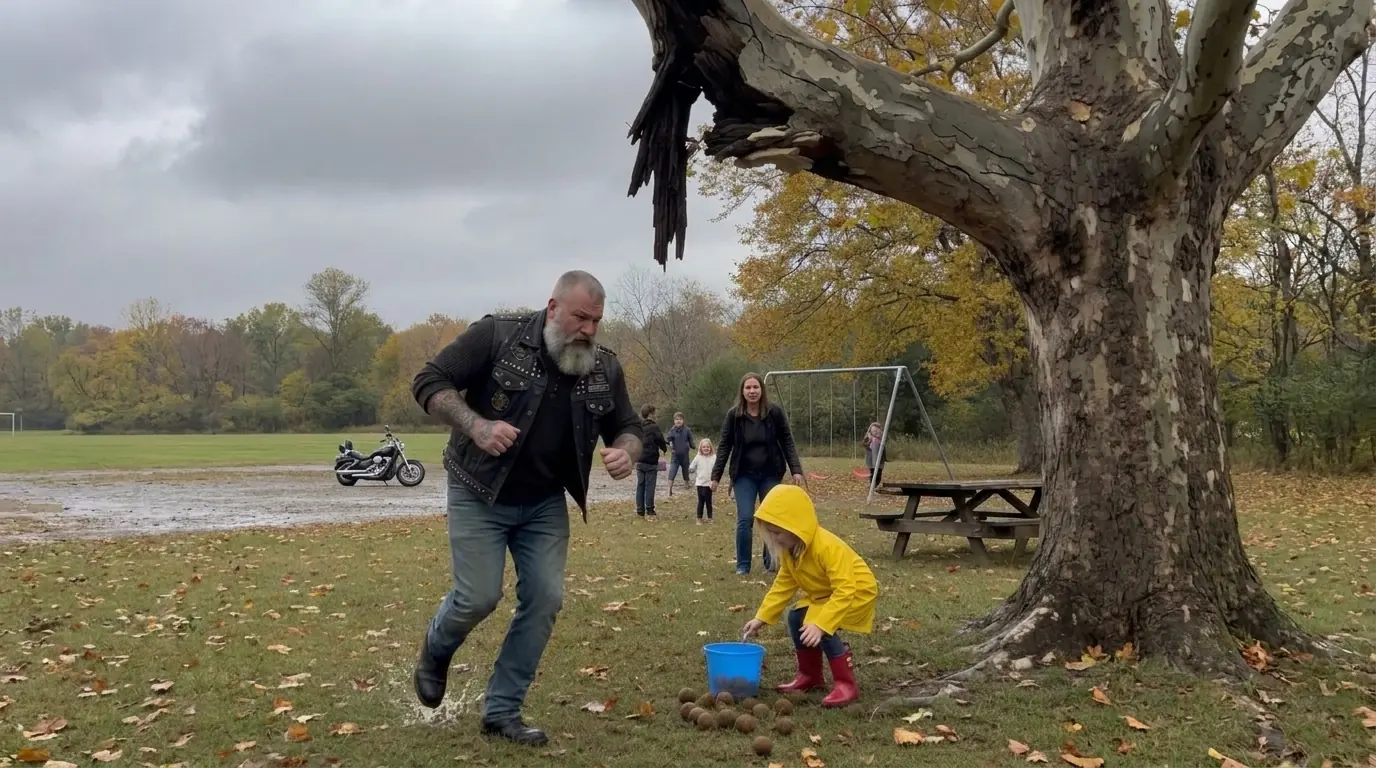
He noticed because old habits do not die just because a man changes jobs. For fifteen years, Caleb had worked for the tree safety division in the fictional city of Hollowbend, trimming storm-damaged limbs, inspecting public parks, and reading bark the way other people read faces. A healthy tree moved like one body in the wind. A damaged one moved in pieces.
That Saturday afternoon, Caleb had no reason to stop at Mercy Bell Park.
He had been riding back from a parts delivery on his black Indian Chief, the saddlebag holding two carburetor kits and a paper bag of barbecue he planned to eat standing over the workbench at his shop. The late October sky was heavy with low gray clouds, and the kind of wind that comes after three days of rain moved through Hollowbend with restless hands.
His right mirror started rattling near the park entrance.
Caleb pulled into the small gravel lot to tighten it.
He was forty-nine years old, six-foot-three, two hundred and seventy pounds, with a shaved head, a gray beard, and tattoos running from both wrists to the collar of his black shirt. His leather vest carried the patch of the Black River Riders, a motorcycle club that made some people cross streets before learning anyone’s name.
He was used to being misread.
Still, misreading gets heavier when children are near.
Caleb removed a wrench from his saddlebag and crouched beside the bike. He tightened the mirror bolt, checked the alignment, and was about to stand when the wind pushed through the park hard enough to make the swing chains clatter.
That was when the sycamore moved wrong.
Not all of it.
Just one great limb reaching over the picnic tables near the playground.
It dipped with the gust, then lifted too slowly. A healthy limb snaps back with the rest of the canopy. This one lagged, heavy and tired, like a shoulder pretending it still had strength after the bone had cracked beneath it.
Caleb stood.
He stared at the branch.
At the base of it was a dark vertical seam where the bark had split open years earlier. Around that seam, the wood had swollen oddly, forming a rough lip that looked solid from a distance but wrong up close. Near the trunk, pale fungus clustered in a crescent, half hidden by fallen leaves and wet grass.
His stomach tightened.
Then he saw the little girl.
She was maybe seven, wearing a yellow raincoat and red boots, crouched under the sycamore with a plastic bucket in one hand. She was collecting the round seed balls that had fallen from the tree and lining them up along the edge of the picnic table like treasure.
Her mother stood fifteen yards away near the swings, talking to another parent with a baby on her hip.
The girl’s name was Ava Monroe.
Caleb did not know that yet.
What he knew was that Ava was directly beneath the failing limb.
The wind hit again.
The branch dipped.
This time, Caleb heard it.
A low internal pop.
Not loud.
Not dramatic.
The kind of sound a tree makes before the world realizes gravity has been invited in.
Caleb dropped the wrench.
He ran.
He did not shout.
Shouting makes children look around. Looking around costs time. Time was the one thing the sycamore had already spent.
From the swing set, Ava’s mother, Tessa Monroe, saw only the running man.
A huge tattooed biker in a black vest was sprinting across the grass toward her daughter. His boots tore up wet leaves. His arms were out. His face was hard with focus, which looked like rage to anyone who did not know what he was seeing.
Tessa screamed.
“Ava!”
The little girl turned.
Too late.
Caleb reached her as the second crack split the air.
He wrapped one arm around Ava’s waist, lifted her clean off the ground, and kept running. Her bucket dropped. Seed balls scattered across the grass. She kicked once in panic, both red boots flashing, and screamed because a stranger’s arm had closed around her before she understood the danger.
That scream changed the park.
Parents turned.
A man near the slide shouted, “Hey!”
Another father started running toward Caleb.
Someone yelled, “He’s taking her!”
A woman grabbed her phone.
Tessa came across the grass so fast she almost fell, terror stretching her face into something Caleb would never forget. He had seen fear in parents before. He had seen it beside ambulances, outside school fences, in emergency rooms. But this fear had his shape in it.
To her, he was the threat.
Caleb ran five more steps.
Then the limb came down.
It fell like part of the sky had broken loose.
A thousand pounds of wet sycamore wood, leaves, and splintered bark crashed onto the exact patch of grass where Ava had been crouching. The picnic table shattered at one end. The bucket vanished beneath leaves. A heavy side branch struck the metal bench and bent it downward with a scream of steel.
The ground shook.
A cloud of dirt and torn leaves rolled outward.
The entire park went silent.
Even the children stopped crying for one impossible second.
Caleb turned his body as the smaller debris hit. A branch scraped across his shoulder, tearing the leather of his vest. Another piece cut his forearm. He held Ava against his chest until the last leaves stopped falling, then immediately set her on her feet and stepped back with both hands raised.
“I’m not touching her,” he said.
His voice came out rough.
“I’m not touching her.”
Tessa reached them and snatched Ava into her arms.
She held her daughter so tightly Ava coughed and complained, but Tessa could not let go. She looked at Caleb with the rage of a mother whose body had not yet received the new information. Her mind understood the branch. Her blood still saw a man grabbing her child.
“You took her,” Tessa whispered.
Then she looked behind him.
The fallen limb covered the place where Ava’s knees had been in the grass.
Tessa’s face changed.
Slowly.
Horribly.
The truth arrived too late to soften what had happened, but early enough to break her open.
“Oh my God,” she said.
Ava peeked over her mother’s shoulder.
“My seed balls got smashed.”
Nobody laughed.
Not yet.
A man named Jordan Pike stood near the slide holding his phone in one shaking hand. He had been filming his son climbing the monkey bars when Caleb ran across the grass. The video caught everything from the wrong angle: a biker grabbing a child, a mother screaming, parents chasing, and then the enormous limb falling into frame like a verdict.
Jordan lowered the phone.
“I thought he was kidnapping her,” he said.
“So did I,” Tessa whispered.
Caleb stayed where he was.
Several feet away.
Hands visible.
Breathing hard.
Blood ran from the cut on his arm and dripped onto the wet grass. A strip of torn leather hung from his vest shoulder. There were leaves caught in his beard, and one of Ava’s sycamore seed balls had rolled against his boot.
Ava pointed at him.
“Mom, he’s bleeding.”
Tessa looked.
For the first time, she really saw him.
Not the vest.
Not the tattoos.
Not the size of him.
The blood.
The shaking hands.
The way he had stepped back before she asked, as if he already knew how badly he looked in the story everyone had almost believed.
Sirens arrived seven minutes later.
That was how the police report described it.
Seven minutes.
To Caleb, it felt longer.
To Tessa, it felt like time had become a hallway with no doors.
Two patrol officers came first, followed by an ambulance and a parks department truck that had no reason to be there yet but somehow arrived because people love to appear after the danger has made its decision. The first officer, Dana Holt, separated witnesses and tried to make sense of the conflicting calls.
One 911 caller reported an attempted child abduction.
Another reported a tree collapse.
A third said a biker had saved a little girl.
The dispatcher probably thought three different emergencies were happening.
They were not.
They were one emergency seen from three different fears.
Paramedics checked Ava first. She had a red mark around her waist where Caleb had grabbed her, a scrape on one knee from being lifted too fast, and a tiny scratch near her elbow. Nothing else.
Nothing.
That word became too large for Tessa to stand under.
She sat on the curb beside the ambulance with Ava wrapped in a silver emergency blanket, rocking her even though the girl was perfectly alert and asking whether the seed balls could be rescued. A paramedic tried to clean Caleb’s arm, but he kept looking toward the fallen sycamore.
Officer Holt noticed.
“You knew it was going to break?” she asked.
Caleb did not answer quickly.
“I knew it might.”
“How?”
“I used to inspect trees for the city.”
Holt glanced at his vest.
“The city?”
He looked at her.
“People can have more than one chapter.”
She accepted that without apology, which he appreciated more than she knew.
The parks supervisor arrived next, a tired man named Edwin Lark with a clipboard, a bright orange jacket, and the defensive posture of someone who had already started hearing lawyers in his head. Caleb saw him glance at the sycamore, then at the crowd, then at the officers.
“This tree was scheduled for routine inspection next quarter,” Edwin said.
Caleb stared at him.
“Next quarter?”
Edwin’s jaw tightened.
“The park tree inventory is large. We prioritize based on submitted reports.”
Caleb walked toward the fallen limb.
Officer Holt stepped with him, not stopping him, just staying close.
Caleb pointed to the torn base.
“Old lightning seam. Fungal fruiting at the root flare. Deadwood in the upper crown. Bad response growth around the branch union. That limb was telling you it wanted to fall.”
Edwin looked uncomfortable.
“I do not know who you are, sir.”
“Caleb Hayes.”
The name landed.
Edwin knew it.
That was the first real twist of the day.
Because Caleb Hayes had not only worked for the city.
He had left it loudly.
Six years earlier, Caleb had written a hazard report on a cottonwood outside Willow Ridge Elementary. The report said immediate closure of the surrounding play area was necessary. His supervisor delayed action because the school district did not want parents complaining about lost recess space, and the city had already blown through its emergency removal budget.
Caleb pushed.
The supervisor ignored him.
Caleb stayed inside the chain of command because men with jobs and rent and daughters in college often tell themselves procedures exist for a reason.
Three days later, a limb fell during morning recess.
It struck a nine-year-old boy named Peter Lyle.
Peter lived.
He walked with a brace afterward.
Caleb attended the public meeting where officials used phrases like unfortunate event and unforeseeable failure. He had stood at the back of the room with his hazard report folded inside his jacket, unable to decide whether exposing the truth would help Peter or only save Caleb from his own guilt.
He resigned a month later.
Opened a motorcycle shop called Hayes Iron Works.
Joined the Black River Riders.
Stopped wearing city colors.
Never stopped reading trees.
Now Edwin Lark recognized him and went pale.
“You are the one from Willow Ridge,” Edwin said.
Caleb’s eyes hardened.
“Yes.”
Tessa heard the name Willow Ridge.
So did Officer Holt.
So did Jordan Pike, still holding his phone.
“What happened at Willow Ridge?” Tessa asked.
Caleb looked at Ava, then at the destroyed picnic table.
His voice lowered.
“A kid got hurt because people saw a report and waited.”
Nobody answered.
Because some sentences do not leave room for immediate conversation.
The park closed that afternoon.
By sunset, yellow caution tape surrounded the sycamore. City crews arrived to cut the fallen limb into sections. The remaining trunk was inspected the next morning and declared structurally compromised. Two additional limbs had internal decay.
Parents gathered near the fence, quieter now.
Many of them had brought their children to that park for years.
Many had walked beneath that sycamore.
Many had taken photos in its shade.
It is hard to admit that danger was present on ordinary days too, not just the day it announced itself.
Tessa did not sleep that night.
Every time she closed her eyes, she saw Caleb running with Ava in his arms. In the first version, he was taking her. In the second, the branch fell. In the third, she imagined what would have happened if he had stopped to explain.
That was the version that made her get out of bed and vomit in the bathroom sink.
Ava slept with three stuffed animals and one rescued sycamore seed ball she had found near the ambulance before they left. She had named it Mr. Spike.
Children survive terror strangely.
Sometimes they turn it into a character.
Tessa envied that.
Four days later, she drove to Hayes Iron Works.
The motorcycle shop sat near the old river bridge in a brick building with faded green trim and a roll-up garage door painted black. Inside, the air smelled like oil, rubber, metal, and coffee strong enough to remove paint. Three motorcycles stood on lifts. A radio played classic rock softly from a shelf.
Caleb was bent over an engine when Tessa and Ava walked in.
He looked up.
His face changed immediately.
“Is she okay?”
Not hello.
Not why are you here.
Is she okay?
Ava held up Mr. Spike.
“He survived.”
Caleb wiped his hands on a rag and nodded solemnly.
“That is a tough seed ball.”
Tessa stepped forward, holding an envelope.
“I came to apologize.”
Caleb looked at the envelope but did not take it.
“You saw a stranger grab your daughter.”
“I called you a kidnapper.”
“You reacted to what you saw.”
“I reacted to what I assumed.”
That made him quiet.
Tessa placed the envelope on the counter.
“It’s for your vest. And your arm. And whatever else I damaged when I screamed it in front of half the park.”
Caleb pushed the envelope back.
“The vest did its job.”
“Please.”
“No.”
“Mr. Hayes—”
“Caleb.”
She looked at him.
“Caleb. I need to do something.”
He studied her for a moment, then glanced at Ava.
“Then help me plant that.”
Ava looked delighted.
Tessa blinked.
“The seed ball?”
“Sycamore seeds. Most will not take. Some might. If Mr. Spike is as tough as she says, he deserves a chance.”
So that was what they did.
Not that day.
Caleb insisted on doing it properly.
The following Saturday, he met them near the riverbank with a small tray of soil, gloves, and a notebook. He explained that sycamores needed space, water, and patience. He explained that not every seed becomes a tree, and not every tree grows strong just because people want it to.
Ava listened like he was teaching magic.
Tessa listened like he was teaching penance.
Over the next month, Caleb showed Ava how to notice trees without being afraid of them. He pointed out mushrooms at the base, cavities in trunks, dead limbs that did not carry leaves, cracks shaped like lightning scars, branches that rubbed against each other until bark wore away.
“Trees are not monsters,” he told her.
Ava looked up at a young maple.
“But they can fall.”
“So can people. That does not make people monsters.”
That answer satisfied her.
It stayed with Tessa.
The video came out a week after the accident.
Jordan Pike posted it only after asking Tessa and Caleb. He did not cut the beginning. He did not remove the screams. He did not make the parents look foolish or the biker look saintly.
The caption read:
Sometimes a rescue looks like danger until the danger finally falls.
The video spread through local parent groups first. Then city pages. Then national accounts that loved stories with a dramatic wrong angle. Strangers argued in the comments, because strangers online can turn even a child’s survival into a debate.
He should have shouted.
The mother was right to scream.
The biker saved her life.
Why was the tree still standing?
Why do cities wait until something falls?
Caleb refused interviews.
Tessa did not.
That became the second twist.
She had spent the first hours after the accident ashamed of being wrong. Then she realized shame was too small for what the park needed. Shame would make her apologize privately and go home. Responsibility required something louder.
She went to the city council meeting with Ava’s yellow raincoat folded on the seat beside her.
When her name was called, she stood at the microphone and looked directly at the parks director.
“My daughter is alive because a man who no longer works for this city saw what your system missed,” she said. “I am grateful. I am also furious. Gratitude does not cancel accountability.”
The room went still.
Tessa continued.
“I screamed at Caleb Hayes because I did not know what he knew. But the city had people whose job was to know. So my question is simple: who knew this tree was dangerous, when did they know, and how many other trees are waiting for a child to stand under them?”
The meeting lasted four hours.
Caleb watched from the back wall, arms folded, vest repaired with temporary stitching, beard hiding most of his expression. When the parks director said inspections were limited by staffing, Caleb looked down. When a council member said risk could never be eliminated entirely, Caleb’s jaw tightened.
Then Officer Dana Holt stood.
She had come in uniform but spoke as a mother.
“I responded to Mercy Bell Park believing there may have been an abduction,” she said. “I left knowing a child had survived because someone acted faster than our systems did. That should trouble every one of us.”
A week later, the city announced an emergency review of public park trees.
It sounded good in the press release.
Caleb did not trust good-sounding things.
Neither did Tessa anymore.
Together, they built something the city could not control with language.
They called it Look Before Shade.
The name came from Ava, who said people always looked for shade before looking at what was making it.
The program started small: one community event at Mercy Bell Park, after the damaged sycamore was removed and the playground reopened. Caleb spoke for twelve minutes, which was eleven minutes longer than he wanted. He brought photographs of tree defects, explained basic warning signs, and repeated one line until every parent could say it back.
“Do not diagnose. Notice and report.”
The Black River Riders handed out flyers.
Children colored pictures of trees.
Ava stood beside a table labeled Mr. Spike’s Seed Station and helped other kids plant sycamore and oak seeds in paper cups. Tessa organized signup sheets for parent volunteers willing to photograph and report obvious storm damage after severe weather.
The city hated that part.
Not publicly.
Publicly, they applauded community involvement.
Privately, they disliked organized citizens with cameras, dates, and email chains.
Caleb considered that a sign of progress.
At the event, a woman approached him holding a boy’s hand.
The boy was sixteen now, tall, thin, with a brace visible beneath his jeans.
Peter Lyle.
The child from Willow Ridge.
Caleb saw him and stopped breathing.
For six years, Peter had lived in Caleb’s memory as a nine-year-old on a stretcher, pale and crying under fluorescent gym lights while adults used clipboards to keep from looking responsible. Now he stood in front of him nearly grown, hair falling into his eyes, one hand resting casually in his pocket.
“Mr. Hayes?” Peter’s mother said.
Caleb’s voice failed once before he found it.
“Yes, ma’am.”
Peter looked at him.
“My mom said you wrote the report.”
Caleb swallowed.
“I did.”
“And they ignored it.”
Caleb’s eyes moved to the grass.
“I should have gone around them.”
Peter shrugged.
Not dismissively.
Carefully.
“I wish somebody had. But I’m glad you did it this time.”
That sentence hit Caleb harder than the falling branch had.
He looked away.
Tessa, standing beside the seed table, saw it happen. She saw the big biker turn his face from the crowd, one hand closing into a fist and opening again. She understood then that saving Ava had not simply been bravery.
It had been a man running toward the exact shape of his old guilt.
Peter stepped forward and held out a small patch.
It was hand-stitched, uneven, probably made by his mother.
A green leaf with two words beneath it.
Still Running.
Caleb stared at it.
Peter smiled faintly.
“My physical therapist said that sounded better than still limping.”
Caleb laughed once.
It broke in the middle.
He accepted the patch with both hands.
That night, he sewed it inside his vest, near the chest, where almost nobody would see it.
Ava noticed anyway.
“What does it mean?” she asked later.
Caleb touched the hidden patch.
“It means some people keep going after the world changes how they walk.”
Ava thought about that.
“Like trees growing crooked?”
“Yes.”
“Crooked is still growing.”
Caleb looked at Tessa.
Tessa smiled.
“Exactly.”
Years passed differently after Mercy Bell Park.
Not magically.
Not easily.
The city did not become honest overnight. Budgets were still argued over. Reports were still delayed. Officials still preferred words like process and prioritization because those words sounded cleaner than we did not do enough.
But the parks changed.
Storm reports became public. Hazard closures became faster. Tree inspections were posted online. Volunteers photographed damage after high winds. The Black River Riders became an odd but dependable part of the system, riding through neighborhoods after major storms and calling in obvious risks.
People still stared when the bikers arrived.
Then they started waving.
That was how reputation changed in Hollowbend.
Not through speeches.
Through repeated usefulness.
Ava grew up with two versions of the same story.
The public version: a biker saved her from a falling tree.
The private version: her mother had screamed at the man who saved her because sometimes love sees danger from the wrong direction.
Tessa never hid that part from her.
“You were protecting me,” Ava said once when she was ten.
“I was,” Tessa answered.
“You were wrong.”
“Yes.”
“Both can be true?”
Tessa looked across the park at Caleb, who was teaching a group of kids how to spot a dead hanging limb.
“Yes,” she said. “Most important things are.”
Mr. Spike did not survive.
The original seed ball sprouted, then failed after two months despite Ava’s careful watering and Caleb’s best instructions. Ava cried like she had lost a pet. Caleb brought her three more seedlings from a nursery, but she shook her head.
“That’s cheating.”
“It’s planting.”
“It’s replacement.”
He did not argue.
Instead, they tried again with seeds collected near the river.
One took.
A sycamore seedling, pale green and fragile, growing in a pot on Tessa’s kitchen windowsill.
When it was strong enough, they planted it at the edge of Mercy Bell Park, far from the playground, where it had room to grow without hanging over swings or benches. A small sign marked it, though Caleb hated signs that sounded too sentimental.
Ava wrote the words herself.
Look up. Then look closer.
On Ava’s eighteenth birthday, she found Caleb sitting beneath that young sycamore.
It was no longer small.
Not huge yet.
Not the kind of tree that owned a park.
But tall enough to make shade.
Strong enough to move as one body in the wind.
Caleb sat on the grass with his back against the trunk, one knee bent, helmet beside him. His beard had gone mostly gray. His hands were still scarred. The vest still looked like trouble from a distance, though up close it carried quiet proof of lives connected to his: the Black River patch, the repaired shoulder seam, the hidden Still Running leaf, and another patch Tessa and Ava had given him years earlier.
Two Seconds.
Ava sat beside him.
“You’re always here before me.”
“You’re always late.”
“It’s my birthday.”
“That is not a medical excuse.”
She smiled.
The wind moved through the sycamore leaves.
Caleb looked up automatically.
Ava noticed.
“You still check?”
“Always.”
“Does it scare you?”
“Not the checking.”
“What scares you?”
He looked across the playground.
Children ran beneath newer trees now, all inspected, tagged, and maintained. Parents sat on benches. A little boy dropped a juice box. A girl in purple sneakers collected leaves in a paper bag. Ordinary life, loud and careless and precious.
“People assuming someone else already looked,” Caleb said.
Ava leaned back on her hands.
“I remember you running.”
“I wish you didn’t.”
“I don’t remember being scared of you. I remember being mad because you dropped my bucket.”
He smiled.
“That bucket saved your life by being replaceable.”
“My mom remembers screaming.”
“So do I.”
“She still feels bad.”
“She shouldn’t.”
Ava turned toward him.
“You mean that?”
“Yes.”
“She thought you were taking me.”
“She saw what any mother would fear.”
“And you saw the branch.”
“I saw the branch.”
Ava looked up at the sycamore.
“So everybody was protecting me from the danger they could see.”
Caleb was quiet for a long moment.
Then he nodded.
“That is the kindest way anyone has ever said it.”
She leaned her shoulder lightly against his arm.
There was no grand music.
No crowd.
No viral caption.
Just a girl alive long enough to become a young woman, sitting beside the man who had once been mistaken for the worst thing in the park because he had moved faster than explanation.
Ava reached into her backpack and pulled out an envelope.
Caleb frowned.
“What’s that?”
“College acceptance.”
His eyebrows lifted.
“Where?”
“Northline State. Environmental safety and urban planning.”
He stared at her.
Then looked at the tree.
Then back at her.
“You want to work with parks?”
“I want to work with systems that decide whether parks are safe.”
Caleb let out a slow breath.
“That is a hard field.”
“I had a good warning.”
He looked away, which meant emotion had found him again.
Ava let him have a second.
Then she nudged him.
“Don’t get dramatic.”
“I am not dramatic.”
“You are a six-foot-three biker sitting under a symbolic tree wearing a patch that says Two Seconds.”
“That is evidence. Not drama.”
She laughed.
The leaves above them shook softly.
Years later, when people in Hollowbend told the story, they often got parts wrong.
They said Caleb Hayes heard a tree crack from across the park like some kind of superhero. They said he outran falling wood by inches. They said he saved a little girl and then started a movement. Some versions made him fearless. Some made Tessa foolish. Some made the city villains and the bikers saints.
Real stories are never that clean.
Caleb had been afraid.
Tessa had been right to scream based on what she saw.
The parents who ran toward him had been trying to protect a child.
The city had failed in ways that were both bureaucratic and human.
And Ava had lived because one man carried an old regret inside him like a second heartbeat, and when the moment came again, he chose not to obey the part of himself that wanted to wait for permission.
That was the whole truth.
Not prettier.
Better.
Because it left room for everyone to learn.
At Hayes Iron Works, the old torn piece of leather from Caleb’s vest hangs above the counter. Beside it is a framed photo of the young sycamore at Mercy Bell Park, taken on Ava’s eighteenth birthday. Customers sometimes ask about the patch stitched into the torn leather.
Two Seconds.
Caleb usually shrugs.
“Long enough to be misunderstood,” he says.
Then, after a pause, he adds the part that matters.
“Long enough to save somebody anyway.”