My name is Allison Mercer, and back then I worked for Harbor County Child Services.
Not as a caseworker yet.
I was not the person who signed court reports or made life-changing recommendations to a judge. I was the person who carried folders between offices, supervised visits when the licensed staff were drowning, and wrote down small human moments in language so cold it barely sounded human.
“Child separated without incident.”
“Adult maintained appropriate tone.”
“Visit concluded at scheduled time.”
Clean words.
Flat words.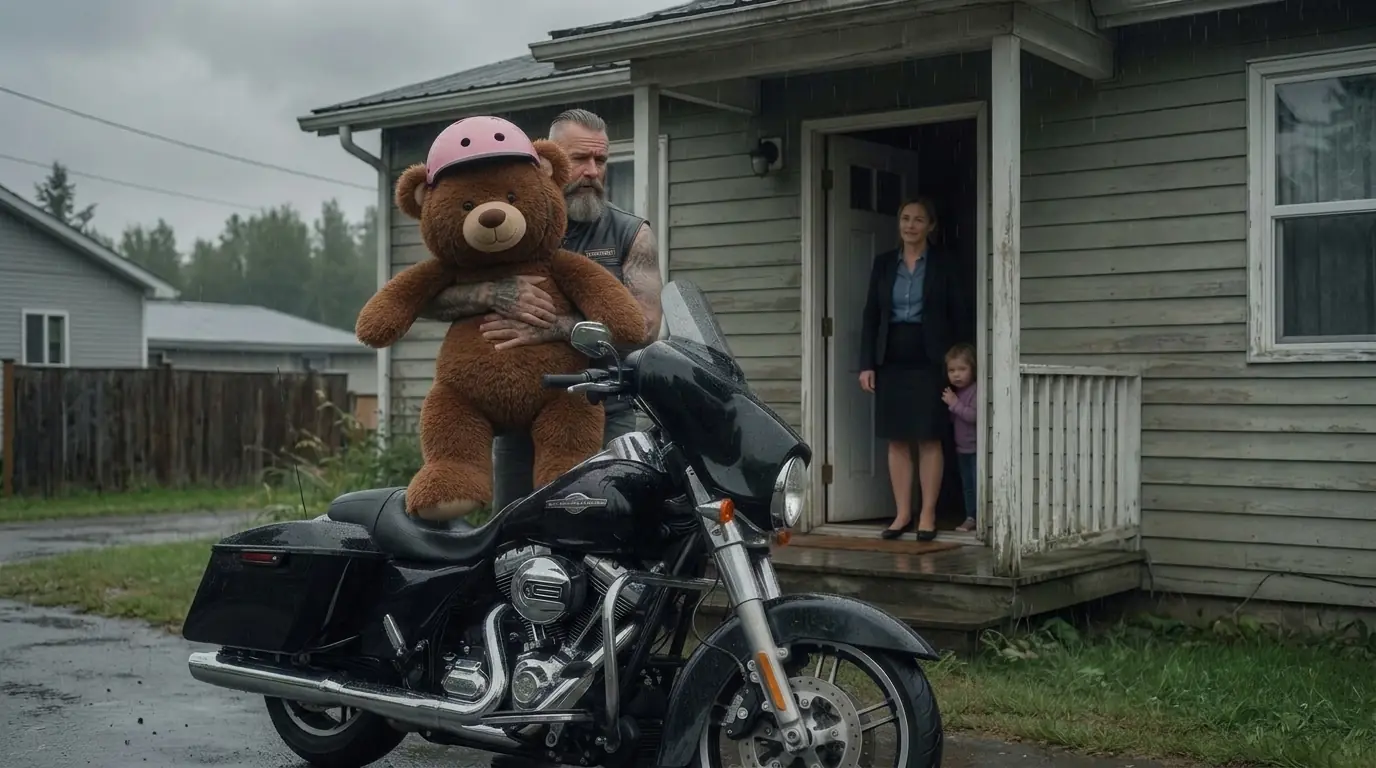
Words that made grief look organized.
The biker’s name was Raymond Cole, but nobody called him Raymond. His club called him Bear, and once you saw him, the name made sense. He was six foot four, broad through the chest, with a gray beard, heavy boots, and hands that looked like they had spent a lifetime fixing engines, holding wrenches, and surviving things most people would rather not imagine.
He rode with a small veterans’ motorcycle club on the Oregon coast called the Iron Lantern Riders.
They were mostly older men and women. Retired mechanics, welders, one former Army medic, one Black woman named Marlene who ran a tow yard and could make grown men go quiet just by taking off her sunglasses. They did Christmas toy drives, veteran funeral escorts, and quiet favors nobody posted online.
But in county offices, people rarely see the whole person first.
They see records.
Old charges.
Old addresses.
Old mistakes with official numbers attached.
Bear had one of those files.
“Assault history,” my supervisor said the first week his name came up.
“Old conviction,” another worker added.
“Motorcycle club association.”
“Possible anger issues.”
Then someone said, “He doesn’t exactly look safe.”
That one stayed with me.
He doesn’t look safe.
I remember looking down at the file and wondering when safety started having a dress code.
Bear did not look safe by county standards.
He wore a black leather vest with faded patches, jeans worn white at the knees, and a silver ring on one hand that clicked against every paper cup of coffee he held. Across the knuckles of his right hand were four tattooed letters.
S T A Y.
At first, it looked almost threatening.
Then I saw him with Ellie.
Ellie Carson was seven years old.
She had brown hair that never stayed brushed, a small gap between her front teeth, and the kind of guarded eyes children get when they have learned too early that adults can leave. She had been in foster care for eleven months when Raymond Cole appeared in the file as a potential kinship placement.
He was not her father.
Not by blood.
He was her mother’s older cousin, though Ellie had been told all her life to call him Uncle Ray. After her mother died and no safe parent remained, his name came up through an old family contact, almost like the system had shaken a dusty box and found him at the bottom.
Ellie called him “maybe home.”
The first time I supervised their visit, Ellie sat at a little plastic table in the family room of the children’s center, coloring a picture of a house with no doors. She acted like she did not care whether he came. That is how children protect themselves in foster care. They build a small wall and then pretend it is personality.
At exactly 2:00 p.m., we heard the motorcycle outside.
Not loud.
Not showing off.
Just a low rumble under the windows, deep enough that Ellie’s crayon stopped moving.
She did not run to the door.
She did not smile.
But her shoulders dropped.
Bear walked in carrying a paper sack from a bakery near the highway. Rain clung to his beard and darkened the shoulders of his denim shirt. Before he looked at Ellie, he looked at me, because men who have had systems judge them learn quickly that rules come before affection in rooms like that.
“Ma’am,” he said. “Raymond Cole.”
Then he looked at Ellie.
“Hey, cricket.”
She kept coloring.
“You brought cinnamon rolls?”
“Two.”
“With the white frosting?”
“Wouldn’t disrespect you with dry bread.”
She tried not to smile.
Failed completely.
That visit lasted one hour.
Bear spent twenty minutes eating cinnamon rolls with her, five minutes fixing a loose chair leg no one had asked him to fix, and the rest of the time listening while Ellie explained the plot of a cartoon with the seriousness of a Supreme Court argument.
He did not interrupt.
He did not look at his phone.
He did not ask her to perform happiness for him.
When the visit ended, Ellie asked the question every child in her position eventually asks when hope becomes too heavy to carry alone.
“Can I come home with you today?”
Bear’s face changed.
Not in a large way.
Just enough that I saw the pain arrive and get locked behind his teeth.
“Not today,” he said.
“Next time?”
“Not next time.”
“Then when?”
He looked at her for a long moment.
“When the people with clipboards stop being nervous about me.”
I almost wrote that down.
Then I did what young county employees learn to do.
I translated the human moment into language the system could digest.
“Adult responded to child’s disappointment calmly.”
That was true.
It was also not nearly enough.
Bear kept coming.
Every Wednesday and Saturday, same time. Sometimes on the Harley, sometimes in an old green pickup when the coast weather turned mean. He brought picture books, socks with cartoon frogs on them, little packs of hair ties, and once a pink lunchbox that Ellie carried around for the whole visit even though there was nothing inside it.
The Iron Lantern Riders helped too, though they did not announce it.
Marlene found a proper bed frame.
A younger rider named Vince painted Ellie’s room sky blue.
Two brothers repaired the back fence because the home study report listed “yard security concerns.”
Bear quit chewing tobacco because Ellie said his jacket smelled like “old campfire and sadness.”
The part nobody noticed at first was the peppermint gum.
Every time he came in, he was chewing it.
Not for himself.
For her.
She had mentioned the smell once.
He changed the next visit.
That was Bear.
Not polished.
Not soft in any way the county was trained to recognize.
But listening all the way down.
The teddy bear started in a gift shop window.
It was during one of their supervised community visits in a little coastal town called Bellhaven. I was with them that day, pretending to browse postcards while keeping the required line of sight. Ellie had been quiet most of the afternoon, not sad exactly, but careful.
Careful children are the ones who worry me most.
We passed a gift shop with seashell magnets, sweatshirts, wind chimes, and one enormous teddy bear sitting in the front window.
It was ridiculous.
Almost as tall as Ellie.
Soft brown fur, big stitched paws, and a red scarf around its neck that said SOMEONE LOVES ME in white letters.
Ellie stopped walking.
Bear stopped too.
“You like him?” he asked.
She shrugged.
“No.”
Bear looked at the bear.
“He’s pretty dumb.”
“Really dumb.”
“Too big.”
“Way too big.”
“Wouldn’t fit anywhere.”
“Nope.”
Ellie pressed one finger to the glass.
“Probably expensive.”
“Probably needs his own job.”
She pulled her hand back like the wanting had burned her.
“Come on.”
So they walked on.
But Bear looked back once.
I saw him.
Two weeks later, the placement review was delayed again.
Not denied.
Delayed.
People outside the system do not understand how cruel that word can be. Denied gives you a wall to hit. Delayed gives you fog. You swing at it and your hand comes back empty.
A background form from another state had not been processed.
His old conviction required secondary review.
The licensing worker wanted more documentation about his support system.
A judge wanted clarification on whether a motorcycle club counted as a risk factor or a protective factor.
Bear sat across from my supervisor with both hands flat on his knees.
Big hands.
Scarred hands.
Clean nails.
“I did the parenting class,” he said.
“We know, Mr. Cole.”
“I put locks on the medicine cabinet.”
“Yes.”
“I fixed the fence.”
“Yes.”
“I got the smoke detectors you wanted.”
“We have that documented.”
“I gave you Marlene’s number, Vince’s schedule, my sister’s address, the pastor who said he’d be backup if I had to work late.”
My supervisor sighed, not unkindly, but tired.
“We know.”
Bear leaned forward.
The chair gave a small warning creak beneath him.
“That little girl asks me every visit if today’s the day,” he said. “I keep telling her no. You ever had to look a child in the face and tell her no when she’s already packed inside her head?”
Nobody answered.
His eyes looked wet, though they did not spill.
If you did not know better, you might have called him angry.
But by then I knew anger was only the coat his grief wore in public.
That Saturday, the visit was shortened from one hour to twenty minutes because we were short-staffed.
Twenty minutes.
Take it or reschedule.
Bear was at work when he got the call, replacing a transmission at a small garage off Highway 101. I heard later he put down the wrench, washed his hands, and said he would take the twenty minutes.
Then he went to the gift shop.
The owner told me the story herself.
He walked in wearing his leather vest, rain dripping from the brim of his cap, and pointed at the window.
“How much for the big bear?”
She told him.
He paid cash.
Then he asked if she sold helmets.
The owner laughed because she thought he was joking.
Bear did not laugh.
“For the bear,” he said.
She found a child’s blue bicycle helmet from the back shelf, discounted because one strap was twisted. Bear bought that too. He adjusted the strap right there in the shop, buckled it under the bear’s chin, tested it with two fingers, and asked for rope.
The owner said, “You’re really putting a helmet on a stuffed animal?”
Bear said, “He’s riding with me.”
Then he carried that giant teddy bear outside like it mattered.
That is how he ended up on Highway 101 in hard coastal rain with a giant bear strapped to the back of his Harley.
The bear wore a blue helmet.
A yellow ribbon was tied around one paw.
The red scarf flapped behind it.
People honked.
A man in a pickup rolled down his window and laughed.
A teenager at a gas station filmed him and yelled, “Hey, biker Santa, where’s the parade?”
Bear checked the bear’s straps and said nothing.
I saw him at that gas station.
I was on my way to the children’s center, and for one second, I almost did what everyone else did. I almost turned him into a joke because the picture was absurd. A huge tattooed biker standing in the rain, tightening a stuffed bear’s helmet as if the bear had a court date.
Then I saw what he bought inside.
One gas station cupcake.
Vanilla.
Rainbow sprinkles.
He asked the cashier if they had candles.
They did not.
He nodded.
“Worth asking.”
The teenager laughed again from the pump.
Bear heard him this time.
He turned, one hand on the handlebar, one hand resting on the bear’s soft paw.
“Kid,” he said, not harshly, “one day you’ll be lucky if you’ve got somebody worth looking foolish for.”
Then he rode away.
I sat in my county car for almost a full minute before I started the engine.
By the time I reached the center, the rain had turned heavy and silver.
The visit was scheduled for 4:00 p.m.
Bear arrived at 3:31.
Too early.
Rules said visitors had to wait until staff called them in.
So he waited.
Outside.
In the rain.
Beside the Harley.
With the giant teddy bear still strapped behind him.
At first, I thought someone would notice and bring him in.
Nobody did.
The front desk was overwhelmed. One child was screaming in the hallway. A foster parent was late. A caseworker was crying in the staff bathroom, quietly enough that she hoped nobody heard. Phones rang until they stopped sounding like phones and started sounding like alarms.
At 3:55, I looked out the window.
Bear was still there.
He had taken off his leather vest and draped it over the teddy bear to keep it dry. Rain soaked through his gray thermal shirt. His beard hung wet against his chest. He stood with his arms folded, not like a tough man trying to look intimidating, but like a cold man trying not to shake.
I told my supervisor, “Mr. Cole is outside.”
She did not look up from her desk.
“We’re running behind.”
“He’s standing in the rain.”
“He can wait in his truck.”
“He came on the motorcycle.”
She rubbed both hands over her face.
“Allison, I have four fires happening right now.”
So Bear waited.
At 4:18, Ellie began crying.
She sat in the playroom staring at the clock above the bookshelf. Children in care know clocks better than adults think. They know the difference between five minutes late and gone. They know every promise has an expiration date until proven otherwise.
“He forgot,” she whispered.
I looked through the window.
Bear stood in the rain with both hands resting on the covered teddy bear’s shoulders, looking at the building like he could will the door open without breaking a rule.
“No,” I said. “He’s here.”
Ellie looked at me.
“Then why isn’t he coming in?”
I had no good answer.
At 4:41, my supervisor finally nodded.
“Twenty minutes.”
I went outside myself.
The rain hit cold and sharp.
Bear turned when he heard the door.
His lips had gone pale. His hands looked stiff from the weather. He did not complain. Not once. He just lifted the soaked vest from the bear, shook water off it, and put it back on his own shoulders.
Then he unbuckled the teddy bear.
Slowly.
Carefully.
Like he was lifting something alive.
That was when I saw the laminated tag tied to the bear’s scarf.
It did not say For Ellie.
It said:
For Ellie Cole. For the day you come home.
I stopped.
“Mr. Cole,” I said softly, “her last name is Carson.”
“I know.”
His voice was low.
“She asked me what it would be if the judge said yes.”
He lifted the bear in both arms.
It was so big its feet almost dragged against his boots.
And then that enormous biker walked through the rain carrying a teddy bear like a baby.
Inside, Ellie saw him.
She did not run to him first.
She ran to the bear.
Her small body hit the stuffed animal with such force that Bear had to brace himself. She buried her face in its fur, both arms wrapped around its middle, and for one second, I saw something flicker across Bear’s face.
Pain.
But not jealousy.
Understanding.
The bear was safe to want.
The bear could not be removed by a court delay.
The bear did not need background approval.
Then Ellie reached out one hand without lifting her face.
Bear took it.
His huge tattooed fingers closed gently around hers.
“Hey, cricket,” he said.
“You came.”
“Yep.”
“You’re wet.”
“Rain does that sometimes.”
“You waited?”
“Yep.”
“How long?”
His eyes flicked toward me.
“Little while.”
I could have protected everyone with the usual county language.
Instead, for the first time in my job, I wrote what actually happened.
“Mr. Cole arrived twenty-nine minutes early and waited outdoors in heavy rain for more than one hour in order to preserve the child’s scheduled visitation. Child showed immediate emotional relief upon his entrance and initiated physical contact first with gift item, then with Mr. Cole.”
That note changed the tone of the file.
Not alone.
But enough.
The next morning, my supervisor asked me to expand my observation.
County language again.
Expand.
Clarify.
Document.
So I did.
I wrote about the bear’s helmet.
I wrote about the cupcake with rainbow sprinkles.
I wrote that he never raised his voice after being made to wait in heavy rain.
I wrote that he followed every rule even when the rule made no practical sense.
I wrote that Ellie believed he had forgotten her, and his presence calmed her faster than staff intervention.
Then I wrote the sentence I was not sure I had the authority to write.
“Child appears to experience Mr. Cole as a reliable attachment figure.”
Reliable.
That word carries more weight than most people know.
Reliable means the child looks toward you when scared.
It means your arrival changes the child’s breathing.
It means love has become predictable enough for the nervous system to believe in it.
Bear did not know any of that language.
He just knew Ellie needed him.
A week later, I drove with the licensed social worker to Bear’s house for an addendum home visit.
He lived outside Newport, off a narrow road lined with fir trees and blackberry bushes. The house was small, white, with blue shutters and porch steps so newly repaired that the wood still looked raw. A wind chime made from old socket wrenches hung by the door.
Inside, the house smelled like coffee, sawdust, peppermint, and rain-damp leather.
Ellie’s room was ready.
Not perfect.
Better than perfect.
A yellow quilt on the bed.
A small bookshelf made from sanded crate wood.
Glow-in-the-dark stars stuck carefully across the ceiling.
A moon night-light plugged beside the dresser.
Purple rain boots lined up near the closet.
On the pillow sat a smaller teddy bear wearing a tiny leather vest.
I looked at Bear.
He shrugged.
“Marlene made that one.”
On the wall, he had taped a handwritten list in thick block letters.
ELLIE’S ROOM
Bed.
Books.
Night-light.
Window lock.
Snack basket.
No yelling.
Always knock.
That last one got me.
Always knock.
I asked about it.
Bear looked at the door instead of at us.
“Kids who bounce through homes don’t get a lot that belongs only to them,” he said. “Figured a closed door should mean something.”
The licensed social worker, Mrs. Bennett, took notes.
She was careful by nature, and she had been skeptical of Bear from the beginning. Not cruel. Not unfair. Just cautious. His file was complicated, and his support system looked strange on paper.
Then the Iron Lantern Riders arrived.
Not planned by us.
Three motorcycles came down the gravel drive and shut off one after another. Marlene stepped off first, tall, silver braids tucked into a bandana, leather vest dark from rain. Behind her came Vince with a box of children’s books. Last was a retired Marine named Carl holding a casserole dish wrapped in towels.
Bear opened the door and frowned.
“What are you doing here?”
Marlene looked at him like he had asked whether water was wet.
“Support system.”
Mrs. Bennett’s pen paused.
Marlene came in, wiped her boots, and introduced herself with paperwork in hand. Copies of her nursing license. A signed statement offering emergency childcare. Vince had his work schedule showing he could help with school pickup twice a week. Carl had proof that he lived ten minutes away and could be available overnight in emergencies.
Bear stared at them.
“You didn’t have to do all this.”
Marlene snorted.
“You watched my grandson for six months when my daughter was in treatment. Sit down and be grateful quietly.”
That was the moment the file changed again.
The motorcycle club was not the danger everyone had imagined.
It was the village.
The patches people worried about were stitched onto the backs of people who had already been showing up for each other for years.
Then Mrs. Bennett asked about the assault charge.
Bear did not dodge it.
“I put a man in the hospital when I was twenty-six,” he said.
The room went still.
“Bar fight. I was drunk. Mean. Looking for somebody to blame for being alive.”
No excuses.
No softening.
No speech about being misunderstood.
“He lived,” Bear said. “I did jail time. Paid restitution. Got sober. Apologized. He didn’t forgive me, and he didn’t owe me that.”
Mrs. Bennett watched him.
Bear kept both hands open on the table.
“There’s no alcohol in this house. My club knows not to show up loud. If Ellie comes here, this place stays calm. No yelling. No slamming doors. No grown-up tantrums.”
He nodded toward the list on the wall.
“Kids remember noise.”
Mrs. Bennett looked again at the words.
No yelling.
Always knock.
I watched her face change.
Not into certainty.
Good social workers do not become certain because of one emotional moment.
But she saw what I had seen.
Bear had not erased his past.
He had built rules around the man he refused to be again.
Before we left, I noticed a small patch sewn inside his leather vest.
Not where the world could see it.
Inside.
Near his heart.
It was a tiny stitched teddy bear with one word beneath it.
WAITING.
I asked him what it meant.
He touched the patch once.
“Ellie said bears are good at waiting,” he said.
Then he closed the vest.
That was all.
The adoption did not happen quickly.
Nothing good in the system moves quickly, and almost nothing moves clean. There were more forms, more calls, another background error, a delay because an old address did not match the state database, and one court review where a lawyer who had never met Bear described him as “unconventional.”
Bear sat through every delay with his hands folded.
Not calmly exactly.
He was never calm when Ellie was on the other side of a decision.
But he stayed respectful.
He kept showing up.
He brought the bear to every visit after that, though not always the giant one. Sometimes he strapped a smaller bear behind the Harley, blue helmet and all. People still laughed sometimes. Tourists took pictures. One man outside a grocery store asked if the bear was his girlfriend.
Bear only said, “No, she’s waiting at home.”
Because after the rain visit, Ellie’s visits expanded.
Then they moved to unsupervised afternoons.
Then weekends.
The first time she came to his house, Bear stood on the porch pretending not to shake.
Ellie walked into the yellow room and said nothing.
She touched the bookshelf.
The moon light.
The snack basket.
The smaller bear on the pillow.
Then she turned back.
“You knock?”
“Every time.”
“Even though it’s your house?”
Bear shook his head.
“Our house.”
Ellie stood very still.
Our.
Children who have lost too much treat certain words like wild animals.
They approach slowly.
They wait to see if the word will bite.
Finally, she climbed onto the bed, pulled the giant teddy bear beside her, and said, “He fits.”
Bear looked out the window until his eyes dried.
After placement began, he kept the Friday ritual.
He would ride to the same gas station where people had laughed, buy peppermint gum, black coffee, and one cupcake with rainbow sprinkles. Then he would ride home slowly because cupcakes are not built for potholes.
Ellie would wait on the porch.
Always with the giant bear.
Always pretending she had just happened to be there.
The adoption finalized on a Thursday afternoon at the Lincoln County courthouse.
It was raining, because of course it was.
There was no huge crowd. Just Bear, Ellie, Mrs. Bennett, me, Marlene, Vince, Carl, and a judge who looked tired in the way people look when they have spent too many years seeing children pay for adult failures.
Ellie wore a purple dress and yellow rain boots.
Bear wore a clean black shirt under his leather vest.
The judge asked Ellie if she understood what adoption meant.
She nodded.
“It means I don’t have to call him maybe home anymore.”
The judge took off his glasses.
For a moment, nobody spoke.
Then he smiled gently.
“That is a very good way to say it.”
When the papers were signed, Ellie asked if she could change the bear’s tag.
Bear pulled a marker from his vest pocket because he had learned to be ready for small ceremonies.
On the wooden bench outside the courtroom, she crossed out the words:
For Ellie Cole. For the day you come home.
Underneath, in careful seven-year-old letters, she wrote:
I’m home now.
Bear read it once.
His jaw tightened.
His eyes went red.
He did not give a speech.
He only pressed his thumb to the tag, lowered his head, and breathed like his lungs had finally remembered how.
Outside the courthouse, the Harley waited at the curb.
The small bear was strapped to the back, blue helmet shining under the gray afternoon light. The giant bear rode home in Marlene’s SUV because even Bear admitted some passengers deserved a seatbelt.
Ellie climbed behind him on the bike.
Her yellow boots found the pegs.
Her arms wrapped around his waist.
Before he started the engine, she leaned her helmet against his back.
“Dad?”
Bear froze.
Just for a second.
Then he turned his head slightly.
“Yeah, cricket?”
“Can we get cupcakes?”
He laughed.
The sound came out rough and surprised and almost broken.
“Yeah,” he said. “We can get cupcakes.”
I stood on the courthouse steps and watched them ride away.
The engine rolled low through the wet street.
The little bear behind them bobbed once with the road.
No one laughed this time.
Not one person.
Years later, I became a licensed social worker. I wrote longer reports, sat in harder meetings, and learned that love by itself does not always make a safe home. But I also learned that sometimes safety looks different from what an office expects.
Sometimes it looks like a tattooed man waiting in the rain because a child is watching a clock.
Sometimes it looks like peppermint gum, a handwritten list, and a door that always gets knocked on.
Sometimes it looks like a motorcycle club with backup childcare forms.
And sometimes it looks like a giant teddy bear wearing a blue helmet, strapped to the back of a Harley, being carried through a storm by a man everybody laughed at because they did not know who was waiting.
Ellie knew.
That was all that mattered.