The first thing Frank Maddox noticed was not the line of cars outside Pine Hollow Elementary.
It was not the balloons tied to the fence.
It was not the fathers walking through the front gate with coffee cups, sleepy smiles, and daughters holding their hands like the whole morning had been made just for them.
It was the little girl standing alone beside the flagpole.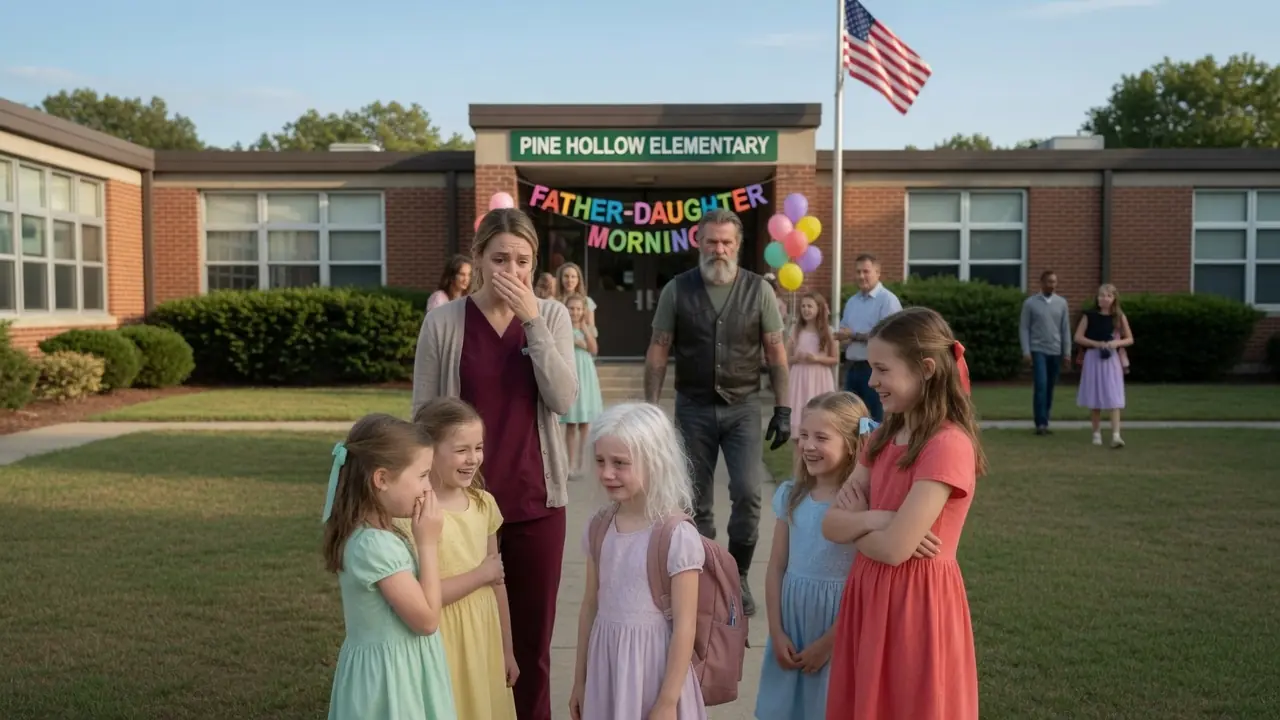
She looked about eight years old, maybe nine if life had made her older in the eyes. She wore a green backpack with one broken zipper, white sneakers with scuffed toes, and a yellow sweater that had been washed so many times it had lost the courage to be bright. Her hair fell around her face in tangled brown waves, half-brushed, half-wild from the wind.
She was trying very hard not to cry.
Frank knew that look.
At sixty-three, he had seen it on men in hospital waiting rooms, on widows after funeral rides, on kids standing outside courtrooms while adults decided where they belonged. Some people cried loudly. Others spent all their strength keeping the tears inside because they had already learned the world did not always know what to do with them.
Frank stood by the school gate in a black leather vest, faded jeans, heavy boots, and a gray beard that made most strangers step aside before they knew whether he was kind.
His riding club, the Iron Creek Riders, had volunteered to help direct traffic for the school’s Father-Daughter Breakfast. The principal had asked for extra adults outside because drop-off always turned into a mess when events brought parents in. Frank had come because he was good at standing where people needed standing.
He did not expect the morning to find an old bruise inside him.
Frank had one daughter.
Her name was Emily, and she was thirty-four now, married, living in Colorado, raising two kids of her own. They spoke on Sundays when nobody forgot, which meant some Sundays. She loved him. He knew that. But love changes shape when children grow up.
Once, Emily had needed him to zip coats, cut crusts off toast, fix bike chains, scare away bad dreams, and braid her hair before school.
Now she needed him mostly to answer the phone and say he was doing fine.
He usually was.
Mostly.
Near the flagpole, four girls approached the lonely child.
They were dressed for the morning in clean skirts, shiny shoes, and ribbons that had clearly been tied by careful hands. One girl wore a pink dress with a silver belt. Another had two perfect braids tied with blue bows. The tallest girl, the one in the middle, walked with the confidence of a child who had never been told no enough to understand mercy.
She stopped in front of the girl by the flagpole.
“Why does your hair look like that?”
The little girl touched her hair quickly.
“I brushed it.”
The girl in pink laughed.
“With what? A rake?”
The others giggled.
The little girl looked down at her shoes.
Frank felt his jaw tighten.
He turned slightly, watching from near the gate. A teacher stood only a few yards away with a clipboard and a walkie-talkie, trying to wave cars forward and answer a parent’s question at the same time. She glanced toward the girls once, saw children talking, and looked away again.
That was how small cruelties survived.
They looked harmless from a distance.
The tallest girl leaned closer.
“Where’s your dad, Emma?”
The little girl did not answer.
The girl smiled.
Not kindly.
“Oh, right. You don’t have one.”
That sentence made the morning colder.
Emma’s fingers tightened around the strap of her backpack.
Another girl said, “My dad said today is for real dads and daughters.”
The girl in pink looked at Emma’s hair again.
“If you had a dad, maybe somebody would’ve made you look normal.”
Emma’s mouth trembled.
She tried to step around them.
They moved with her.
Not touching her.
Not hitting.
Just blocking her enough to make her understand she was surrounded.
Frank had seen grown men use the same trick.
He moved before he had fully decided to.
His boots crossed the pavement slowly, not fast enough to frighten the children, not slow enough to pretend he had not seen. The girls noticed him first. Their laughter faded as the large old biker came toward them with tattoos on his forearms and rain-gray eyes under thick brows.
Frank stopped a few feet away.
He did not glare.
He did not raise his voice.
He looked at Emma first and let his face soften.
“Morning, sweetheart.”
Emma blinked up at him.
She did not know him, but his voice had no sharp edges.
Frank looked at the other girls.
“Everything all right here?”
Nobody answered.
The tallest girl shifted her weight.
“We were just talking.”
Frank nodded.
“Talking can be a good thing.”
He looked at Emma’s red face, then back at the girls.
“Depends whether you use it to make somebody feel bigger or smaller.”
The girl with the blue bows stared at the ground.
The tallest girl opened her mouth, found nothing useful, and closed it again.
Frank did not keep scolding.
Children sometimes hear more in a silence than in a lecture.
He turned to Emma.
“You here for the breakfast?”
She nodded once.
“My dad’s not coming.”
The way she said it told him everything.
Not late.
Not busy.
Not around.
Frank crouched carefully so he was not towering over her.
“That can hurt pretty bad.”
Emma looked surprised.
Most adults tried to jump over pain before a child could stand in it.
They said it was okay.
They said not to cry.
They said be brave.
Frank had lived long enough to know sometimes the bravest thing was simply admitting something hurt.
Emma swallowed.
“My mom had to work. She tried to switch shifts, but nobody would trade.”
Frank looked toward the gym doors.
Through the windows, he could see fathers helping daughters hang paper stars, filling plates with pancakes, kneeling beside craft tables. One man had a little girl on his shoulders. Another was tying a ribbon around his daughter’s wrist like it mattered.
To them, it was a cheerful school event.
To Emma, it was proof of absence.
Frank pulled off his leather gloves.
“Can I ask you something?”
Emma nodded.
“Would it help if someone walked in with you?”
She stared at him.
“You?”
“If you don’t mind an old biker who smells a little like motor oil.”
For the first time that morning, something almost like a smile touched her face.
Then it disappeared.
“My hair looks bad.”
That sentence hit Frank harder than he expected.
Not because of the hair.
Because he heard what was underneath it.
I look like nobody helped me.
I look like nobody chose me.
I look like what they said is true.
Frank looked toward the teacher.
“Ma’am?”
The teacher hurried over, already realizing she had missed something important.
“Yes?”
“Is there a nurse’s office nearby?”
“Of course.”
“You got a brush in there?”
The teacher’s face changed.
She looked at Emma, then at the tangled hair around her face.
“I’ll get one.”
She returned a minute later with a small brush, two hair ties, and a blue ribbon from a classroom craft box.
Frank held them like they were tools more delicate than anything in his garage.
He looked at Emma.
“May I?”
Emma hesitated.
Then nodded.
Frank stood behind her and began brushing her hair with the patience of a man untangling something sacred. He did not hurry. When the brush caught, he stopped, loosened the knot with his fingers, and started again. The schoolyard seemed to quiet around them.
“Sorry,” Emma whispered.
Frank paused.
“For what?”
“My hair.”
He lowered his voice.
“Kiddo, you never apologize for needing care.”
Emma went still.
The teacher turned away quickly, blinking at the clipboard like it had become hard to read.
Frank separated Emma’s hair into three sections.
His fingers were thick, scarred, and stiff from years of engine work, but they remembered. Under, over. Under, over. The same rhythm he had used when Emily was seven and refused to let anyone else braid her hair because her daddy “didn’t pull so mean.”
The braid was not perfect.
A few strands escaped near Emma’s ear.
But it was neat.
It was gentle.
It looked like someone had taken time.
He tied the end with the blue ribbon, then folded his clean black bandana into a narrow strip and wrapped it softly across the top of her head like a headband.
Emma reached back and touched it.
“How does it look?”
Frank stepped in front of her.
He took the question seriously.
Then smiled.
“Like a girl who belongs anywhere she walks.”
Emma’s eyes filled.
This time, she did not look ashamed of the tears.
The tallest girl who had teased her whispered, “It looks pretty.”
Emma turned toward her.
She did not smile.
She did not thank her.
She only took Frank’s hand.
“Will you still walk in with me?”
Frank stood slowly.
“Yes, ma’am.”
Together, they walked toward the gym.
The room changed when they entered.
Not loudly.
Just enough.
People looked over their shoulders. A few fathers stopped mid-conversation. One mother put a hand to her mouth. The principal, standing near the microphone, saw Emma’s blue ribbon, then saw Frank’s leather vest, then saw their joined hands.
Emma did not look down.
That was the thing Frank noticed.
Her shoulders were still small, but they were straighter than they had been outside.
At the craft table, a teacher handed them construction paper.
“We’re making cards that say what we love about our dads,” she said gently.
Then her face tightened because she realized too late what she had said.
Emma stared at the blank card.
Frank sat beside her.
“Well,” he said, picking up a green crayon, “cards don’t have to follow rules when the rules don’t fit.”
Emma looked at him.
“They don’t?”
“Best cards usually don’t.”
She thought about that.
Then she began writing slowly, tongue caught at the corner of her mouth in concentration.
At the top of the card, in crooked purple letters, she wrote:
Thank you for helping me walk in.
Frank turned his head.
He pretended to study the glue sticks.
His eyes had already started to burn.
Emma drew a little girl with a blue braid.
Beside her, she drew a tall man with a beard, tattoos, and a motorcycle so large it looked like a dinosaur with wheels.
Frank looked at it.
“I’m prettier in the picture.”
Emma giggled.
“You have a lot of beard.”
“I’ve been working on it.”
A few minutes later, the principal stepped up to the microphone.
“Good morning, everyone,” she said. “Today is about celebrating the people who show up for our children.”
Her eyes moved briefly to Frank and Emma.
“Fathers, grandfathers, uncles, brothers, family friends, neighbors, and anyone who helps a child feel safe and loved.”
Emma looked at Frank.
Something softened in her face.
Not because a missing father can be replaced by one kind man in one morning.
Life is not that simple.
But because for the first time that day, she did not look like the only girl without someone.
She looked chosen.
After crafts, the school served pancakes in the cafeteria.
Frank carried Emma’s tray because the syrup cup was filled dangerously high. She told him she liked horses, drawing, spelling tests, and strawberry milk. She told him her mother worked at the hospital and sometimes came home so tired she fell asleep in her shoes.
Frank listened.
Not politely.
Fully.
He asked questions.
What kind of horses?
What did she draw best?
What word had she missed on her last spelling test?
Emma answered every one like she had been waiting all morning for an adult who did not rush her.
Near the end of breakfast, a woman in burgundy scrubs hurried through the cafeteria doors.
Her hair was pulled back messily, her face pale with worry, and one hand still held her car keys. She looked around the room until she saw Emma at the table beside Frank.
Her name was Natalie Porter.
She was Emma’s mother.
“Emma,” she said, breathless. “Baby, I’m so sorry. I tried to get here sooner.”
Emma jumped up and ran into her arms.
“Mom, Mr. Frank helped me.”
Natalie held her tightly.
Then she looked over Emma’s head at the old biker standing awkwardly beside the table.
She saw the braid.
The blue ribbon.
The bandana.
The card.
The way her daughter’s face was not crushed the way she had feared it would be when she left work early and drove too fast across town.
Natalie’s eyes filled.
“I don’t know what to say.”
Frank tucked his hands into his vest pockets.
“She did most of the work.”
Natalie gave a small broken laugh.
“That sounds like her.”
“I just braided the hair and carried the syrup.”
Emma turned around.
“And he walked in with me.”
Natalie looked at him again.
That was when Frank saw the shame in her face.
Single mothers carried a special kind of shame for things that were not failures. Shift schedules. Empty chairs. Missed school mornings. The places where love existed fully but still could not be physically present.
Frank shook his head slightly before she could apologize.
“You do not owe me an explanation.”
Natalie’s mouth trembled.
“I wanted to be here.”
“I know.”
“I worked a double because rent is due.”
“I know that too.”
She looked at him carefully.
“How?”
Frank glanced at Emma.
“Because kids this loved do not get that way by accident.”
Natalie covered her mouth.
Emma handed her the card.
Natalie read the words.
Thank you for helping me walk in.
Her face broke then.
She pressed the card to her chest like it weighed more than paper.
The principal came over softly.
“Mr. Maddox, I hope you know what you did for her today.”
Frank looked uncomfortable immediately.
“I just helped.”
“That is usually what people say when they do something important.”
Before he could answer, Emma tugged his vest.
“Will you come to Family Reading Night?”
The question landed in him quietly.
Frank thought of his daughter three states away.
Thought of old photographs in a shoebox.
Thought of all the mornings he had not been needed by anybody small enough to hold his finger with a whole hand.
He crouched in front of Emma again.
“Well, I’m not family.”
Emma touched the blue ribbon in her braid.
“No.”
Then she smiled.
“But you know how to show up.”
Frank pressed one hand over his mouth.
For a second, the cafeteria faded.
All he could see was a little girl asking him for the simplest and most dangerous thing a person can ask.
Be there again.
He nodded.
“I’ll be there.”
Emma threw both arms around his neck.
Frank closed his eyes and held her carefully.
Not too tight.
Just enough for her to know he meant it.
Outside, near the motorcycles, the Iron Creek Riders had watched enough through the cafeteria windows to understand. One man wiped his eyes and blamed the wind, though there was no wind. Another suddenly became very busy adjusting a helmet strap that did not need adjusting.
Frank’s oldest friend, Charlie Boone, looked away and smiled.
Some moments were not meant to be interrupted.
They were meant to be guarded.
That afternoon, Frank rode home slower than usual.
The sun was high.
The road was clear.
His Harley hummed beneath him, steady and familiar, but something in him felt different from when he had arrived that morning.
He had not expected to be needed.
That was the truth of it.
Men spend years being necessary to their children, then one day they wake up and nobody needs them to tie a shoe, check under a bed, cut pancakes, or carry a sleeping body from the car. People call that success. They say it means you raised them right.
They do not always mention the ache.
A week later, an envelope arrived at the Iron Creek garage.
Frank’s name was written across the front in purple marker.
Inside was a drawing.
A little girl with a blue braid held hands with a tall man in a black vest. Behind them was a motorcycle, a school, and a sun with so many rays it looked like it might burst.
Across the top, Emma had written:
The day my biker friend helped me be brave.
Frank stared at it for a long time.
Then he took off his glasses.
Charlie walked past his workbench and stopped.
“You all right?”
Frank nodded.
“Dust.”
“In the office?”
“Bad dust.”
Charlie said nothing.
He only handed Frank a piece of tape.
Frank put the drawing above his workbench where everyone could see it.
After that, Emma waved every time Frank passed Pine Hollow Elementary.
At first, she waved from the fence.
Then from the sidewalk.
Then, on Family Reading Night, from the front steps, wearing the same blue bandana in her hair.
Frank showed up carrying three books because he did not know which one she would like.
Emma chose all three.
Natalie sat beside them that evening, tired but smiling, and watched her daughter lean against the arm of a tattooed old biker while he read a story about a horse that refused to be ordinary.
His voice was rough.
The children listened anyway.
By spring, Frank had become a familiar sight at Pine Hollow.
He helped with traffic.
Fixed a broken gate latch.
Repaired the loose wheel on the cafeteria cart.
Showed a fourth-grade class how a motorcycle engine worked after the teacher asked for community helpers.
He never called himself anything special.
The children called him Mr. Frank.
Emma called him her backup dad once during art class, and the name followed him around the school for months.
He pretended to hate it.
He did not.
One afternoon, Natalie found him outside the school, leaning against his Harley while Emma ran back inside for a forgotten jacket.
“I hope this has not been too much,” she said.
Frank looked at her.
“What?”
“All of this. Emma asking for you at things. Me letting her.”
He thought about that.
Then shook his head.
“Ma’am, lonely people do not always know they are lonely until somebody gives them somewhere to go.”
Natalie looked toward the school doors.
“She talks about you all the time.”
Frank smiled softly.
“I talk about her too.”
That summer, Emily came to visit from Colorado with her two children.
Frank took them all to the bakery after church.
Emma happened to be there with Natalie, choosing a cupcake with the seriousness of a bank president. When she saw Frank, she ran over and hugged him around the waist.
Emily watched it happen.
Not jealous.
Not confused.
Moved.
Later, while the kids were outside drawing chalk horses on the sidewalk, Emily stood beside her father and said, “You braided her hair?”
Frank looked down.
“Badly.”
Emily smiled.
“You used to braid mine badly too.”
“I got better.”
“No, you didn’t.”
He laughed.
Then Emily slipped her hand through his arm.
“I’m glad somebody still needs you for that.”
Frank did not answer for a moment.
When he did, his voice was low.
“Me too.”
Years later, people at Pine Hollow still talked about the morning the old biker walked into Father-Daughter Breakfast with a little girl who had almost not come inside.
Some told it like a sweet story.
Some told it like proof that rough-looking men could be gentle.
Some told it as a lesson about bullying, or fatherhood, or how schools should make room for children whose families did not fit on a flyer.
But Emma told it differently.
She said it was the day she learned that love does not always arrive wearing the title you expected.
Sometimes it wears leather.
Sometimes it has grease under its nails.
Sometimes it smells faintly of motor oil and keeps a clean bandana in its pocket.
Sometimes it kneels in a schoolyard, brushes knots from your hair, and tells you that needing care is nothing to apologize for.
Frank kept Emma’s drawing above his workbench until the paper faded at the edges.
Whenever a new rider asked about it, Charlie would grin and say, “That’s the day Gravel got adopted by a third grader.”
Frank always corrected him.
“Second grader.”
Then he would look at the drawing for half a second longer than he meant to.
Because engines were not the only things a man could help fix.
Sometimes it was a braid.
A morning.
A child’s courage.
Or an old heart that had forgotten how good it felt to be chosen.
And every time Frank passed Pine Hollow Elementary on his Harley, Emma ran to the fence and waved with both hands.
Her braid bouncing.
Her smile wide.
Her head held high.
Not because the empty place in her life had disappeared.
But because one gentle man had shown her the truth she needed most.
Not having a father beside her at school did not mean she was unloved.
It only meant love had found another door.