My name is Laura Whitcomb, and until that afternoon, I thought I understood what danger looked like.
Danger looked like three older boys waiting near the creek path after school.
Danger looked like a quiet street with no adults close enough to hear a child’s voice shake.
Danger looked like a huge man in a black leather vest standing outside my little blue rental house with a motorcycle at the curb and my ten-year-old daughter crying behind him.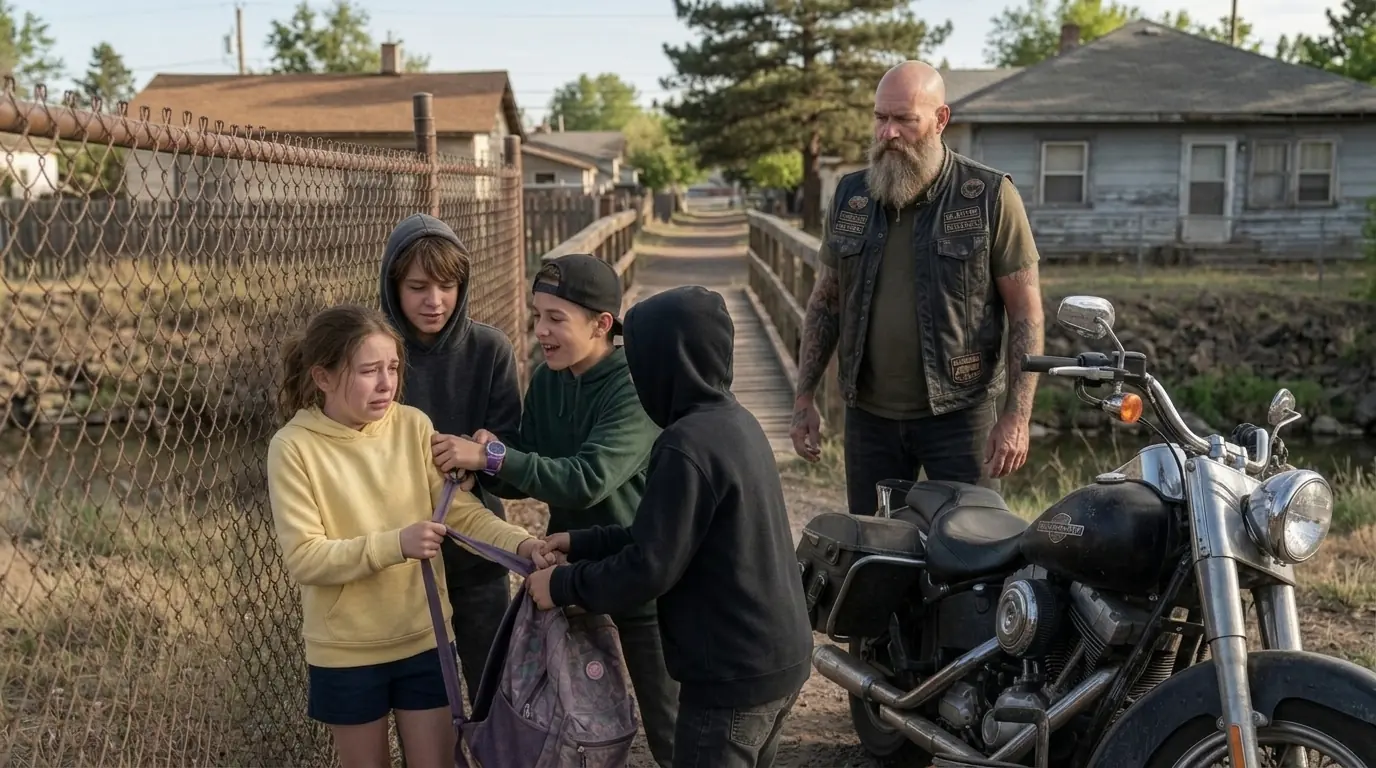
I was wrong twice before the sun went down.
We lived on the east side of Flagstaff, Arizona, in a neighborhood where pine trees leaned over the roads and old pickup trucks sat beside newer houses that cost too much for the people who had lived there longest. Route 66 was not far from us, carrying tourists, truckers, college kids, and riders who stopped for gas before heading toward the open desert.
My daughter, Maisie, and I lived in a small house with peeling trim, a narrow porch, and a mailbox that leaned no matter how many times I straightened it.
I was thirty-six, divorced, tired most days, and trying hard not to let Maisie notice how often I counted money in my head before buying groceries.
Her father sent support when the court reminded him. He called on birthdays if no one else had offered him something better to do. So it was mostly me helping with math homework, me remembering dentist appointments, me taking out the trash, me checking the windows at night after Maisie fell asleep.
Maisie wanted freedom the way children want it.
Not the big dramatic kind that adults write songs about.
The small kind.
Walking to the park without me right beside her. Riding her bike one street farther. Carrying her own house key on a purple lanyard. Saying, “Mom, I know,” with the wounded dignity of someone who had already lived ten whole years and considered herself practically grown.
That day, I let her walk home from Juniper Hollow Park alone.
I still remember how ordinary the decision felt.
The park was close. She knew the route. She had my old digital watch, the one my mother gave me when I started waitressing after high school. Maisie called it ugly, but she wore it because Grandma Ruth had once told her a watch was “a promise you keep on your wrist.”
I did not know three boys had been bothering younger kids for almost two weeks.
None of us knew.
Not really.
Children had lost lunch money, earbuds, a skateboard, a baseball glove, small things that parents explained away because parents are often too busy surviving to recognize a pattern until fear points at it with both hands.
The boys were fifteen or sixteen.
Old enough to know better.
Young enough to believe cruelty made them look powerful.
They waited near the footbridge where the park trail bent between cottonwoods and a dry wash that only carried water after real rain. Maisie told me later they stepped out slowly, not running, not shouting, just placing themselves where she needed to pass.
One in front.
Two at the sides.
A little fence made of sneakers, shoulders, and bad intentions.
“What’s in the backpack?” the biggest one asked.
“School stuff,” Maisie said.
“Then give it here.”
“No.”
She tried to step around him.
He moved with her.
The second boy laughed.
The third pointed at her wrist.
“What’s that watch worth?”
“Nothing,” Maisie said.
“Then you won’t miss it.”
She covered it with her hand.
That was when she started crying.
Not loudly.
Maisie hated crying where people could see. When she was scared, she went quiet, like a rabbit pressed under porch steps waiting for danger to lose interest. She told me later she kept thinking if she stood still enough, maybe they would get bored and leave.
They did not.
Then the motorcycle came around the curve.
Maisie heard it before she saw it, a deep, steady growl moving along the park road. Not fast. Not reckless. Just present in the way thunder is present before a storm chooses what it is going to do.
The rider came into view beneath the pine shadows.
He was big, bald under a black half helmet, with a gray beard down to his chest and tattoos covering both forearms. His leather vest had a desert hawk patch on the back and small memorial pins along the front. The motorcycle was a black Harley touring bike with faded saddlebags and a little brass bell tied near the frame.
His name was Owen Keller.
Most people called him Saint, though I would later learn nobody meant it as a compliment at first.
He rode with a small recovery and veterans’ club called the Desert Cross Riders. They were men and women with bad knees, old grief, repaired engines, and the kind of pasts people either brag about too much or never mention at all. Owen belonged to the second kind.
He saw the boys.
He saw Maisie.
He saw the space between them.
That was all he needed.
He eased the Harley forward until it sat between my daughter and those boys.
He did not rev the engine.
He did not yell.
He did not threaten them.
He simply put both boots on the pavement, cut the engine, removed his sunglasses, and looked at them like he was memorizing every face.
The silence did the work.
The boys tried to hold the stare at first.
One muttered something Maisie would not repeat. The boy in the red cap stepped back first. Then the one with the backpack. Then the biggest one looked down the trail, spat into the dirt, and said, “Whatever.”
They ran toward the wash.
Owen stayed on the motorcycle until they disappeared.
Then he swung one leg over, stood beside the bike, and crouched a few feet away from Maisie. She told me later his knees cracked so loudly she almost laughed even though she was crying.
“You live close, kid?” he asked.
Maisie pointed toward our street.
He nodded.
“I’ll walk the bike. You walk on the sidewalk. No riding with strangers. No touching. That sound fair?”
Maisie nodded.
That was how my daughter came home beside a man most of our neighborhood would have crossed the street to avoid.
Owen pushed the Harley the whole way.
Ten minutes.
Boots on pavement.
Chain clicking softly.
The bike’s hot metal ticking in the late afternoon air.
Maisie walked two steps to his right, both hands gripping her backpack straps, crying less with every block but still too scared to speak much. He did not crowd her. He did not ask for details. He did not make her prove she was frightened enough to deserve protection.
At my gate, he stopped.
He did not open it.
He waited while Maisie lifted the latch and called, “Mom?”
I came to the door with a wooden spoon in my hand and pasta sauce on my shirt.
I saw Maisie crying.
Then I saw him.
Huge.
Tattooed.
Leather vest.
Harley at the curb.
My body moved before my brain could catch up. I pulled Maisie behind me and stood between her and the man who had just brought her home safely.
“What happened?” I asked.
My voice was sharp.
Too sharp.
Owen took two steps back and raised both hands, palms open.
“Ma’am,” he said, low and calm, “three boys stopped her near the footbridge. She’s home now. She’s safe.”
Maisie pushed around my hip.
“Mom, he helped me.”
I heard her.
I did.
But fear had already picked its target, and it had picked the man in leather instead of the boys who were no longer standing in front of me.
That shame came later.
In the moment, I was only a mother with a shaking child and a stranger at the gate.
Owen seemed to understand that.
He looked toward the street instead of into my house. He kept his hands where I could see them. He gave me room to be afraid without acting insulted by it.
“There were three,” he said. “One red cap. One gray hoodie. One green backpack with a broken zipper. Fifteen or sixteen, maybe. They ran toward the wash trail.”
I swallowed.
“Did they touch her?”
“No.”
The answer came fast.
Certain.
A mercy.
“They scared her,” he added. “That counts.”
Then he pulled a folded receipt from his vest pocket and held it out.
I hesitated.
He saw that too.
“My number,” he said. “For the police report. Not for anything else.”
That sentence hit me harder than anger would have.
I took the paper.
His hands were scarred, but clean. Grease sat dark in the lines around his knuckles. On the inside edge of his leather vest, half-hidden by the fold, I saw a small piece of blue cloth stitched into the lining.
A name was embroidered on it.
Ruth.
My mother’s name.
But Ruth is a common name.
That is what I told myself.
“Call the police,” Owen said. “Tell them to check the creek trail before dark.”
Then he stepped back again.
“Lock the door after I leave.”
“Wait,” I said.
He paused.
“What’s your name?”
He looked at Maisie first.
Then at me.
“Owen.”
“Owen what?”
His jaw tightened slightly.
“Keller.”
Then he walked to the Harley, started it with a low cough, and rode away slowly enough that Mrs. Delgado from across the street had time to peek through her blinds and pretend she had not.
I locked the door.
Then I sat on the floor with Maisie and let her tell the story in pieces.
Children do that when fear is too large to carry in one load.
At first, she said, “They were just being mean.”
Then, “They wanted my backpack.”
Then, after twenty minutes with her knees tucked under my sweatshirt, she whispered, “One said he’d throw Grandma’s watch in the wash if I screamed.”
That sentence turned the room cold.
I called the police.
They came quickly once I explained there was an adult witness with descriptions. Maisie told them what she could. I gave them Owen’s number. The officer asked if the biker was involved, and something in the question made me feel protective of a man I had been scared of an hour earlier.
“He brought her home,” I said. “He didn’t touch her. He helped.”
By dark, officers found the three boys near the wash behind the old baseball field.
By the next morning, they connected them to six other incidents involving younger kids around the park, the library shortcut, and the gas station path near Route 66.
Six.
Six children who had gone quiet.
Six families who thought something felt wrong but had no proof.
Six times fear had walked home alone.
That was the first twist.
Owen Keller had not only protected my daughter.
He had broken open a pattern the whole neighborhood had missed.
The bigger twist came two days later.
I posted on Facebook trying to find him because a thank-you felt too small and silence felt worse.
I wrote, “To the biker named Owen who walked my daughter home from Juniper Hollow Park, thank you. You may have protected more children than you know.”
The post spread through Flagstaff by lunchtime.
Neighbors shared it. Parents commented. Someone from a diner off Route 66 tagged a recovery riding group. People began adding stories about bikers who had changed tires, waited with stranded women, carried groceries, paid for gas, or stood guard after wrecks until police arrived.
Owen did not respond.
Not at first.
Then, late that night, a comment appeared from a profile with no photo.
“Laura, you don’t owe me thanks. Your mother saved mine when I was too small to remember. I was just keeping the road even.”
I read it once.
Then twice.
Then I had to sit down.
Because my mother had saved someone with a baby.
She had told me that story many times when I was young, usually when she was trying to teach me that kindness was not kindness if it waited for convenience.
My mother, Ruth Whitcomb, worked nights for years at a diner called The Copper Spoon near Route 66.
She raised me alone after my father left, and she had a rule she repeated so often I can still hear her saying it while scraping burnt toast into the trash.
“If life drops somebody in your path, Laura, don’t step around them.”
Thirty-two years earlier, during a winter storm, she found a young woman behind the diner holding a baby under a thin coat.
The woman’s name was Teresa Keller.
Her boyfriend had abandoned her at a gas station after a fight and taken the car, the money, and the diaper bag. She had no family nearby. No coat warm enough. No idea where to go. Her baby had a fever and a cough that scared her.
People inside the diner saw her through the kitchen window and looked away.
My mother went outside.
She brought Teresa and the baby into the kitchen, warmed formula, called a nurse she knew from church, and drove them to a women’s shelter before sunrise. Then she kept showing up. Diapers. Job listings. Rides to interviews. Soup in old butter tubs. Babysitting when Teresa had to work a shift nobody else wanted.
That baby was Owen.
The man who walked my daughter home.
I clicked his profile and found one old photo.
A young woman with tired eyes holding a baby wrapped in a blue blanket. Beside her stood my mother, younger than I remembered her, wearing a diner apron and that crooked smile she always had when she was doing good without asking permission.
I cried so hard Maisie came out of her room.
“Mom?”
I turned the phone toward her.
“The biker,” I said. “Grandma helped his mom when he was a baby.”
Maisie stared at the picture.
“So he helped me because Grandma helped him?”
“Yes.”
She touched the ugly digital watch on her wrist.
“Grandma’s promise came back?”
I could not answer.
I just pulled her close.
The next morning, I drove to The Copper Spoon.
The diner still stood off Route 66, though the sign had been repainted and the booths had new red vinyl. The coffee smell was the same. So was the bell over the door. So was the long counter where my mother once poured refills for men who never tipped enough and mothers too tired to count change twice.
A row of motorcycles sat outside.
My minivan looked embarrassed beside them.
Inside, seven riders occupied the back booth.
Owen sat near the window, black leather vest over a faded gray T-shirt, beard tucked against his chest, coffee untouched in front of him. Beside him sat an older Black man with a white beard and a cane hooked over the table edge. Across from him was a white woman with short red hair and tattooed fingers. A younger Navajo rider with a prosthetic leg leaned back with his arms crossed.
They all looked up when I walked in.
My courage nearly left me at the door.
The red-haired woman smiled first.
“You must be Laura.”
I nodded.
“She’s got Ruth’s eyes,” the older man said.
Owen looked down into his coffee.
“Don’t start, Amos.”
The woman laughed.
“Brother, you knew this was coming.”
I slid into the booth across from Owen.
For a second, neither of us spoke.
Then I said, “I know who your mother was.”
His face tightened.
“She was everything,” he said.
“So was mine.”
He nodded.
That was enough to break something open between us.
The red-haired woman introduced herself as Frankie. The older man was Amos. The younger rider was Niko. They were not soft people, not in the way people mean when they imagine kindness with clean hands and gentle voices.
They were scarred.
Blunt.
Funny in places that felt dangerous.
They teased Owen because they loved him, and he tolerated it because at some point in his life, they had stayed when others left.
Frankie pointed at Owen’s vest.
“Show her.”
Owen glared.
She raised her eyebrows.
He sighed and opened the left flap of his vest.
There it was.
A small square of blue cloth stitched into the lining, faded nearly gray at the edges. The name Ruth was embroidered in careful white thread. Under it were three words in my mother’s handwriting.
Don’t step around.
I covered my mouth.
“She made that?”
Owen nodded.
“When I was seventeen, I bought my first motorcycle jacket. Thought I was grown enough to be stupid. Your mother saw me in it outside the diner and told me if I planned to ride around looking like trouble, I’d better make myself useful.”
That sounded so much like her I laughed through tears.
“She stitched that in herself?”
“Told me a man needs reminders in places he can’t ignore.”
Owen touched the patch once with two fingers.
“My mother talked about Ruth until the day she died.”
Frankie’s voice softened.
“Teresa said Ruth was the first person who helped without making her feel like a problem.”
I looked down at the table.
My mother had died five years earlier, ovarian cancer that took her faster than any of us expected. I had spent years missing her in ordinary places. At grocery stores. In my kitchen. At Maisie’s school programs. But sitting in that diner, across from a man whose life had bent because my mother once refused to look away, I felt her closer than I had since the funeral.
Owen looked at me.
“I saw Maisie with those boys,” he said. “Didn’t think about debts or old stories. I just saw the road put somebody in front of me.”
My mother’s words.
Returned through him.
I wanted to give a speech.
I wanted to thank him until the words became large enough to hold what he had done.
But Owen Keller was not a man built for speeches.
So I did what my mother would have done.
I pushed his untouched coffee closer and said, “Drink that before it gets cold. You look awful.”
Frankie slapped the table and laughed.
Amos grinned.
Owen stared at me for a second.
Then he laughed too.
Rough.
Surprised.
Real.
After that, the neighborhood changed in small ways first.
Parents started walking the park trail again. Not hovering exactly, though some of us absolutely hovered and pretended we did not. Kids started talking. The school sent home a letter about reporting intimidation, though it used softer words because schools are careful that way.
The police added patrols near the wash.
One boy admitted his skateboard had been taken. Another child finally told his mother why he had stopped wanting to walk to the library. A girl from Maisie’s class said the boys had made her empty her lunch box twice, and she had been too ashamed to say so.
Shame had kept the pattern alive.
One biker’s attention broke it.
The Facebook post kept moving.
People called it “The Saint Story.”
Owen hated that.
He said it made him sound like a statue or a liar.
He never gave an interview. Never posted a follow-up. Never corrected strangers who turned him into something cleaner than he was. He still went to The Copper Spoon every Thursday morning and sat in the back booth with the Desert Cross Riders, drinking black coffee that usually went cold before he finished it.
Once a month, Maisie and I joined them for breakfast.
She called him Mr. Owen.
He told her, “Just Owen.”
She said, “Mom says adults get titles.”
He looked at me.
“Your mom sounds like work.”
Maisie nodded solemnly.
“She is.”
Owen looked down at his plate.
“Good.”
He listened to her in a way that made me ache.
Not with the distracted patience adults sometimes give children while waiting for their turn to talk. He listened as if every sentence had weight. Her math test. Her spelling words. The fact that a boy named Carter breathed too loudly during silent reading. Her plan to become either a veterinarian, an astronaut, or the owner of a donut truck.
Owen asked follow-up questions.
Serious ones.
That was the thing I noticed about the riders. Their kindness was not soft in the way I expected. It was practical. Specific. Grounded. They did not say, “Let us know if you need anything.” They changed porch bulbs. Walked the park route. Fixed a neighbor’s broken gate. Asked kids what time they got out of school and then happened to be near the diner window when they passed.
One afternoon, I found Owen standing by the footbridge at Juniper Hollow Park.
His Harley was parked under a pine tree.
He was not doing anything dramatic.
Just leaning on the rail, watching the trail, making himself visible.
I walked up beside him.
“You patrol now?”
He shrugged.
“Bike needed air.”
“That is a terrible lie.”
“Still counts.”
The creek bed below us was dry, lined with stones and yellow leaves.
I looked at him.
“Do you ever get tired of paying back what my mother did?”
Owen did not answer right away.
He touched the inside of his vest where the blue patch sat hidden.
“I’m not paying her back,” he said. “You can’t pay back something like that.”
“Then what are you doing?”
“Passing it forward before I forget what I was given.”
That stayed with me.
People talk about kindness like it is soft, but it is not.
Real kindness has memory.
It remembers who pulled you from the cold, who fed you when you were ashamed, who stood between you and harm when you were too small to stand for yourself.
On the first anniversary of the day Owen brought Maisie home, we walked the park trail together.
Not as a ceremony.
Owen would have refused a ceremony.
Just a walk.
Me, Maisie, Owen, Frankie, Amos, Niko, a handful of parents, and several kids who had once been too scared to say what happened to them. We started at the baseball field, passed beneath the cottonwoods, and stopped at the footbridge.
Maisie stood beside Owen.
She was taller by then, but still wore Grandma Ruth’s old watch.
Owen looked at it.
“Still keeping promises?”
Maisie nodded.
“Always.”
He reached into his vest pocket and pulled out a thin strip of blue cloth.
Not a ribbon exactly.
A scrap from the same kind of cloth my mother had used in his jacket.
He tied it to the bridge rail.
Small.
Quiet.
No sign.
No plaque.
Just blue cloth moving gently in the wind.
For Ruth.
For Teresa.
For Maisie.
For every child who had walked that trail scared and every adult who had finally learned to see what was happening.
Nobody clapped.
Nobody needed to.
The wind did enough.
Maisie is twelve now.
She walks home from the park again, though not alone every time. Sometimes with friends. Sometimes with me ten steps behind pretending to check my phone. Sometimes with Owen pushing his Harley for the first block because he still insists “the bike likes a walk,” which remains the worst lie in northern Arizona.
He still does not come inside our house.
Not once.
He stands on the porch if I bring coffee. He accepts cookies wrapped in foil. He lets Maisie tell him about school, animals, and the donut truck she still plans to own someday. He listens like listening is a duty and a gift at the same time.
Last week, Maisie asked why he never likes being called a hero.
Owen looked toward the street.
“Heroes know what they’re doing,” he said. “I was just passing by.”
Maisie thought about that.
Then she said, “Maybe passing by counts if you stop.”
He did not answer.
His eyes got wet, but he turned his face toward traffic like old riders do when feelings get too close.
When he left, the Harley started with that deep iron heartbeat. He lifted two fingers from the grip as he rolled away. The leather shifted, and for half a second I saw the blue patch inside his vest.
Ruth.
Don’t step around.
Maisie and I stood on the porch until the taillight turned small at the end of the street.
My mother had been gone for five years.
Teresa Keller had been gone even longer.
But somehow, on an ordinary afternoon near a park trail, their kindness had come back on two wheels, wearing leather, carrying scars, and standing between my daughter and fear.
That is the part I still think about.
Not the motorcycle.
Not the boys.
Not even the Facebook post.
I think about how one woman stepped outside a diner thirty-two years ago because a young mother and a sick baby were standing in the cold, and how that one decision kept moving long after she died.
Through Teresa.
Through Owen.
Through my daughter.
Through every child who finally spoke up because someone believed them.
I used to think danger had a certain look.
Now I know better.
Sometimes danger wears a school hoodie and smiles like it is joking.
Sometimes safety has tattoos, a gray beard, and a Harley with scratched saddlebags.
Sometimes the person you fear at first is the person carrying a promise made before you even knew their name.
And sometimes the road gives back what your mother once sent into the world.
Not all at once.
Not loudly.
Just with a biker at your gate, both hands raised, saying, “She’s home. She’s safe.”
That was enough.
That was everything.