A Billionaire Family Humiliated a Black Waitress — They Didn't Know She'd Just Bought Their Company

A Billionaire Family Humiliated a Black Waitress — They Didn't Know She'd Just Bought Their Company
Reader Theme:
Font Size:
24px

"Hey, you, the waitress. Your break's over. Get back to the kitchen."

"I'm not a waitress. I'm a guest."
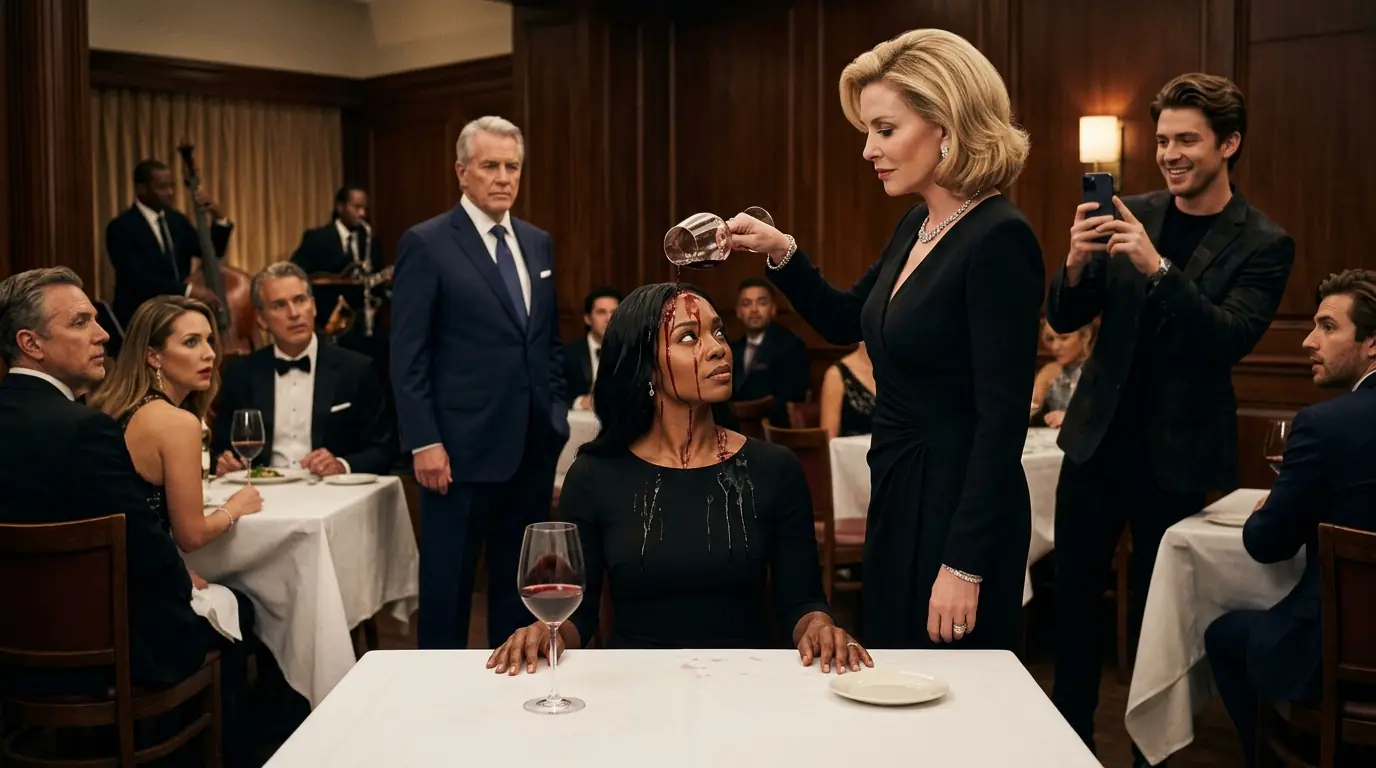


"Then get up anyway. Your stench is ruining everyone's appetite."

"I have a reservation."

Victoria's smile dropped. "A reservation? You think a reservation makes you one of us?" She picked up Belle's wine glass and poured it straight down the front of her dress. "There. Now the outside matches the inside."

"Vicki, stop wasting good wine on a stray. That bottle costs more than her whole life." Preston Caldwell didn't even glance over. The jazz stopped. Sixty forks went still. Not one person in that room said a word.

Belle sat there, wine dripping off her chin, hands steady, eyes locked on Victoria. What this family had just done in front of all those witnesses was the beginning of the fastest downfall in American business history.

Six hours before that wine hit Belle Townsend's dress, she was standing barefoot in the kitchen of her two-bedroom apartment in Brooklyn. Not a penthouse, not a townhouse, just a regular apartment with a cracked tile by the fridge and a coffee maker that took three tries to start. On the counter sat a stack of legal documents thick enough to stop a door: acquisition paperwork. Fourteen months of negotiations, audits, and shareholder meetings had been compressed into one final signature page.

Belle signed it with a ballpoint pen. Not a Montblanc, not a ceremony, just ink on paper with coffee getting cold beside her. That signature made her the sole controlling owner of Caldwell Hospitality Group, a 12-property restaurant and hotel empire worth $800 million. Its flagship was Maison Caldwell on Manhattan's Upper East Side, a two-Michelin-star restaurant with a 60-year legacy built by three generations of Caldwells, and now it belonged to her.

But Belle Townsend did not grow up in boardrooms. She grew up on the South Side of Chicago in a one-bedroom apartment she shared with her mother, Diane. Diane Townsend worked double shifts as a waitress at a diner off Halsted Street five days a week, sometimes six. Belle remembered sitting in a booth after school doing homework while her mother carried plates back and forth, her shoes worn through at the soles.

By 16, Belle was waiting tables too. Same diner, same worn shoes. She worked the dinner rush, closed out at 11:00, then studied until two in the morning. Her SAT prep book had grease stains on every page.

She got into Northwestern on a full scholarship, graduated at the top of her class, then went to Wharton for her MBA, where one professor told her to her face that she was only there because of a diversity quota. She did not argue. She simply outperformed every single person in that room for two straight years. At 28, she founded Pinnacle Ventures with two employees and a rented desk in a shared office in Midtown.

Six years later, her firm managed $2.8 billion in assets. It was not family money and it was not a lucky break. Every dollar traced back to deals she sourced, negotiated, and closed herself. But that night was not about business.

Belle pulled up a photo on her phone of her mother, Diane, taken at that same diner around 1998. Her apron was stained, her hair pulled back, and she wore a tired smile. Diane had died four years earlier from a heart attack at 59. She never saw her daughter's name on a building, never saw the Forbes profile, never knew what Belle would become.

Belle stared at the photo for a long time. Then she put on a simple black dress with no labels and no jewelry except a thin gold chain her mother had given her for graduation. She looked in the mirror and saw exactly what she wanted the world to see that night: just a woman going to dinner.

Before the deal went public Monday morning, Belle wanted to walk into Maison Caldwell one time as nobody. She wanted to sit down, order food, watch how the staff moved, and see who got respect and who did not when there were no cameras, no press releases, and no power suits in the room. She wanted the truth, the version of that restaurant the Caldwell family showed when they thought nobody important was watching.

Her driver dropped her off at 8:15. It was late October on the Upper East Side, with cold air, gold light spilling from restaurant windows, and couples in long coats walking arm in arm. Maison Caldwell sat on the corner of East 72nd and Madison, with polished brass doors and a doorman in a three-piece suit. It was the kind of place where the wine list had more pages than most novels.

Inside were amber light, white tablecloths, and a live jazz quartet playing something soft in the corner. Every table was full. The crowd was almost entirely white: old money, corporate money, the kind of people who did not look at prices because looking was beneath them. In the far corner sat the Caldwell family at their permanently reserved table.

Preston Caldwell sat at the head, loud and laughing, commanding the room like he owned it, which until Monday morning he technically still did. Victoria adjusted flowers on the table as if she were staging a magazine shoot. Their son, Garrett, was on his third cocktail, scrolling through his phone, bored with everything around him. Belle walked in alone.

The hostess smiled politely, but her eyes did a quick sweep up and down, followed by a half-second pause. "Do you have a reservation?"

"Yes. Table 9, under Adams."

The hostess checked, found it, and seated her. Belle ordered a glass of red wine and opened the menu. She had no idea that in less than an hour she would be wearing that wine instead of drinking it.

It started with Garrett. He noticed Belle about 15 minutes after she sat down. It was hard not to. She was one of maybe three Black faces in the entire restaurant and the only one not wearing a uniform.

Garrett leaned back in his chair, swirling his bourbon and watching her the way a cat watches something it has not decided whether to chase. Then he stood up.

"Where are you going?" Victoria asked.

"Relax, Mom. Just being friendly." He straightened his jacket, a $6,000 Tom Ford that did not fit right because Garrett had the kind of body expensive clothes could not save, and walked over to Belle's table. He slid into the empty chair across from her without asking.

"Hey."

Belle looked up from her menu. "Can I help you?"

"I was going to ask you the same thing." He smiled, the kind of smile rich boys learn early, part charm and part ownership. "You look like you could use some company. Sitting here all alone."

"I'm fine, thank you."

"Come on. Pretty girl, empty table, Saturday night. Let me buy you a drink."

"I already ordered one."

"Then let me buy the next one."

"I appreciate it, but I'm good."

The smile stayed, but something behind his eyes shifted. It was that micro-expression men make when they hear the word no and their brain does not know how to file it. He leaned forward.

"You know this is my family's restaurant, right? My dad owns this place. Everything you're looking at, the chairs, the glasses, the food you're about to eat, that's Caldwell. That's us."

Belle set down her menu. "I'm aware."

"So when I say let me buy you a drink, that's not really a question."

Belle held his gaze. "And when I say no, that's not really a negotiation."

Garrett's jaw tightened. He sat back and looked her over again, but differently this time. He was not flirting anymore. He was assessing her the way his father looked at things, deciding whether to buy or discard.

"You know what? Forget it." He stood and adjusted his jacket. "I don't even know why I walked over here. You're not exactly the type we cater to."

He said that last part louder, loud enough for the nearby tables to hear. Belle said nothing. She picked up her wine glass and took a sip.

Garrett walked back to the family table. Victoria noticed his expression immediately.

"What happened?"

"Nothing. Just some waitress sitting in the guest section acting like she belongs here."

Victoria's eyes snapped toward Belle and narrowed. Then she turned to Preston. "Preston, look at table 9."

Preston looked. He did not see a person. He saw a problem.

"Who seated her there?"

"That's what I'd like to know," Victoria said. "Right next to our section, this close to our guests. It's embarrassing."

Preston set down his fork and dabbed the corner of his mouth with a napkin. Then he stood. At six-foot-two, with silver hair and a navy suit tailored to the millimeter, Preston Caldwell walked like a man who had never once been told he was in the wrong room because he never had been.

He stopped at Belle's table. He did not sit or smile. He simply looked down at her.

"Ma'am."

Belle looked up. "Good evening."

"I'm going to be straightforward with you. This section is reserved for our private guests. I don't know how you ended up here, but I'm going to need you to move."

"The hostess seated me here. I have a reservation."

"I don't care what the hostess did. I'm telling you this table is not available."

"The restaurant confirmed this table two days ago."

Preston's patience was a performance, and the curtain was dropping fast. He turned and snapped his fingers at the floor manager, a white man in his mid-30s already sweating through his shirt. "Connor, come here."

Connor hurried over. "Yes, Mr. Caldwell?"

"Why is this woman sitting at table 9? This is four feet from our party. Who approved this?"

Connor's eyes bounced between Preston and Belle. "Sir, she has a valid reservation. The system assigned—"

"I don't care what the system says. I care what I see. And what I see is a problem. Fix it."

Connor turned to Belle. His face said everything his mouth was too scared to say. "Ma'am, would you be comfortable moving to a table in the back? We have a lovely spot near the kitchen."

"No. I'm comfortable here, thank you."

Preston stepped closer. His voice dropped, not quieter, but heavier. "Let me make this simple. My family has owned this restaurant for 31 years. I decide who sits where, and I'm deciding that you don't sit here."

"On what basis?"

"On the basis that I said so."

"That's not a basis. That's a preference."

The temperature in the room shifted. Diners at nearby tables stopped pretending not to listen. Forks went down. Conversations paused. The jazz quartet played on, but nobody was hearing the music.

Victoria appeared at Preston's shoulder. She had been watching from the family table, and whatever she saw in Preston's face told her he was not finishing this fast enough.

"Oh, for God's sake, Preston. Stop negotiating. She's not a shareholder. She's not a guest. She's just some girl who wandered in off the street and doesn't know when to leave."

Victoria turned to Belle and made full eye contact, the kind of look designed to make someone feel small enough to disappear. "Sweetheart, I don't know what fantasy you're living in, but this isn't your world. This restaurant is for people who built something, not people who serve people who built something."

Belle did not blink. "And which one are you, Mrs. Caldwell? The one who built something, or the one who married someone who did?"

The room held its breath. Victoria's face went white, then red. Her lips pressed into a line so tight they nearly disappeared. Nobody talked to Victoria Caldwell like that, not her staff, not her friends, not her own son, and certainly not a Black woman in a $50 dress sitting at a two-top near the bar.

Victoria reached across the nearest table, picked up a bread plate, and dropped it in front of Belle with a ceramic crack. "If you insist on staying, make yourself useful. Clear the table."

Belle looked at the bread plate, then at Victoria. She gently pushed it aside, picked up her menu, and continued reading. "I'll have the duck, I think."

Behind the bar, 20 feet away and half hidden by the espresso machine, a 26-year-old waitress named Sophie Emerson watched everything. Her hands were shaking, not from fear, but from anger. She pulled out her phone and pressed record. Nobody noticed.

What happened next took less than 10 minutes, but for Belle Townsend, sitting in that chair with 60 pairs of eyes on her, every second stretched like an hour. Preston pulled out his phone right there, standing five feet from Belle's table. He did not whisper or step away. He wanted her to hear every word.

"Tommy, it's Preston. Yeah, I know it's Saturday. Listen, I need a unit at the restaurant. We've got a situation. Black female, mid-30s, refusing to leave the premises."

"She's disrupting our guests, causing a scene, and I want her removed. Ten minutes? Make it five."

He hung up and looked at Belle. "There. That should simplify things."

Belle's expression did not change. "You called the police because I'm eating dinner."

"I called the police because you're trespassing."

"I have a reservation."

"You have a problem, and it's about to walk through that door in a uniform."

Preston turned his back on her, walked to the family table, sat down, picked up his fork, and resumed eating as if nothing had happened.

Victoria was not done. She snapped at Connor, who stood frozen near the bar pretending to check a receipt. "Connor, remove her place setting."

Connor looked up. "I'm sorry?"

"Her glass, her silverware, her napkin. Take it all. She is not a guest. Stop treating her like one."

Connor's hands trembled. He looked at Belle. She looked back at him. She did not nod or shake her head. She simply looked at him, and in that look was a question: What are you going to do?

Connor walked to her table. His voice was barely a whisper. "Ma'am, I'm so sorry."

He picked up her wine glass, her fork, her knife, and her napkin one by one and placed them on a tray. He left the bare white tablecloth empty except for the bread plate Victoria had thrown down. Belle sat at a stripped table in a packed restaurant with no glass, no silverware, nothing.

Garrett thought this was the funniest thing he had ever seen. He tilted his chair back, pulled out his phone, and hit record. "Yo, check this out. This lady really thinks she can sit in a Michelin-star restaurant and just stay, like a cockroach that won't leave. Bro, someone please call an exterminator."

He zoomed in on the table and laughed, then showed the video to Victoria, who smirked. Belle heard every word. Her jaw tightened, the smallest crack in her composure, but she did not turn around or give him the angle.

Then Victoria delivered the final blow. She walked to Belle's table, picked up her own glass, a $400 Bordeaux nearly full, and carried it over. She stood over Belle the way someone stands over something they are about to throw away.

"You know what I've been thinking? You came here for the full experience, right? Let me give it to you."

She tilted the glass slowly and poured it directly over Belle's head. Red wine ran through Belle's hair, down her forehead and cheeks, soaked into the collar of her black dress, pooled on her shoulders, and dripped from her chin onto the tablecloth in dark red circles.

The entire restaurant gasped. A woman at table four covered her mouth. A man near the window stood up, then sat back down. Phones appeared at three, four, five tables.

Victoria set the empty glass down on Belle's table gently, like she was placing a period at the end of a sentence. "There. Now the outside matches the inside."

The jazz quartet had stopped. The only sound was wine dripping from Belle's chin onto the marble floor. Drip, drip, drip. Belle closed her eyes for two seconds, then three. When she opened them, they were dry, steady, and locked on Victoria.

"Are you finished?"

Victoria blinked. That was not the reaction she wanted. She wanted tears and a scene. She wanted this woman to crumble so she could point at the mess and say, See, this is why they do not belong here.

But Belle did not crumble. She sat there, wine dripping from her face, with more composure than anyone in the Caldwell family had shown all night.

Then the police walked in. Two uniformed officers in their mid-40s, one tall and one stocky, entered through the front door and the room seemed to split. Diners leaned back in their chairs, making way and watching like this was the third act of something they could not stop.

Preston was already on his feet. He met the officers halfway, hand extended as if greeting golf buddies. "Officers, thank you for coming. She's right over there, the one covered in wine."

The taller officer looked at Belle, wine-soaked and sitting at a bare table, surrounded by well-dressed white diners who looked anywhere but at her. "Ma'am, can you stand up for me?"

Belle stood. Wine dripped from her dress onto her shoes.

"Can you tell me what's going on here?"

"I made a reservation. I came to eat dinner. I've been here for 45 minutes. I haven't raised my voice. I haven't touched anyone."

"That woman," she said, looking at Victoria, "poured wine on me twice. That man," she continued, looking at Preston, "called you to remove me because I wouldn't give up my table."

The officer turned to Preston. "Sir, is this your establishment?"

"It's my family's restaurant. Yes. And she's trespassing."

"She says she has a reservation."

"I don't care what she says. I want her out."

The officer paused and looked at his partner. A silent conversation passed between them, the kind officers have when they know the situation is wrong but the path of least resistance is clear.

"Ma'am, the property owner is asking you to leave. If you don't comply, we'll have to escort you out."

"I understand." Belle's voice did not shake. "I'll leave, but I want both your badge numbers and your names."

The officers exchanged another look. The stocky one shifted his weight. Belle pulled her phone from her purse slowly and deliberately, making sure everyone saw that it was only a phone, and typed their badge numbers into her notes.

"Thank you."

She walked toward the front door, past the family table where Garrett was still filming, past the 60 diners who had watched a woman get wine poured on her head and done nothing, past the jazz quartet standing with their instruments at their sides, and past Connor, who could not meet her eyes.

At the door, Belle paused. She turned around and looked at the room one last time. Nobody looked back.

She stepped outside into the cold October air, wine-stained, alone, and with her head high. A black town car pulled up. Her driver opened the door. Belle got in, closed her eyes for three seconds, then pulled out her phone.
She called Nenah Ashford. Nenah picked up on the first ring.

"How was dinner?"

"Move the press release up. I want the acquisition public by 9:00 a.m. Monday."

"Belle, that's 36 hours. We were planning for Wednesday."

"Monday, 9:00 a.m. And Nenah, pull everything. HR complaints, health-code violations, employee discrimination filings, insurance audits, all of it. I want a full picture by tomorrow night."

"What happened?"

Belle looked out the window at Maison Caldwell's gold sign glowing against the dark street. "I found out exactly how they treat people when nobody important is watching." She paused. "And Nenah, one more thing. I'm not saving this company anymore. I'm cleaning it out."

Sunday was quiet. Belle spent the day in her apartment with Nenah Ashford and Derek Collinsson, her CFO. The dining table was covered in documents, with 14 months of acquisition work condensed into folders, tabs, and sticky notes. Nenah had worked through the night.

By noon Sunday, she had everything. There were 43 formal discrimination complaints filed by employees of color across Caldwell properties over the previous 15 years. Every single one had been marked resolved internally. Not one resulted in disciplinary action.

Payroll records showed Black and Latino kitchen staff earning 22% less than white counterparts in the same roles. Zero Black employees had been promoted to management at any of the 12 properties in the entire history of the company. A health inspection from 2019 should have shut down two locations, but it had not.

The inspector's name matched a guest entry in Preston Caldwell's private club records. There had been three visits and two bottles of scotch, with no violations reported. Nenah laid it all out on the table.

"This isn't just bad culture, Belle. This is a pattern. A federal-level pattern."

"Good. Hold everything until after Monday."

Derek looked up from his laptop. "The board meeting is confirmed for 9:00 a.m. All seven directors will be present. Preston, Victoria, and Garrett are all expected."

"Do they know I'll be there?"

"No. The agenda lists it as a quarterly review with a note about shareholder restructuring. Preston's assistant confirmed he barely read the email."

Belle nodded. "He wouldn't. He's never had to worry about who owns what. It's always been his."

She looked at the wine stain still visible on the black dress hanging on the back of her bathroom door. She had not washed it. Not yet.

"Let's go take his chair."

Monday morning, 9:00 a.m., Caldwell Hospitality Group headquarters. The company occupied a glass-and-limestone tower on West 57th Street. The boardroom sat on the 32nd floor, with floor-to-ceiling windows overlooking Central Park, a long mahogany table, 12 leather chairs, and a portrait of Preston's father, Theodore Caldwell, hanging on the far wall. Theodore had founded the company in 1962.

By 8:45, the room was filling up. Board members took their usual seats. Coffee was poured. Small talk covered the weekend, the markets, and someone's new boat.

At 8:50, three people walked in whom nobody recognized. Nenah Ashford wore a navy suit and carried a black briefcase. She nodded at the board members but did not introduce herself, then took a seat at the far end of the table, the end usually left empty.

Derek Collinsson followed in a gray suit with a laptop under his arm. He sat beside Nenah and opened the laptop without a word. A third Pinnacle executive, a woman named Clare Buchanan, head of operations, entered and stood near the door. The board members exchanged looks.

Preston's assistant leaned toward one of the directors. "I don't know who these people are. They weren't on the list."

At 8:58, Preston, Victoria, and Garrett walked in. Preston owned the room before he even sat down, with a loud voice and a big handshake. He clapped a board member on the shoulder, laughed at something nobody else found funny, and pulled out his chair at the head of the table.

Victoria sat behind him in a row of guest chairs along the wall. She crossed her legs, adjusted her bracelet, and started scrolling through her phone. Garrett dropped into a chair at the far end, already bored.

At 9:00 a.m., the boardroom doors opened one more time. Belle Townsend walked in wearing a tailored navy suit, her hair pulled back and the same thin gold chain around her neck that she had worn Saturday night. It was still the only piece of jewelry she wore.

She walked the full length of the table without rushing or hesitating. Every board member watched her. Belle pulled out the chair at the head of the table, directly across from Preston, and sat down.

Preston stared. He did not recognize her, not at first, not in the suit, not in this building, not in his chair.

Then Victoria made a small, sharp inhale, like someone stepping on glass. She recognized the face. Preston looked at his wife, then back at Belle, and it hit him: the restaurant, the wine, Saturday night.

His mouth opened. Nothing came out.

Nenah stood. "Good morning. My name is Nenah Ashford, chief counsel for Pinnacle Ventures. As of 6:00 a.m. this morning, Pinnacle Ventures has completed its acquisition of a controlling 68% stake in Caldwell Hospitality Group. All regulatory approvals were finalized Friday. Every legal requirement has been met."

She placed a bound acquisition document on the table and slid it toward Preston. "Ms. Belle Townsend, CEO and founder of Pinnacle Ventures, is now the majority owner of this company."

Silence settled over the room, the kind that had weight.

Belle spoke calmly and clearly, looking directly at Preston. "We've met before, Mr. Caldwell. Saturday evening, at your restaurant. You might remember you called the police to have me removed."

Preston's hand gripped the edge of the table, his knuckles white. Garrett's phone slipped from his hand and clattered onto the mahogany.

"That... that was—" Garrett stammered.

"That was me," Belle said without raising her voice. "The woman your mother poured wine on. The woman your father called a stray. The woman you filmed and called a cockroach."

She paused and let it sit. "I know my place, Garrett. It's right here."

Victoria stood up from the guest chairs. "This is ridiculous. Preston, call Richard. Call the lawyers. They can't just—"

Nenah did not look at Victoria. "Mrs. Caldwell, I'd encourage you to sit down. The acquisition is legally binding."

"There is no challenge. There is no injunction. It's done."

Victoria sat.

Belle laid three folders on the table. "Effective immediately, Preston Caldwell is removed as chairman of the board. Garrett Caldwell is terminated as VP of operations, and I am ordering a full internal investigation into discriminatory employment practices across all 12 Caldwell properties."

She looked around the table. Every board member was frozen.

"This company was built on the belief that certain people don't belong. I'm going to rebuild it on the belief that everyone does."

She pressed a button on the conference phone. "Security, this is Belle Townsend. Please send a team to the 32nd-floor boardroom. We have two former employees who need to be escorted from the building."

Preston stood, his chair scraping against the floor. His face was the color of ash. "You can't do this."

Belle looked up at him. "I already did."

Two security guards appeared at the door. Preston looked at them, then at the board members who would not meet his eyes, then at his son, who had nothing to say for the first time in his life. Preston and Garrett were escorted out.

Victoria was waiting in the lobby. She saw them come through the elevator doors, Preston with no briefcase, Garrett with no badge, both flanked by security. Her scream echoed off the marble walls. Nobody stopped to look.

The Caldwell family had never been told no. Not by employees, not by business partners, not by banks, regulators, or city officials. For 30 years, the Caldwell name had opened every door in Manhattan. By Monday afternoon, every one of those doors was closing.

Preston's first call was to Richard Hamill, the family's attorney for two decades, who worked from a corner office on Park Avenue and billed at a rate that could fund a small school. Preston paced his living room with the phone pressed to his ear, his voice shaking between rage and disbelief.

"Richard, this woman, this nobody, walked into my boardroom and took my company. I want an injunction. I want this reversed by end of day."

Richard had already received a copy of the acquisition documents couriered from Nenah Ashford's office at 7:00 a.m. He had been reading them for three hours.

"Preston, sit down."

"I don't want to sit down. I want my company back."

"Sit down and listen to me carefully."

Richard's voice was flat. "She acquired your debt through six shell purchases over 14 months. She accumulated stock through three separate brokerage accounts. She secured five of your seven board members' votes before you even knew her name."

"The regulatory filings are clean. The SEC disclosures are timely. Every single step was legal."

"There has to be something."

"There isn't. I've been doing this for 34 years, Preston. This is the most airtight acquisition I've ever seen. Whoever her counsel is, they didn't leave a thread to pull."

Silence.

"You don't own Caldwell Hospitality anymore. She does. And if you challenge this publicly, the only thing you'll accomplish is making the story bigger."

Preston hung up without saying goodbye.

Victoria's approach was different. She did not call lawyers. She called journalists. By Tuesday morning, she had reached out to three media contacts, people who had covered Caldwell charity events, attended Victoria's dinner parties, and owed her favors.

Her pitch was simple: Belle Townsend was a corporate raider, a predator who had used deceptive tactics to steal a family business from an American institution. Victoria wanted the narrative framed as a hostile takeover by an outsider, and she did not need to say what she meant by outsider.

The first journalist, a business columnist at the New York Post, made two phone calls, one to Pinnacle Ventures' media office and one to a former Caldwell employee. He called Victoria back within an hour.

"Victoria, I'm not running this story. And if I were you, I'd stop making these calls. What I'm hearing about your family's employee record is going to be the story, not the acquisition."

The second journalist did not call back at all. The third did, but not to help. She was an investigative reporter who had been looking into Caldwell Hospitality for months after a tip from a former line cook. Victoria's call only confirmed the story was worth chasing.

Garrett tried a different angle. He posted a 45-second video on Instagram, with his suit and slicked hair, speaking directly to the camera.

"My family built Caldwell Hospitality from the ground up. Three generations, 60 years. And now, someone who has zero connection to this legacy has come in and stolen it through financial manipulation. This is corporate theft, plain and simple. We will be fighting this."

The video received 200,000 views in six hours. But the comments were not what Garrett expected, because by Tuesday afternoon Sophie Emerson had uploaded her video.

It ran three minutes and 41 seconds and had been shot from behind the bar at Maison Caldwell. The audio was clear. The footage was steady. It showed everything: Victoria calling Belle a stray, Preston calling the police, the wine, the glass poured on Belle's dress and then the second glass poured over her head, Garrett filming and laughing, the stripped table, and the officers walking Belle out while 60 people watched in silence.

Sophie posted it with one line: "This is how the Caldwell family treats people when they think nobody's recording."

Four million views in 48 hours. Eight million by the end of the week. The comments became a flood, and hashtags started trending before midnight: #JusticeForBelle, #MaisonCaldwellRacism, #SheOwnsThem, #CaldwellIsOver.

News outlets picked it up by Wednesday morning: CNN, MSNBC, and The New York Times. The contrast was devastating, a billionaire family pouring wine on a Black woman who, at that very moment, already owned their entire company. Garrett deleted his Instagram video, but the internet had already saved everything.

Then the floodgates opened. Former employees started coming forward, not one or two, but dozens. Current and former staff from all 12 Caldwell properties spoke on camera, on podcasts, and in print.

A sous-chef from the Brooklyn location said, "I worked there for four years. Never saw a Black employee make it past line cook. Not once."

A former hostess from the Hamptons property said, "Victoria once told me to seat Black guests in the back corner because they, and I'm quoting her, 'bring down the ambiance.'"

A maintenance worker who had been with the company for 11 years said, "You learn fast. Keep your head down. Don't make eye contact with the family. And if you're not white, don't expect a promotion. That's just how it worked."

Sophie Emerson gave her first on-camera interview to NBC. She sat on a stool with her hands folded and her voice steady.

"What they did to that woman Saturday night, that wasn't unusual. That was a regular Tuesday for them. The only difference was she was the first person who had the power to actually do something about it."

The interviewer asked, "Were you scared to post the video?"

Sophie paused. "I was terrified. I thought they'd sue me. I thought I'd never work in this industry again."

She looked directly into the camera. "But I watched a woman sit in a chair while someone poured wine on her head, and she didn't flinch. If she could do that, I could press upload."

Within two weeks, this was no longer just a restaurant story. It was a federal case. Belle's team had turned over the payroll records, buried HR complaints, and health-inspection coverups to the Equal Employment Opportunity Commission and the New York State Attorney General's Office.

The EEOC opened a formal investigation on a Thursday. By Friday, federal prosecutors had joined, because what they found inside those files was not just discrimination. It was a system.

Fifteen years of payroll data showed Black and Latino employees across all 12 Caldwell properties had been paid between 18 and 22% less than white employees in identical positions. Same hours, same roles, same responsibilities, different checks.

Promotion records were worse. In the company's entire 60-year history, not one Black employee had ever been promoted to a management position. Not one. Across 12 properties, hundreds of staff members, six decades, zero.

The 43 discrimination complaints filed by employees of color had all been routed to the same internal HR director, Paula Greer, who reported directly to Preston. Every complaint followed the same path: filed, acknowledged, investigated internally, closed. No corrective action, no follow-up, no record of any findings, just a rubber stamp and a filing cabinet.

But it was the health-inspection records that caught prosecutors' attention. Two Caldwell locations, the Tribeca Steakhouse and the Midtown Hotel restaurant, had failed city health inspections in 2019. The violations were critical: rodent activity, improper food-storage temperatures, and cross-contamination risks.

Those failures should have been public. They should have resulted in fines, mandatory closures, and reinspections. They did not.

The inspector's name was Glenn Buckley, a city employee with 23 years on the job, and his name appeared three times in Preston Caldwell's private-club guest records. Two bottles of single-malt scotch, each worth $900, had been charged to Preston's account and delivered to an address matching Buckley's home. No violations were reported. The restaurants stayed open.

When federal investigators brought Buckley in for questioning, he cooperated within 40 minutes and gave a full confession. He had been accepting gifts from Preston for years, not just scotch, but Knicks tickets, a weekend at the Caldwell family's Hamptons property, and a cash payment of $15,000 after the 2019 inspection.

Preston Caldwell had not merely run a discriminatory company. He had bribed public officials to keep it running.
Ray Dawson broke the story. Dawson was an investigative journalist at The Atlantic with 15 years of experience, two national magazine awards, and a reputation for dismantling institutions one document at a time. He had been tracking the Caldwell family for six months before any of this happened. A tip from a former line cook had put him on the trail, and Sophie's video accelerated his timeline by a year.

His piece dropped on a Wednesday morning. Twelve thousand words. The title was: "The Caldwell Legacy: Three Generations of Racism Behind Manhattan's Most Famous Restaurant."

Twenty-eight former employees were interviewed on the record. The article included internal documents, financial records, payroll comparisons, and a timeline of every buried complaint dating back to 2008. Then came a detail nobody saw coming.

Victoria Caldwell had operated a charitable foundation, the Caldwell Family Foundation, for 11 years. It claimed annual donations to youth education programs in underserved communities. Tax returns showed $600,000 in charitable disbursements per year.

Dawson pulled the foundation's Form 990 filings and cross-referenced them with the listed recipient organizations. Four of the seven organizations did not exist. Their addresses led to empty lots, P.O. boxes, and a storage unit in New Jersey.

The remaining three were real nonprofits, but each confirmed that it had never received a single dollar from the Caldwell Foundation. In total, $6.6 million in fabricated charitable donations had been used as tax deductions over more than a decade. Victoria's charity was a fraud.

The public reaction was volcanic. #CaldwellIsOver trended nationally for three straight days. Protest groups organized outside Caldwell properties in Manhattan, Brooklyn, and the Hamptons.

Former employees held a press conference on the steps of City Hall. They stood in a line and read their experiences one by one into a microphone. Corporate partners severed ties within the week.

The wine distributors, linen companies, and the PR firm that had managed the Caldwell brand for 15 years released a one-sentence statement: "We no longer represent Caldwell Hospitality Group."

Eight months later, the case reached the Federal Courthouse in the Southern District of New York. The trial lasted three weeks. The evidence was overwhelming.

The defense, led by Richard Hamill, who had taken the case despite his own earlier advice, argued that Preston was a hands-off executive who delegated HR decisions and had no direct knowledge of discriminatory practices. The jury did not accept that argument.

Preston Caldwell was convicted on three counts of tax fraud, two counts of bribery of a public official, and one count of conspiracy to obstruct a federal investigation. The judge, 61-year-old Judge Dorothy Adler, delivered the sentence without emotion: six years in federal prison and $4.2 million in fines.

Victoria Caldwell was convicted on two counts, accessory to tax fraud and filing false charitable returns through the foundation. She received 18 months in federal prison and three years of supervised probation upon release.

Garrett Caldwell cut a deal. After the acquisition was announced, he had gone into the Caldwell HR office at two in the morning and shredded 14 boxes of employee complaint records. Security cameras caught everything.

He pleaded guilty to obstruction of justice and employment fraud. He received two years in federal prison. The Caldwell family was also ordered to pay $1.5 million in restitution to affected employees, including back pay, damages, and compensatory settlements distributed across all 12 properties.

Sentencing day came on a cold spring morning outside the courthouse. Preston walked out first in a gray suit with no tie and his wrists in cuffs. Reporters lined both sides of the steps. Camera shutters sounded like insects.

He said nothing. He stared straight ahead and walked to the waiting transport van. Victoria followed, holding a folder over her face.

Her Valentino gown had been replaced by a gray pantsuit two sizes too big. The woman who once poured wine over a stranger's head to prove a point could not look a single camera in the eye. Garrett came last, handcuffed in front with his head down.

The man who had called Belle a cockroach on camera had nothing to say when the cameras were pointed at him.

Three blocks away, at the newly renovated restaurant on East 72nd and Madison, no longer Maison Caldwell, Belle Townsend watched the verdict on a television mounted behind the bar. The restaurant's new name was etched in gold on the front window: TOWNSENDS.

Belle sat at table 9, the same table and the same chair. Sophie Emerson, no longer a waitress but the youngest floor manager in company history, walked over with a glass of red wine and set it down gently.

Belle looked at the glass, then at Sophie. Sophie smiled. "This one's for drinking."

Belle picked up the glass, took a sip, and set it down. Then she looked up at the television, watched Preston Caldwell disappear into a federal transport van, and nodded once to no one in particular.

One year later, the Caldwell name had disappeared from every awning, menu, and business card in the company. Belle did not erase it out of spite. She erased it because it was time.

Townsends Hospitality Collective was the new name. Twelve properties, same locations, same kitchens, different soul. The first thing Belle changed was not the logo, furniture, or wine list. It was the pay structure.

Every employee across all 12 properties was audited. Every wage gap was closed. Black and Latino staff who had been underpaid for years received full back-pay restitution, with some checks going back a decade.

One dishwasher at the Tribeca location opened his envelope and found a check for $38,000. He called his wife from the breakroom and could not get the words out.

The second thing Belle changed was the promotion pipeline. She hired an outside firm to design a transparent advancement program. Every role, requirement, and salary band was published openly.

No more backroom decisions. No more Preston Caldwell deciding who got ahead based on the color of their skin. Within eight months, 11 employees of color were promoted to management positions across the company. Eleven, after 60 years of zero.

The third thing Belle built was the one that mattered most to her. She called it the Second Table Scholarship, named after the experience of being told you did not deserve a seat.

The program funded culinary-school tuition, hospitality degrees, and small-business grants for first-generation students of color. It was fully funded, with no strings and no repayment. The first class had 42 students.

Belle met every one of them on the first day, shook every hand, and told them the same thing. "Someone once told me I didn't belong at the table, so I bought the table. Now I'm adding chairs."

Sophie Emerson was running the floor at Townsends' flagship restaurant, the same dining room where she had once stood behind the bar with shaking hands, pressing record on her phone. She had been promoted twice in 12 months. The staff did not fear her. They respected her.

There was a difference, and Sophie knew it because she had lived on both sides.

On a Tuesday night, six months after the trial, Belle did something she had not done since the acquisition. She put on an apron. She walked into the kitchen at Townsends during the dinner rush without announcing herself or bringing cameras.

She tied the apron, washed her hands, and started plating beside the line cooks. The head chef, a Dominican woman named Elena Vargas who had been hired three months after the takeover, looked over and froze.

"Ms. Townsend, you don't have to."

"I know. I want to."

Belle plated for an hour, carried dishes to the pass, and wiped down a station when it got backed up. The kitchen staff did not know what to do at first. Then they simply cooked side by side.

The CEO and the line. Same aprons, same rhythm.

After the rush, Belle stood by the back door, the same door Victoria once told her she should have used to enter. She looked out at the dining room.

The tables were full. People laughed. A jazz quartet played in the corner. At table 9 sat a Black family of four.

Two children colored on paper menus while their parents split a bottle of wine. Nobody stared at them. Nobody asked whether they belonged. They were simply eating dinner.

Belle watched them for a long time. Then she pulled out her phone, opened her photos, and scrolled to the picture of her mother, Diane, at the diner in 1998. Apron stained, tired smile.

The woman who had carried plates for 30 years and never once got to sit down in a place like this.

Belle looked at the photo, then at the dining room.

"We made it, Mom."

The Caldwell family had believed they could pour wine on someone's dress, call the police, strip her table bare, laugh, film, and tell her she did not belong. What they could not take away was what Belle had built with her own hands.

Sometimes, the person being looked down on is the same person holding the power to change the room. Belle did not walk into Maison Caldwell to start a fight. She walked in to see the truth, and the Caldwell family handed it to her freely because they believed nobody important was watching.

Sixty years, three generations, and an $800 million empire could not survive one evening of honesty. Not because Belle destroyed it, but because the family finally had to sit in the same room with who they really were.

News in the same category

News Post