"200 machines. Every single one of them broken."
"Same model, most of them."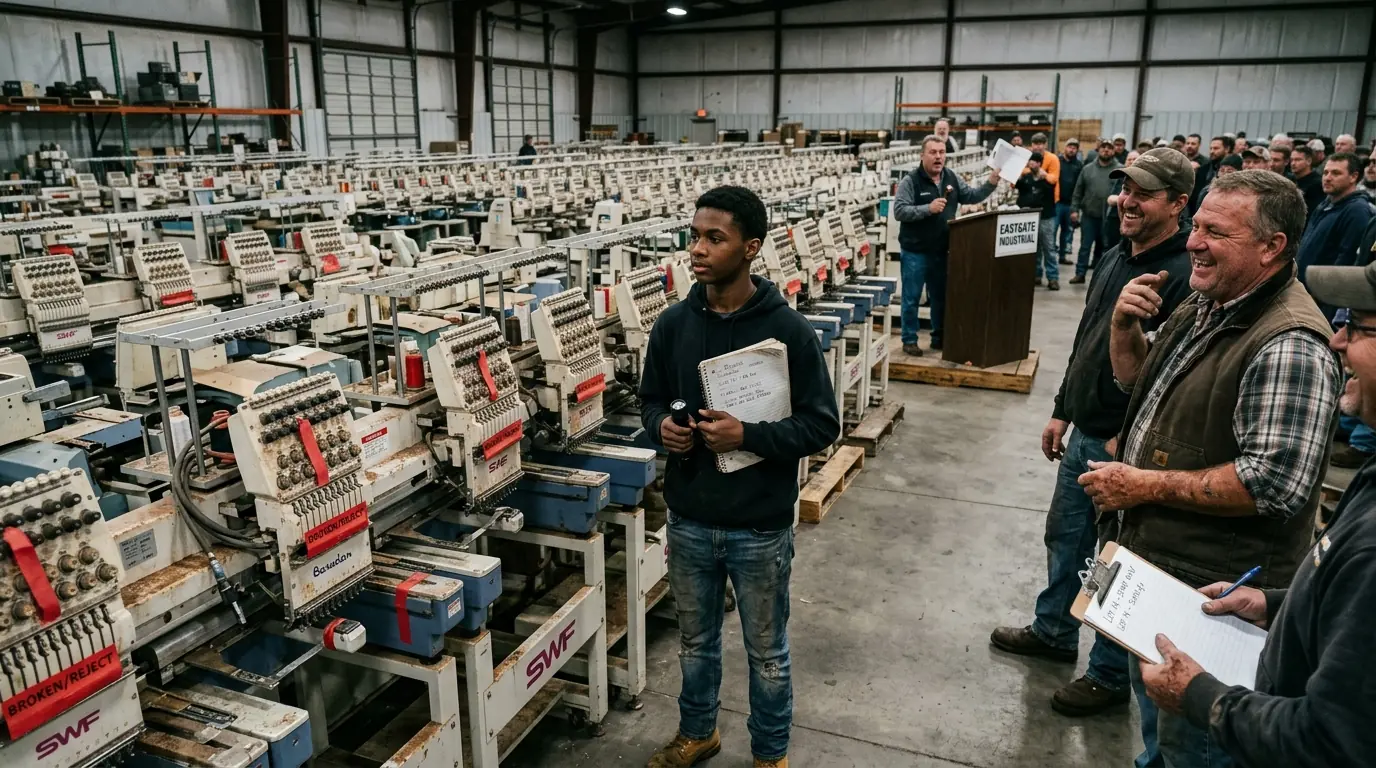
"Son, I've been doing this 30 years. You know what I see? Scrap metal. About 5 cents a pound."
"What's the asking price on the lot?"
"Nobody's asking. Nobody wants them."
"Any offer on the back warehouse? Full lot as is."
"$1,000."
"Kid wants to open a museum."
Russell Bain was not wrong about the machines. By every standard he knew, 200 broken industrial embroidery units were worth exactly what the scrapyard would pay, nothing more. He had spent three decades in salvage, and he understood metal. What he did not understand was the 17-year-old standing quietly in the back of that warehouse, running his fingers along serial number plates instead of lifting lids to check motors.
Damon Reigns was not counting what was broken. He was counting what matched. And in a room full of experienced buyers, not one of them thought to ask why that mattered.
The warehouse at Eastgate Industrial Depot smelled like rust and old oil—the kind of smell that settles into concrete after years of machines sitting still. It was a Tuesday morning in late October, and the lot was already crowded with buyers who had shown up before the auction officially opened. Men in work boots with clipboards. Men who knew exactly what they were looking at and exactly what it was worth.
Damon Reigns was not one of those men. He was 17, and he had taken the bus.
He had heard about the Northstar Apparel Works liquidation through a notice posted on an industrial supply forum his father used to follow. The factory had been one of the larger uniform manufacturers in Belridge, North Carolina. And when it closed, everything inside went with it: the shelving, the cutting tables, the thread spools, and most importantly, the machines.
200 computerized embroidery and industrial sewing units, all tagged with the same label in red marker: Broken, as is, no warranty.
Damon had written the address on the inside cover of one of his father's old notebooks and shown up with $1,080 folded inside a sealed envelope.
The serious buyers moved quickly through the back warehouse, lifting lids, checking motor housings, pulling copper coils. Russell Bain, a heavy-set man in his early 50s with the kind of sunburned forearms that came from decades of outdoor lot work, was the most efficient of all of them. He opened a machine, looked inside for about four seconds, and closed it again. He did this eight or nine times before he had seen enough.
When he finally spoke, he wasn't talking to anyone in particular, just announcing his conclusion to the room the way a man does when he's certain no one will argue. He said the whole lot was scrap. He said the best thing anyone could do with 200 broken embroidery machines was drive them straight to the shredder and sell the copper and steel by weight. Most of the other buyers nodded or said nothing, which in that room meant agreement.
Damon was not nodding. He was moving slowly along the far wall, not opening machines, not checking motors. He was reading the plates bolted to the side of each unit: the manufacturer codes, the serial number prefixes, the model identifiers stamped into the metal. He had a small flashlight and one of his father's notebooks, and he was writing things down.
What he had noticed about twenty minutes into walking the warehouse was something that none of the scrap buyers were looking for, because they had no reason to: a large portion of the machines shared the same model designation. Not all 200, but enough—maybe 130 of them. All variations of the same base unit manufactured within a span of about six years.