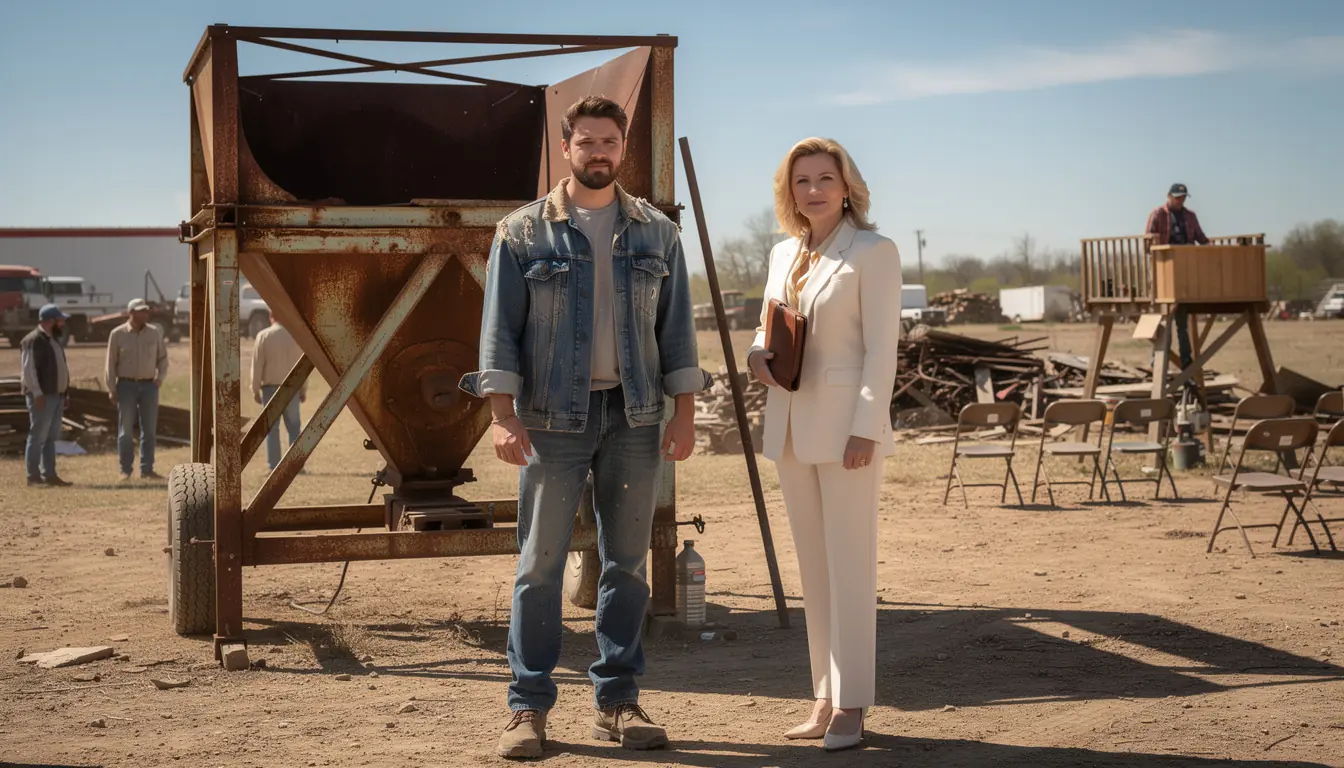
"Then nobody's going to fight me for it."[laughter]"Rotten frame, no hopper, frozen shaft, not even a motor. That's not a mill. That's 1,000 pounds of trouble.""It's 1,000 pounds I own now.""You're doing this because of my new minimum, aren't you? Because I won't stop my line for 300 pounds of corn.""You priced every small farm out.""I priced in reality, and it's not changing. You bring corn to Whitmore, it waits behind every contract account, and you pay the full minimum. No exceptions.""Not even in winter?""Especially in winter. Go grind it on your $12 junk."Darius said nothing.The surplus yard sat beside the demolition dump. Lot 47 was a stone burr grain mill that hadn't turned in years. Darius had come for a cheap metal trough; he was leaving with half a ton of iron. He folded the $12 receipt into his jacket pocket.Before he left, he did something strange: he never looked for a motor mount. He wiped the rust off the belt pulley instead, like it was the only part that mattered.What did a broke 20-year-old see in that pulley that Caroline Whitmore had missed?Darius had it off the county lot with 40 minutes of daylight to spare. It took a trailer borrowed from the repair shop, a come-along chained to a fence post, and every bit of patience he had left. The county man checked Lot 47 off his clipboard and drove away. Nobody stayed to help.Home was 36 rented acres at the end of a gravel road north of Morrow Creek. He had a few beef cows, a row of hog pens, a flock of laying hens, and a crib of corn he'd grown himself or traded labor for. The cows did fine on whole corn. The hogs and hens didn't; they needed it ground.That was the whole problem.Four days before the sale, he'd backed his pickup up to the scale at Whitmore Feed and Grain with 300 pounds of corn. The woman at the window slid him the new rate sheet. Small custom batches now waited behind every contract account or paid the full minimum, the same as a load twice his size."This line can't stop every time somebody wants a few sacks ground," she'd told him. And she hadn't even said it mean.The worst part was that he understood it. He'd worked on enough equipment to know what a changeover cost a plant: cleaning out the system, resetting the batch, the lost time. Caroline's math worked for Caroline.That night, on the back of a parts invoice, Darius had figured out the winter: grinding fees, plus the diesel to haul corn into town and back, would eat most of what his hogs were going to bring.