Dorian Vance had one rule when it came to strangers in trouble: you stop. You always stop.
So, when he spotted the black luxury sedan dead on the shoulder of Route 11, rain hammering the asphalt, hazard lights blinking into nothing, he pulled his beat-up service truck over without a second thought. He fixed her car in the rain, didn't ask for money, didn't ask for her name. 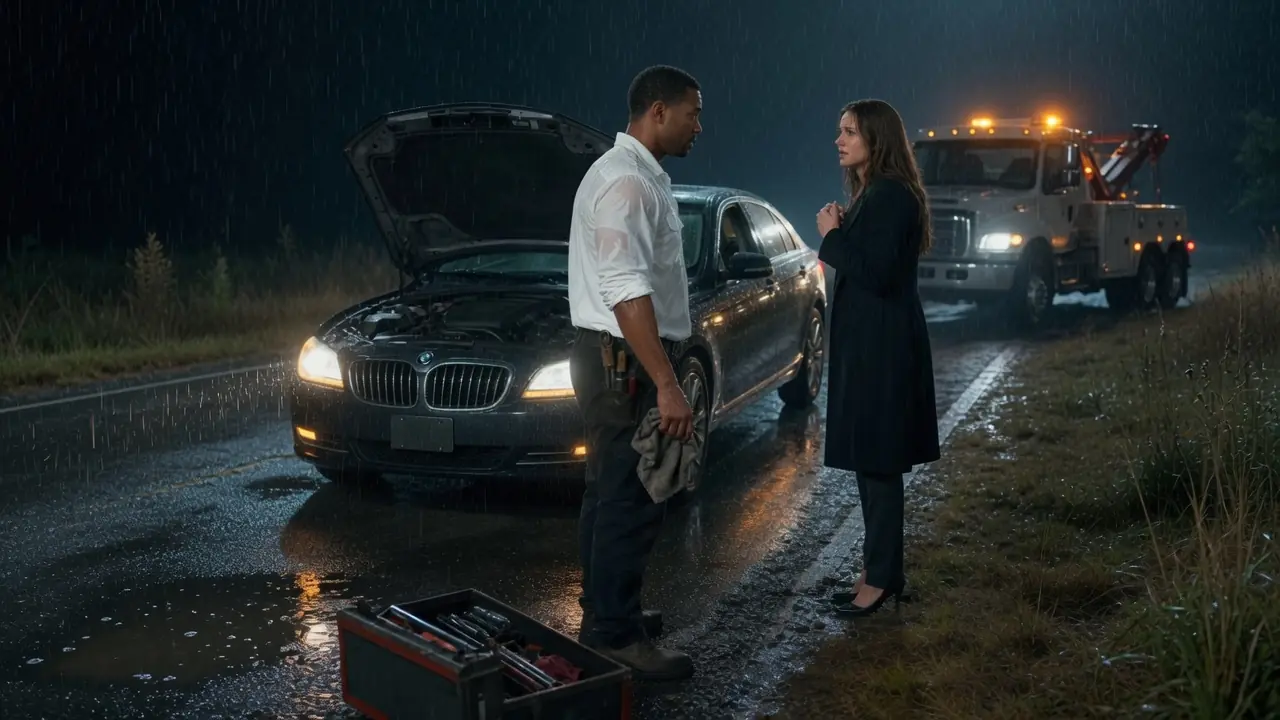
When the engine caught and he started walking back to his truck, she stepped out into the downpour and called after him—not "thank you," not "wait," but his name. His full name. A name he had never told her.
Dorian turned around slowly. The woman standing in the rain was beautiful, composed, and trembling all at once. She looked at the small scar on his right wrist, and something broke open behind her eyes.
"You really don't remember me, do you?"
Dorian had not planned on being out past 9:00 that night. He had a daughter at home, a sitter who charged extra after 10:00, and a transmission job due first thing in the morning. But a client had called at 7:00 with a dead battery across town, and Dorian was not the kind of man who told people to figure it out on their own. So, he went. He always went.
He was heading back down Route 11 when the hazard lights caught his eye—amber flashes swallowed half by rain, half by dark. The sedan was pulled crookedly onto the shoulder, one tire riding the gravel, and the woman beside it had stopped trying to flag anyone down. She just stood there, arms folded tight across her chest, rainwater running off her coat like she had already accepted that no one was coming.
Dorian pulled his truck in behind her and stepped out into the downpour without bothering with his hood. He told her to get back in the car and stay warm. She looked at him the way people sometimes looked at him—that brief, involuntary calculation—and then something in her face settled, and she did what he said.
Dorian lifted the hood, clicked on his flashlight, and got to work. The problem turned out to be a failed fuel pump relay. A stupid little component, the kind of thing that cost $12 and left a $40,000 car completely dead. He had a spare in his toolbox; he almost always did.
He worked with his left hand mostly, the way he always did on tight engine jobs, bracing with his right—a habit that had started years ago after the scar on his right wrist had left that hand slightly less reliable under pressure.
At some point, he became aware that the woman had gotten out of the car again and was standing a few feet away watching him. Not hovering. Just watching the way someone watches a thing they are trying very hard to memorize. He didn't look up; he finished the job.
When the engine turned over, Dorian wiped his hands on a shop rag and told her she should be fine to drive, but she ought to get the relay replaced properly within the week because a spare was never a permanent fix. He was already turning back toward his truck when he heard her speak. Not "thank you." Not "how much do I owe you?" But his name. Both parts of it.
"Dorian Vance."
He turned around slowly. She was standing in the rain with her arms at her sides, and she was trembling, and it had nothing to do with the cold. She was looking at his right wrist, at the small, pale scar that ran along the outer edge of it, and then she looked up at his face, and whatever composure she had been holding on to quietly came apart.
"You really don't remember me, do you?" she whispered.
Dorian Vance had grown up in Heartwell, in a neighborhood where people fixed things themselves because they couldn't afford to pay someone else to do it. He had been taking apart engines since he was twelve, following his uncle around a salvage yard on weekends, learning the language of machines the way other kids learn to read.
Then Cheryl got sick, and the years after that were a different kind of thing entirely. By the time Maya was three, it was just the two of them: Dorian and his daughter in a small house on Clement Street, and a grief so heavy it had taken him the better part of two years to learn how to carry it without buckling.
He opened Vance Auto Works when Maya started kindergarten. It was not a glamorous operation—a two-bay garage on the ground floor of a building he rented by the month, a second-hand lift, a sign he had painted himself. But it was his, and it was honest, and it kept the lights on.
Maya would come straight from school some afternoons and do her homework at the little desk he had set up in the corner of the office. On those days, the garage felt less like a workplace and more like something worth protecting.
That was the life Dorian was living when Alara Bennett's car died on Route 11.
He did not recognize her. She was dressed simply for someone who had clearly come from somewhere formal: a dark coat, heels that were not meant for standing on wet gravel, hair that had been carefully arranged before the rain got to it. But there was nothing about her face that connected to anything in his memory. She was a stranger. That was all he registered until she said his name.
Alara Bennett had run Bennett Horizon for six years, and in that time, she had negotiated mergers, survived two hostile takeover attempts, and testified before a Senate subcommittee on data privacy without once losing her composure. She was known in the industry and in the press for a particular quality of stillness—the ability to sit in a room where people were trying to dismantle her and make them feel somehow that they were the ones at a disadvantage.
None of that was available to her right now.
She had left the shareholder meeting early, telling her assistant she needed air. What she actually needed was to not be in a room full of people who were smiling at her while quietly voting against her. She had sent the car service home and driven herself, which she almost never did, because she needed the particular silence of being alone in a moving vehicle with no one watching her face.
She had been doing fine, all things considered, right up until the moment the engine died and took the heater with it. She had been standing on that shoulder for twenty minutes before Dorian's truck appeared.
She had not known it was him at first. She had been too cold, too tired, too aware of how absurd her situation was—one of the most recognizable women in American tech stranded in the rain because she had been too proud to let her driver take her home.
She watched the man climb out of the truck and walk toward her in the rain without any particular hurry, and she thought, "Good, someone who knows what they're doing." Then he turned to reach into the truck bed for his toolbox, and the floodlight from a passing car swept across him for just a moment, and she saw his profile.
Her heart did something violent and complicated inside her chest. She got back in the car the way he told her to because she needed a moment that he could not see. She sat behind the wheel with her hands in her lap and told herself she was wrong. She was exhausted and stressed and projecting, and the mind did that kind of thing when it was under pressure; it looked for familiar shapes in strangers' faces.
She told herself that for as long as she could. Then she got out of the car again because she had to know.
She watched his hands—the way he used his left hand for the tight angles, bracing with his right. And there it was: the scar along the outer edge of his right wrist, pale against his dark skin, exactly where she remembered it. The same wrist, the same scar. The one he had gotten the night he pulled her away from a bus that had jumped the curb on Mercer Street fifteen years ago, throwing himself between her and the impact without a second of hesitation.
When Dorian turned around and really looked at her, he tried to find something. The mind does that—reaches back through years of stored faces, trying to make a match. But there was nothing solid. There was something, maybe, around the shape of her eyes, the particular stillness of the way she held herself. But the name Alara Bennett meant nothing to him. The woman standing in the rain meant nothing to him, not in any way he could put into words.
"I don't think we've met," he said carefully. "How do you know my name?"
Alara looked at him steadily. "Your truck. 'Vance Auto Works'—it's on the door."
Dorian glanced back at his truck. She was right, of course. His name was right there in white block letters. He felt faintly foolish, and then faintly something else. Wary, maybe. Not of her specifically, but of the feeling that something was happening here that he didn't have the full picture of.
"That still doesn't answer my question," he said.
Alara reached into her coat pocket and produced a business card, holding it out to him in the rain. He took it. In the glow of his flashlight, he read: *Alara Bennett, Chief Executive Officer, Bennett Horizon.*
He had heard of the company. He had seen the name in headlines. He had never had any reason to think about her twice.
He looked up from the card. "You tried to give me money," he said. "I told you no. So, now you're telling me we've met before."
"I'm telling you," she said quietly, "that I've been looking for you for a long time."
Dorian handed the card back—not rudely, just with the same quiet finality he used when a client tried to talk him into a repair he didn't think was necessary.
"I've got a daughter at home and a sitter on the clock," he said. "Drive safe, Ms. Bennett. Get that relay looked at."
He walked back to his truck. He was halfway to the door when she called after him one more time, and something in her voice stopped him. Not desperation, not manipulation, but something rawer than either. Something that sounded like a person who had been carrying a very heavy thing for a very long time, and had just, for one unguarded moment, set it down.
"Fifteen years ago," she said, "you gave me every dollar you had in your wallet. You didn't know me. You didn't ask for anything. You just said—"
She stopped. The rain came down between them.
Dorian stood with his hand on the door of his truck, his back still to her, and felt something shift in the very back of his memory. Not a clear image, not a name, but a feeling. A cold night, a girl who was frightened, a bus that had come too close to the curb, a wrist that ached for weeks afterward from the impact of pulling someone clear.
He had thought about that night occasionally over the years, the way you think about dreams that fade before you can hold on to them. He had never expected it to come back and find him.
He turned around one more time. Alara was still standing in the rain, her arms at her sides, not asking him for anything. Just waiting. Just there.
"Get in the truck," he said finally. "I'll drive you somewhere dry."
It was not forgiveness, and it was not recognition, and it was not the beginning of anything he could name yet. It was just what Dorian Vance did when a person was standing in the rain and had nowhere else to go.
He stopped. He always stopped.
She came to the garage the next morning. Dorian heard the car before he saw it—a different vehicle than the sedan from the night before. Something quieter and darker. The kind of car that was designed to be unnoticed and succeeded only in being conspicuous in a neighborhood where nothing cost that much.
He was under a raised pickup truck when the sound of her heels on the concrete floor told him who it was before he even rolled out from beneath it. The guys in the neighboring bay went quiet. That happened sometimes when something unusual walked into a working garage—not rudely, just that particular stillness of men who were trying not to stare and not entirely succeeding.
Dorian wiped his hands on a shop rag, stood up, and looked at her with an expression that gave nothing away.
Alara was dressed differently than the night before. Still polished, still composed, but the formality had been dialed back slightly, as if she had made a deliberate effort to close some of the distance between herself and this place. It hadn't entirely worked. She still looked like someone who had taken a wrong turn between two different worlds and was pretending she hadn't noticed.
"I should have called first," she said.
"You don't have my number," Dorian replied.
"No," she agreed. "I don't."
He did not invite her into the office. He leaned against the workbench with his arms crossed and waited, because he had learned a long time ago that the fastest way to understand what someone actually wanted was to let the silence do the work.
She told him everything in pieces, the way someone tells a story they have told themselves many times but never out loud.
Fifteen years ago, she had been twenty-three, and she had been running—not metaphorically, but literally—with two changes of clothes in a backpack and less than $40 to her name. Her parents had died in a car accident when she was nineteen, and the uncle who had assumed guardianship of their estate had spent the following years methodically dismantling everything they had built, while keeping Alara close enough that she couldn't challenge him legally without witnesses she didn't have.
The night she ran, she had just found the paper trail she needed: documents her father's lawyer had told her existed, but that her uncle had claimed were lost. She had found them in a filing cabinet in his home office, photographed them with a disposable camera, and walked out the front door with her backpack, her $40, and the specific clarity of someone who knows they have exactly one chance to get this right.
She had made it as far as the Hartwell bus depot before she realized the last bus had already gone.
It was raining hard by midnight. She had been standing on Mercer Street trying to figure out her next move when a bus jumped the curb—a rear tire blowout, a driver who overcorrected. A young man who had been walking a few feet ahead of her spun around and pulled her back in one fast, hard motion that put his right wrist directly into the impact of the side mirror as the bus clipped the sidewalk.
He had not made a sound about it. He had checked that she was standing, checked that she was breathing, and then walked her the half-block to the all-night gas station where he worked the late shift. He cleaned the cut on her left hand—she had caught it on her backpack buckle when she stumbled—with a first aid kit from under the counter. He wrapped his own wrist with the rest of the bandage roll without ceremony, the way someone wraps a thing that hurts but doesn't require comment.
And when she explained, haltingly, that she needed to get to a city three hours south where her father's lawyer had an office, he opened his wallet and gave her everything in it: sixty-three dollars. She remembered the exact amount because she had tried to give it back and he had refused.
"I only help people who need helping," he had said. "That's all this is."
Alara had made it to the lawyer's office. The documents had been enough. The legal process had taken two more years, but she had won. And she had built everything that came after on the foundation of that one night—not just the money she eventually recovered, but the understanding that a stranger's uncomplicated decency could be the thing that kept a person from giving up.
She had tried to find him three separate times over the years, and three times the trail had gone cold. She had eventually accepted that some debts could not be repaid directly. And then she had driven down Route 11 in the rain, and the universe had apparently decided it was done being patient with her.
Dorian listened to all of it without interrupting. When she finished, the garage was quiet except for the radio in the next bay playing something low and indistinct. He stood with his arms still crossed, looking not at her, but at a fixed point on the concrete floor. He was quiet long enough that she began to wonder if she had miscalculated badly.
Then he said, "I remember a girl on Mercer Street. I don't remember much else. Just that she was scared, and it was raining, and it seemed like the obviously right thing to do."
"It was," Alara said. "It changed everything."
"I'm glad," he said. And he meant it genuinely and without complication, right up until she told him she wanted to help.
Not vaguely; she had clearly thought about it. She mentioned the garage, said she had noticed the lease agreement paperwork visible on his desk through the office window, and that she had contacts in commercial real estate who could renegotiate the terms in his favor. She framed it as a connection rather than a gift, but the architecture of what she was offering was unmistakable.
Dorian set the shop rag down on the bench with a deliberateness that was its own kind of answer.
"Ms. Bennett," he said, "I appreciate you coming here and telling me what you told me. But what happened fifteen years ago, I did that because it was the right thing to do, not because I was making an investment. If you turn it into something I get paid back for, you take away the only part of it that meant anything."
Alara's jaw tightened slightly. "I know that."
"Then you know that what you're describing would change what it was," he said. "It would make it into a transaction. And it wasn't."
She looked at him with something complicated moving behind her eyes—not anger, exactly, but the expression of someone who has prepared a careful argument and arrived to find the premise no longer applies.
She said quietly, "Is it not possible that I simply want to know you? Not as a debt to settle. Just as a person."
Dorian looked at her for a long time. Then he said, "My daughter gets home at 3:15. I close up at 5:00. You want to see what this place actually looks like, you're welcome to come back then."
It was not a warm invitation, but it was an honest one.
She came back at 4:00.
Maya took one look at the woman sitting in the plastic chair beside her father's office desk and announced, with the frank confidence of an eight-year-old who has nothing to lose, that her coat was very nice and asked if it was real wool.
Alara said she believed it was.
Maya considered this and said her dad's jacket was also wool, but it had a hole in the elbow.
Dorian told Maya to go finish her math worksheet. Maya went, but slowly, and kept glancing back over her shoulder.
Over the following week, Alara came back twice more. She did not offer anything. She asked questions about the work—not politely, not as small talk, but with the focused curiosity of someone who genuinely wanted to understand how things operated. She watched Dorian explain a brake job to a customer in terms the man could actually follow. She watched him negotiate a fair price for a woman who had come in panicked about a noise that turned out to be nothing more than a loose heat shield. She watched him move through his work the way she moved through hers: with total absorption, without performance.
On the third visit, Maya asked Alara directly whether she was going to be around for a while.
Alara said she wasn't sure.
Maya thought about that and then said, "That's what everyone says," and went back to her drawing.
Dorian, who had heard this from the next room, said nothing. But when Alara left that evening, she caught him looking at his daughter with an expression she recognized—the particular vigilance of someone who has already absorbed one loss and has arranged their entire life around making sure the next one doesn't get close enough to land. She understood it. She did not take it personally, but she filed it away as the thing she would need to be most honest about if she stayed.
Then the letter came.
Dorian found it on a Tuesday morning, slid under the garage door—a formal notice from Caldwell Property Group informing him that his lease would not be renewed at its current terms and that the building, along with the four adjoining properties on that block, had been acquired for a commercial redevelopment project. He had thirty days to either meet the new proposed rent—nearly double what he currently paid—or vacate.
He read it twice in the empty garage before he had even turned the lights on, then set it on his desk and went to work, because there was a car due at 7:00 and the work did not stop because the world was doing something unreasonable.
The bank told him what he already suspected: without additional collateral, they couldn't extend a loan large enough to cover the gap. The building's property manager was professionally sympathetic and entirely immovable.
When Alara heard about the letter two days later, Maya mentioned it with the unfiltered honesty of a child who does not yet understand why adults keep difficult things from each other.
Alara looked into Caldwell Property Group within the hour. What she found made her go very still, in a way that her assistant, who had worked with her for four years, recognized as the particular stillness that preceded something significant. Caldwell had a shared board member with a private equity firm that had made two investments in the past eighteen months at the direct recommendation of a group of Bennett Horizon shareholders—who had also, in that same period, voted consistently against Alara's proposed expansions.
The connection had been built to not be obvious. But once Alara saw it, she understood that the letter under Dorian's garage door was not a coincidence. It was a test: someone watching to see whether she would move, and whether that movement could be used against her.
She went to the garage the next morning, ready to act. Dorian listened to what she'd found, and then told her, with a flatness that she had learned by now was not coldness but conviction, that he did not want her to intervene. Not like that.
"You can't just solve it," he said. "You solve it for me and it's your win, not mine. This is my garage. My name is on the sign. If I can't keep it, I need to know I tried to keep it myself first."
Alara wanted to argue. She had a good argument ready. She kept it to herself because she was beginning to understand that with Dorian Vance, the quality of the argument was never the point.
She left and sat in her car outside for longer than she intended, watching him through the garage window moving with that same quiet steadiness, and thought about what it cost a person to carry their dignity that carefully every single day in a world that was always trying to find reasons to make them put it down.
She started the car. She had a board meeting in three hours and a decision to make that was larger than either of them.
The board meeting lasted four hours, and by the end of it, Alara knew exactly what she was dealing with. The shareholder group—three men and one woman who had been a unified voting block for the better part of a year—had come prepared. They had documentation suggesting that Alara had used her personal relationships to influence the Caldwell Property Group acquisition in Hartwell. The documentation was thin and circumstantial, but it didn't need to be airtight. In the hands of the right journalist or the wrong analyst, the implication alone was enough to move the stock and justify calling for a leadership review.
Alara sat through the presentation with her hands flat on the table and said nothing until they finished. Then she asked very quietly whether anyone in the room had a single piece of evidence that she had made one phone call, sent one email, or spent one dollar of company money on anything related to Caldwell or Hartwell.
The room was quiet. She thanked them for their time and ended the meeting.
Her general counsel caught up with her in the hallway and told her the stock had already dropped four percent on the rumor alone. She told him to prepare a full audit of her personal finances for the past two years—every transaction, every transfer, everything—and to have it ready to go public within forty-eight hours if necessary.
That same afternoon, Dorian received the second notice. This one came from Caldwell's legal team, stating that given his failure to respond to the initial renegotiation offer, the vacancy timeline had been accelerated. He now had seven days.
He read it at his desk while Maya was in the back room doing homework, and he was careful about his face because the wall between the office and the back room was thin, and his daughter had always been good at hearing the things he didn't say out loud. He folded the letter, put it in the drawer, and went back out to the floor to finish the brake job he had started that morning.
He worked until 6:00. He sent Maya home with his neighbor, Mrs. Patterson, for dinner. He stayed at the garage alone.
He stood in the middle of the floor and looked at the place: the lift his uncle had helped him install, the pegboard where he kept his most-used tools in a system only he fully understood, the little desk in the corner where Maya had done three years of homework and drawn approximately forty-seven pictures of dogs that were taped to the wall above it. He had built this from nothing—not with resources, but with stubbornness and care, and the refusal to let the work be less than honest.
He thought about calling Alara. He thought about it seriously for the first time, which told him something about how bad things had gotten. Then he thought about what he would actually be asking for and what it would cost both of them, and he put his phone back in his pocket and went home.
Alara's phone rang at 8:00 the next morning. Her assistant was calling to say that a child had shown up in the Bennett Horizon lobby, asking for her by name.
Maya Vance had taken the city bus—one transfer, forty minutes, a route she had quietly memorized over two previous visits to the neighborhood with her father—and had told the front desk receptionist that she had important business with Ms. Bennett and was prepared to wait.
The receptionist had called security. Security had called the assistant. The assistant, who had met Maya once at the garage, told security to stand down and called Alara instead.
Alara rode the elevator down to the lobby herself. Maya was sitting in one of the low, modern chairs near the entrance, her backpack in her lap, wearing her school clothes and the expression of someone who has made a decision and intends to stand behind it. She looked up when Alara walked toward her and did not look even slightly uncertain about being there.
"My dad doesn't know I came," Maya said before Alara could speak. "He'd probably be upset, but I needed to talk to you."
Alara sat down in the chair beside her and said, "I'm listening."
Maya was quiet for a moment, organizing her thoughts with the visible effort of a child who has something real to say and knows it. Then she looked at Alara directly and said, "My dad doesn't hate you. He's not too proud or whatever. He's just scared that if someone like you helps him, it means he couldn't do it himself. And if he couldn't do it himself, then maybe everything he's been trying to show me was wrong."
Alara held very still.
"He wants me to see that you can do things the right way," Maya continued, with the quiet certainty of a child who has been paying close attention to an adult for a long time. "Even when it's hard. Even when nobody's helping you. He thinks that's the most important thing I could learn. So, you coming in and fixing everything—that wouldn't save the garage. It would break something else, something he can't replace."
Alara looked at this eight-year-old for a long moment and felt something loosen in the center of her chest, some calcified certainty she had been carrying so long she had stopped noticing its weight. She had been so focused on what she could do that she had not stopped to ask what her doing it would take away.
"Your dad is lucky," Alara said, "to have someone paying that much attention."
Maya shrugged. "He pays attention to me, too." Then she looked at Alara with a steadiness that was not quite accusation, but was close enough. "Are you going to leave when things get hard?"
"No," Alara said. She said it without qualification, because she meant it without qualification.
Maya nodded once, as if this confirmed something she had mostly already decided, and stood up. She asked if someone could arrange a car back to school because she didn't want to be late again. Alara had her assistant take care of it, watched the car pull away from the curb, and then rode the elevator back up to her office and sat at her desk without moving for a long time.
When Dorian found out that evening, Maya told him herself matter-of-factly over dinner, the way she told him most things. He sat across from his daughter at the kitchen table and looked at her for a long moment with an expression that was equal parts exasperation and something that had no clean name.
Then he said, "That was brave. And also, you are grounded from solo bus trips for one month."
Maya accepted this with the equanimity of someone who had already calculated the cost and decided it was worth it.
Alara came to the garage that same evening. Dorian was locking up when she arrived, and when he saw her face, he understood that this was different from the other visits. He let her in without saying anything, and they stood in the middle of the empty garage, the overhead lights humming, the smell of oil and metal always present no matter how well the place was swept.
Alara told him about the board meeting, the shareholder group, and the Caldwell connection. She laid it out plainly—not as a warning and not as an argument, just as the truth of the situation as she understood it.
Dorian listened. When she finished, he said, "So, being around me is a liability for you?"
"People trying to use you to get to me is the problem," she said. "That's different from you being one."
He turned that over. "What are you going to do?"
"Tell the truth publicly," she said. "The audit will show I haven't touched a dollar of company money for any of this, and I'm going to explain the Caldwell connection in enough detail that the shareholder group loses the room before they get a chance to use it." She stopped, then added, "But I wanted to tell you first. Not to ask permission. Just because you were part of this story before any of it was a problem, and you deserve to know what I'm going to say about you."
"What will you say?" he asked.
"That fifteen years ago, a young man working a late shift gave everything he had to a stranger because it was the right thing to do. That it changed the direction of my life, and that finding him again reminded me of the kind of person I wanted to be when I had nothing, before I had everything to protect." She looked at him steadily. "I'm not going to make you a symbol. I'm just going to tell what happened and let people decide what it means."
He was quiet for a long time, then asked, "What do you want from me in all of this?"
"Nothing you don't want to give," she said. And then, because honesty had always been the only thing that worked between them, "But I'd like to keep showing up, if you'll let me."
Dorian looked at his hands. He thought about Maya across the table at dinner, telling him what she had done with the calm of someone who had already done the math on the consequences and accepted them. He thought about what it meant to raise a child who was brave enough to walk into a building full of strangers and say the true thing, even when it was uncomfortable. He was not sure he had taught her that. He thought maybe she had taught herself by watching him try.
"You can keep showing up," he said.
The press conference was the following morning. Alara stood at the podium in the Bennett Horizon conference room, with the full audit displayed on screens behind her, and told the story from the beginning. She was precise and calm, and she did not perform emotion, but she did not hide it either.
She talked about the night on Mercer Street, about a young man who had not asked her name before he pulled her out of the path of a bus, about the $63 and the first aid kit, and the thing he said that she had never stopped thinking about. She talked about what that night had meant across fifteen years of building something from almost nothing. Then she laid out what she had found about Caldwell Property Group and its connections to the shareholder block, and let the evidence speak for itself.
The shareholder group issued a statement that afternoon. It was carefully worded and accomplished nothing. The board voted the following day to open a formal investigation into the conflict of interest. Caldwell Property Group, facing sudden and unwanted scrutiny, quietly withdrew from three pending acquisitions, including the block in Hartwell.
Two weeks later, Dorian renegotiated his lease directly with the building's original ownership trust, which had been entirely unaware of Caldwell's methods. The new terms were fair. He signed them himself, with a lawyer he found through a community legal aid organization reviewing every line. Alara, at his request, stayed out of the negotiation entirely.
Dorian called her the afternoon the papers were signed. He didn't say much—just that it was done, that he had managed it himself, that he was aware of how much of the ground clearing she had done to make that possible, and that he was not going to pretend otherwise.
"I know," she said.
"That's not nothing," he said. "What you did. I want you to know I understand that."
It was the closest thing to a "thank you" that Dorian Vance was constitutionally capable of producing, and Alara understood it perfectly. She told him she would see him Thursday. He said Maya had been asking about her, which was the closest thing he was capable of producing to *I've been thinking about you, too.*
Spring came to Hartwell the way it always did: reluctantly, in fits, with cold mornings that forgot to warm up until afternoon.
Vance Auto Works got a fresh coat of paint on the exterior—navy blue with white trim—though the sign stayed exactly as it was. Maya added a small umbrella to the corner of the front window in yellow paint, carefully outlined with four letters underneath in her best printing: *home*.
On a Thursday evening in late April, the rain came back softer than before—the kind of rain that felt like permission rather than punishment. A car rolled to a stop in front of the garage, hazard lights on, engine dead.
Dorian picked up his toolbox and walked out. Alara, who had been inside helping Maya with a school project, came to the doorway and held out his jacket. He took it from her. Their hands touched for a moment in the way that meant something now—in the way that both of them had stopped pretending it didn't.
He looked at her and said, "I remember now, all of it."
Alara stepped out from under the doorframe and into the soft rain, and she was smiling—not the composed expression she kept for boardrooms and cameras, but the real one, the one that had been waiting fifteen years for a place safe enough to appear.
"I never forgot," she said.
They walked out together toward the stalled car, and the rain came down soft and steady around them. And Hartwell went on the way it always did, with people getting where they needed to go and occasionally needing a little help along the way.
There's something this story keeps coming back to: the idea that the most important things we do are often the ones nobody sees.
Dorian didn't stop on Route 11 because he knew it would matter. He stopped because someone needed help, and that was reason enough. No audience, no reward, no guarantee that it would ever mean anything beyond that one night in the rain.
And yet, it meant everything. Fifteen years later, the ripple of one quiet, uncalculated act of decency came back around—not as repayment, not as a fairy tale, but as something truer than either of those: two people who had both been shaped by the same moment, finally in the same room, finally saying the things that had been waiting to be said.
Most of us will never know which of our small, ordinary choices quietly changed the direction of someone else's life. We hand someone $63, or hold a door, or say the right thing at the right time. And then we move on, because that's what decent people do. They don't keep score. They don't wait for the story to come full circle.
But sometimes, it does.