He cleaned her floors every night. She didn’t even know his name. Then one night a drunk billionaire stumbled into the wrong room and found him there. She looked right at him and said, “I knew you’d still be here.” He said, “Ma’am, I think you have the wrong room.” She smiled, took one slow step toward him, then another, and said quietly, “Just tonight.
Nobody has to know.” He should have left, but she was stunning, the kind of woman who made a man forget every reason he had to walk away. A man can only endure so much. He stayed, and the night unfolded the way it does when two people make a decision they can never take back. He walked out at dawn thinking it was over.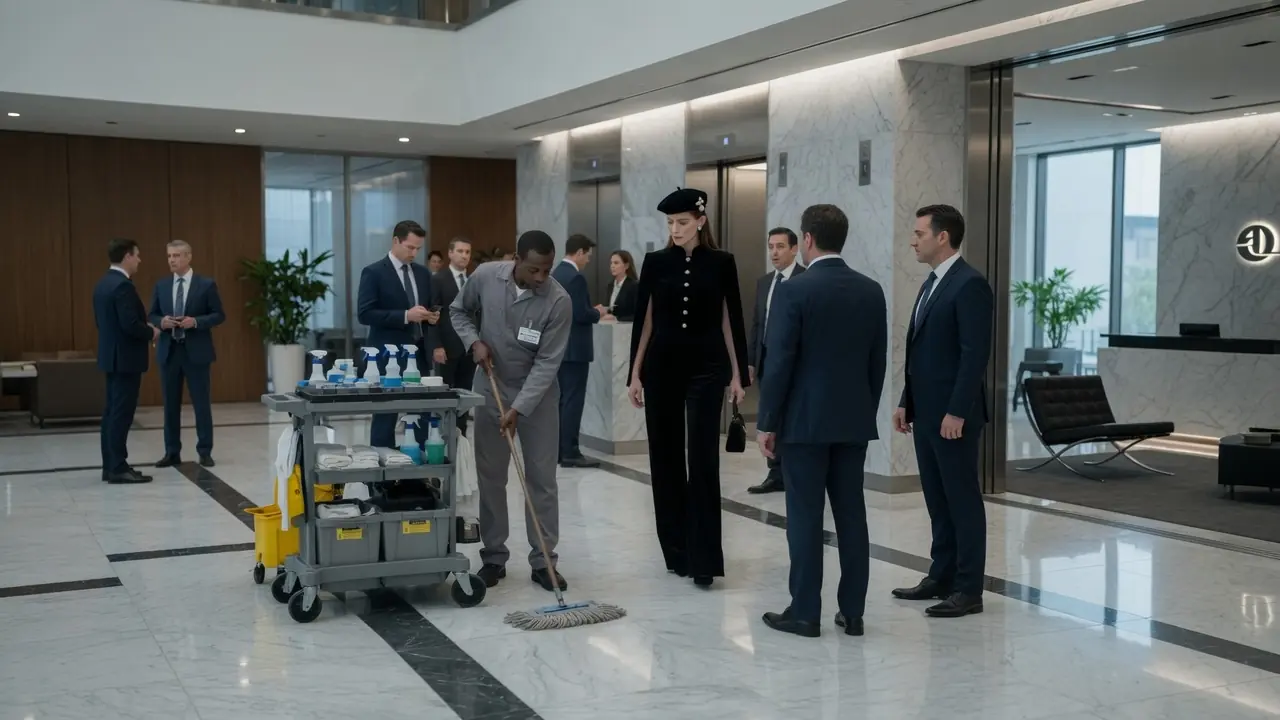
Three weeks later, Victoria Hayes, CEO of one of the most powerful companies on the East Coast, walked into the lobby he had just mopped, looked him dead in the eyes, and said four words that stopped every single person in that room cold. “I think I’m pregnant.” Darius Johnson had worked the night shift at Hayes Corp for three years, and in all that time not a single executive had ever learned his name. They saw the mop, the gray uniform, the cart with the squeaky left wheel. They did not see him.
He had made peace with that a long time ago, or at least he told himself he had, because peace was cheaper than anger, and anger was a luxury a single father raising a seven-year-old on a janitor's salary could not afford. He thought about Marcus every time the elevator doors opened on the 42nd floor, and the smell of leather and expensive cologne hit him like a wall. His son was probably already asleep by the time Darius clocked in each night, tucked under the faded blue blanket he refused to give up even though it was two sizes too small. Their neighbor, Mrs. Callaway, would be in the armchair by the door half watching television waiting for Darius to come home so she could go back to her own apartment one floor down.
It was a quiet arrangement built on trust and the $10 an hour Darius couldn’t always pay on time. But Mrs. Callaway never complained. She had known his wife, Elena, before the cancer took her. That meant something.
Darius moved through the corridors the way water moves through pipes purposefully, invisibly, without disturbing anything. He knew every inch of Hayes Corp’s upper floors. He knew which boardroom had a coffee stain under the conference table that no one else could see. He knew that the private bathroom near the East Wing always smelled like cigarettes after 10:00 in the evening, which meant someone on the executive floor was lying to their doctor.
He knew things about this building that the people inside it would never think to notice because they had never once looked at the man holding the mop. That particular night a gala was winding down on the 40th floor. Darius could hear the last of the music bleeding through the ceiling as he worked, something slow and forgettable played by a live quartet no one was really listening to anymore. The guests had thinned out, the caterers were packing up, and the hallways were beginning to fill with that specific kind of end-of-party silence that felt more exhausted than peaceful.
He was supposed to start on 41, but the service elevator had taken him two floors too high and by the time he realized it, he figured he might as well begin at the top and work his way down. It was on the 42nd floor that he heard two voices coming from behind the door of conference room C. The door was cracked open just enough for the sound to slip through, and Darius would have kept walking if his cart hadn’t caught on the corner of the doorframe at exactly the wrong moment. He freed it quickly, quietly, but the few seconds it took were enough for him to hear what was being said inside.
One voice belonged to a man he recognized as Gerald Pratt, the chief operations officer. The other was lower, more measured, the voice of someone used to being listened to. Darius didn’t know the name that went with that voice, not yet. What he heard was this Gerald saying something about a timeline, about the board being ready, about Victoria being distracted.
And the other voice replying calm as a man reading weather reports, “Good. Keep her distracted. We just need a few more weeks.” Darius didn’t understand what he was hearing. It didn’t connect to anything in his world.
She had smiled the right number of times. She had laughed at exactly two jokes, both of them her Uncle Richard’s, because Richard Hayes controlled enough board votes that his jokes were professionally worth laughing at even when they weren’t funny. Especially then. Victoria was 38 years old and had run Hayes Corp for the past six years, turning a mid-tier consulting firm into one of the largest private investment companies on the East Coast.
She had done this through a combination of ruthlessness, precision, and a total unwillingness to let anyone see her sweat. The industry respected her. Her competitors feared her. Her family, on the other hand, simply waited.
Richard Hayes was her father’s younger brother, and he had been waiting since the day Victoria was named CEO, waiting for her to stumble to show weakness, to make the kind of mistake that would justify what he had been quietly building for years. Earlier that evening, he had casually suggested in front of four board members that the company’s public image might benefit from a more traditional leadership structure, his elegant way of saying she should get married and become easier to manage. Victoria had smiled and said nothing because that was the game, and she had been playing it long enough to know the rules by heart. What she was less prepared for was how much that comment would stay with her.
It wasn’t that Victoria drank often, she didn’t. But the meeting before the gala had left something tight and unresolvable sitting behind her sternum, and one drink became two, and two became three because a board member from the Chicago office wanted to toast her success, and it seemed rude to refuse. By the time the gala ended, Victoria was not drunk in the way people become drunk at office parties, giggly, loose, regrettably honest. She was drunk in the quiet, private way that only people who never let themselves feel anything can manage, composed on the surface, completely unmoored underneath.
She told her assistant she was going to her private suite on the 42nd floor. Her assistant asked if she needed an escort. Victoria said no because Victoria always said no. She took the elevator up, stepped off, and walked down the corridor toward what she believed was her suite.
The handle turned. The room was dim and quiet. She stepped inside. What Victoria didn’t know, what neither of them knew that night, was that the suite she had walked into was not the one her key card should have opened.
The door to that particular room had been released remotely from a system terminal at 10:51 that evening after the gala had ended and after Victoria had told her assistant she was going up alone. Someone with administrative building access had unlocked it deliberately. The stage had been set before either of them arrived. Darius had finished cleaning that suite earlier in the evening and had left pulling the door firmly shut behind him.
He had come back only because he realized he had left his secondary cleaning kit inside a small thing, barely worth the trip but he was particular about his inventory. He had retrieved the kit and was about to leave when the door opened and a woman in a black evening gown walked in with the kind of quiet authority that made it very clear she believed she owned the room. He started to stand, started to say something. “Excuse me, ma’am.
I’m just finishing up.” But she was already moving toward the window and she turned and looked at him and said, “You stayed.” The two words landed with a weight he didn’t understand. Her eyes were not quite focused. She looked at him the way people look at something they have been waiting for without realizing it and she said a name, not his name, someone else's name, a name he didn’t know in a voice so unguarded, so different from anything he had ever heard come out of a person who lived on this floor that the correction died somewhere between his throat and his mouth. He told himself later that he should have left.
He told himself that a hundred times, a thousand times. But the woman standing in front of him looked like someone who had been holding herself together for so long that the effort had become invisible and the few drinks she’d had that night had not made her reckless or loud, they had simply made her human. And Darius, who spent every night being invisible in rooms full of people who felt nothing for him, understood that particular kind of loneliness down to the bone. He stayed.
That was the whole truth of it. He stayed and the night happened and when the first pale light came through the window, he gathered his things and walked to the elevator and pressed the button for the lobby and did not look back. Three weeks passed. Darius worked his shifts, picked up Marcus from school on the afternoons he worked mornings, heated up dinner, helped with homework and told himself that what had happened on the 42nd floor was a closed door.
Then on a Tuesday morning at 8:47, Darius had just clocked in, had not even taken his jacket off yet. The lobby elevator opened and Victoria Hayes walked across the polished floor toward him. She was in a charcoal gray suit, hair pulled back, looking exactly like every photograph he had ever seen of her on the company newsletter, except that she was looking directly at him and the expression on her face was not the one from the photographs. Every person on the floor went still.
A phone that had been ringing stopped. Someone dropped something at the reception desk and did not bend to pick it up. Victoria stopped two feet in front of him and looked at him with the steadiness of someone who has rehearsed a thing many times but is still not entirely sure they can say it. Then she said it anyway.
“I need to speak with you.” “I think I’m pregnant, and I believe you’re the father.” Her voice did not shake. It was not loud. But in the silence of that lobby it might as well have been broadcast over every speaker in the building. Darius felt the floor shift under him in a way that had nothing to do with the floor.
He was aware of his jacket still half on, of the cart handle in his left hand, of the fact that his heart had done something complicated in his chest and had not yet returned to its normal rhythm. He stood there in his gray uniform in the lobby he had mopped a hundred times and understood that the door he had told himself was closed had never been closed at all. It had been waiting. The story spread the way things always spread in a building where people had too much time and too little power fast, distorted, and completely impossible to stop.
By noon every person on floors 38 through 42 had a version of what had happened in the lobby that morning. Some said Victoria Hayes had come down to fire the janitor personally. Some said the janitor had been bothering her for weeks. One version passed between two assistants over lunch claimed there had been a scene shouting, tears, a security guard called in.
None of it was true. None of it needed to be. Darius kept his head down and finished his shift. He didn’t respond to the looks.
He didn’t respond to the comment a co-worker named Derek made under his breath when they passed each other near the supply closet. Something low and mean that Darius caught only the shape of, not the words. He had learned long ago that responding was the thing that cost you not the insult itself. So he pushed his cart, did his work and clocked out at four in the afternoon feeling like he had run a mile in concrete shoes.
He picked Marcus up from school at 4:30. His son came through the double doors with his backpack hanging off one shoulder a drawing crumpled in his left hand talking before he had even reached the car. Something about dinosaurs about how his teacher had said his Stegosaurus looked more like a turtle and Marcus found this deeply unjust. Darius listened to every word.
He told Marcus that Stegosauruses and turtles were both excellent animals and that his teacher was simply uninformed. Marcus considered this and decided it was a satisfying answer. That night after dinner, after the homework was done, and the blue blanket was tucked around a sleeping seven-year-old Darius, sat at the kitchen table with a cup of coffee that had gone cold and thought about what came next. He didn’t have an answer.
But he knew sitting in his quiet kitchen with his son asleep in the next room that whatever it was, it was already in motion. Victoria’s assistant called two days later and scheduled a meeting at a law office on 53rd Street neutral ground, which told Darius everything he needed to know about how Victoria intended to frame what came next. He wore his best shirt, the navy one with the small tear at the left cuff he had ironed flat so it wouldn’t show. He sat across from Victoria and a lawyer he was not introduced to by name and listened to what she had to say.
The pregnancy was confirmed, eight weeks. Victoria delivered this information the way she delivered everything directly without softening, watching his face for a reaction she could catalog and use. The lawyer slid a document across the table. She needed a father on record, not a husband, not a partner, a name.
Someone legally present who could absorb the story the board would otherwise construct on their own. In exchange, Darius would receive financial support, job security, and a legal guarantee that his custody of Marcus would never be challenged. Darius looked at the document for a long time without touching it. Then he looked at Victoria and asked her what happened if he said no.
She told him without any particular hostility that she couldn’t protect him from the narrative already forming inside the company if he wasn’t part of the arrangement she was offering. It wasn’t a threat. It was the truth delivered in the tone of someone describing weather patterns. Darius picked up the pen and signed because Marcus’s custody was not a thing he was willing to gamble with and because he understood in the way people who have never had power understand it very clearly that he was not the one holding the terms of this negotiation.
He drove home in silence that evening. When Marcus asked at dinner if anything was wrong, Darius told him they might be seeing some changes soon. Marcus asked if they were getting a dog. Darius said probably not.
Marcus accepted this with the philosophical resignation of a child who has learned that most interesting possibilities do not pan out and went back to his food without further comment. Richard called Victoria the morning after the contract was signed. He didn’t ask how she was. He said he had heard about the arrangement and wanted her to understand something clearly before it went any further.
He said a child with Darius’ss name attached to black janitor with no assets, no standing, no family of any consequence would be a problem the company could not recover from. He didn’t use ugly words. He didn’t need to. The structure of everything he said made the ugly word unnecessary the way a room can be freezing without anyone touching the thermostat.
Victoria stood at her office window and listened to her uncle explain in measured and reasonable tones that the Hayes family had spent four decades building a particular kind of reputation and that reputation did not include this. He said Darius was not the kind of man who belonged in this story. He said it the way people say things they have always believed and never once examined with the total comfort of someone who has never been asked to justify himself. Victoria said she would take his concerns under advisement which was the thing she said when she had already decided not to listen.
Richard told her she was making an emotional decision and that she would regret it. She hung up and stood at the window for a long time, and something shifted in her, not dramatically, not all at once, but the way a foundation shifts before anyone on the surface notices. She thought about Darius in the lawyer's office looking at a contract that gave him no real power, and signing it anyway, because it was the only way to protect his son. She thought about a man who had been invisible in her building for three years, doing his job with more dignity than most people she paid 10 times his salary.
And she thought about her uncle's voice, calm, certain, never once considering that he might be wrong, and she felt for the first time something close to shame. What Darius had not expected was how completely the contract would fail to protect him from anything happening inside the building. The document was legal. The arrangement was real.
But the paper meant nothing to the people who passed him in the hallway every morning and had already decided what kind of man he was. The whispers didn’t stop, they evolved. Now they carried a different charge, something uglier than gossip, the suggestion that he had planned it, that he had seen an opportunity and taken it, that a man like him, the qualifier always unspoken but unmistakably loud, had known exactly what he was doing in that penthouse. He heard it most clearly one afternoon in the break room when two men from the accounting department didn’t realize he was in the supply closet with the door cracked.
One of them said Darius had probably been waiting for something like this his whole life. The other laughed and said it was almost impressive. Darius stood very still until they left, and then stood there a little longer, not because he couldn’t move, but because he needed a moment to put everything back where it belonged inside himself before he walked back out into the hallway. That evening he picked up Marcus and somewhere between the school and home, Marcus reached over from the backseat and put his small hand on Darius’s arm without saying anything.
He didn’t know what his father was carrying. He was seven. But children who grow up alongside quiet grief develop a particular kind of radar and Marcus had always been tuned to his father’s frequency. Darius put his hand over his son's and kept driving and that was the thing that kept him from turning the car around and doing something he couldn’t undo.
Uh, the man who came to find Darius was not Gerald. He was older with the kind of stillness that comes from being paid very well to deliver unpleasant messages without flinching. He appeared beside Darius’s car one evening in the Hayes Corp parking garage leather folder in hand and introduced himself as representing the Hayes family’s private legal interests. He said the family had given the matter considerable thought and had reached a conclusion they felt was generous under the circumstances.
He opened the folder and placed a check on the hood of the car. The number written on it was large enough that Darius had to read it twice. Then the man said without dropping his pleasant tone that a child bearing the Hayes name needed to enter the world with the right kind of foundation. He said the word optics twice.
He said that Darius, a janitor, a single father with no assets and no standing was not what that foundation looked like. And then as if the words cost him nothing at all, he said this was not a situation where a man of Darius’s background could expect to be taken seriously as a long-term presence in the child's life. The family had the resources to make certain of that with or without his cooperation. The check was simply the easier path.
Darius stood very still and let the man finish. He thought about the word background. He thought about what that word was standing in for, what it was carefully, politely refusing to say out loud while saying it as clearly as anything he had ever heard. He picked up the check, tore it in half, and set the two pieces back on the hood.
Then he said one sentence, “Tell them I’ll see them in court.” The man’s expression didn’t change. He closed the folder, picked up the torn check, and walked away. Darius sat in his car for a long time before driving to pick up Marcus because his hands were shaking and he didn’t trust himself on the road until they stopped. It was Gerald Pratt who let the next piece slip without realizing it.
Darius was in the hallway outside conference room C, the same corridor, the same door he had passed on the night of the gala, when Gerald stepped out with a phone pressed to his ear, too absorbed in his own conversation to register the man with the cart four feet away. Gerald said, low and satisfied, “She’s distracted just like we needed. The pregnancy changes everything. The board will move when we tell them to move.” Then he went back inside and pulled the door shut.
Darius stood in the hallway and heard those words land on top of the ones he had already heard weeks earlier, “Keep her distracted, just a few more weeks.” and felt them connect into a shape he could not yet fully see, but could feel the edges of clearly enough. Something had been built around him and around Victoria. Neither of them was the architect of it. The call from Marcus’s school came on a Thursday.
Not from the teacher, from the administrative office. A concern had been raised by an anonymous source regarding the stability of Marcus’s home environment. The words financially precarious were used. So were emotional volatility and unfit to provide consistent care.
Darius gripped the phone until his knuckles ached. He asked who had submitted the concern. The administrator said they weren’t at liberty to say. That evening, he drove to Victoria’s building and called her from the lobby.
She came down herself. He told her about the phone call plainly without editorializing. He watched her expression shift in the small precise way that meant something had been recalculated behind her eyes. She said she would look into it.
He said that wasn’t enough. He told her that whatever game was being played around them, Marcus was not a piece on that board, and anyone who touched his son would find out very quickly that a man with nothing left to lose is the most dangerous kind there is. Victoria held his gaze and nodded. Not the nod of a CEO managing a situation, but the nod of someone who had just heard something true.
And then two weeks later, Darius was called into HR and presented with a report alleging that he had removed cleaning supplies from the company inventory for personal use over several months. Small enough to seem credible, specific enough to be hard to disprove without investigation. Combined with what HR described as concerns regarding professional conduct, the report recommended immediate termination. His ID badge was deactivated before he left the building.
That same afternoon, the Hayes Corp Board of Directors issued a statement announcing that Victoria Hayes was stepping back from operational duties pending an internal review of recent decisions inconsistent with the company’s long-term interests. She had been removed cleanly and quickly by the people who had been building toward exactly this for longer than either of them had understood. By 5:00, Darius had no job, a threatened custody case gathering momentum, and a son who needed to be picked up from school in thirty minutes. Victoria had no company, no board access, and no leverage over the people who had just taken everything she had spent six years building.
They had both hit the floor on the same day in the same building, and neither of them had seen it coming fast enough to break the fall. Darius spent the first night after his termination doing what he always did when the ground shifted under him. He made dinner, helped Marcus with his reading, and waited until his son was asleep before he allowed himself to sit with the full weight of what had happened. He laid out everything in his mind.
The two conversations outside conference room C, Gerald on the phone, satisfied saying the pregnancy changed everything. The earlier voice telling Gerald to keep Victoria distracted. The HR report that had appeared with suspicious precision, as if someone had been preparing it long before they needed it. The man in the parking garage with his leather folder and his careful bloodless language about background and foundation and optics.
The phone call to Marcus’s school. He had been trying to understand these pieces as separate events. Now sitting alone at two in the morning with a cold cup of coffee and nowhere to be the next morning for the first time in three years, he stopped trying to understand them separately and looked at them all at once. The shape that emerged was not complicated.
Someone had known about that night on the 42nd floor very early. Someone had decided that a pregnant CEO and a black janitor from the wrong side of every line that mattered, class, race, salary, zip code, was not a scandal to be contained, but a weapon to be used. And the door to that suite had not been left open by accident. He remembered now with clarity that he had shut it firmly when he left and that it had swung open too easily when Victoria pushed it, not the resistance of a closed latch, but the give of a door already waiting.
Someone had unlocked it remotely. Someone had needed them both in that room. He was not the variable that had been chosen at random. He had been chosen because he was the most disposable variable available, a black man with a mop and a dead wife and a child to protect, someone who could be paid off or frightened off or destroyed, depending on which approach proved necessary.
He sat with that knowledge for a long time in the quiet kitchen. And when he was done sitting with it, he picked up his phone and called Victoria. She answered on the second ring, which told him she hadn’t slept either. He told her what he had put together not as a theory, but as a sequence of events laid end to end with the gaps filled in by the only logic that made them coherent.
Victoria listened without interrupting. When he finished, she said very carefully, “Gerald doesn’t move without authorization. He never has.” Darius said he knew. She said she needed to see what he had.
He told her he didn’t have documents, he had memory and pattern. She said that was more than she currently had access to and asked if he could come to her. He dropped Marcus at school and drove to Victoria’s building thinking about how different this felt from every other time he had come here. No anger, no ultimatum, just two people who had been outmaneuvered by the same hand and were finally standing on the same side of it.
Victoria opened the door herself. She was in a plain white shirt and dark slacks. No jewelry, no armor. There were papers on the dining table, a laptop open, a glass of water with a ring mark beneath it that she hadn’t wiped up, the kind of detail that told Darius more about her current state than anything she could have said.
They sat at the table and went through it together. Victoria pulled up internal communications she had retained on a personal device scheduling records, a series of calendar entries showing Richard Hayes meeting privately with three board members in the six weeks before the gala meetings, not logged in any official company record. Darius laid out the full timeline of what he had heard and when. Then Victoria pulled up one more file, an internal security log from the night of the gala.
The suite adjacent to Victoria’s registered suite had its door release overridden remotely at 10:51, not propped, not left unlocked, but released from a system terminal by someone with administrative building access at a specific time. After the gala had ended. After Victoria had told her assistant she was going up alone. Darius looked at the timestamp and thought about a door swinging open to a darkened room, a woman in a black dress walking in with the certainty of someone who believed she owned it, a man who had gone back for a cleaning kit and found himself standing in the middle of something arranged without his knowledge or consent.
He said quietly, "They didn’t just use what happened. They built it." Victoria said, “Not all of it.” “But enough.” She looked at the screen and then she looked at him and for the first time since the lobby, since the lawyer's office, since every cold transaction conducted across a table with documents between them, she looked at him without any of the distance she had maintained so carefully. She said, “I owe you an apology.” Darius said she owed him a few. She said she knew.
He said they could settle that account later. Right now he wanted to know what she planned to do with what they had. What they had, it turned out, was enough. Not overwhelming, not the kind of evidence that ends careers in a single afternoon, but enough to begin a conversation with the right people that Richard Hayes could not control or contain.
Victoria contacted the company’s external legal counsel, directly bypassing the internal team Richard had spent two years quietly stacking with his own appointments. She sent the security log, the calendar discrepancies, and a formal statement outlining the full pattern of conduct. Darius provided a written account of both hallway conversations, signed and dated with a specific request that the anonymous complaint filed against him regarding Marcus’s welfare be traced to its source. It took eleven days.
Darius counted them. He picked Marcus up from school every afternoon, made dinner every evening, and answered every call from the legal team with the same steadiness he had brought to every difficult thing in his life, not because he wasn’t afraid, but because fear had never once been a reason he accepted for stopping. On the fourth day, Mrs. Callaway brought soup and didn’t ask questions. On the seventh day, Marcus showed him a new drawing, a Stegosaurus unmistakable this time with careful plates along its back, and a look of considerable dignity.
Darius put it on the refrigerator next to a magnet shaped like the state of Ohio that had been there since Elena bought it on a road trip eight years ago. On the 11th day, Gerald Pratt was placed on administrative leave pending investigation. The board member who had seconded every one of Richard’s procedural motions over the past 3 months resigned without explanation. And Richard Hayes, who had built his play over more than a year with the patience of someone who believed he was untouchable, who had sent a man to a parking garage with a check and the comfortable certainty that a black janitor with no money and no connections would take the easier path.
Discovered that the man he had selected as the most disposable variable in his calculation had remembered two conversations, word for word had refused to be bought, and had the clarity of mind to understand exactly what those conversations meant. Richard’s removal from the board was not dramatic. It happened in a meeting Darius was not present for, described to him afterward by Victoria in three sentences. She said it was quiet.
She said Richard had looked for the first time in her memory like a man who had run out of moves. She said she had watched him leave the room and felt nothing in particular, which surprised her because she had spent six years assuming that moment would feel like something enormous. The custody filing collapsed ten days after that. The source of the anonymous complaint was traced to an email account registered under a name that turned out to be a former Hayes Corp contractor with documented ties to Richard’s personal staff.
The case was closed. The social services flag was removed from Marcus’s file. Darius received the letter confirming this on a Wednesday afternoon and sat in his car outside the school for a few minutes holding the paper before he went in to get his son. Marcus came through the double doors with his backpack on one shoulder and a new drawing in his left hand, something with wings.
He explained with great seriousness that it was a pterodactyl and that his teacher had said it was excellent, which Marcus felt was long overdue recognition of his abilities. Darius laughed a real one, the kind that comes up without planning, and Marcus looked pleased and climbed into the backseat and talked about pterodactyls for the entire drive home. That evening, Victoria came to the apartment for the first time. She stood in the doorway for a moment, taking in the small kitchen, the drawings on the refrigerator, the blue blanket folded over the arm of the couch, the general evidence of a life built carefully from limited materials and held together by something that had nothing to do with money.
Marcus looked at her with the direct unselfconscious assessment that seven-year-olds apply to all new information. He asked her if she liked dinosaurs. She said she didn’t know very much about them. He said he could teach her in a tone that made clear this was a significant offer not extended to everyone.
Victoria said she would like that very much. Darius watched this from the kitchen doorway and felt something settle in his chest that had been unmoored for months longer than months, if he was honest. Something that had braced against impact for a very long time, finally carefully let go. They didn’t talk about what came next that evening.
Victoria stayed for dinner. Marcus insisted, and Victoria, who had spent her adult life declining things on instinct, found that she didn’t have a reason ready that felt true. She sat at a kitchen table that had seen better decades and ate pasta that Darius had made from what was available and listened to a seven-year-old explain the differences between herbivorous and carnivorous dinosaurs with the intensity of a doctoral candidate. She asked questions, real ones.
It was late by the time Marcus fell asleep on the couch under the blue blanket, one arm thrown over his face in a posture of total uncomplicated peace. Darius and Victoria stood in the kitchen with mugs of coffee that were actually warm this time, and Victoria said without preamble, "I don’t know how to do this." Darius said, “Do what?” She said, “Any of it.” And gestured at the apartment, at the sleeping child, at the general territory of a life not organized around control and performance and the exhausting maintenance of distance. He said, “You don’t have to know how. You just have to show up.” She looked at him for a long moment, and he could see her weighing that against every defense she had ever constructed, all the walls built, because the world had taught her repeatedly and efficiently that needing people was the fastest route to losing everything.
And for the first time, she found that she didn’t entirely want to hide behind them. She showed up. The next morning and the one after that. Not in any way that resolved things cleanly or filled in all the gaps at once, but in the small accumulating way that real things are built one ordinary day at a time.
Darius went back to work, not at Hayes Corp, but somewhere new, somewhere he chose. Victoria returned to Hayes Corp with the board restructured and Richard’s influence removed down to the roots. The baby grew. Marcus accepted all of this with the philosophical flexibility of a child who has always understood at some level that families are not issued.
They are built from whoever is willing to stay and keep showing up. The 42nd floor still existed. The suite with the door that someone had unlocked remotely at 10:51 on the night of the gala still existed. But neither of them lived there anymore.
They lived here in a kitchen with a pterodactyl on the refrigerator next to a magnet shaped like Ohio in a life that no one had planned and that had against considerable odds turned out to be exactly enough.