The day Delia Weston called Marcus out of the clear blue October sky, he'd been standing in his garage for 20 minutes debating whether a cracked fence post counted as a reason to drive across town or just a reason to remember everything he'd spent the last 2 years trying to set down. Marcus Alade was 38 years old. He ran a one-man restoration outfit out of a rented workshop on Clement Street, mostly furniture. Dining tables that needed their joints re-glued, dressers that smelled like someone's grandmother, chairs with legs that had given up on the concept of vertical. He was not tall in a way that announced itself, but he was steady in a way that rooms tended to notice.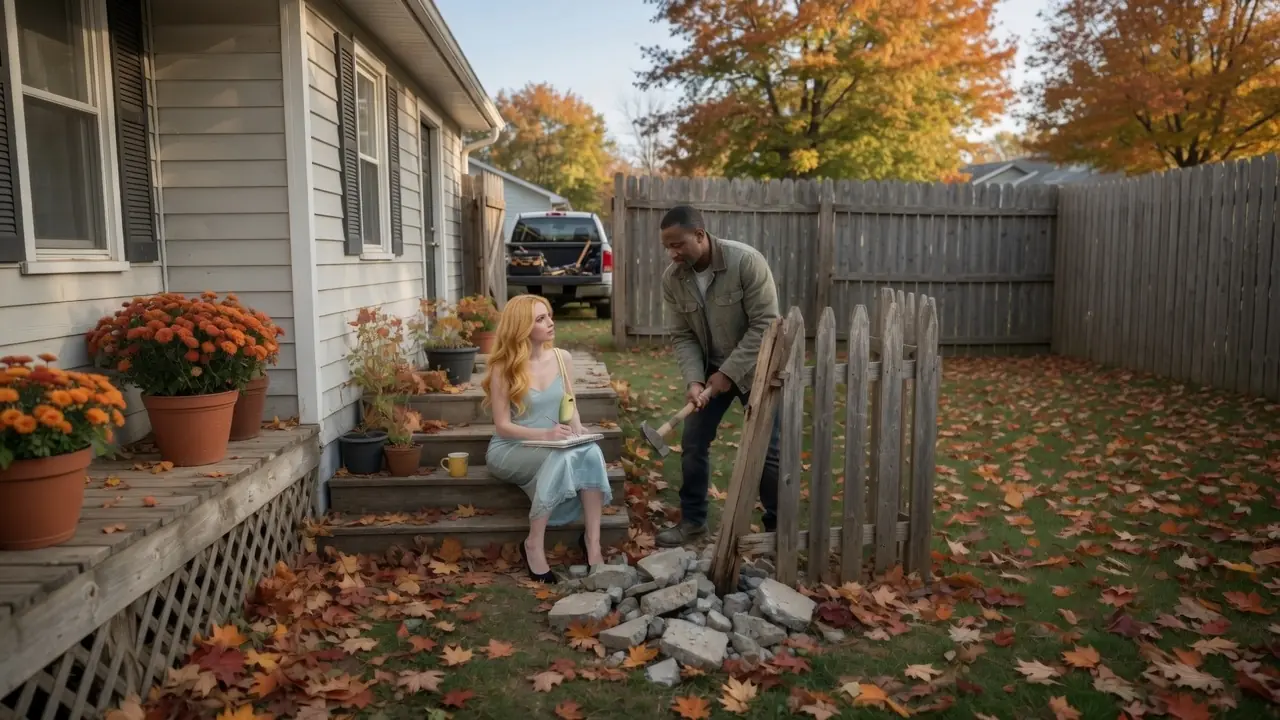
His hands were calloused at the base of every finger, and he kept them clean. His daughter Zora was seven and had an opinion about everything, and Marcus privately considered that the most accurate description of his emotional life in the last 2 years was that he organized it entirely around a second grader who needed her sneakers tied differently depending on the day of the week. He and Kendra had been over for 2 years. It had not been dramatic, which somehow made it harder. There was no villain in that story.
There was just a woman who needed more movement than Marcus could generate, and a man who needed more stillness than Kendra could offer, and a daughter in the middle who'd asked once, very carefully, whether Daddy was sad, and Marcus had said, "No, just thinking." And Zora had said, "Okay," and gone back to her drawing, and he had stood at the kitchen sink for a long time after that. Delia Weston was Kendra's mother. She was 61, lived 12 minutes away in the same house where Kendra had grown up, and had always treated Marcus with a particular warmth that he understood now had never actually been contingent on his relationship with her daughter. She'd called him about a fence post.
The back panel of her yard fence had come loose from its anchor, she said. She'd called the handyman her neighbor used, and he'd quoted her something that sounded to Delia like the man had priced her based on the quality of her neighborhood rather than the quality of the job and she wasn't going to have that. She'd remembered that Marcus kept tools. He told her he'd be there Saturday morning. He almost talked himself out of it twice on the drive over.
Not because of Kendra. Kendra had moved to Charlotte 14 months ago for a position she'd been angling toward for years and she called Zora on Sundays and sent books with sticky notes inside them and Marcus thought of her with something that had mercifully settled into something close to uncomplicated respect. He almost talked himself out of it because the Weston house had a particular gravity. He'd eaten Christmas dinner there four times. He knew which step on the back porch creaked and which burner on the stove ran hot.
Some houses hold you even after the reason you visited them is gone and the Weston house on Aldrich Lane was that kind of house for Marcus Alade. He pulled up to the curb at 8:45. The oak in the front yard had gone full copper red and there were three ceramic pots on the porch steps that he did not remember planted with something purple and trailing. The fence ran along the right side of the property and dipped around back. He could see from the driveway that the third post from the end was leaning at an angle that suggested it had already made its peace with the ground.
He was reaching into the truck bed for his post driver when the side gate opened. She was not Delia. She was roughly his age, maybe 35, wearing a gray Henley with the sleeves pushed to her elbows and dark jeans that had a smear of something terracotta colored above the right knee. Her hair was natural and pinned back in a way that looked like she'd done it without looking, which was either effortless or the very precise imitation of effortless. And Marcus had enough sisters to know there was a meaningful difference.
She was carrying two mugs and squinting slightly in the morning light and she looked at him with an expression that was not unfriendly, but was measuring, the way people look at someone who shows up at a house where they're also a guest. “You must be Marcus,” she said. “Last I checked.” He lifted the post driver out of the truck. “You must be visiting Delia.”
It was the yellow mug with the chipped handle. He'd used that mug before. He looked down at it for a beat longer than was probably noticeable and then looked back up. “I’m Simone,” she said. “Kendra’s cousin.”
“We grew up pretty close.” He nodded. He remembered the name. Kendra had mentioned her, someone who'd been in Chicago for years, some kind of ceramics practice, he thought. He'd never met her.
“I know who you are,” Simone said with a tone that made it clear she meant it neutrally. “She talked about you.” “Delia talks about you more.” He let that sit where she'd put it. They walked around back together.
The yard looked the way it always had, a little wild at the edges, the garden beds going shaggy with the end of the season, a folding table near the back steps with Delia's coffee and what looked like a seed catalog open to a page of garlic varieties. The loose fence post was worse up close. It wasn't just leaning, the concrete footing had cracked and heaved, and the wood itself had started to rot at the ground line. He'd need to pull it entirely, cut a new post, and reset it properly. An hour and a half, maybe two if the soil gave him trouble.
Delia appeared at the back door in a robe and reading glasses pushed up on her head like a second pair of eyes. She was a small woman who took up more room than her size suggested, and she looked at Marcus the way she always had, like something she'd been expecting but was still pleased to see. “Marcus,” she said. “Look at you. You still look like you haven’t slept enough.”
“Good morning, Delia.” “I told Simone to bring you coffee. Did she bring you coffee?” “She brought me coffee.” “Good.”
She looked at the fence and then back at him. “Tell me it’s not as bad as the man who came out last week made it sound.” He told her it was almost exactly as bad, which meant it was completely fixable, which meant it was not a problem. Delia smiled at that, the particular smile she had for news she'd already decided to receive calmly. She went back inside and Marcus set down his coffee and looked at the post and began to work.
Simone sat on the back steps with her own mug and a sketch pad balanced on one knee and did not make conversation, which he appreciated. She made small marks on the page. He pulled the post and assessed the footing and began the work of breaking up the cracked concrete with a cold chisel. And the yard filled with the sharp sound of steel on stone and the smell of turned earth and coffee and the particular clean cold of an October morning in a city that still remembered how to have autumn. After about 20 minutes, she said, without looking up from the sketch pad, “Does it bother you coming here?”
He stopped and looked at her. She was looking at him now, directly, with the matter-of-fact curiosity of someone who has decided that indirect questions are a waste of everyone's time. “No,” he said. Then, because it was a better answer, “Not the way it used to.” She nodded as though she'd expected something in that range.
“Delia said you’ve been good about it, about Zora, about keeping things clean.” “Zora’s the only part of any of it that was never complicated.” Simone made a sound that was not quite a laugh, but was adjacent to one. “I don’t know how you do it, the clean part.” "My divorce" she stopped, moved the pencil to a new position on the page, reconsidered, it was not clean.
He did not ask. He'd learned that people tell you the thing they mean to tell you at the speed they mean to tell it. And pulling on the thread early just frays it. She told him anyway, a few minutes later. A man named Daniel who had been composed and logical and reasonable in precisely the way that made it very hard to explain to anyone outside the marriage why composed and logical and reasonable had felt across four years like being slowly compressed.
"He never raised his voice," she said. "Not once. He just made everything I wanted sound naive." She closed the sketch pad on her pencil. "I moved back here 3 months ago.
I'm 41 days sober from feeling stupid about myself and I'm using Delia's garage as a studio and I'm very much a work in progress." He looked at her. She was looking at the fence where the new hole was taking shape. And her jaw had the set of someone who has decided to be unbothered and is succeeding at it by some effort. “For what it’s worth,” Marcus said, “you don’t sound stupid to me.”
She looked at him then. Not softly, that wasn't quite the word, but openly. The way people look when they've been braced for something that didn't come. “I’m going to go get more coffee,” she said. “Do you want more coffee?”
He handed her the yellow mug. She brought it back 12 minutes later with a plate of something wrapped in foil that turned out to be two pieces of Delia's cornbread, which was, he knew this from four Christmases, the kind of cornbread that made you briefly sad about every other cornbread you'd ever had. He ate one piece leaning against the truck and did not say anything about it. Because some things are beneath the need for commentary. Delia appeared in the yard again, now dressed with reading glasses still on her head.
She looked at the work in progress and at Marcus and at Simone sitting back on the steps and something passed across her face that she did not bother to hide, but also did not announce. She sat down in the folding chair near the garden bed and opened her seed catalog like she'd simply come outside to garden plan, which Marcus believed approximately not at all. The second post there was always a second post in his experience once you started looking had a soft spot at the base where water had been pooling. Not failed yet, but heading there. He pointed it out to Delia, who told him to do what was right, which was how she'd always communicated her trust in someone.
Not with enthusiasm, but with the specific absence of instruction. He worked through the morning. The sun moved. The yard smelled like coffee and cold earth, and at some point Simone went inside and came back with a radio. An actual plug-in radio on an extension cord and set it on the porch rail tuned to something that was soul in the way that meant it was at least 30 years old, and she went back to her sketchpad, and Marcus found that the rhythm of the music and the rhythm of the work made the same time signature, which was the best kind of morning.
Around 11:00, Delia went inside to start lunch, and the yard was quiet for a stretch. Just the radio and the sound of Marcus tamping new concrete around the first post with a rod. “Can I see what you’re doing?” Simone asked. He explained the footing, the depth requirement, the need to keep the post plumb while the concrete cured, the brace he'd rigged with scrap two-by-four and two stakes.
She listened with the quality of attention of someone who is genuinely interested in how things work rather than making conversation about how things work. She asked a specific question about the cure time, and when he answered it, she said, “So, if it rains tonight, it won’t matter?” “Not after four hours.” “Good,” she said. “It’s going to rain.”
He looked at the sky. It was cloudless and sharp-edged blue. "I checked this morning," she said with a small flat confidence that he found privately very funny. She was correct. He found that out later.
But right then, he just went back to work, and she went back to her sketchpad, and neither of them felt the need to fill the space between those two things with anything additional, which is rarer than people talk about. Delia called them in for lunch at noon. The kitchen was exactly as he remembered it. Too many magnets on the refrigerator. The window over the sink that faced the yard.
The ceramic rooster on the counter that Kendra had always wanted to relocate and Delia had always refused. She'd made soup. The kind of soup that requires a full morning to exist. That means someone started it before you arrived and planned for you before you were there to plan for, and Marcus sat down at the kitchen table and was aware, in a way he hadn't planned to be, that he had missed this table. Simone sat across from him.
Delia sat at the head. They ate. Delia asked about Zora's school year. Marcus's daughter was in second grade and had recently declared that her teacher was, “Pretty good, but a little strict about the pencil grip.” And Delia laughed at that in the way of someone who has watched children be opinionated about small things for 60 years and finds it as delightful as the first time.
"She sounds exactly like Kendra at that age," Simone said. "Kendra had a problem with the pencil grip conversation, too." "Kendra had a problem with any conversation that involved someone correcting her form," Delia said, warmly and without apology. Marcus smiled at that. Not because it was unkind, it wasn't, but because it was accurate in the way that only people who love someone clearly can be accurate about them.
He looked up and found Simone looking at him with a faint expression that he couldn't entirely decode, something between amusement and curiosity, and she looked back down at her soup when he caught it. After lunch, he went back out and set the brace on the second post and cleaned up the work area and loaded his tools back into the truck. He was washing his hands at the outdoor spigot when Delia came around the side of the house with a dish towel over her shoulder and a look that said she had something to say and had decided to say it directly. “You didn’t have to come today,” she said. “You know that.”
“I know, but I’m glad you did.” She looked at the fence, at the two new posts standing straight and clean where the rotted ones had been. “You always did good work.” He dried his hands on his jeans. He was about to say something about the cure time and the brace and when she could safely take it down, but Delia was looking at him with something that was not about the fence.
“She’s going through something,” Delia said. "Simone, she doesn't show it the way some people do. She's like you that way." He didn't say anything to that. "I'm just telling you."
Delia said. "She's a good woman. She always was." She turned to go back inside and then she stopped with her hand on the gate latch and looked back at him with an expression he hadn't seen on her face before or maybe he had and hadn't known what it was. “You always were my favorite,” she said.
"I told Kendra that once and she told me I wasn't supposed to say things like that." He stood there for a moment after she went inside. The yard was still. The radio had been turned off. The new posts stood plumb and even in the cool noon light.
He was almost to his truck when the back door opened again. “Hey.” Simone came down the porch steps with his yellow mug still washed and dried. She handed it to him and he started to say it was Delia's and she said, “I know. She told me you’d probably try to leave without it.”
A beat. “She said you always use that one.” He took the mug. He looked at it. “I’m going to be setting up the studio for the next few weeks,” Simone said.
"The garage is it needs work. Organization. There's a table in there that's missing two legs." He looked at her. “I’m not asking,” she said quickly.
“I’m just noting it in the general vicinity of a person who restores furniture.” He took a slow breath of October air, cold and leaf-smelling, and somewhere underneath it, the first hint of rain. “I could look at it,” he said. “The table.” “It’s just a table.”
“Tables are usually just tables until someone fixes them.” She was quiet for a moment, and then the corner of her mouth moved in a way that wasn't quite a smile, but was clearly the structural predecessor to one. “That’s an oddly hopeful thing to say about furniture.” “I’m a fairly hopeful person.” She looked at him then, openly, steadily, with the same measuring quality she'd had that morning, but without the distance.
The wind moved through the copper oak in the front yard. The mug was warm in his hands. “Saturday?” she said. “I could do Saturday,” he said. She went back inside.
He stood on the driveway for a moment with the yellow mug and the smell of coming rain and the sound of the Aldrich Lane neighborhood going about its Saturday. And he felt something that he had not felt in long enough that he'd stopped naming the absence, the uncomplicated forward lean of something that might with patience become something else. He drove home. He picked up Zora from her weekend play date and listened to a 17-minute account of a dispute about the rules of a game he had never heard of and could not follow. And he made dinner and read two chapters of her current book with her and sat on the edge of her bed after the light was out.
She asked him if he'd had a good day. He told her it had been a better day than he'd expected. She said good, rolled over, and was asleep inside 4 minutes. He sat with his own coffee in the kitchen and looked at the yellow mug he'd set on the counter, which he had absolutely no explanation for having brought home and did not try to generate one. He went back the following Saturday.
And the Saturday after that. The table in Delia's garage had a split in the center stretcher and a water ring on the top surface and was honestly in pretty good shape for something that had been neglected as long as it had. He worked on it over three visits while Simone arranged her wheel and her glazing shelves and her collection of reclaimed clay and they talked in the way of people who were both careful by nature and have decided quietly to be careful together instead of separately. She told him about Chicago. She told him about Daniel.
More of it, the longer version. Delivered across the second Saturday while he clamped the repaired stretcher and she wedged clay and when she finished she said, "Okay, that's probably more than you needed." And he said, "No, it wasn't." And she looked at him for a moment and then looked back at her clay. He told her about Kendra.
Not the dissolution of it, which was a longer story, but the education of it. The way two people can genuinely care about each other and still be genuinely wrong for each other and the way you don't always know which one is true until you've been both at the same time. Simone listened to all of it. She did not offer an interpretation. He appreciated that more than he could have explained.
The third Saturday, Delia made dinner. She did not announce she was making dinner, she simply made it and when Marcus appeared in the kitchen doorway at 6:00 with sawdust on his sleeves, she pointed at the sink and told him to wash up, which he did. Simone appeared from the garage a few minutes later with clay on her forearms and her hair coming down from the pin. And she stood at the kitchen sink next to him and washed her hands and their elbows almost touched and neither of them moved to create more space. "You're staying."
Delia said from the stove and it was not a question. They stayed. After dinner, Delia went to watch her program, which she named in a tone that communicated she would not be taking questions about it. And Marcus and Simone did the dishes. The kitchen was warm and the window fogged slightly and the radio was on again, the same station, and at some point they stopped doing the dishes and were just standing at the counter and the conversation had dropped to a register that was quieter than the radio.
“I want to ask you something,” Simone said. “Okay.” She turned to look at him. She had a dish towel in one hand and her expression was that direct, unhedged look that he'd been collecting quietly for 3 weeks. “You’ve been coming over here every Saturday,” she said.
“The table’s not done.” “The table was done last week, and you know it.” He looked at her. The light over the sink was warm and low. Outside, there was the distant sound of the Aldrich Lane neighborhood settling into a Saturday evening.
“Yeah,” he said. “I know it.” She set the dish towel on the counter. She was close enough that he could see the small clay smudge she'd missed at the edge of her left wrist. “I’m not made of glass,” she said quietly, and it was not a metaphor he had introduced, but one she was offering him.
Permission. Offered plainly in the voice of a woman who has decided she is not interested in indirection. He reached over and very gently, with his thumb, cleared the smudge at her wrist. Her breath changed, not dramatically, just the small shift of someone paying attention to something that matters. He looked at her.
“I know,” he said. She leaned forward and kissed him. It was not tentative. It was the kiss of a person who has thought carefully about whether they mean it and has arrived at a clear answer, and Marcus held very still for a moment in the way of a man who has forgotten what it feels like to be chosen and is remembering it now in real time, and then he stopped being still. The radio kept going.
The kitchen light stayed warm. They were still standing at the counter when Delia's program ended and she appeared in the kitchen doorway in her reading glasses and robe. She looked at them with the expression of someone who has not been surprised in approximately 30 years. “Is there any of that cornbread left?” she said. There was.
They all three had some. Daniel called Simone twice in November, both times using language that was composed and careful and logical in a way that was designed to suggest she was making an impractical decision about her life. She took the first call in the garage. She did not take the second one. She told Marcus about it afterward, sitting on the back porch with coffee while the first frost came in over the fence line.
“He said I was being sentimental,” she said. Marcus was quiet for a moment. “Then he’s mistaking knowing what you want for sentiment. Those aren’t the same thing.” Simone turned to look at him.
Then she put her head on his shoulder briefly and looked back at the yard. “No,” she said, “they’re not.” The table was finished by December and looked, Marcus told Delia, better than the day it was made, which was the highest thing he could say about a piece of furniture because it meant it had survived something and come out with more character than it started with. Delia ran her hand across the surface and said it was beautiful and asked him if she could keep him and Simone from the doorway said, “Delia.” And Delia said, “I’m just asking.”
In March, Zora came to the house on Aldrich Lane for the first time. She spent 45 minutes in the garage watching Simone work the wheel with her chin resting on the workbench and the focused expression of a child encountering something they don't yet have a category for. At the end of the session, she said, very seriously, “Can the clay be any color?” And Simone told her it could. And Zora said, “I want to make something purple.”
And that was more or less how that went. The following August, Marcus asked Simone to marry him in the kitchen of the house on Aldrich Lane while Delia was pointedly in the other room and the radio was on and there was coffee on the stove. He had a ring that had been his grandmother's, which he'd carried in his jacket pocket for 11 days waiting for a moment that felt right and what he eventually understood was that any moment in that kitchen with Simone Weston was going to feel right. So, he simply stopped waiting for a better one. She said yes before he'd fully finished the question.
Delia appeared in the doorway approximately 45 seconds later with reading glasses on her head and the expression of someone who had been listening through the kitchen wall and was not going to pretend otherwise. “Well,” she said. “Finally.” Marcus told her she was supposed to be watching her program. Delia told him she'd already seen that episode.
She came into the kitchen and hugged Simone for a long time and then she hugged Marcus and she smelled like coffee and cedar and the particular warmth of a house that has loved people through long enough to know the difference between what lasts and what merely visits. They were married in October in the backyard on Aldrich Lane with the copper oak at full color and the new fence posts standing straight in the ground and Zora as the ring bearer wearing her good sneakers tied the correct way for the occasion. The ceramic pots on the front steps had been replaced twice since that first morning Marcus had seen them, but there were still three still planted with something purple and trailing because some arrangements, once you find the right ones, you simply continue. He said what he needed to say that day and she said what she needed to say and Delia sat in the front row in her reading glasses and did not bother wiping her eyes because she had decided at 61 that a person who has earned the right to cry at something should simply cry at it. The lesson in all of it, Marcus thought, was not complicated.
Sometimes careful is just fear with better manners. Sometimes the thing you keep yourself from wanting is the thing that was waiting where you couldn't see it, behind a fence post in a yard you already knew, in a woman you hadn't met on a Saturday morning that looked like any other Saturday morning until a side gate opened and someone handed you a mug of coffee and looked at you like they were making a fair and unhurried assessment. He hadn't planned any of it. He'd just shown up to fix a fence. Turned out the fence wasn't the thing that needed fixing.