“Good morning, beautiful.” “Oh, hi. Good morning.” Dorian Ellis said it the way a man says something he means, but knows better than to mean too much. Easy, warm, with just enough smile behind it to make it land soft.
The woman standing beside the jammed photocopier looked up from the avalanche of folders threatening to slide out of her arms. And for a second, she just blinked at him like she wasn't sure if he was talking to her. He was absolutely talking to her. New access badge not yet activated. Folders with no labels.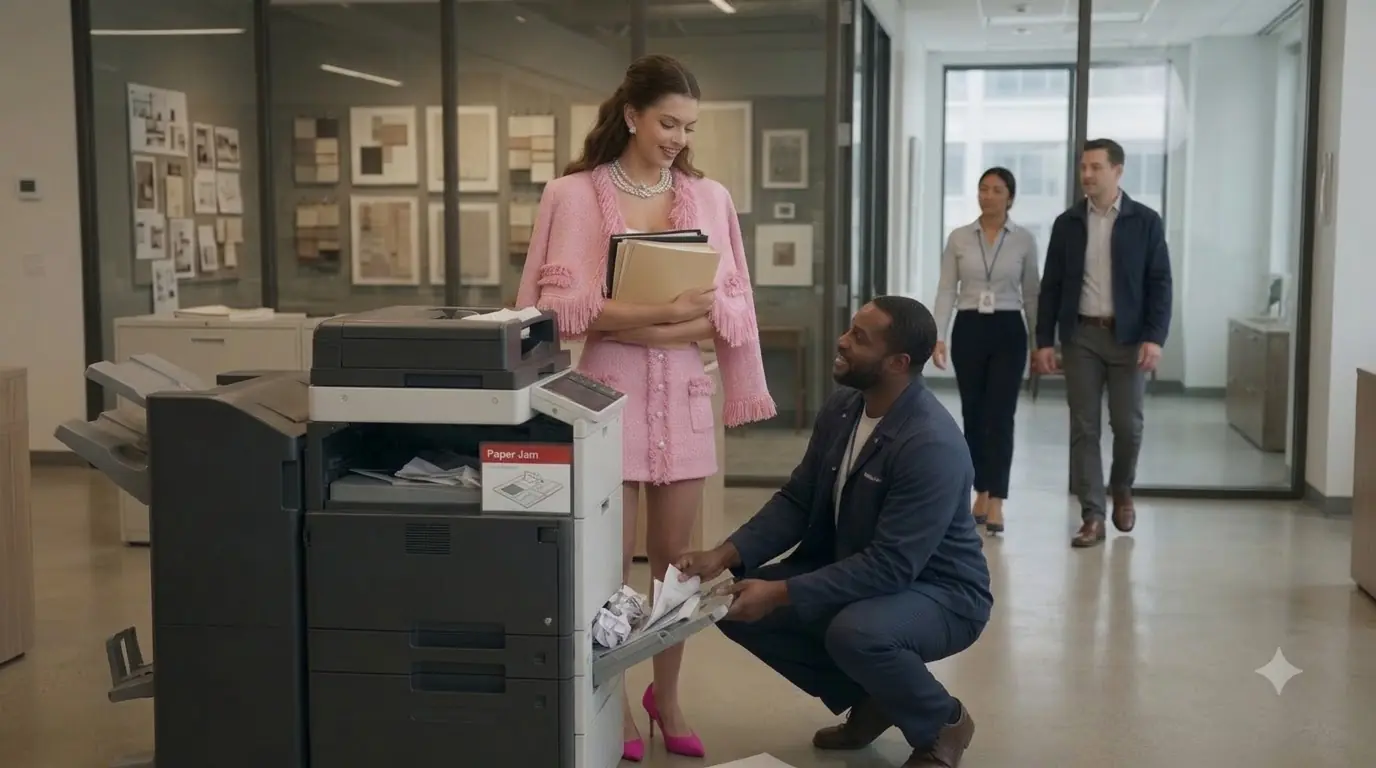
The particular expression of someone who had been pointed toward a desk and then immediately forgotten about. Dorian had seen it a hundred times. The universal look of a first-day intern abandoned in a building that didn't care she existed. He fixed the paper tray stacked on her folders and grinned. “I accept payment in smiles,” he added.
“Fair rate for a full orientation tour.” She laughed. She never corrected him. Monday morning, she walked onto that stage in a navy blazer and was introduced as the new CEO of Marlowe & Finch, and Dorian's entire world quietly stopped making sense. Dorian Ellis had worked at Marlowe & Finch long enough to know exactly which elevator stuck between floors two and three, which conference room had a heating vent that screamed like a kettle every time the temperature dropped, and which members of senior management would walk past a burned-out hallway light for six weeks before thinking to report it. He knew these things because fixing them was his job, operations manager for the Chicago branch.
The person who kept the building breathing while everyone else focused on looking good inside it. He was thirty-six years old, broad-shouldered with the kind of calm that came not from having an easy life, but from deciding a long time ago that panic was a luxury he couldn't afford. His daughter Amara was eight, sharp as a tack, and had her father's eyes and her own very strong opinions about which cartoons deserved a second season. Dorian raised her alone, had been doing it for years, and had quietly built his entire existence around two things: keeping his job stable and keeping her world steady. Everything else came second.
Marlowe & Finch was a high-end interior design firm with a reputation that had once meant something. Showrooms that felt like stepping into a different version of your life. Clients who paid serious money to feel understood by a room. But somewhere along the way, the creativity had curdled into procedure. The design teams ran on fear of disapproval.
The approval chains were so long that a good idea could die of old age before it ever reached a client. And the people who actually held the place together, maintenance operations, reception, the woman who restocked the supply closet, and somehow always knew when you were running low on printer paper, were treated like background noise. Dorian had watched it happen gradually and said nothing because saying something was not what people in his position were supposed to do. He was not a director. He did not sit in the big conference rooms.
He fixed what broke and kept his opinions between himself and the four walls of his apartment, where Amara would occasionally ask him why he looked tired, and he would say he was fine, and she would give him the look that said she was eight, not stupid. The Friday it happened was ordinary in every way that mattered. He had already handled a water pressure complaint on the fourth floor, argued a delivery company into rescheduling a late shipment, and sweet-talked the ancient photocopier on three back into functioning temporarily, as always before 9:00 in the morning. He was heading back to his office when he spotted her. She was standing beside that same photocopier which had apparently staged a relapse.
Folders were stacked precariously in both arms, a few sheets already making a break for the floor. Her access badge hung from a lanyard with the telltale look of something printed that morning, white background placeholder font not yet loaded into the system. She was wearing a white button-down and dark jeans, hair pulled back, and she had the expression of someone who had been told to go make copies and had arrived to find the machine actively hostile. Dorian crouched down, picked up the escaped pages, and pulled open the paper tray with the specific angle of pressure that convinced the machine to cooperate. He set the stack straight on top of the folders she was holding and straightened up with an easy smile.
“And the fact that you're trying to negotiate with the worst machine in the building. Rule number one, this copier has a grudge and it's personal. Rule number two, if you need someone to show you how the rest of the place works, I accept payment in smiles.” She laughed then, a real one, not the polite version people offered when they wanted someone to go away. She shifted the folders to one arm and looked at him with genuine curiosity. “And what exactly does the tour cover?
“Everything they don’t put in the welcome packet,” Dorian said. “Which elevator to avoid, which conference room is actually haunted, where they hide the good coffee, the essentials.” Her name, she offered, was Tessa. No last name, no title, nothing further. Dorian didn't push. New interns were often nervous about how much to share with people they'd just met, and he'd learned a long time ago that making someone feel comfortable was mostly about not demanding anything from them.
So, he talked, and she listened, and then she started asking questions. Not the wide-eyed kind, but the careful, specific kind. What was morale like? Whether people felt heard by management, whether the creative teams still had room to push back on briefs. Dorian told her the truth the way he always told the truth when he thought it didn't much matter.
He said the company had a good heart underneath all the bureaucracy, but that the heart had been squeezed pretty hard for a few years running. He said the designers were talented and exhausted, and mostly afraid to say so. He said the people in operations and maintenance and support did the work that kept everything standing, and management's awareness of that fact was approximately zero. He said the new CEO, whoever that turned out to be, was probably going to walk in with a smile and a restructuring plan, and nothing would change except the names on the org chart. Tessa listened to all of it.
She didn't take notes, didn't flinch, didn't offer the reflexive reassurances that people offered when they were uncomfortable with honesty. She just listened. And while she listened, Dorian watched her watching the office. Not in a self-conscious way, but in the way of someone cataloging information that mattered to them. She nodded at the security guard by the elevator.
She noticed when a young woman dropped a binder and two people walked past before someone stopped to help. She watched Dorian stop to tighten a loose chair leg for an older employee without being asked. By the time he walked her to the correct floor and said goodbye, Dorian had convinced himself he had done a good thing. Helped a new intern feel less alone on her first day. The interaction had the clean, pleasant shape of a small kindness, and he carried it with him through the rest of Friday without examining it further.
He spent the weekend the way he spent most weekends. Amara had a soccer game on Saturday that she played with the intensity of someone competing for a championship, and Sunday was grocery shopping, laundry, and a very serious debate about whether pancakes counted as dinner. By Sunday night, he was tired in the best way. The kind of tired that meant the day had actually happened. Monday arrived the way Mondays always did at Marlowe & Finch, with a mandatory all-hands meeting that everyone attended with the energy of people walking toward something they had not chosen.
The entire Chicago branch packed into the main hall, and Dorian stood near the back with the operations team, quietly betting with his colleague Marcus on how long the opening remarks would run before they heard the words “exciting new chapter.” The board representative took the microphone and said several things that Dorian did not retain because the door at the side of the room opened, and the woman who walked through it was wearing a navy blazer, and the particular expression of someone who had decided long ago exactly how much space she was allowed to take up, and had decided it was all of it. It was Tessa. Not Tessa the intern, not Tessa with the jammed folders and the unactivated badge. Tessa Langford, the board representative was saying, who had led turnarounds at three firms in four years, who brought a philosophy of structural accountability and human-centered leadership. Dorian stopped hearing the words because the words had become irrelevant.
He was looking at the woman he had called beautiful, teased about payment in smiles, and spent 40 minutes educating about the company's dysfunction, and she was the new CEO of Marlowe & Finch. The room applauded. Marcus leaned over and said something that Dorian did not catch. He was aware distantly that his expression had probably done something unfortunate because two people near him turned to look and then looked away with the specific care of people choosing not to comment. By lunch it was around the office.
Dorian had talked to the new CEO before anyone knew who she was. He had flirted with her. He had complained about management to her face. The details grew slightly with each retelling the way details always did and by 2:00 in the afternoon he had received three separate texts from colleagues whose messages all communicated some variation of the same thing, “You are in serious trouble.” He was still trying to decide what to do with that information when the message came from Tessa's assistant. She was requesting a meeting.
His office. End of day. Dorian sat with that for a moment. Then he straightened his desk, refilled his coffee, and went. Her office still had the impersonal quality of a room that hadn't been lived in yet the furniture was there.
The view of the city was there but none of the weight of a person had settled into it. Tessa was standing when he entered, jacket off, looking at him with an expression he couldn't quite read. She set a legal pad on the desk between them. On it she had written a series of bullet points. Things he recognized pieces of what he'd said Friday morning reconstructed in her handwriting with the clean efficiency of someone who had been paying very close attention.
“The things you told me on Friday,” she said, “I need to know which of them are true.” Dorian looked at the notepad. He looked at her. He understood with total clarity that the correct move for his continued employment was to soften everything to say he had been exaggerating, to apologize for speaking out of turn, and offer some version of himself that was easier to manage. He also understood with equal clarity that he was not going to do that. “All of it,” he said.
“I wouldn't have said it otherwise.” Tessa studied him for a moment. Then she picked up her pen and made a small mark at the top of the page. The kind of mark that meant something had been confirmed rather than noted for the first time. “I appreciate that,” she said. And she meant it.
He could hear it. Not the performance of appreciation, but the real thing from someone who had spent long enough in rooms full of careful answers to recognize an honest one when it arrived. Dorian apologized for assuming she was an intern. He did not apologize for anything he had actually said about the company, and Tessa did not ask him to. He left her office 20 minutes later unsure of exactly what had just happened, but certain somehow that something had shifted.
Not in the dramatic way stories described shifts, no music, no revelation, just the quiet and specific feeling of a door that had been closed for a long time moving slightly on its hinges. The changes Tessa made in her first two weeks were not the ones anyone had predicted. There were no layoffs, no restructuring announcement, no consultant teams arriving with matching luggage and color-coded slide decks. Instead, she showed up on different floors at different hours, sat in on meetings she hadn't been invited to, and asked questions that were specific enough to make clear she had already done her homework. She reopened an anonymous feedback channel that the previous CEO had quietly shut down.
She cut the design approval chain from seven signatures to three. She restored the creative budget that had been quietly redirected toward executive travel over the past two fiscal years. Nobody said out loud that these changes tracked closely with what Dorian had told her beside a jammed photocopier on a Friday morning. But the people who paid attention noticed. And the people who paid attention talked to each other, and within three weeks Dorian's name carried a particular weight in hallway conversations that it had never carried before.
He did not find this comfortable. He started taking different routes through the building, arriving early to avoid the morning crowd, eating lunch at his desk. Not because he had done anything wrong, but because he understood how stories worked inside an office, and the story people were telling about him that he had some kind of special access, some line to the top that others didn't, was the kind of story that made colleagues into competitors without anyone deciding to. He kept his head down and did his job and told himself the distance was the right call. Tessa, for her part, kept her distance, too.
When they passed in the hallway, she was professional and brief, the way she was professional and brief with everyone. If she noticed him making himself smaller, she gave no sign of it. Dorian told himself this was fine. He told himself this was exactly how it should be. Then Silvergate Living came in.
The client was a high-end home furnishings company looking to redesign their showroom chain across five cities starting with Chicago. It was the largest contract Marlow and Finch had pursued in 3 years, and Tessa made clear in the project briefing that the Chicago branch's performance on this pitch would determine whether the branch expanded or contracted going into the following year. The design leads were assigned immediately. What surprised people was that Tessa also requested Dorian's team for the operations and site assessment component, citing the need for someone who understood how a space actually functioned for real people, rather than just how it photographed. There was a version of this where Dorian could have declined, cited workload, kept the walls he'd been building.
He didn't. Because the project was real, and the stakes were real, and he was underneath everything else someone who cared about doing good work. The first site visit changed the texture of things between them in ways that were hard to name. They walked the existing Silvergate showroom together, Tessa with her notebook, Dorian with his eye for the things that didn't work. He pointed out a display corridor that looked elegant in photographs, but created a bottleneck that would frustrate anyone using a stroller or a wheelchair.
He noticed that the lighting near the furniture groupings was designed for drama rather than accuracy. So, customers bought pieces that looked different under natural light at home. He flagged a material selection that was beautiful to touch in the showroom and nearly impossible to maintain in a real household. Tessa wrote all of it down without commentary. Then she looked at him with something that was not quite surprise, but adjacent to it and said, “You’ve been thinking about design for a long time.
“I’ve been thinking about how spaces feel to be inside,” Dorian said. “That's not the same as design, I don't think, but it might be close.” She held his gaze a beat longer than necessary, then turned back to her notebook. They kept walking. The late nights started in the third week of the project because the pitch deadline was firm. The design team was running hard, and the operational components, logistics assessments, vendor timelines, installation sequencing, all had to be built around the creative framework rather than the other way around.
Dorian stayed late because that was the job. He told himself very firmly that this was simply the job. Tessa stayed late, too. Sometimes he would find her still at the site table when he came back from a vendor call, working through material specifications with a focus that suggested she had forgotten to eat dinner. He started bringing two coffees without announcing it as a decision.
She started leaving one of the site maps on his chair when she'd updated it without making it a conversation. They developed the particular rhythm of two people doing serious work together, and it was comfortable in a way that Dorian found increasingly difficult to think about too directly. One evening, working late in the sample showroom space the team had mocked up on the second floor, Dorian climbed a short ladder to replace a track light that had been flickering all week. The bulb had been the wrong color temperature from the start—too cold, making the wood finishes look cheap—and he had finally gotten a replacement. When he climbed back down and switched the circuit back on, the room changed.
The wood warmed. The fabric samples stopped looking washed out. The whole space exhaled. Tessa was standing near the center of the room, and she turned slowly taking it in. “That’s it,” she said quietly.
“That's what it was missing.” “Took three tries to get the right temperature,” Dorian said. “The specs called for something that looked good in a catalog and did not account for what people actually see when they're standing in the room.” She looked at him then, and the look had too much in it to be entirely about lighting specifications. “You always do that,” she said. Dorian set the old bulb down. “Do what?
“Fix the thing that’s actually wrong,” Tessa said. “Not the thing that's easiest to point to.” The room was quiet around them. The new light fell warm and even across the floor, and Dorian was very aware that they were alone, and that the distance he had been carefully maintaining for weeks had at some point in the last hour quietly closed. He was aware of her the way you became aware of a sound you'd been hearing for a while without registering suddenly completely all at once. “There are some things,” he said, keeping his voice level, “I'm not sure I'm supposed to fix.” Tessa held his gaze.
Whatever she was about to say, she decided against it. Instead, she stepped back just slightly, and something in her expression settled into a different configuration, careful and deliberate and a little sad. “I’m your CEO, Dorian,” she said. It wasn't a rejection, exactly. It was a boundary drawn by someone who understood exactly what was at stake for both of them.
He knew she was right. He also knew that knowing she was right did not make the room feel any less like something he would remember for a long time. He nodded. She picked up her notebook. They went back to work.
The trouble started the following week, arriving not with a confrontation, but with the particular silence that precedes one. A group of senior managers, three directors who had survived the previous regime and spent the current one watching their influence erode, began finding reasons to be dissatisfied with the Silvergate project. They questioned the operational timeline. They raised concerns about budget variances that had existed long before Dorian's team joined the project. They used the word irregular in meetings to describe the working dynamic between the CEO and the operations manager.
Always with just enough plausible deniability that no one could call them on it directly. Then someone, no one admitted to it, no one ever did, sent an internal message to a board member characterizing Tessa and Dorian's working relationship as a potential liability. The phrasing was careful and the implication was not. Within 48 hours, the story had shaped Dorian had flirted with the CEO before knowing who she was. And now, he was working directly beside her on the company's most important contract.
And didn't that seem like something worth examining? Dorian heard about it from Marcus, who heard about it from someone in HR, who had heard it in the way that information heard in HR always sounded official enough to be alarming, vague enough to be impossible to address directly. He sat with it for the rest of the afternoon and felt something he recognized from a long time ago, from years of being the person in the room who was good at his job and still somehow had to prove it differently than other people did. The feeling had a texture he knew well. He had simply hoped by this point in his life to have put more distance between himself and it.
Tessa called him that evening. She said the board had requested an internal review not just of the working relationship, but of the full Silvergate project. She said she wanted him to know before he read it somewhere else. Her voice was even and professional, but he had spent enough time in rooms with her by now to hear what was underneath it. She was angry and she was containing the anger because containing it was what the situation required.
“This isn’t about the project,” Dorian said. “No,” she agreed. “It isn't.” Neither of them said the obvious thing, which was that the people who had manufactured this problem were betting that one of them would make a move that confirmed the story that Tessa would protect him too visibly or that Dorian would lean on her connection to defend himself. Either outcome served the people causing the problem. He drove home in the dark and found Amara already in her pajamas sitting at the kitchen table with a drawing she was very serious about.
She looked up when he came in and her eyes moved across his face the way they always did when something was wrong, quietly, carefully reading what he hadn't said. “Did something bad happen at work?” she asked. Dorian sat down across from her and looked at his daughter who was 8 years old and sharper than most adults he knew and who deserved a father whose life was not quietly unraveling over a story someone else had decided to tell about him. “Some people said some things that weren’t true,” he said. “I have to figure out what to do about it.
Amara considered this with the gravity she brought to most things. You should tell the truth, she said like it was simple, like it was obvious, like it was the only answer that had ever made sense. Then she went back to her drawing. Dorian sat in the kitchen for a long time after she went to bed. He was being asked in the way that life sometimes asked things without ever phrasing them as questions to make a choice.
He could go quiet, pull back from the project, make himself easy to overlook until the whole thing passed. It was the safe move. It was the move that cost him nothing visible and everything else. Or he could walk back in there with every document, every timestamp, every piece of evidence that told the actual story, and say it plainly in a room full of people who had decided they didn't want to hear it. He already knew which one he was going to do.
He had known it since Amara said the word truth. With the confidence of someone who had never been given a reason to doubt that it mattered. He showed up anyway. The review meeting was scheduled for 9:00 in the morning in the large conference room on the sixth floor, the one with the long table and the windows that looked out over the city, and the kind of lighting that made everyone look slightly more serious than they actually were. Dorian was technically on suspension, which meant he had no formal right to be there.
He came anyway, carrying a folder that was two inches thick and had taken him until 2:00 in the morning to assemble. Marcus met him in the lobby and looked at the folder, and then looked at Dorian's face and said nothing, which was the most useful thing anyone said to him that morning. The room was already full when he walked in. The three directors who had manufactured the problem were seated on one side of the table, with the particular arrangement of people who had agreed on their story in advance. Several board members occupied the far end.
Tessa sat near the center, and when Dorian entered, she looked at him with an expression that was carefully neutral and completely awake. One of the directors, a man named Greg Paulson, who had been at the company for 11 years and spent most of them making sure his name appeared on work other people had done, looked up from his notes with the expression of someone who had not expected this particular complication. “This meeting is for authorized personnel,” Paulson said. “I’m the subject of it,” Dorian said. “I figured I should be here.” He set the folder on the table and sat down without waiting to be invited.
Nobody physically stopped him, which was the only invitation he needed. The review opened with Paulson's group presenting their case, which had been assembled with the particular care of people who knew the truth and had worked hard to arrange the facts around it. They argued that the budget variance on the Silvergate project, a discrepancy of roughly $40,000 across the operational line items, had originated with Dorian's team. They presented a timeline that showed the variance appearing after his involvement began. They used words like “oversight failure“ and “blurred professional boundaries“ and never once said directly what they were implying because saying it directly would have required them to stand behind it.
One board member, a woman named Patricia Hale, who had the posture of someone who had been listening to corporate presentations for 30 years and had stopped being impressed by any of them, asked a flat question. “What specifically did the operations team do that caused the variance?” Paulson began a response that contained several sentences and no actual answer. Dorian opened his folder. He didn't raise his voice. He didn't perform outrage or appeal to anyone's sympathy.
He simply laid out the documents in the order that told the story most clearly. The original budget approval with Paulson's own signature authorizing a vendor contract at a rate that was already over projection. The internal emails showing that Dorian's team had flagged the discrepancy twice before the project formally began. The revised timeline showing that the operational delays cited in Paulson's presentation had originated from a design approval bottleneck that predated Dorian's involvement by three weeks. “The variance existed before my team touched the project,” Dorian said.
“I have the timestamps. I have the approval chain. What I don't have is an explanation for why those documents weren't included in the materials distributed to this room this morning.” The room shifted. Not dramatically, nobody gasped, nobody stood up, but the quality of the attention changed. The way a room's attention always changed when the actual facts arrived to compete with the arranged ones.
Patricia Hale picked up one of the documents and read it with the focus of someone who did not need anyone to explain it to her. Tessa had not spoken yet. She had sat through the entire presentation and Dorian's response with the stillness of someone who had made a decision about when to enter the conversation and was waiting for the right moment. When she spoke, her voice was even and unhurried. “Before I joined this branch,” she said, “I spent a Friday morning here that no one knew about.
I came in without announcement because I wanted to see how this place operated before anyone had a chance to prepare for me.“ She looked around the table without hurry. “In that time, I watched a member of the operations team fix a machine, help a colleague find a meeting room, adjust a broken chair for someone who hadn't asked him to, and spend 40 minutes telling a stranger who turned out to be me exactly what was wrong with this company and why it still had a chance to be worth saving. He didn't do any of that because it benefited him. He did it because it was who he was. She set her own folder on the table.
It was thicker than Dorian's. What I have here, she continued, is the complete record of budget decisions made on the Silvergate project from initial authorization to present. I also have records of three separate incidents over the past 18 months in which budget documentation was altered after the fact within this department records I obtained during the operational audit I commissioned in my first week before any of this became a formal issue. I was planning to address these findings through the standard review process. This meeting has accelerated that timeline.
The silence that followed was a different kind of silence than the room had held before. Paulson looked at the folder and then looked away from it, which told Dorian everything about what was in it. Patricia Hale set down the document she'd been reading. I think, she said in the tone of someone drawing a meeting to a specific close, that we need to adjourn and reconvene with counsel. It took another three weeks for the formal process to conclude.
Dorian was reinstated before the end of the first week once the preliminary review made clear that the documentation did not support the claims against him. The three directors were placed under formal investigation. Two of them eventually resigned. The third stayed and became in Dorian's observation a noticeably quieter presence at every subsequent meeting. The Silvergate project continued.
The pitch was delivered revised based on client feedback that Dorian's site assessments had largely anticipated and approved in the fifth week after the review. The installation timeline ran four days ahead of schedule, which Marcus called a miracle and Dorian called a function of having planned it correctly the first time. At the all-hands meeting following the project's completion, Tessa stood in the same room where she had been introduced two months earlier and spoke about what the company had been through with a directness that made people uncomfortable in the productive way, the way that meant something was actually being said. She talked about what happened when institutions decided that some people's voices mattered and others didn't, and about what it cost to run that way, and about what it looked like to start running differently. She didn't name Dorian specifically.
She didn't need to. The people in the room knew who she was talking about, and more importantly, they knew she was also talking about the receptionist and the junior designer who had been afraid to speak for two years, and the maintenance crew who kept the building standing while everyone else held their meetings about the building's future. Afterward, Dorian found a formal letter in his company inbox. Tessa was creating a new role, director of space experience, that would sit at the intersection of operations, design, and client services. The letter explained that to ensure no conflict of interest, she was recusing herself entirely from the selection committee.
The role would be filled through an independent review panel. He was encouraged to apply if he believed his experience was relevant. He read the letter twice. Then he called Marcus, who said, “Obviously, you’re applying.” before Dorian finished explaining what the letter said. He applied.
He was selected. The panel's decision came back in writing with three pages of notes about his site assessment methodology and his understanding of how people actually inhabited designed spaces. The first time Dorian had seen those particular instincts described as qualifications, rather than opinions. The new role meant he no longer reported directly into Tessa's operational chain. The line between them, which had been charged and complicated and carefully maintained became something cleaner.
Not gone. He was still part of the company she led, but no longer the thing that made every conversation between them carry weight it wasn't supposed to carry. She came to find him on a Thursday afternoon about a week after his first day in the new role. He was in the sample room on the second floor, his sample room now officially rearranging a furniture grouping that had been bothering him since the installation. She leaned against the door frame and watched him for a moment.
“I don’t want to start anything,” she said. “If it's going to make you feel like you owe me something, or like any of this came with a price attached.” Dorian set down the chair he'd been repositioning and looked at her directly. “You recused yourself from my hiring panel,” he said. “You let me walk into that review meeting and make my own case. You didn't run interference and you didn't make me a project.” He considered what he wanted to say next.
“What makes me trust you isn't the title. It's the way you chose not to use it.” Tessa held his gaze. Something in her expression shifted into something quieter and more open than her professional face. The face she wore in boardrooms and all hands meetings and conversations with people who were still deciding whether to trust her. “Okay,” she said simply.
“Okay,” he said. They didn't define it further that day. They didn't need to. Some things were better built slowly from the ground up by people who had already proven they could tell the truth to each other in rooms that made truth difficult. The Silvergate showroom opened on a Wednesday morning in early spring and it was the kind of space that made people stop walking when they entered it.
Not because it was overwhelming, but because it was exactly right. Warm and considered and full of the specific intelligence that came from understanding how people actually lived. The press wrote about Tessa's leadership. The design team celebrated loudly and deservedly. Dorian stood near the back and felt the particular satisfaction of someone who could see in every corner of the room the evidence of work that had mattered.
A few weeks after the opening Tessa came to a company outdoor event that Dorian brought Amara to. Within 10 minutes Amara had installed herself beside Tessa on a blanket and produced a sketchbook. And the two of them were deep in the construction of an imaginary house that featured at Amara's insistence a slide connecting the bedroom to the kitchen and a reading nook built into the walls. Tessa didn't try to impress the girl with anything. She just sat with her genuinely consulting on slide placement and reading nook dimensions fully present in the way that children recognized immediately and adults often forgot how to be.
Dorian stood a short distance away and watched his daughter lean over the sketchbook with total confidence and watched Tessa match her energy without performance or effort. He understood something then that he hadn't had words for before. That the right person didn't make your life smaller to fit inside theirs. They made the whole thing wider. More room, more light, more of whatever it was that made a space feel worth being in.
Some weeks later Dorian was passing the third floor photocopier when he heard a sound he recognized, the specific mechanical complaint of a paper tray staging a protest. He turned to find Tessa standing beside it with a stack of documents and an expression of entirely unconvincing helplessness. “First day?” he said. She looked up and the look she gave him had layers in it. Amusement and warmth and something steadier underneath both.
“I think I might need a guide.” She said. “Rate still the same? Dorian said. “Payment in smiles.” Tessa looked at him the way she looked at him on that Thursday afternoon with her professional face set aside and the real one present instead. “Then I owe you a lot,” she said.
He smiled first. She followed. And the machine, as if finally persuaded that the moment called for cooperation, printed every page without complaint. This story is a reminder that the most valuable people in any room are often the ones nobody thought to introduce. Dorian didn't have a title that impressed anyone.
He had something rarer, the habit of treating every person he met as someone worth seeing before he knew whether it would ever benefit him. That's not a small thing. That's everything.