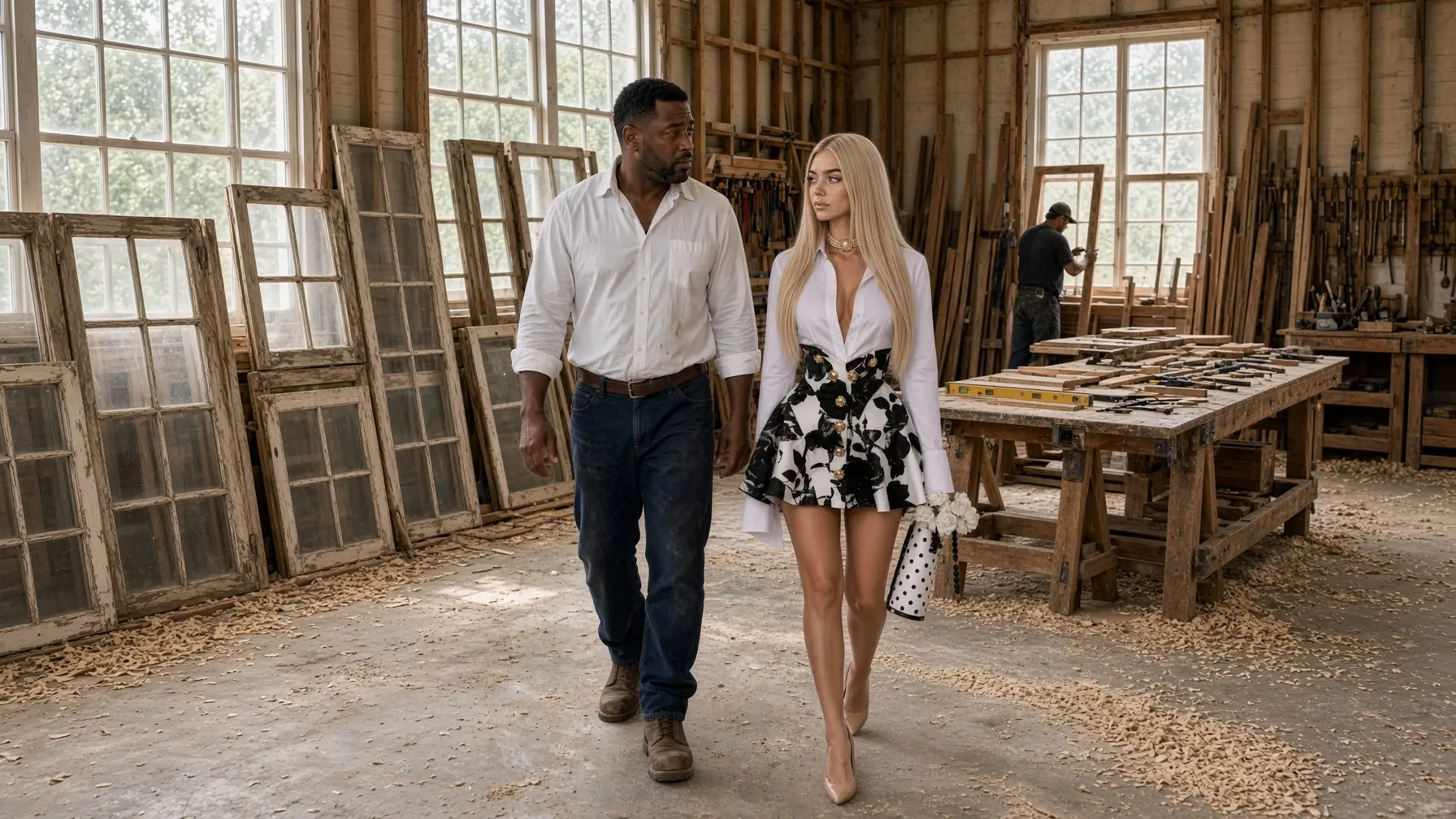
Marcus Reed drove a screwdriver straight through a rotting window frame and it snapped clean off in his hand. He stared at the broken tool, then at the crumbling school around him. Then he laughed, not because it was funny, because what else do you do when everything keeps falling apart? He was 42 years old, widowed, raising an 11-year-old girl alone, and fixing abandoned buildings that nobody cared about for barely enough money to keep the lights on. Then a convoy of black SUVs pulled up and a woman in a designer suit walked straight toward him and said six words that changed everything.
Marcus Reed drove that screwdriver into the rotting window frame with everything he had and felt the wood give way like wet cardboard. The whole frame shuttering a century of neglect collapsing under a single push. He yanked his arm back. Splinters a long thin cut across his forearm. He pressed his sleeve against it, looked up at the Georgia sky, white and hot and indifferent, and let out a slow breath through his nose.
"Beautiful," he muttered to nobody. He was the only person there. That was the thing about East Side Preparatory Academy. It had been sitting empty for 3 years. The city had officially closed it down in 2021 budget cuts, they said, as if that explained why 800 kids suddenly had nowhere to go.
The building sat at the corner of Edgewood and flat sholes, four stories of crumbling brick and broken glass, and Marcus had been hired to assess the structural damage. Not fix it, just assess it. Just tell the city what it would cost to save it. But Marcus had been in that building for 3 days now, and he'd already fixed six windows. He hadn't been asked to.
He wasn't being paid to. He just couldn't look at a broken thing and walk away. That was his problem. Had always been his problem. He crouched down and opened his toolbox.
His hands were already rough, not from this job, but from 20 years of jobs like this. Carpenter, then contractor, then the guy other contractors called when they didn't know what they were doing. He had calluses on his calluses. His knuckles had been split so many times they'd stopped healing straight. He wore a plain gray t-shirt that had been washed so many times the color had faded to almost nothing, jeans stained with primer and sawdust, and boots that had been resold twice.
He looked, in other words, exactly like what he was, a working man. He pulled out a replacement strip of oak trim, measured it against the window frame, marked it with a pencil, and picked up his handsaw. The sound of it cutting through wood was the only sound on the block. No traffic at this hour, no people, just Marcus Reed and a dying school and the slow, steady rhythm of work. His phone buzzed.
He checked it. A text from Lily. Dad, did you eat lunch? He smiled. 11 years old and already mothering him.
He typed back, yes, which was a lie. He'd had coffee at 6:00 and a granola bar at 10:00, and it was now almost 2:00 in the afternoon, and the granola bar was a distant memory. He set the phone face down on the floor and went back to work. He heard the cars before he saw them. That particular sound, multiple engines, expensive ones, the kind that purr rather than growl, was not a sound you associated with Edgewood Avenue in the East Atlanta neighborhood at 2:00 in the afternoon on a Tuesday.
Marcus looked up from the window frame. Through the gap in the boards he'd pried off earlier, he saw them pulling up to the curb. Three black SUVs, not Escalades. Something quieter, more discreet. The kind of vehicles that don't want to be noticed, which is its own kind of arrogance because vehicles that expensive are always noticed.
Marcus watched the doors open. Men in dark suits stepped out first. Not police, no badges, no vests, private security. They fanned out across the sidewalk with practiced efficiency, and Marcus had the odd thought that they were doing the same thing he did when he entered a new job site, scanning for hazards, calculating exits. Then she stepped out.
He registered her in pieces. The way you register something unexpected, not all at once, but in fragments that your brain assembles slowly. Dark blazer, heels that were absolutely not designed for cracked Atlanta sidewalks. Hair pulled back. Posture so precise it almost looked like effort.
A face that Marcus had seen somewhere before, though he couldn't place it. She looked at the building, then at the front entrance. Then she said something to one of the men beside her, and he pointed toward the side entrance, the one Marcus had propped open with a brick. Marcus set down his saw. She appeared in the doorway of the classroom he was working in about 3 minutes later.
Her security stopped at the threshold. She came in alone. She looked around the room at the crumbling plaster, at the boards he'd pried off, at the oak trim he'd cut and was preparing to install. At his toolbox. At him, Mr.
Reed, she said. Depends on who's asking, Marcus said. He hadn't moved. He was still crouched by the window holding the trim piece, looking up at her. My name is Sophia Whitmore, she said.
I'm the CEO of the Whitmore Education Foundation. That's where he'd seen her on the news. He'd seen her face on television. Something about a press conference, something about school funding, something he'd half watched while Lily did homework at the kitchen table and he cooked dinner. He'd registered her as one of those people who existed in a different atmosphere than he did.
The kind of person who talked about education reform at press conferences rather than kneeling on rotting floors trying to save actual school buildings. Okay, Marcus said, "How'd you find me here? " "The city's contractor registry. You were the assessor assigned to this building. She glanced at the trim in his hand. They didn't hire you to repair it.
No. Marcus agreed. Then why are you? He looked at the trim, then at the window frame. Because it needed doing a pause.
She studied him the way you study a document that doesn't say what you expected it to say. Can we talk? She said. I'm listening. Marcus said.
He set the trim down and stood up. He was taller than her by several inches and brought her across the shoulders. And he watched her adjust, not nervously, but the way a person recalibrates when the reality in front of them is different from what they'd prepared for. Not here, she said. Somewhere more, Ms.