The late light in Room 214 at Halberd Preparatory arrived the way it always did in October: thick and gold through the multi-paned windows, catching dust in soft columns, warming the dark wood trim until the room smelled faintly of varnish and chalk.
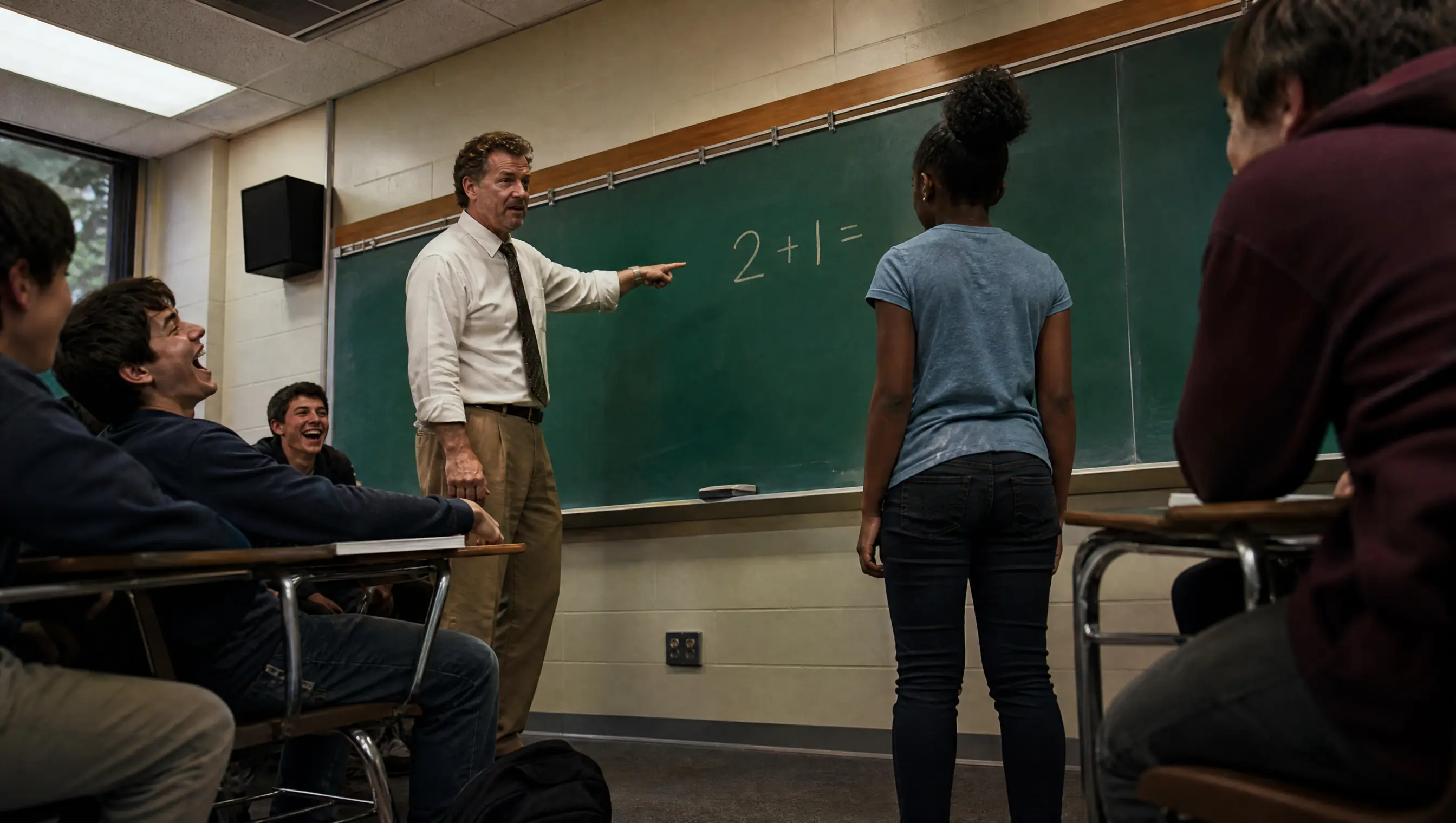
Wooden desks sat in tidy rows. The chalkboard still held yesterday's leftover fractions in a faded corner, ghosts of someone else's certainty. Imani Quartey sat three seats from the left aisle with her purple backpack—stars and white dots on nylon that had seen too many wash cycles—propped against the leg of her chair. Her round gold-rimmed glasses sat slightly crooked on her nose. She had meant to straighten them before class and had forgotten, which was the sort of small failure she catalogued without mercy.
Mr. Gavin Ellery stood at the board in his navy suit, white shirt, and the dark blue tie with the red geometric pattern that made him look, Imani thought, like a man who had practiced looking prepared in a mirror. He was late thirties or early forties, short brown hair cut with the kind of neatness that suggested a barber who knew his name. He smiled with one corner of his mouth when he wrote, as if difficulty itself were a private joke he was generous enough to share.
"This one," he said, chalk tapping, "is intentionally difficult. Don't worry if you struggle. Struggle is how we learn who we are in mathematics."
The equation bloomed across the board in his clean hand: a nest of nested terms, a squared quantity that should have been negative if the rest of the expression were honest, an epsilon tucked where a student might miss it, a K that looked like a constant and behaved like a trap. Imani felt the wrongness before she finished reading it. Not the wrongness of her own confusion—she knew that feeling intimately, the hot blank of not knowing—but the wrongness of a sentence that claimed to be a problem and was, instead, a door designed to stay shut.
Her hand went up before she finished deciding to raise it.
Mr. Ellery's eyebrows lifted. "Already?"
"There's a mistake in the equation," Imani said. Her voice came out steadier than her stomach felt. The maroon piping on her gray blazer caught the light; the school crest sat over her heart like a small, expensive accusation. Her natural hair, held by a plain headband, itched at the temples. She did not scratch.
From the front row, Cole Brennan—reddish-brown hair, freckles across his nose like someone had flicked cinnamon—leaned toward Rohan Mehta and whispered, loud enough for the middle rows, "She thinks the teacher got it wrong."
Rohan's mouth twitched. He did not laugh. He looked at the board the way a person looks at a locked cabinet when someone claims the key is fake.
Mr. Ellery's smile did not change. "I wrote the problem myself."
Imani's fingers tightened on the edge of her desk. "That's why I'm telling you."
A soft rustle moved through the room—uniforms shifting, plaid jumpers, white shirts, the shared choreography of children who had been taught that interrupting a teacher was either courage or catastrophe and had not yet learned which. Lila Chen, two seats back, stopped chewing the end of her pencil. Harriet's twin cousins in the far row—no, those were the Wexler boys, not Harriet; Harriet was the dean—sat up straighter. Imani corrected herself privately: names mattered. Precision mattered. She was eleven years and four months old, and she had learned that adults loved precision until it pointed at them.
Mr. Ellery set the chalk in the tray with a small, theatrical click. "Alright. Come prove it."
Imani stood. She took her purple backpack with her because leaving it felt like leaving a piece of her body, and also because her mother had told her never to leave bags unattended in rooms where people liked to invent stories. She walked to the board. The floorboards made a polite sound under her shoes. Golden-hour light made the chalk dust look like glitter that had forgotten how to celebrate.
"This term," she said, pointing, "should be negative."
Mr. Ellery folded his arms. "And if it isn't?"
"Then there is no real solution."
He held out the marker—dry-erase for the side panel, chalk for the main board; he preferred chalk for performance. "Show your work."
Imani wrote. She wrote the way she did homework at the kitchen table when the building's pipes knocked and her mother was still on a late shift at the hospital pharmacy: rapidly, cleanly, with little pauses only to check that the logic still held when she turned it sideways in her mind. She isolated the nested term. She expanded. She showed the sign error that made the squared quantity collapse into an impossibility unless you pretended the world was complex and this class was not supposed to be. She ovals the final expression like a verdict: