The summer of 1884 had burned every soft thing out of the San Pedro Valley.
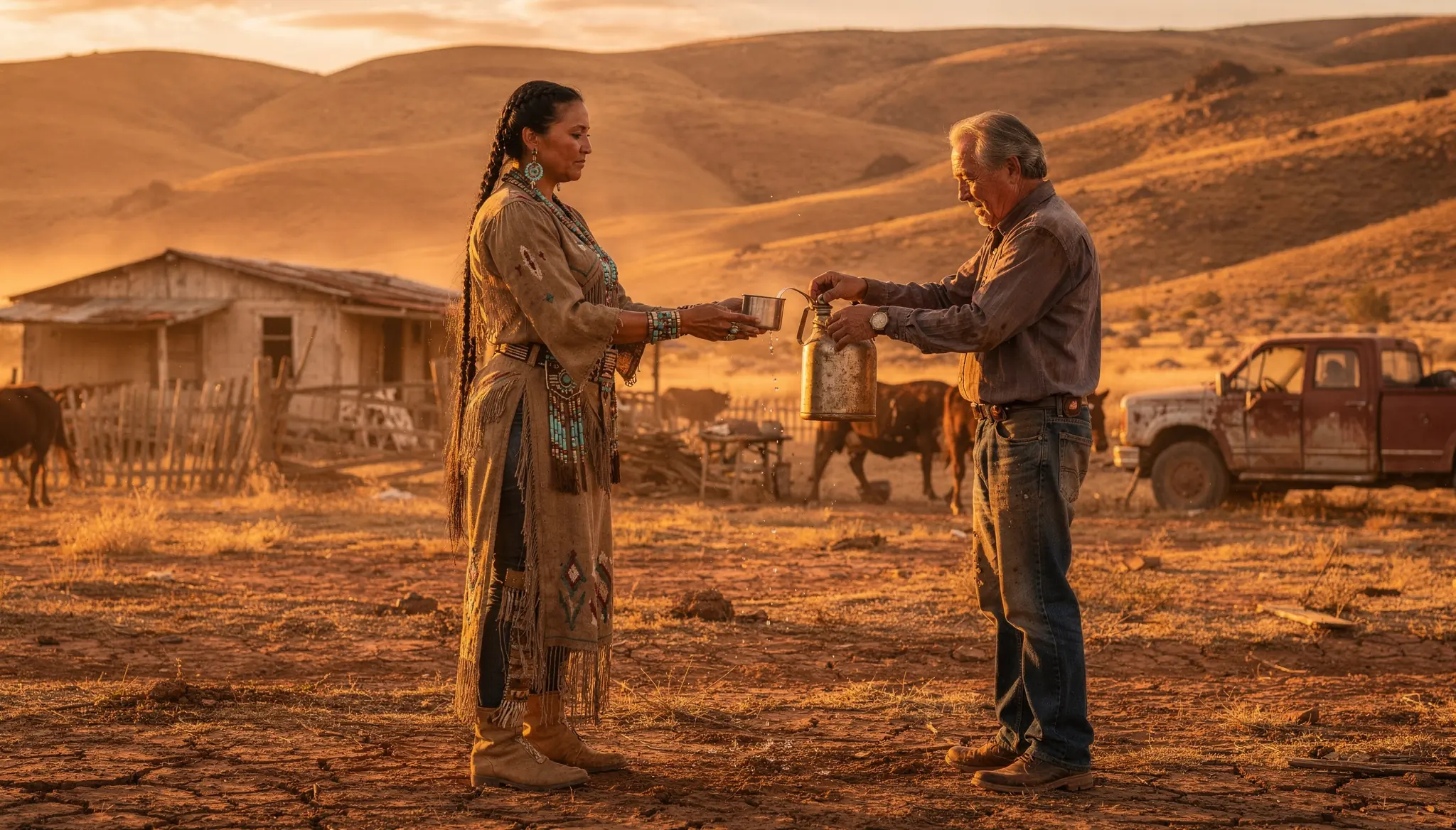
Grass turned the color of old rope. Creek beds became pale scars between cottonwoods. Cattle wandered farther each day for water, then returned to the shade with their ribs showing beneath dusty hides. Even the wind seemed exhausted, dragging hot sand across the Arizona Territory without enough strength to cool anything it touched.
Samuel Hale had stopped looking at the sky for rain.
At thirty-eight, he had learned that a man could waste a surprising amount of his life staring upward and asking the weather to care about him.
His ranch sat twelve miles from the nearest town and nearly forty from the military road. It was not much by the standards of the cattle barons who had begun swallowing entire valleys. One hundred and sixty acres. A weathered adobe house. A barn leaning slightly east because Samuel had promised himself for three winters that he would straighten the foundation.
Most important was the well.
Forty-one feet deep.
Cold even in August.
Samuel’s late wife, Miriam, had called it the only rich thing they owned.
She had been dead six years.
The well remained.
On the afternoon everything changed, Samuel was repairing a broken rail near the corral when his bay mare, Ruth, raised her head and stared toward the southern trail.
Samuel stopped hammering.
Dust moved in the distance.
At first he thought cattle.
Then he saw a horse.
One horse.
Walking slowly.
A rider sat upright despite the heat.
Samuel rested the hammer on the fence post and shaded his eyes.
The horse stumbled.
Recovered.
Took another twenty steps.
Then stopped completely.
The rider dismounted.
She was tall.
That was the first thing Samuel noticed.
Tall enough that when she stood beside the exhausted horse, her head nearly reached its saddle horn. She wore a faded buckskin dress darkened by dust and sweat, worn moccasins, and a turquoise necklace that caught the sunlight even from across the yard.
Her black hair had been divided into two long braids.
She did not wave.
She did not call.
She simply stood with one hand on the horse’s neck and looked toward the well.
Samuel looked past her.
No one else.
That bothered him.
During the previous month, rumors had moved through every ranch house and saloon between Benson and the border.
Cattle stolen.
Fences cut.
Two prospectors missing.
Apache families supposedly leaving reservation boundaries.
Army patrols moving through dry country.
Every incident grew larger each time it crossed another dinner table.
Samuel had learned not to trust stories that became more certain the farther they traveled from whoever actually saw something.
Still, he kept the hammer in his hand.
The woman began walking toward him.
Her horse followed reluctantly.
When she reached the corral, Samuel could see how exhausted the animal was.
Foam had dried along the bit.
Its nostrils flared rapidly.
The woman’s lips were cracked.
She looked at Samuel.
Then toward the pump beside the well.
“Water.”
Her English was clear.
Samuel said nothing for several seconds.
The woman waited.
No begging.
No explanation.
Just the request.
Samuel looked toward the trail again.
Nothing.
“Your horse first,” he said.
Something shifted in her expression.
Surprise, perhaps.
Samuel walked to the trough and worked the pump handle.
Cold water spilled from the iron spout.
The horse tried to push forward.
The woman held it back.
“Slow.”
Samuel nodded.
She understood animals.
That made him trust her more than anything else had.
He filled a wooden bucket instead and let the horse drink gradually.
When it finished, he filled another.
The woman took it in both hands.
She drank.
Not desperately.
Carefully.
Samuel watched her stop after several swallows even though thirst was written across her entire face.
“You can have more.”
She looked at him.
“Horse needs more.”
“There’s enough.”
She glanced at the well.
Then back at Samuel.
“Enough for who?”
The question confused him.
“For both of you.”
She studied his face as if deciding whether he had understood something she had not actually asked.
Then she drank again.
Samuel filled the trough.
The horse lowered its head.
For several minutes, the yard contained only the sound of water and the creak of the pump handle.
Finally Samuel asked: