The wrench slipped from Wade Hanley’s hand before he even realized he had stopped holding it.
It struck the concrete floor with a hard metallic clang.
Every mechanic inside Iron Sentinels Customs looked toward him first.
Then toward the open garage door.
A boy stood there.
Maybe thirteen.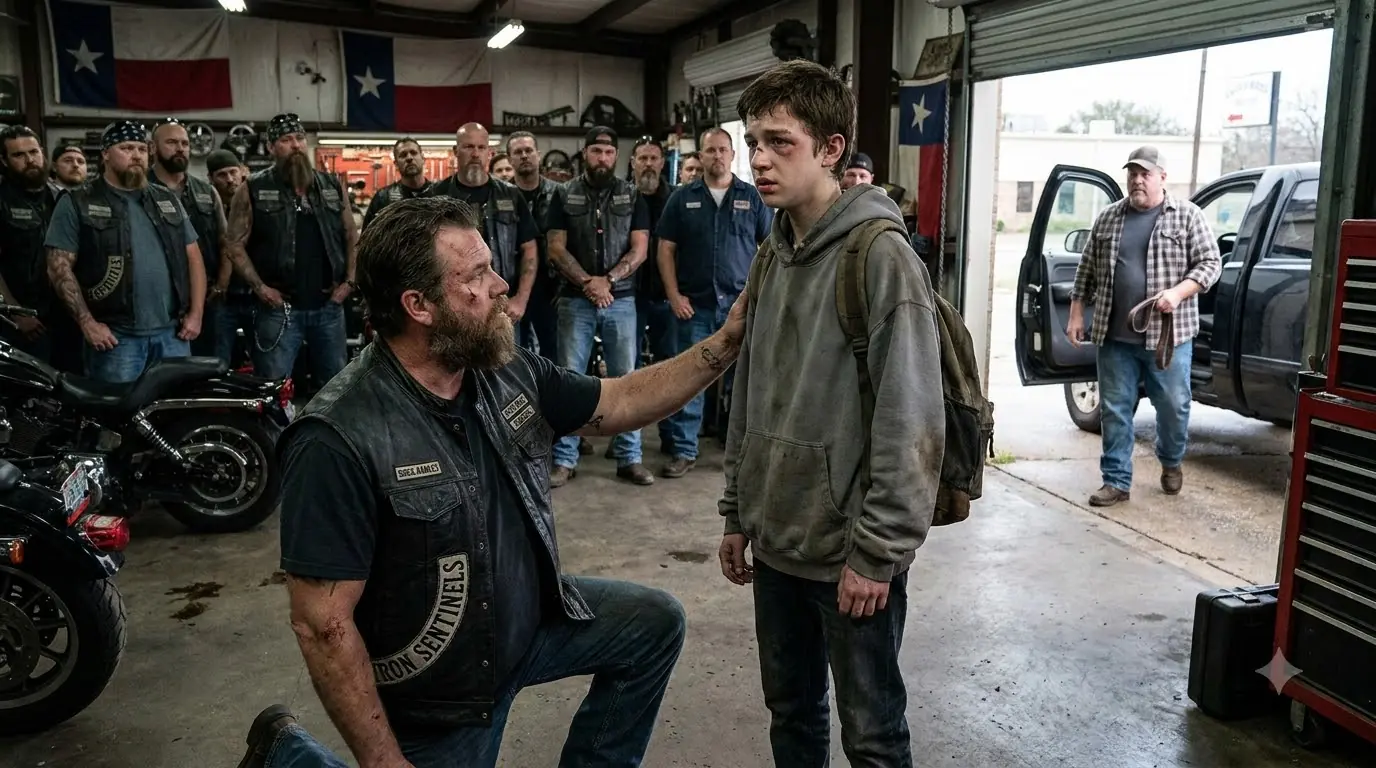
Skinny enough that the gray hoodie hanging from his shoulders looked borrowed from someone twice his size.
His brown hair was dirty and flattened strangely on one side, as if he had slept in it.
A backpack hung from one shoulder.
One eye was swollen purple.
His lower lip was split.
And he was staring at forty grown men in leather vests as though he had already decided they were less frightening than wherever he had come from.
That was the detail Wade remembered later.
Not the bruises.
Not the backpack.
The choice.
The kid had seen a motorcycle shop full of scarred mechanics, tattooed riders, heavy boots, loud engines, welding sparks, and men who looked intimidating even when discussing carburetors.
And he had walked inside anyway.
The garage radio played classic rock from a speaker above the tool cabinets.
An air wrench screamed near the rear workbench.
A Harley idled on a testing stand.
Nobody noticed the boy for several seconds.
Then he spoke.
“Can I sweep?”
The mechanic nearest him, Tommy Velez, looked up from an engine block.
“What?”
The boy swallowed.
“Floors.”
He pointed weakly toward the concrete.
“I can sweep them.”
Tommy wiped his hands on a rag.
“You selling something?”
The boy shook his head.
“No.”
“You need money?”
Another shake.
Wade had not moved yet.
He was fifty-four years old, six feet three, broad enough through the chest and shoulders that most strangers assumed he spent his life looking for arguments. His slicked-back salt-and-pepper hair, gray beard, scarred hands, and tattooed forearms did little to correct that assumption.
The back of his leather vest read:
IRON SENTINELS
TEXAS
Most people saw Wade and called him Brick.
Only his mother had called him Wade regularly.
She had been gone twelve years.
Now nearly everyone called him Brick because thirty years earlier someone decided his shoulders resembled a wall.
The nickname stayed.
Brick looked at the boy.
Then at the door behind him.
Nobody followed.
“What’s your name?” Brick asked.
The kid looked toward him.
“Ethan.”
“Ethan what?”
A hesitation.
“Cole.”
Brick walked forward slowly.
Ethan took half a step backward.
Brick stopped immediately.
That mattered.
He had spent enough time around frightened children through charity rides and community events to understand that size could become pressure even when the person carrying it meant well.
So Brick crouched.
Not close.
Just lower.
“You said you want to sweep.”
Ethan nodded.
“I’ll do anything.”
“We’re not hiring.”
“I know.”
Brick frowned.
“How do you know?”
Ethan looked at the floor.
“There’s no sign.”
That almost made Tommy laugh.
He stopped himself.
Brick said:
“Then why ask?”
Ethan gripped his backpack strap.
“I don’t need money.”
“What do you need?”
The kid’s eyes shifted toward the open garage entrance again.
Then toward the clock on the wall.
2:17 p.m.
“I just need somewhere to stay until dark.”
The air wrench at the back of the garage stopped.
Not because anyone ordered it.
The mechanic holding it had heard.
Someone lowered the radio.
Brick studied Ethan’s face.
Up close, the swollen eye was worse.
Yellow fading around the edges of purple.
Not today’s injury.
Maybe two days old.
The lip was newer.
Then Brick saw the wrists.
Ethan’s hoodie sleeves had pulled back slightly where his hands held the backpack.
Dark finger-shaped bruising circled one wrist.
The other looked older.
Brick’s expression changed.
He kept his voice level.
“You hungry?”
Ethan shook his head too quickly.
Tommy looked toward Brick.
Brick ignored the answer.
“Tommy.”
“Yeah?”
“Get a sandwich.”
Ethan immediately said:
“I don’t need—”
Brick looked at him.
“Kid.”
Ethan stopped.
“I own the garage.”
“Okay.”
“That means if I want to waste a sandwich, nobody can stop me.”
Tommy nodded solemnly.
“Absolute power.”
Brick looked at him.
“Go.”
Tommy disappeared toward the office refrigerator.
Ethan stayed near the entrance.
He would not move deeper into the shop.
Brick noticed that too.
“Want to sit?”
“No.”
“Okay.”
“Water?”
Ethan hesitated.
Then nodded.
A mechanic named Lewis Grant rolled an unopened bottle across the workbench rather than walking toward him.
Ethan picked it up.
“Thanks.”
Brick looked toward the backpack.
“You come from school?”
Another hesitation.
“No.”
“Didn’t go today?”
“No.”
Brick did not ask why.
Not yet.
Instead:
“Anybody know you’re here?”
The boy’s eyes went toward the street again.
“No.”
Brick sat on an upside-down bucket so Ethan remained taller than him.
That seemed to help.
“Ethan.”
The boy looked at him.
“You’re not in trouble here.”
No response.
“But if you’re hiding from somebody, I need to understand enough to keep everybody safe.”
Ethan’s hand tightened around the bottle.
Brick continued.
“You don’t have to tell forty people.”
He glanced around.
“Most of them barely understand English before coffee anyway.”
Someone in the back said:
“It’s two in the afternoon.”
Brick ignored him.
Ethan almost smiled.
Almost.
Brick lowered his voice.
“You can tell me.”
The boy looked at the door.
“What happens if I do?”
“That depends what you tell me.”
“Will you call somebody?”
“If I think you’re in danger, yes.”
Ethan’s expression closed immediately.
Brick saw it happen.
The kid stepped backward.
“No.”
Brick remained seated.
“Okay.”
“I shouldn’t have come.”
“You can leave if you want.”
That surprised him.
Brick continued.
“But I’d rather you didn’t.”
Ethan looked suspicious.
“Why?”
“Because your face tells me today already went badly enough.”
The boy looked down.
Tommy returned carrying a turkey sandwich in a plastic container.
He placed it on a tool cart several feet from Ethan.
Then walked away.
No pressure.
Ethan stared at it.
Brick said nothing.
A minute later, Ethan picked it up.
He ate standing.
Fast.
Too fast.
Brick watched without making the observation visible.
When the sandwich was half gone, Ethan slowed.
That told Brick the boy had been much hungrier than he admitted.
Eventually Ethan whispered:
“I don’t want to go home.”
Brick nodded.
“Okay.”
Ethan looked surprised by the lack of argument.
Brick asked:
“Home with who?”
The boy’s mouth tightened.
“My foster dad.”
Several men around the garage exchanged glances.
Brick noticed.
He lifted one hand without looking at them.
Stay quiet.
“What’s his name?”
“Calvin Redd.”
“How long you lived with him?”
“Eight months.”
“Anybody else there?”
“A girl.”
Brick’s stomach tightened.
“How old?”
“Ten.”
“Foster kid too?”
Ethan nodded.
“Her name’s Maribel.”
“Is she there now?”
Ethan looked away.
“I think.”
Brick’s voice became even calmer.
“Ethan, look at me.”
The boy did.
“Did Calvin do that to your face?”
No answer.
Brick waited.
Ethan swallowed.
Then whispered:
“He gets mad.”
“That wasn’t my question.”
The boy’s eyes filled.
“Yes.”
Nothing moved in the garage.
Even the idling motorcycle had been shut down.
Brick heard only traffic outside and the faint ticking of cooling engines.
He asked:
“What happened?”
Ethan shook his head.
“I can’t.”
“Okay.”
“He said if I told—”
Ethan stopped.
Brick waited.
The boy’s breathing became faster.
“If I told anyone, they’d send me somewhere worse.”
Brick’s jaw tightened.
He knew enough about fear to recognize borrowed language.
Adults had given the boy those words.
“Who told you that?”
“Calvin.”