"Hey, leave him alone. That's enough." "Relax. It's just a joke." "A joke?"
"That's my father. I could buy this whole restaurant. Apologize." "Whoa. We had no idea."
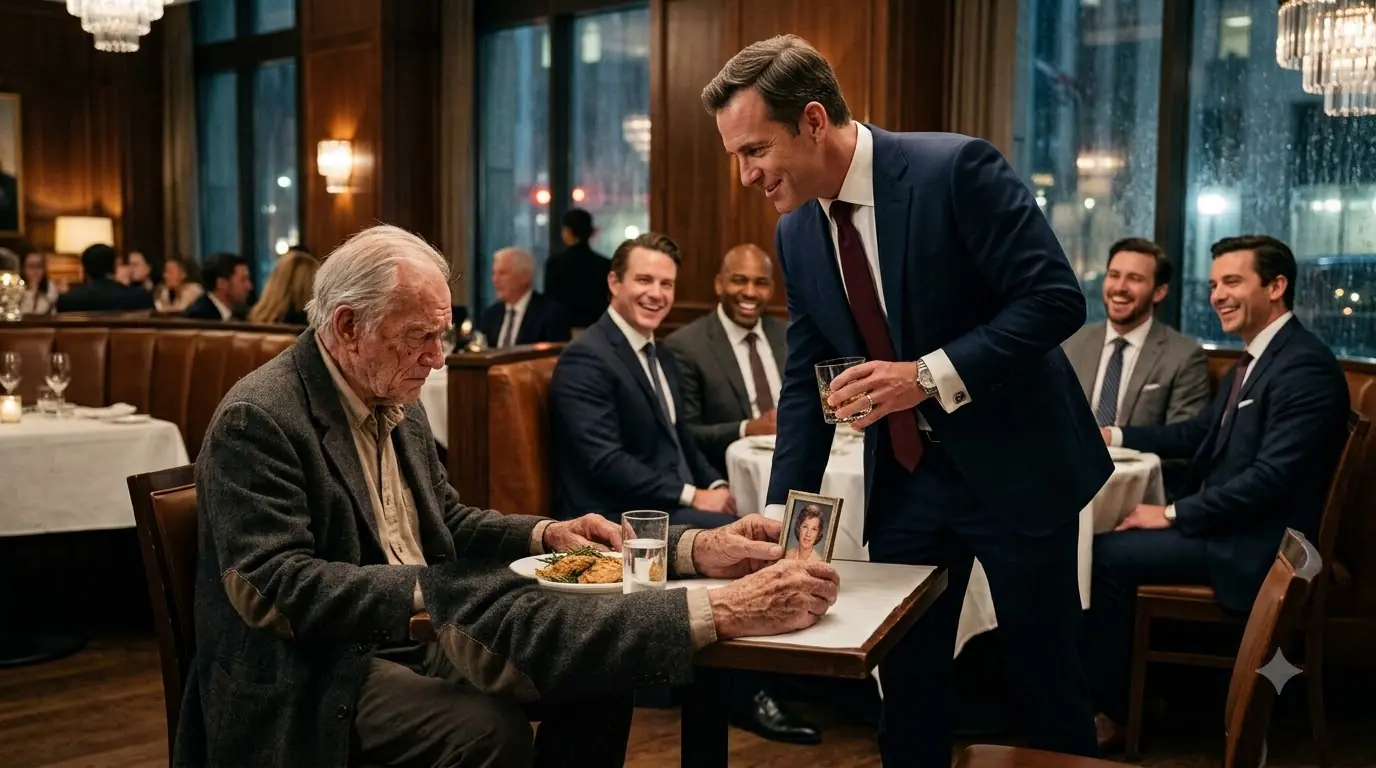
"Stop it. Leave him alone." "Mind your business, waitress." "He's a customer. Show some respect."
"What is going on here?" "Who are you?" "His daughter. And you're done here." A kind waitress defends an old man being mocked, unaware that his daughter is a billionaire.
The rain had just stopped over the city when the old man pushed open the glass doors of Lavoaza, the most expensive restaurant in the financial district. He didn't belong there. Everyone in the room seemed to know it the moment he stepped inside. His coat was patched at the elbows, gray with age and weather. His shoes were split at the seams.
His hands trembled slightly, not from fear, but from years, years of work, of loss, of carrying more than his body could hold. His name was Elmore Whitfield. He was 78 years old. And today, of all days, he had come to eat alone. "Table for one," he said quietly at the host stand, his voice rough like gravel dragged over stone.
The young host, a sharp-jawed man in a slim black suit, looked him over from head to toe. His eyes lingered on the torn sleeve, the scuffed shoes, the frayed collar. "Sir, I think you might have the wrong address," the host said, his tone syrupy with false politeness. "This is a reservation-only establishment." "I called ahead," Elmore said.
"Table for Whitfield, 6:00." The host's smile faltered. He checked the screen, and sure enough, there it was. A reservation paid in advance in full. He had no choice.
"Right this way," the host muttered, clearly displeased, and led Elmore toward the back of the restaurant, as far from the windows and from the other guests as possible. Elmore didn't complain. He never did. He simply nodded, thanked the young man, and lowered himself slowly into the chair. On the table sat a small, unlit candle, and beside it, tucked into his coat pocket, a photograph worn soft at the edges from years of handling, a woman with kind eyes and a gentle smile.
Today would have been her 65th birthday. His wife Karen had been gone three years now. But every year on this day, Elmore came somewhere nice, somewhere she would have loved, and ordered her favorite meal, roast chicken with rosemary, a glass of red wine he never finished. It was the only extravagance he allowed himself all year. He didn't know that tonight that quiet ritual would be shattered.
20 feet away, a table of five men in tailored suits were three rounds of scotch into a celebration. Investment bankers, all of them celebrating a deal that had closed that afternoon, a deal worth more than most people would see in 10 lifetimes. Their laughter was loud, careless, the kind of laughter that fills a room because the people making it have never once worried about being unwelcome in it. "Boys, to another record quarter," said Desmond Cole, the loudest of them, raising his glass. He was broad-shouldered, silver cufflinks catching the light, a Rolex peeking from beneath his sleeve.
The others clinked glasses, laughed, and ordered more. It was Desmond who noticed Elmore first. "What in the world is that?" he said, not even bothering to lower his voice, nodding toward the old man, seated alone near the back. His friend Wit Harrove turned to look, then chuckled. "I think the health inspector let someone in by mistake."
More laughter, ugly, careless laughter. Elmore heard every word. He always did. His hearing, unlike his hands, had never betrayed him. But he had learned over many years that some battles weren't worth fighting.
He simply looked down at the menu and pretended not to hear. "Seriously, though," said a third man, Brantley Voss, dabbing his mouth with a napkin. "How does someone like that even get a table here? Did he wander in from the subway grate?" "Maybe he's here for the free bread," Desmond said, and the table erupted again.
At the host stand, a young woman had just clocked in for her shift. Her name was Juny Alvarez, 26 years old, hair pulled back in a low knot, an apron tied twice around her narrow waist. She had worked at Lavoaza for 8 months, ever since her mother's medical bills had made every extra shift a necessity rather than a choice. She noticed the old man immediately, not because of his clothes, but because of his eyes. There was something in them, a quiet dignity that didn't ask to be seen, but earned it anyway.
She noticed, too, the table of loud men and the direction their laughter kept drifting. "That table needs a server," her manager, Priscilla Danes, said flatly, pointing toward Elmore's table. "You've got it." Juny walked over with a warm smile already in place, not performed, but real. It was simply how she carried herself.
"Good evening, sir," she said. "Can I start you with something to drink?" Elmore looked up, surprised by the warmth in her voice. Most people who looked at him lately did so with pity, or worse, contempt. Not Juny.
"Water is fine," he said. "And do you still make the roast chicken with rosemary?" "We do. It's one of my favorites on the menu." Juny smiled.
"Great choice." "My wife's favorite," Elmore said softly, almost to himself. Something in his voice made Juny pause. She didn't ask. She simply nodded gently, the way you nodded at someone carrying something heavy and wrote down the order.