Wednesday morning began quietly enough that Zara Coleman expected to remember almost none of it.
She was fourteen years old, traveling alone from New York to London on Flight 212, carrying one burgundy leather travel bag and the instructions her father had repeated so many times she could recite them without thinking. Keep your passport where you can reach it. Never surrender your phone. If something feels unsafe, find a uniformed crew member before trying to solve it yourself. And whenever possible, pay attention to how people behave when they believe nobody important is watching.
The last instruction had always fascinated her.
Her father, Marcus Coleman, had built his entire career around that idea.
Coleman Atlantic Airways had begun twenty-three years earlier with twelve leased aircraft, three regional routes, and a reputation for taking chances larger airlines considered foolish. By the time Zara was born, the company had become part of the international Coleman Aviation Group, operating passenger airlines, cargo services, airport lounges, charter operations, and aircraft-maintenance facilities across North America and Europe.
Marcus owned enough of the company to control it.
But he hated being treated differently because of that fact.
So did Zara.
Whenever possible, she traveled under ordinary booking procedures. Her reservations were paid normally, her status never marked with executive-service codes, and crew members were not told that the teenager sitting quietly in 2A was the controlling shareholder’s daughter.
Marcus had started the habit when Zara was eleven.
“One day,” he told her, “you may sit in rooms where executives tell you our passengers are happy.”
Zara had asked, “What if they are?”
“Then you should know why.”
“And if they aren’t?”
“You should know that before the executives do.”
Three years later, Zara understood his point better than she wanted to.
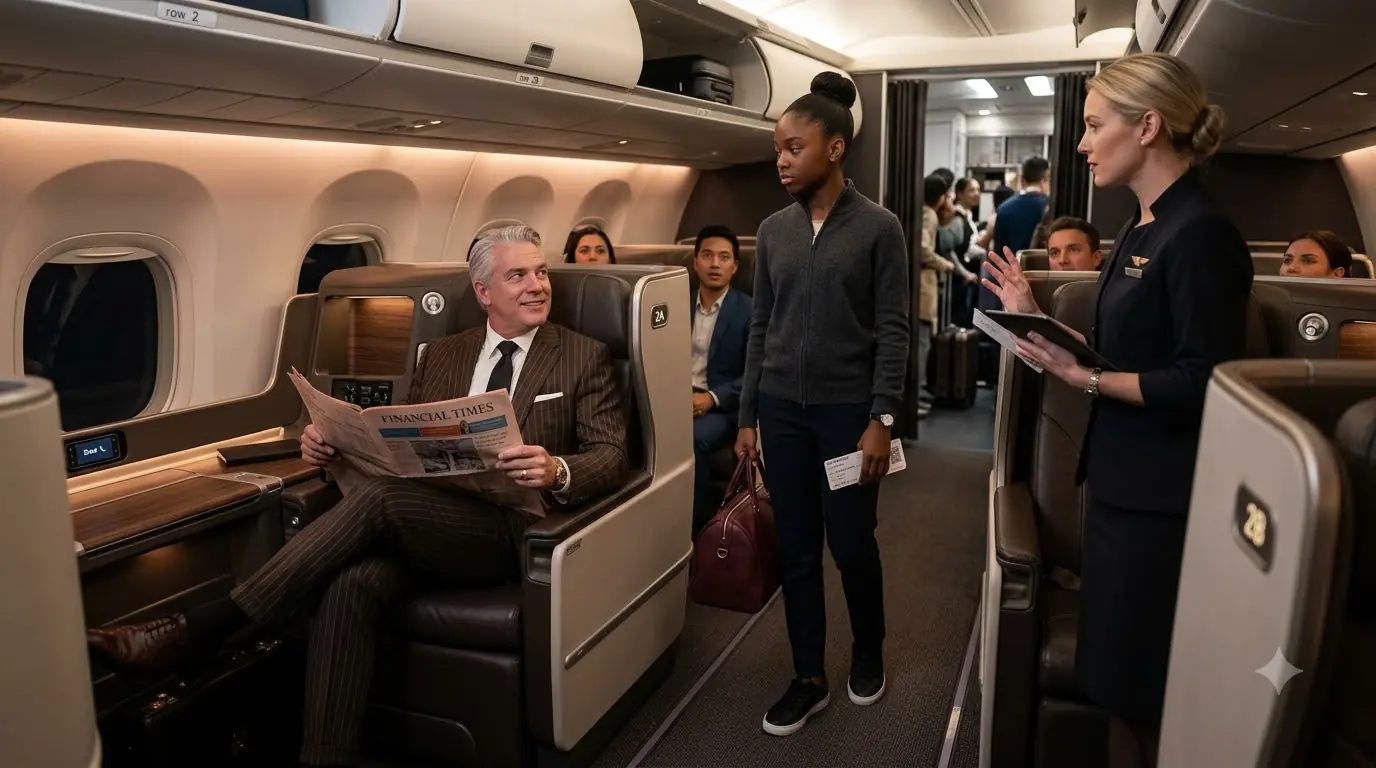
Because when she reached row two that Wednesday morning, a stranger was sitting in her seat.
The man occupying 2A looked as though he considered himself part of the aircraft’s permanent furniture.
He was perhaps fifty-eight, broad through the shoulders, with silver hair cut perfectly around the ears and a face carrying the relaxed confidence of someone accustomed to employees remembering his preferences. His brown pinstripe suit was expensive enough that Zara recognized the tailoring even though she did not care much about clothes. A heavy watch showed beneath one cuff, and a leather briefcase rested across his lap while a financial newspaper occupied the neighboring seat.
Zara looked at the overhead number.
2A.
Then at her boarding pass.
2A.
She waited.
The man did not look up.
“Excuse me, sir.”
Nothing.
Zara tried again.
“I think you’re in my seat.”
The newspaper lowered approximately two inches.
The man looked at her.
Then behind her.
Then back.
“Economy starts about thirty rows back.”
His voice was not loud.
That somehow made the sentence worse.
He spoke with casual certainty, as though helping a confused child locate the correct classroom.
Zara felt the first flush of heat rise behind her ears.
She hated when that happened.
Her father had spent years teaching her that composure did not mean never becoming angry.
It meant refusing to let someone else decide what your anger made you do.
Zara held out her boarding pass.
“My ticket says 2A.”
The man barely glanced at it.
“Then somebody made a mistake.”
“No, sir.”
That got his attention.
He lowered the newspaper completely.
Zara continued.
“You may have 2B.”
She pointed toward the aisle seat.
“Mine is the window.”
The man’s expression tightened.
“You don’t belong in first class.”
The words landed heavily enough that the younger passenger across the aisle stopped fastening his seat belt.
A woman in a cream jacket lowered her phone.
Another man looked toward the galley.
Zara remained where she was.
“I have a first-class ticket.”
“I heard you.”
“Then please move.”
The man leaned back.
“What is your name?”
“Zara.”
“Well, Zara, I’ve been flying international business routes since before you were born.”
“That doesn’t change the seat assignment.”
Someone across the aisle coughed suspiciously into his fist.
The man looked irritated.
“My name is Richard Bennett.”
Zara waited.
He looked almost offended by the silence that followed.
“Bennett Strategic Holdings.”
Still nothing.
Zara had heard the company name before, although she gave no sign of recognition. Bennett Strategic Holdings advised manufacturing firms, investment groups, and private-equity funds. Marcus had once mentioned its enormous annual corporate-travel contract during a board meeting Zara attended over school vacation.
Richard apparently expected his name to settle the disagreement.
Instead Zara glanced once more at the printed seat number.
Richard’s jaw tightened.
“My company spends almost three million dollars every year on corporate travel.”
Zara nodded.
“That means your company buys a lot of airline tickets.”
The passenger across the aisle finally smiled.
Richard noticed.
His face reddened.
“You have no idea who you’re talking to.”
Zara looked directly at him.
“That’s interesting.”
“What?”
“You haven’t asked who you’re talking to either.”
The first flight attendant arrived before Richard could answer.
Her name tag read ELIZABETH HART.
She was forty-six, blonde, professionally composed, and had worked international cabins for nearly twenty years. Zara remembered seeing her before but doubted Elizabeth remembered her. The entire purpose of Zara traveling without executive notation was preventing exactly that sort of recognition.
“Is there a problem?”
Richard answered first.
“This child is confused.”
Zara held out her boarding pass.
“Seat 2A.”
Elizabeth took it.
Her eyes moved across the information.
COLEMAN, Z.
FLIGHT 212. JFK-LHR. FIRST. SEAT 2A.
Elizabeth turned to Richard.
“May I see your boarding pass, sir?”
He laughed softly.
“This is ridiculous.”
“Your boarding pass, please.”
Richard eventually produced it.
Elizabeth checked.
“Mr. Bennett, you are assigned to 2B.”
Richard waved toward the seats.
“So we’re beside each other. What difference does it make?”
“The difference,” Zara said, “is that you took mine.”
Elizabeth kept her attention on Richard.
“Sir, I’ll need you to move to 2B.”
Richard stared at her.
“You’re going to make me rearrange myself because a child wants the window?”
“It is her assigned seat.”
“I’m a full-fare executive customer.”
“So is Miss Coleman.”
Elizabeth paused faintly when she said the surname.
Coleman.
Her eyes returned briefly to Zara.
Recognition had not arrived yet, but something had touched the edge of memory.
Richard noticed none of it.
He folded his arms.
“No.”
Elizabeth’s expression changed.
“Sir?”
“I said no.”
“Mr. Bennett—”
“I am not moving because some kid wandered into first class and decided she wants my seat.”
Zara’s fingers tightened around her bag.
Elizabeth lowered her voice.
“Her reservation is valid.”
Richard looked Zara up and down.
Charcoal sweater.
Dark trousers.
Simple sneakers.
No parent.
No obvious luxury logos.
His assumption hardened.
“Did somebody upgrade her?”
Elizabeth’s face became noticeably colder.
“Sir, that is irrelevant.”
Richard continued.
“Or is this some sympathy program?”
A man in row three muttered:
“Come on.”
Richard ignored him.
“You don’t belong here,” he repeated.
Zara looked at him for several seconds.
Then smiled faintly.
Not because anything was funny.
Because she had decided she was finished arguing.
“Keep it.”
Richard blinked.
“What?”
“Keep 2A.”
Elizabeth stepped toward her.
“Miss Coleman, you don’t need to—”
“It’s okay.”
Richard settled deeper into the seat.
“There. Good choice.”
Zara picked up her burgundy bag.
She met his eyes one last time.
“In a few seconds, you may feel differently.”
Richard smirked.
“Is that supposed to be a threat?”
“No.”
Zara turned toward the forward galley.
“It was information.”
The contact on her phone was labeled:
DAD — OPERATIONS.
Marcus had given her the number two years earlier.
It bypassed his personal assistant and routed through the aviation group’s twenty-four-hour operations desk if he did not answer. Zara had never used it.
She pressed call.
One ring.
“Z?”
Her father’s voice was relaxed.
Then he heard her breathing.
“What happened?”
Zara looked toward Richard Bennett.
He had reopened his newspaper.
“A passenger took my assigned seat.”
Pause.
“Crew involved?”
“Yes.”
“And?”
“He refused to move.”
Marcus’s tone changed.
“Why?”
Zara swallowed.
“He said I don’t belong in first class.”
Silence.
Not empty silence.
The kind that meant her father’s full attention had arrived.
“Are you safe?”
“Yes.”
“Did anyone touch you?”
“No.”
“Did the crew support you?”
“Elizabeth tried.”
Elizabeth Hart, standing only a few feet away, went pale.
Zara continued.
“But he’s still sitting there.”
Marcus asked:
“Flight?”
“Two-twelve.”
“New York to London?”
“Yes.”
Zara looked through the open aircraft door.
Ground employees were preparing for final close.
Then she said:
“Dad, they took my seat.”
Marcus inhaled once.
“I understand.”
Zara waited.
Then came his reply.
“Stay near Elizabeth.”
Another pause.
“Do not argue with anybody.”
“Okay.”