By the time Reverend Edwin Locke lifted the deed above his head, nearly half of San Aurelio had gathered beneath the canvas awning outside the mission hall.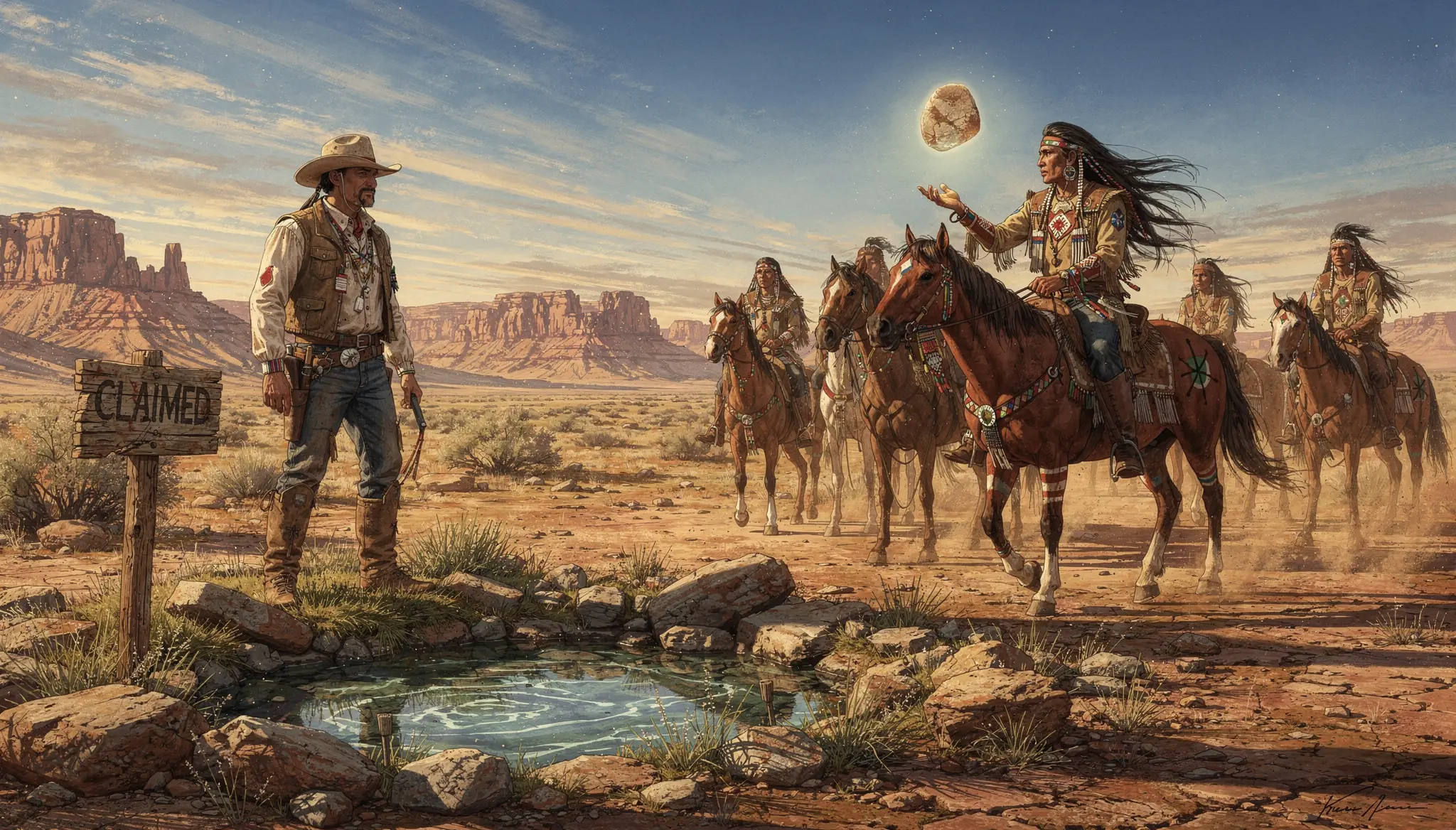
It was June of 1887, and southern Arizona had gone eighty-three days without meaningful rain.
Dust lay over the town like flour.
It collected on window ledges, wagon wheels, horses’ backs, and the shoulders of men who worked outside long enough to stop noticing it. The cottonwoods beside the wash had begun dropping leaves early, and three wells south of town had already gone dry.
That was why everyone had come.
Not for Silas Vane.
Not even for the land.
They had come because of water.
Bluewater Spring rose from a limestone shelf six miles east of San Aurelio and fed a narrow creek that survived even the worst summers. For generations, Western Apache families had watered horses there while moving between seasonal camps. Mexican ranching families used the lower creek. Later came American homesteaders, freighters, miners, and cattle.
No one had ever fully agreed who owned the spring.
Most years, nobody needed to.
Then Silas Vane arrived.
He began with four hundred cattle.
Within nine years, he controlled nearly eight thousand acres surrounding San Aurelio.
His fences spread farther every season.
His men dug ditches.
His lawyers filed claims.
His money paid debts faster than neighboring ranchers could accumulate them.
Now he stood beneath the mission awning in a tan three-piece suit, cream Stetson, and polished boots, one hand resting on a walking stick he did not need.
He was forty-seven, broad through the chest, with a dark mustache curled neatly at both ends.
Beside him, Reverend Locke held the papers.
The reverend was sixty, gray-haired and severe in a black clerical coat despite the heat.
He had served San Aurelio for twenty-two years.
People trusted him.
Silas understood the value of that.
Anna Mercer stood near the back of the crowd and knew something was wrong before the reverend read the first line.
She had seen the document the previous afternoon.
Only briefly.
Silas’s attorney brought it into the county recorder’s office ten minutes before closing and asked that it be entered first thing Monday.
Anna worked there three days each week when school was not in session.
The other days, she taught twenty-six children in the little schoolhouse behind the livery stable.
At twenty-four, she knew nearly every recorded deed in the county because her father had taught her to read survey descriptions before she learned algebra.
The paper Silas filed looked ordinary enough.
Federal patent.
Supplemental boundary description.
Water access provision.
Transfer assignment.
Three seals.
Two signatures.
One of those signatures belonged to Elias Mercer.
Her father.
Anna had stared at it long enough for Silas’s lawyer to ask whether she needed help reading.
She had answered no.
Then she went home and vomited behind the kitchen.
Elias Mercer had been San Aurelio’s surveyor and assistant land clerk for fourteen years.
He had died on August 19, 1881.
The document Silas Vane now intended to use to claim Bluewater Spring was dated October 3, 1881.
Six weeks after Elias was buried.
Reverend Locke unfolded the paper.
The crowd quieted.
“By authority of the territorial recording office and pursuant to the supplemental federal patent entered October third, eighteen eighty-one…”
Anna stopped hearing the rest.
Her mother, Margaret Mercer, stood beside her.
Margaret was fifty-three, thin from years of widowhood and work, wearing a brown dress with sleeves too heavy for the temperature.
She touched Anna’s arm.
“You’re white as linen.”
Anna swallowed.
“Father’s name is on that.”
Margaret frowned.
“What?”
“His signature.”
“Where?”
“Attesting the amended boundary.”
Margaret’s face changed.
“That cannot be.”
“I know.”
At the front, Reverend Locke continued.
The deed recognized Silas Vane as lawful holder of the Bluewater parcel, including the spring head, east pasture, wagon approach, and diversion rights.
Murmurs moved through the crowd.
Silas removed his hat and held it against his chest with practiced humility.
The performance might have worked better if three of his hired men were not standing beside the street with rifles across their saddles.
Reverend Locke reached the final paragraph.
“Existing users shall be granted temporary access for sixty days, after which water use shall be subject to the owner’s reasonable schedule and fee.”
That sentence caused the first real sound.
A rancher named Ben Polk shouted:
“Fee?”
Another man cursed.
A Mexican farmer near the back asked in Spanish whether the lower ditch would remain open.
Silas raised one hand.
“Gentlemen.”
The crowd did not quiet.
He tried again.
“No one is losing water today.”
Anna felt her anger sharpen.
Today.
A useful word when somebody intended to take something tomorrow.
Silas stepped forward.
“I know what this spring means.”
“Do you?”
Ben Polk shouted.
Silas ignored him.