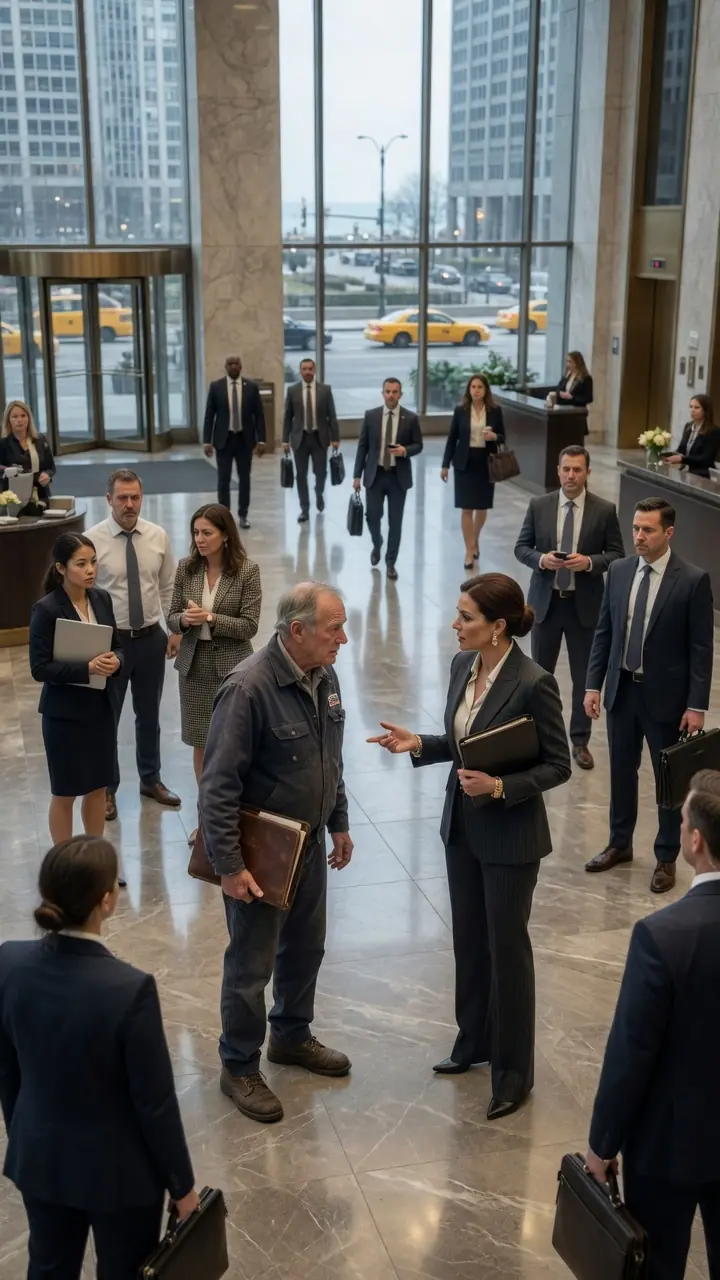
The apology did not settle anything, which was the first thing that surprised Amelia. She had imagined that saying the words would close the matter the way a payment closes a debt. Instead, she carried the encounter back downtown with her, and it sat in her chest through the rest of the week refusing to be filed away. Graham, for his part, returned to his drawings and expected nothing further to come of it. He had taken the measure of the young woman and found her more honest than most, but honesty was not the same as trust, and he had built his quiet life specifically to avoid the kind of people who lived in glass towers. He assumed the chapter had closed.
He was wrong.
Because Leonard Sterling had other plans.
The old man came to the print shop himself a week after the incident in the lobby. He lowered himself onto the only spare stool, set his cane against the table, and told Graham what he wanted. The city had finally approved the renovation of the historic harbor district, the row of nineteenth-century warehouses near the water that had been left to rot for a generation. Sterling Dominion had won the contract. Leonard wanted Graham to advise on the design.
“I have plenty of architects,” Leonard said. “What I don’t have is someone who’ll fight to keep the thing human. You used to do that better than anyone alive. The harbor deserves it. So do I before I’m done.”
Graham looked at the old man for a while before answering. The harbor meant something to him that he did not say aloud. His wife had loved those warehouses, had walked him through them in the early years when they were both poor and full of plans, and the thought of someone else flattening them into luxury frontage had bothered him for a long time without his ever intending to do anything about it.
Leonard had found the one project Graham could not entirely refuse.
“I’ll do it,” Graham said at last. “On two conditions. I don’t appear in any of it. No press. No photographs. No name on the plaque this time. And I stay out of whatever happens inside your company. The politics. The meetings. The maneuvering. I advise on the building and nothing else.”
Leonard agreed without hesitation, and the two men shook hands a second time in a small print shop far from any cameras.
What neither of them said, though both understood, was that the renovation fell under the southern division, which meant Graham would be working every day with the woman who had told him he did not belong. Amelia received the news from Leonard’s office rather than from Richard, which she noted. She was to lead the harbor project as division head, and Graham Cole would serve as senior design adviser, reporting his recommendations directly to her.
The arrangement was almost unbearable in its symmetry.
The man she had humiliated was now a daily fixture in her working life, and she could not refuse him without exposing exactly the flaw she was trying to bury.
The first weeks were stiff and careful. They met in a converted office near the waterfront surrounded by surveys and renderings, and they spoke only of the work. Graham was precise, demanding, and utterly without flattery. He rejected the firm’s first three concepts outright, calling them expensive ways of erasing history, and he did it so calmly that Amelia found herself agreeing before she could defend the work her own teams had produced.
She had expected to resent him.
Instead, she found that working beside him exposed how little of her own authority was built on substance.
In the boardroom, she ruled through speed and certainty, through never letting a silence sit long enough for anyone to question her. Graham was immune to all of it. He let silences sit. He answered her sharpest questions with longer ones. And slowly, against every instinct she had, she began to want his good opinion.
Which frightened her more than any hostile board ever had.
The tension between them was not only professional, and they both felt it without naming it. There was something in the room when they worked late, an awareness that neither acknowledged, a charge that came from the strange intimacy of two guarded people circling the same problem.
She told herself it was only respect.
He told himself it was only the work.
Neither was being entirely truthful.
Richard Vale watched the arrangement curdle from his own perspective.
He had expected the lobby incident to weaken Amelia, to make her dependent on him for guidance through the scandal, and instead it had thrown her together with a man Leonard Sterling treated like family.
He saw the way the old chairman’s eyes followed Graham, the way the harbor project had been carved out and handed to the two of them, and he understood with the cold instinct of a man who had survived nineteen years inside corporate politics that his path to the chair was being quietly closed.
He had never intended for Amelia to lead the division for long.
He had supported her appointment precisely because he believed she would stumble, and that her stumble would eventually deliver him the position he felt he deserved.
The lobby should have been that stumble.
The fact that it had instead drawn her closer to Graham and to Leonard’s favor was, to Richard, an outcome that needed correcting.
He began in his patient way to look for the correction.
The work pushed Amelia and Graham closer, whether they wished it or not.
One night, deep into the planning process, they stayed long after the rest of the team had gone, arguing over the central question of the project: whether the old warehouses should be open to the public or sealed behind the kind of exclusivity the investors wanted.
The argument went past the building and into something else.
And somewhere in it, the careful distance between them finally gave way.
“You keep fighting for the people who’ll never afford to live here,” Amelia said. “Why? You don’t owe them anything.”
“I owe them what every building owes the people who walk past it,” Graham replied. “The chance to feel like they belong in their own city.”
He looked at her.
“You’d understand that better than anyone, I’d think.”
A pause.
“You didn’t always have a coat like that.”
The remark was not cruel.
But it found something.
She looked at him, and the polished surface she presented to every room cracked quietly in the empty office by the water.
“No,” she said.
“I didn’t.”
And then, without quite deciding to, she told him.
She told him about a childhood spent in places not so different from the ones they were arguing over. About a mother who cleaned other people’s houses and came home too tired to speak. About the particular shame of being the one whose clothes were wrong, whose name was on every list of families behind on something.
She told him about the wealthy people who had looked through her as though she were furniture.
And how she had promised herself, with fierce certainty, that she would never be looked through again.
“So I learned to look first,” she said quietly.
“I learned that if I decided who didn’t matter before they could decide it about me, it couldn’t touch me.”
A long pause.
“I got very good at it.”
“Good enough that I did it to you in my own lobby without thinking twice.”
The office was silent except for the distant sound of water beyond the glass.
“I became exactly the kind of person who used to make me feel like nothing,” she said.
“I just did it from the other side of the room.”
Graham listened without interrupting.
Then he gave her something far more valuable than comfort.
“People who get hurt badly enough,” he said slowly, “usually turn into the thing that hurt them.”
The words settled heavily between them.
“It’s the most common story there is.”
He looked out toward the harbor.
“The cruelty doesn’t disappear when it lands on you.”
A pause.
“It just looks for somewhere new to live.”
“And the easiest place is your own hands.”
For a long moment neither spoke.
No one had ever described Amelia to herself so precisely.
And the strange relief of being seen all the way through nearly undid her.
This was the center of everything.
The night she stopped performing.
The night she finally let another person see the actual shape of her fear.
And Graham saw it too.
He had taken her for cold in the lobby.
Simply cold.
Now he understood something different.
The ice was not the absence of feeling.
It was a barrier built around far too much of it.
A woman who had been taught that softness was something other people punished.
He did not forgive the lobby in that moment.
But he stopped seeing her as the woman who had spoken there.
And started seeing the frightened person underneath who had been speaking for years.
What neither of them knew was that they were not alone.
Richard had not gone home.
He had returned for a forgotten file and noticed the light still burning inside the waterfront office.
Instead of leaving, he waited.
And when the two of them finally stepped outside together, tired and unguarded after hours of honest conversation, Richard stood hidden in the darkness of the parking lot.
Phone raised.
Watching.
Waiting.
He could not hear the words.
He did not need to.
The photographs captured exactly what he wanted.
Two people alone at night.
Close enough to suggest intimacy.
Close enough to invite suspicion.
To anyone willing to believe the worst, the images told a complete story.
And Richard knew something most people never learned.
The truth matters far less than appearance when appearance is all anyone sees.
He looked down at the photographs.
And smiled.
Because at last, he believed he had found the weapon he needed.
The blow came two weeks later.
And it came formally.
Richard submitted a written complaint to the board of Sterling Dominion alleging that Amelia Whitmore had entered into an inappropriate personal relationship with a project adviser, that she had compromised the firm’s judgment, and exposed it to reputational risk in front of the very investors the harbor project depended upon.
He framed it as reluctant duty.
A senior officer forced to act for the good of the company he loved.
He attached the photographs.
The images did exactly what he intended.
To anyone who wanted to believe the worst, they were damning.
A young CEO and an older man alone after hours.
The body language of people who had forgotten to be careful.
Richard circulated them to the board with a sober note about standards and appearances.
The same vocabulary he had spent months feeding Amelia now turned around and aimed at her throat.
He had taught her to weaponize image.
Now he used image to destroy her.
The board convened an emergency hearing.
Amelia received the notice on a gray morning and read it twice before its meaning fully landed.
After months of clawing for legitimacy, she stood to lose the chair within her first year.
Not for any failure of competence.
Not for any business decision.
But for a fabricated story dressed in photographs.
The cruelest part was that the story used the truest night of her life.
The one evening she had finally been honest.
And turned it into evidence of a crime she had not committed.
Graham learned of it the same day.
And for the first time since the lobby, his calm broke.
He had asked for exactly one thing in exchange for helping with the harbor project.
To stay out of the company’s politics.
And the politics had reached past him and seized the woman beside him anyway.
He understood instantly that he was the lever Richard had used.
His presence.
His closeness.
Had become her undoing.
The guilt landed harder than any insult ever could.
The hearing was held in the main boardroom on the upper floor of Sterling Tower.
In the building Graham had designed.
Under the light he had calculated decades earlier.
The irony was not lost on either of them.
Amelia walked in alone.
Dressed in the sharpest armor she owned.
And faced a long table of directors who had never fully trusted her.
Now they had a reason, however manufactured, to remove her.
Richard presented his case with the practiced regret of a man performing reluctance.
He spoke of the company’s reputation.
Of investor confidence.
Of standards.
Of appearances.
Of leadership.
He let the photographs speak for him.
He did not raise his voice.
He did not need to.
He had spent months shaping the room’s assumptions.
Now he simply collected the harvest.
When it was Amelia’s turn to speak, she did something nobody expected.
She did not deny the lobby.
She named it herself.
Before anyone else could.
She told the board she had judged a man by his clothing in front of all of them.
She told them it had been the worst mistake of her professional life.
And she said it without excuses.
The honesty unsettled the directors.
Several shifted uncomfortably.
Because they had expected denial.
Instead, they got accountability.
But on the accusation itself, she refused to bend.
She told them plainly that the photographs showed two colleagues working late on a company project.
Nothing more.
There was no inappropriate relationship.
No conflict of interest.
No abuse of authority.
Only a lie carefully arranged to resemble truth.
She did not name Richard.
Not yet.
She had no proof.
Only certainty.
So she stood her ground and let the truth stand on its own.
Richard watched her and believed he had already won.
The denial sounded exactly like what guilty people always said.
The photographs remained on the table.
The room remained uneasy.
He had spent nineteen years learning that in corporate rooms, appearance often mattered more than reality.
And a young CEO with an admitted lapse in judgment and a folder full of suspicious photographs had very little room left to maneuver.
He allowed himself a small smile.
The smile of a man watching a plan complete itself.
Then the boardroom door opened.
And Leonard Sterling walked in.
He had not been scheduled to attend.
The room shifted immediately.
Leonard crossed to the head of the table and set his cane down.
His eyes moved from the photographs.
To Amelia.
To Richard.
Then he spoke.
“The complaint before this board is not what it appears to be.”
The room fell silent.
Leonard continued.
He told them he had been quietly investigating Richard Vale for over a year.
Long before the harbor project.
Long before the lobby incident.
Long before the photographs.
Manipulation.
Political maneuvering.
Carefully engineered efforts to undermine executives who stood between Richard and the chair he believed belonged to him.
Leonard laid out the evidence piece by piece.
A trail.
A history.
A strategy.
The photographs were simply the latest instrument.
A night of honest work twisted into a weapon.
The room turned toward Richard.
For the first time all morning, he looked uncertain.
Leonard's voice remained calm.
“You decided this company belonged to you.”
A pause.
“It never did.”
Another.
“It belongs to the people who walk into our buildings.”
His eyes hardened.
“And to the way we treat those who can offer us nothing in return.”
Silence.
“You forgot that a long time ago.”
Richard’s face lost color.
The board voted immediately.
His suspension was unanimous.
Nineteen years of influence collapsed in less than five minutes.
He gathered his folder.
His photographs.
His carefully constructed future.
And left the room without another word.
Amelia should have felt victorious.
The lie had been exposed.
Her position was safe.
The man who tried to destroy her had failed.
But standing there beneath the light of the building Graham had designed, she understood something else.
The greatest failure of the entire story had never been Richard.
It had never been the hearing.
It had never been the photographs.
It was still the lobby.
It was still the moment she had looked at another human being and decided his worth before knowing a single thing about him.
And no vote in the world could undo that.
The boardroom emptied slowly after Richard was gone.
But Amelia stayed.
She sat alone at the long table looking at the light moving across the floor.
She had kept her chair.
She had won by every measure her old self would have counted.
And yet the victory felt strangely hollow.
Because she understood now that the thing she most needed to fix was not on any agenda the board could vote on.
In the days that followed, she found herself looking at Sterling Tower differently.
She had walked through its lobby for a year and seen only a stage.
A place to be photographed.
A backdrop for the image she maintained.
Now she began to notice what Graham had actually built.
The way the entrance drew people inward without intimidating them.
The way the light fell so that no one, regardless of how they were dressed, felt small standing in it.
The building had been designed to make people feel they belonged.
And she had stood in the middle of it and told a man he did not.
She raised the subject with him one afternoon at the waterfront office.
The harbor plans were spread across the table between them.
The windows stood open to the breeze off the water.
“I think I finally understand the tower,” she said.
Graham looked up from the drawings.
“Do you?”
“I thought it was designed to display power.”
A pause.
“But it wasn’t.”
She looked toward the harbor.
“You designed it to remove distance.”
“To make people feel welcome.”
“To make them feel like the building belonged to them too.”
Graham rested his pencil against the table.
“That’s what it was supposed to do.”
Another pause.
“Whether it still does depends on who’s standing in the lobby.”
The words weren't cruel.
They weren't even directed at her.
They were simply true.
And Amelia accepted them that way.
The harbor project continued.
Month after month.
The work pulling them together whether either intended it or not.
Graham kept his distance after the hearing.
And Amelia didn't push against it.
She understood now that trust wasn't something she could request.
Only something she could earn.
The old version of her would have managed the situation.
Found the right words.
Applied pressure in the correct places.
Instead, she showed up.
Every day.
For the work.
Nothing more.
And slowly, almost without noticing, she changed.
She stopped leading from the top floor.
Started spending her time at the harbor site.
Walking through the warehouses.
Speaking with engineers.
Learning the names of laborers and masons and welders.
People she once might never have noticed.
The division changed too.
Employees who had spent a year bracing themselves against her sharpness found themselves being asked questions.
Being heard.
Being credited.
Fear slowly disappeared.
Respect took its place.
The kind of respect that couldn't be demanded.
Only earned.
Graham watched all of it.
Quietly.
He saw her standing in mud beside construction crews.
Saw her arguing with investors to preserve public access to the waterfront.
Saw her defend ideas she once would have dismissed as impractical.
And he understood something important.
This wasn't image management.
He knew the difference.
This was change.
Real change.
The kind that happens when a person adjusts themselves instead of their appearance.
Nearly a year after the hearing, the harbor district finally opened.
The old warehouses remained.
Restored rather than erased.
Brick and timber preserved.
The waterfront accessible to everyone.
Not just those wealthy enough to buy their way inside.
The city loved it immediately.
Families.
Tourists.
Workers.
Retirees.
People filled the walkways from morning until night.
The investors who had wanted exclusivity discovered something unexpected.
An open harbor was worth more than a private one.
A modest ceremony marked the opening.
Nothing extravagant.
Just a platform beside the water.
A crowd.
A few speeches.
Leonard Sterling spoke first.
Briefly.
Then Amelia stepped forward.
The cameras turned toward her.
And she did something no one expected.
She thanked Graham Cole by name.
Not for his awards.
Not for his reputation.
Not for his talent.
For something else.
“When I arrived at this company,” she said, “I believed respect came from keeping people beneath you.”
The crowd fell quiet.
“I believed strength meant never being vulnerable.”
A pause.
“I was wrong.”
Her eyes found Graham standing at the edge of the gathering.
Away from the cameras.
Exactly where he preferred.
“This project exists because one man cared enough about people to fight for them.”
Another pause.
“But the more important thing he built this year wasn't the harbor.”
The silence deepened.
“It was the person standing here speaking to you.”
For the first time since the lobby, Graham looked away.
Not embarrassed.
Just uncomfortable with praise.
Amelia smiled slightly.
“The woman who took this job isn't the woman standing here today.”
“And for that, I owe him more than he knows.”
No applause came immediately.
Only silence.
The kind that arrives when people recognize truth.
Then the crowd responded.
Slowly.
Sincerely.
Graham remained where he was.
Outside the photographs.
Outside the spotlight.
Exactly as he had requested.
But for the first time in a very long while, something in him eased.
A weariness he had carried since his wife died.
Since he left architecture.
Since he stopped believing people changed.
It loosened slightly.
Because standing on that waterfront, listening to a woman who once judged him by his boots, he realized something.
Sometimes people really do change.
Not all at once.
Not dramatically.
But completely.
Graham stayed on with the company after that.
Not as a returning legend.
Not as a celebrated architect.
And certainly not as a man interested in titles.
He remained exactly what he had always wanted to be.
A part-time adviser.
He came in when the work deserved his hands and returned to his print shop when it did not.
Leonard never pushed for more.
Amelia never tried to persuade him into more.
Both had learned the same lesson.
The surest way to keep Graham Cole was to ask nothing from him that he did not freely choose to give.
A few weeks after the harbor opening, a winter afternoon found Amelia and Graham standing on the upper floor of Sterling Tower.
The city stretched beneath them.
The harbor shimmered in the distance.
The low sun painted everything gold.
Below them, the lobby moved with its usual rhythm.
People entering.
People leaving.
Executives.
Tourists.
Maintenance workers.
Delivery drivers.
No one sent around to the side entrance.
Not anymore.
Amelia watched the movement below for several minutes.
Then finally spoke.
The question surprised even her.
Because it had no strategic value.
No business purpose.
No safe answer.
“Do you believe people can really change?”
Graham didn't answer immediately.
He looked down at the marble floor below.
At the lobby.
At the exact place where a man in work boots had once been told he didn't belong.
Then he thought about the distance between that day and this one.
Not measured in months.
Not measured in projects.
Measured in choices.
Hundreds of them.
Small ones.
Difficult ones.
The kind nobody applauds.
The kind nobody sees.
Finally he answered.
“Yes.”
Amelia looked toward him.
He kept watching the lobby.
“When they learn to look at other people the way they'd want to be looked at themselves.”
A pause.
“That's the whole thing.”
The silence settled comfortably between them.
“Most people never manage it,” Graham continued.
“The ones who do change all the way down.”
Amelia followed his gaze.
The lobby continued filling and emptying beneath them.
A living current of strangers.
People with stories neither of them knew.
People carrying victories.
Failures.
Losses.
Dreams.
People who, if she was being honest, she once would have sorted into categories before ever speaking to them.
Now she simply watched.
And understood.
Graham wasn't only answering her question.
He was telling her what he believed about her.
Not the woman from the lobby.
Not the executive behind the armor.
The person she had become afterward.
Neither mentioned it.
Neither needed to.
Some truths lose power when spoken directly.
They stood together at the glass.
Two people who had spent years building walls against the world.
Watching a city move beneath them.
Watching sunlight fall across a harbor built for everyone.
Watching people enter a building designed to make them feel welcome.
And somewhere in the quiet between them sat the understanding that the most important thing either had built that year wasn't made of steel.
Or brick.
Or glass.
It wasn't the harbor.
It wasn't the tower.
It wasn't even the company.
It was trust.
The kind earned slowly.
The kind impossible to force.
The kind that begins the moment one person finally chooses to see another clearly.
Years later, when people spoke about the harbor project, they usually talked about the architecture.
The preservation.
The economic success.
The revitalization of the waterfront.
Those things mattered.
But the people who had been there knew something else.
The real story wasn't about a harbor.
Or a tower.
Or a corporation.
It began in a lobby.
With a mistake.
A painful one.
The kind most people spend their lives trying to excuse.
What made it different was what happened next.
One person chose honesty instead of pride.
Another chose truth instead of revenge.
And together they proved something most people forget.
Character isn't revealed by how we treat powerful people.
It's revealed by how we treat the people we believe have nothing to offer us.
Because titles fade.
Money moves.
Buildings eventually crumble.
But the way we make another human being feel?
That stays.
Sometimes for a lifetime.
And sometimes, if we're fortunate enough to learn from it, it changes who we become.