Nia Laurent had spent twenty-three years learning that the fastest way to understand an organization was to enter it without introducing herself.
Boardrooms lied beautifully.
Reports were worse.
Customer-satisfaction dashboards converted human frustration into percentages, executive presentations turned repeated failures into colored graphs, and management teams could explain almost anything if given twenty minutes and a projector. But a boarding gate at 7:10 in the morning did not have enough time to prepare a performance.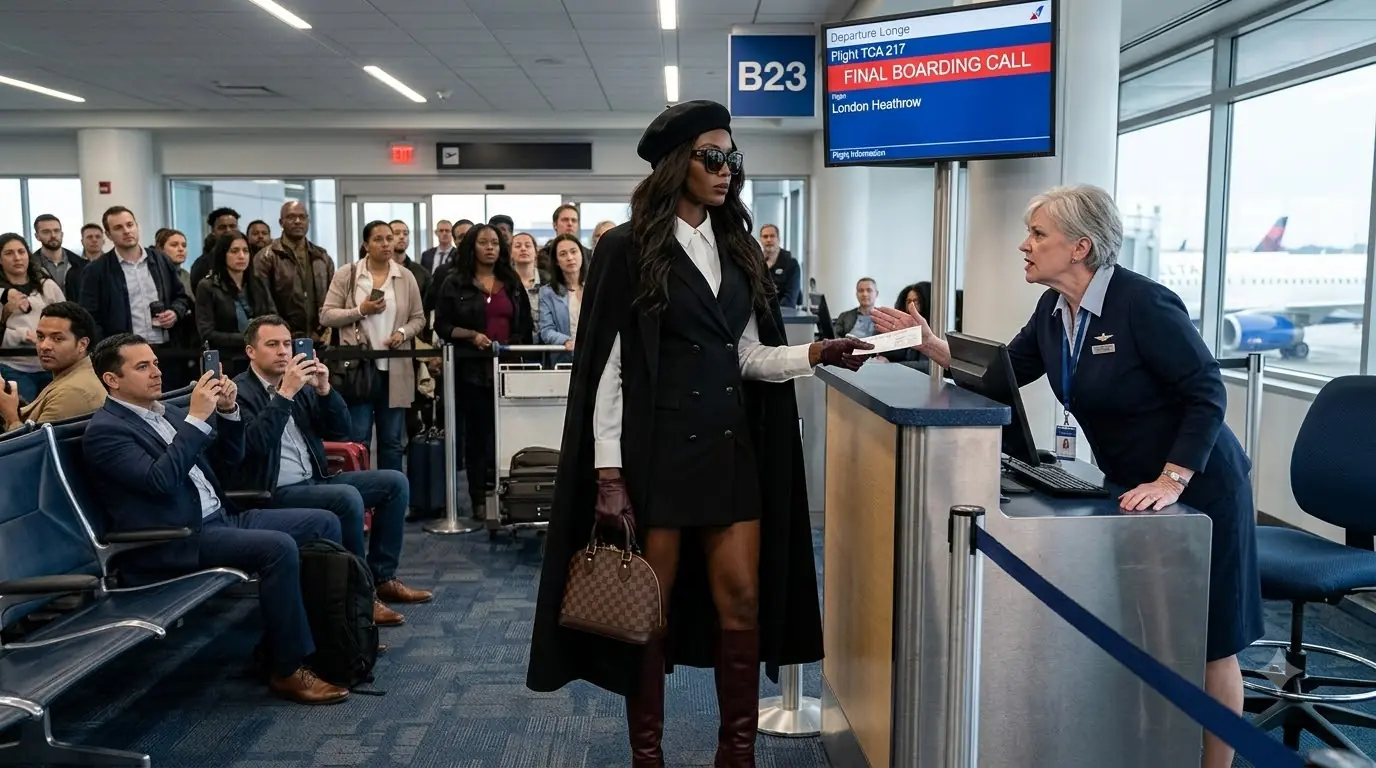
That was why Nia was alone.
No assistant.
No driver waiting inside the terminal.
No legal counsel following two steps behind.
No vice presidents.
Only one brown checkered handbag, one black cape draped over her shoulders, one first-class boarding pass, and a phone containing documents that had changed the future of TransContinental Atlantic Airlines less than five hours earlier.
At 2:14 a.m. Eastern Time, Laurent Meridian Group had completed the final transfer.
Sixty-four percent controlling interest.
$6.8 billion transaction value.
Board authority effective immediately.
Public announcement scheduled for 10:30 a.m.
Until then, only a small group of people knew.
The outgoing chairman.
General counsel.
Bankers.
Regulators.
Four directors.
Nia.
Nobody at Gate B23.
That was intentional.
Nia wanted three hours before the announcement.
Three ordinary hours.
She had bought airlines before.
Not entire carriers, but regional operators, cargo companies, maintenance businesses, aviation technology firms. TransContinental Atlantic was different. It had once been respected, even admired, but years of cost cutting, inconsistent leadership, aging internal systems, and a strange obsession with premium-image branding had left the company profitable enough to survive but unhealthy enough to decay quietly.
Employee turnover was climbing.
Complaint rates were rising.
On-time performance was mediocre.
Premium revenue remained strong.
The board kept focusing on that last line.
Nia had spent six months reviewing the company from the outside.
Now she wanted to see it from inside.
She entered Terminal 4 at John F. Kennedy International Airport shortly after six.
People noticed her.
They often did.
At thirty-four, Nia carried herself with the confidence of someone accustomed to entering rooms where everyone else expected her to ask permission. Her long black hair fell beneath a black beret, dark sunglasses covered her eyes, and a tailored black double-breasted mini dress sat over a crisp white collared blouse. A long black cape-style coat flowed behind her as she walked, while dark burgundy knee-high boots struck the polished terminal floor in measured steps.
She looked wealthy.
Because she was.
But she did not look like the kind of wealthy person Marianne Holt respected.
That distinction would matter.
Nia passed through security normally.
Nobody recognized her.
She bought coffee.
Watched a father struggle with two sleepy children.
Watched an elderly couple argue quietly about whether Gate B23 was left or right.
Watched a TCA employee walk past a trash pile without stopping.
She made mental notes.
At 6:48, she arrived at the gate.
The large display read:
FINAL BOARDING CALL
FLIGHT TCA 217
NEW YORK TO LONDON HEATHROW
GATE B23
STATUS: BOARDING
The aircraft visible through the glass was a Boeing 777-300ER.
Nia paused.
She had spent eighteen months negotiating the acquisition, but seeing the airline’s blue-and-copper tail through an airport window felt different.
Ownership on paper was abstract.
That aircraft was not.
Three hundred fourteen passengers.
Seventeen crew.
Maintenance teams.
Catering staff.
Dispatchers.
Baggage workers.
People whose livelihoods now connected in some way to decisions she would make.
Nia looked at the boarding pass on her phone.
Laurent, Nia.
Seat 2A.
Group 1.
She had purchased the ticket through a normal retail booking using her real name.
The name meant little publicly.
Laurent Meridian Group was widely known in financial circles, but Nia had deliberately avoided celebrity CEO culture. She rarely attended entertainment events, gave few television interviews, and allowed corporate communications to use company branding more often than her face.
That anonymity had once annoyed investors.
Today she considered it useful.
First class had mostly boarded.
Nia approached the counter.
A younger gate agent named Olivia Chen looked up.
“Good morning.”
“Morning.”
“London?”
“Yes.”
Nia handed over her passport and displayed the boarding code.
Olivia scanned it.
The machine beeped.
Not the normal green confirmation.
A yellow message appeared.
Olivia frowned.
“One moment.”
Nia waited.
Olivia scanned again.
Same tone.
“What’s wrong?”
“Probably nothing.”
Olivia typed.
Then looked toward the supervisor standing several feet away.
“Marianne?”
The supervisor turned.
Marianne Holt, fifty-seven, had worked for TransContinental Atlantic for twenty-four years. Her navy uniform was immaculate. Gold scarf tied precisely. Hair pinned into a conservative twist. Reading glasses hanging from a chain.
She approached.
“What?”
Olivia lowered her voice.
“Seat 2A is showing a manual verification hold.”
Marianne looked at Nia.
Not the screen.
Nia.
The inspection lasted perhaps two seconds.
Long enough.
“What kind?”
“Corporate allocation conflict.”
Marianne reached for the passport.
Nia handed it over.
Marianne looked at the name.
“Nia Laurent.”
“Yes.”
“Who booked this?”
“I did.”
Marianne glanced at the first-class designation.
“How?”
Nia paused.
“With a credit card.”
Olivia looked down.
Marianne’s mouth tightened.
“I mean through what channel?”
“Your website.”
“Directly?”
“Yes.”
Marianne typed.
Nia watched.
The problem was real, but simple.
Seat 2A had originally been blocked for executive travel because several senior leaders were expected on Flight 217 after a New York strategy retreat. The seat had been released overnight when one executive canceled. Nia booked it after release.
Corporate systems, however, still showed an old note requiring verification if the seat was reassigned within twelve hours of departure.
Not Nia’s fault.
Not fraud.
Not complicated.
Olivia saw it.
“Looks like the seat was properly released at 1:06 a.m.”
Marianne kept typing.
Olivia continued.
“The ticket is confirmed.”
Marianne looked irritated.
“Let me handle it.”
Olivia stepped back.
Nia noticed.
A small moment.
But interesting.
Marianne examined the passport again.
“Do you have another form of identification?”
“Yes.”
“Government issued?”
“Yes.”
Nia handed over a driver’s license.
Marianne compared both.
Then the boarding pass.
“This ticket was purchased less than six hours ago.”
“Yes.”
“First class.”
“Yes.”
“International.”
“Yes.”
Marianne’s eyes moved over Nia’s clothes.
“What exactly do you do, Ms. Laurent?”
Nia tilted her head.
“What does my occupation have to do with boarding?”
“I’m verifying the reservation.”
“Does verification require employment history?”
Marianne’s expression hardened.
“No need for attitude.”
Nia lowered her sunglasses slightly.
“I asked a question.”
A few passengers nearby began watching.
Olivia looked increasingly uncomfortable.
Marianne typed again.
“Your reservation does not contain a corporate traveler number.”
“Because I did not book as a corporate traveler.”
“This seat was held for corporate use.”
“And released.”
Marianne looked at Olivia.
Olivia nodded reluctantly.
“It was released.”
Marianne ignored her.
Nia glanced at the clock.
Boarding closure in twelve minutes.
“Is the ticket valid?”
Marianne hesitated.
“Yes, but—”
“Is my passport valid?”
“Yes.”
“Is there a security hold?”
“No.”
“Payment issue?”
“No.”
“Then scan the pass.”
Marianne stared at her.
“You don’t dictate procedure at my gate.”
Nia smiled faintly.
“Your gate?”
Marianne misread the smile as sarcasm.
“Yes.”
“I’m responsible for this departure.”
“Then perhaps departing passengers should be your priority.”
People heard that.
A businessman behind Nia looked up from his phone.
Marianne flushed.
“Step aside.”
“No.”
“You’re delaying boarding.”
Nia looked around.
There was no one waiting behind her.
Group boarding was nearly complete.
“I’m the only passenger at the counter.”
“Step aside while we resolve this.”
“What remains unresolved?”
Marianne did not answer.
She looked again at the screen.
Then at Nia’s handbag.
Boots.
Cape.
Beret.
Sunglasses.
The expression on her face shifted into something Nia knew immediately.
Suspicion without evidence.
Nia had seen it in luxury stores.
Hotel lobbies.
Private clubs.
Boardrooms.
Not always racial in the crude, obvious sense.
Something subtler.
A calculation about who looked as if they naturally belonged in expensive spaces and who looked as though they might need to explain their presence.
Marianne leaned toward Olivia.
“Run the payment card again.”
Olivia frowned.
“It cleared.”
“Run it.”
Nia’s voice became colder.
“No.”
Marianne looked up.
“Excuse me?”
“You have confirmation that payment cleared.”