Sunday morning in Woodhaven Crest, Maryland, was supposed to be quiet enough to hear sprinklers ticking under the lawns.
The neighborhood sat behind stone entrance pillars and clipped hedges, the kind of place where every driveway curved like it had been drawn by an architect and every mailbox looked more expensive than most apartment doors. The houses were set far back from the street, half-hidden behind oak trees, iron gates, and flower beds maintained with the kind of care only money could afford. At 7:42 a.m., nothing moved except mist rising off the grass and the slow silver arc of water from a garden hose.
Malcolm Reeves liked that hour.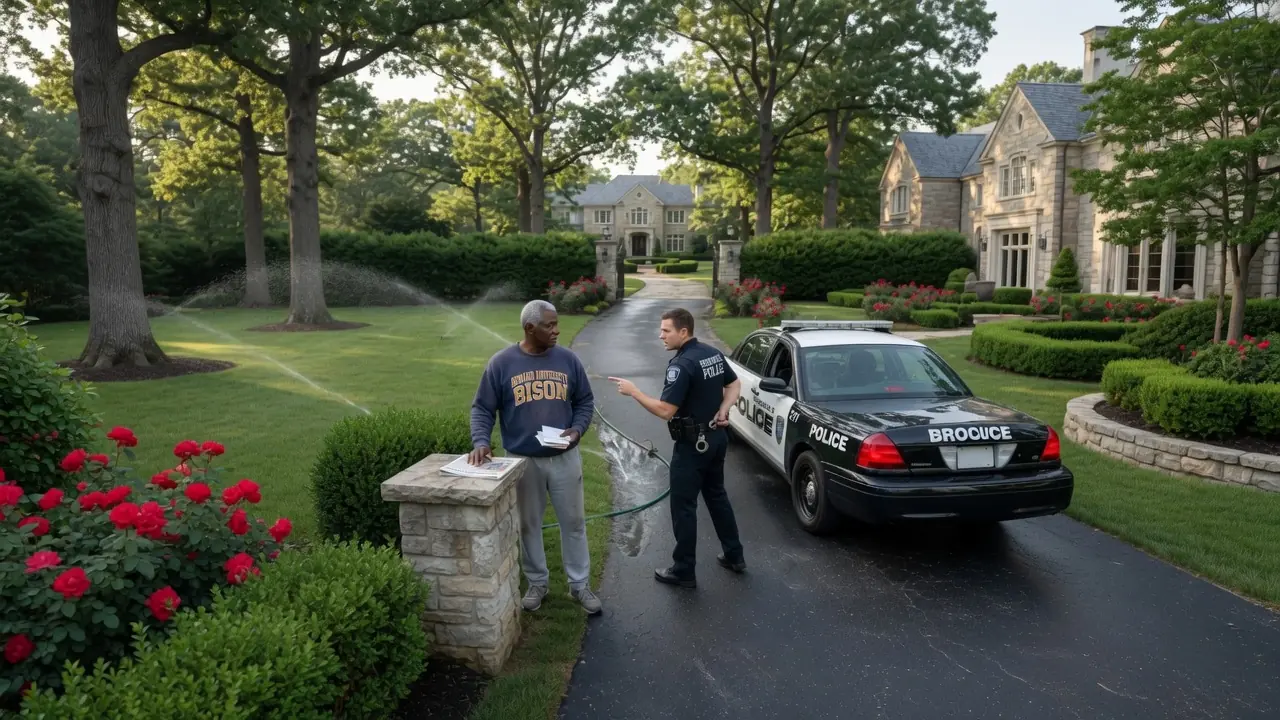
For six days a week, his life belonged to crisis rooms, encrypted briefings, congressional oversight committees, and phone calls that began with the words, “Sir, we have a problem.” But Sunday morning gave him a narrow piece of himself back. Before the secure phone started buzzing, before the motorcade detail remembered he preferred quiet over protocol, Malcolm could stand in old sweatpants, worn sneakers, and a faded Howard University sweatshirt, watering the roses his late wife had planted along the front walk.
At sixty-one, he still looked like the kind of man who could fill a doorway without trying.
He was tall, Black, broad through the shoulders, with close-cut silver hair and a face that had learned long ago not to give away more than necessary. He carried himself with the easy balance of a former field agent, even while holding a green garden hose in one hand and the Sunday newspaper under the other arm. To anyone who knew him, he was Director Malcolm Reeves of the Federal Bureau of Investigation, one of the most powerful law enforcement officials in the country.
To Officer Travis Keene, crawling past in a Brookvale patrol cruiser, he looked like trouble.
Keene tapped the brake before he even understood why. He was twenty-nine, restless, and convinced the world owed him a faster climb than patrol duty could provide. Around the station, older cops called him ambitious when they were being polite and reckless when they were being honest. He had a habit of turning quiet calls into confrontations and confrontations into reports that made him sound braver than he was.
In the passenger seat, Officer Neil Porter leaned back with a coffee balanced against his stomach.
Neil had been on the force almost nineteen years, long enough to know that Woodhaven Crest did not need heroics before breakfast. “Keep driving,” he muttered, already reading the younger man’s posture. “That’s probably the homeowner.”
Keene stared through the windshield. “Homeowner?”
“The Reeves place,” Neil said. “Some federal big shot owns that house. I don’t know his face, but I know the address.”
Keene’s mouth curled.
At the end of the long driveway, Malcolm had shut off the hose and was walking toward the oversized limestone mailbox. He opened it, pulled out a stack of envelopes, and tucked them under the newspaper. He did not look rushed. He did not look nervous. He looked like a man collecting mail outside his own home.
Keene saw something else.
He saw a Black man in old clothes standing in front of a mansion no ordinary person could afford, and his mind filled in the blanks before facts had a chance to enter. “That does not look right,” he said.
Neil sighed. “Nothing is happening.”
“That’s how people miss things,” Keene replied, throwing the cruiser into park. “You get lazy because the lawns look nice.”
Before Neil could stop him, Keene stepped out of the cruiser and started up the driveway with one hand resting on his belt. His boots struck the concrete too loudly for the peaceful street, each step announcing authority before he had earned the right to use it. Malcolm heard him coming and turned with the calm courtesy of a neighbor greeting a delivery driver.
“Good morning, Officer,” Malcolm said.
Keene stopped ten feet away. “Step away from the mailbox.”
Malcolm’s expression changed only slightly. The polite softness left his eyes, replaced by the stillness of a man who had spent decades reading danger in small movements. He took one step back, not because he was afraid, but because he understood procedure better than the man misusing it.
“This is my mailbox,” Malcolm said evenly. “I live here.”
Keene gave a short laugh without humor. “Sure you do.”
Neil had stepped out of the cruiser now, walking slower, already uneasy. “Travis,” he called, “take a breath.”
Keene ignored him. “Do you have identification?”
“My wallet is inside,” Malcolm said. “I stepped out to water my plants and get the paper.”
“Convenient.”
“Not convenient,” Malcolm replied. “Ordinary.”
The word seemed to irritate Keene more than an argument would have. He moved closer, chin lifted, chest forward, trying to make up with volume what he lacked in judgment. “Whose house is this?”
“Mine,” Malcolm said.
“Name?”
“Malcolm Reeves.”
Keene’s eyes narrowed. “You expect me to believe you own this property?”
Malcolm looked at him for a long second.
“Officer,” Malcolm said quietly, “I strongly suggest you run the address before you take another step.”
Keene’s face hardened. “Do not tell me how to do my job.”
“I am trying to prevent you from ending your career before eight in the morning.”
Neil stopped halfway up the driveway. “Travis, maybe we should check the address.”
Keene spun on him. “I have it under control.”
Malcolm set the newspaper on top of the mailbox and kept his hands visible. His posture remained relaxed, but there was something in his calm that made Neil’s stomach twist. Most people confronted by police protested. Some pleaded. Some got angry. Malcolm Reeves simply observed.
Keene read that calm as disrespect.
“Turn around,” he barked.
Malcolm did not move. “On what charge?”
“Failure to identify and suspected trespassing.”
“I have identified myself,” Malcolm said. “And you have made no effort to verify it.”
Keene grabbed Malcolm’s wrist and wrenched it behind his back.
For one sharp second, Malcolm’s body reacted before his mind did. Old training tightened his shoulders, shifted his weight, and prepared a counter that would have put Keene on the driveway in less than a heartbeat. Then discipline took over. Malcolm let the motion happen, his jaw tight, his breath controlled.
Neil hurried forward. “Travis, he’s not resisting.”
“He is refusing lawful orders,” Keene snapped, pulling out his cuffs.
The metal closed around Malcolm’s wrists with a hard click. Too tight. The edge bit into skin, and Malcolm felt the dull pressure settle over bone.
He turned his head slightly. “Officer Keene, I will not resist you. I will say this once. Remove these cuffs, call dispatch, and we may still treat this as poor judgment instead of a federal crisis.”
Keene shoved him toward the cruiser. “Save the speech.”
Neil looked sick.
Malcolm did not look back at his house as he was pushed into the rear seat. He noticed the camera angle, the time on the cruiser display, the street number visible through the windshield. Details mattered. Men like Keene survived on chaos, but Malcolm Reeves had built a career on turning chaos into evidence.
The cruiser pulled away from Woodhaven Crest with the director of the FBI handcuffed in the back seat.
Keene was glowing with satisfaction by the time they reached the main road. He drove with one hand on the wheel, glancing in the rearview mirror like a hunter admiring a catch. “This is what proactive policing looks like,” he said. “Guy’s standing at a rich house with no ID and a story about owning the place.”
Neil stared out the passenger window. “You still haven’t called it in.”
“I don’t need to.”
“You should.”
Keene scoffed. “You always want to make everything complicated.”
In the back seat, Malcolm sat upright despite the hard plastic forcing his shoulders forward. The cuffs pressed deeper each time the cruiser turned. He closed his eyes, not to rest, but to think. He needed a controlled environment, a recorded phone call, and the right people notified before Keene realized who he had put in the back of a patrol car.
If Malcolm revealed himself now, panic could make the younger officer more dangerous.
So he waited.
Brookvale Police Department sat behind a municipal courthouse and a row of exhausted-looking maples. It was a low brick building from another era, with narrow windows, a flagpole, and a parking lot full of cruisers whose paint had begun to dull. Keene pulled into the rear entrance like he was bringing in a trophy.
He opened the back door and grabbed Malcolm by the arm. “Out.”
Malcolm stepped out without stumbling.
That seemed to bother Keene too.
Inside, the booking area smelled of burnt coffee, floor cleaner, and old paperwork. Two officers looked up from their desks, then went back to typing. Behind the counter, Sergeant Wallace Grady sat with a breakfast sandwich half-wrapped beside his keyboard.
Keene pushed Malcolm toward the desk. “Caught him casing a house in Woodhaven Crest. Refused ID. Claimed he owned the property.”
Grady looked Malcolm over.
Old sweats. Worn sneakers. Georgetown-gray hair. Calm face.
“No wallet?” Grady asked.
“My wallet is inside my home,” Malcolm said. “Your officer handcuffed me before verifying the address.”
Keene laughed. “He’s got a whole routine, Sarge.”
Grady chewed slowly, but his eyes lingered on Malcolm longer than Keene’s had. There was something wrong with the picture. Not because Malcolm looked rich or poor, guilty or innocent, but because no fear moved behind his eyes. The man looked annoyed, disappointed, and entirely in control of a room that had just locked him inside.
“Take the cuffs off,” Grady said.
Keene blinked. “Sarge—”
“Take them off.”
Keene did it, muttering under his breath. Malcolm brought his hands forward and rubbed his wrists, letting the red marks face the booking camera. He then reached into his pocket and placed a single brass house key on the counter.
“That is all I carried outside,” he said.
Keene smirked. “No phone, no wallet. Exactly.”
“A man watering roses does not require a wallet,” Malcolm replied.
A few officers stopped typing.
Malcolm looked at Grady. “Sergeant, I am requesting my phone call. I am also advising you to preserve all body-camera, dash-camera, lobby-camera, and holding-cell footage connected to this detention.”
Grady’s chewing stopped.
Keene rolled his eyes. “Now he thinks he’s a lawyer.”
“No,” Malcolm said. “I think you are in trouble.”
Grady slowly pushed the desk phone toward him. “Dial nine first.”
Malcolm picked up the receiver with steady fingers.
He did not hesitate over the number. He dialed a secure direct line from memory, one known by fewer people than could fit around a small conference table. It rang twice.
“Walsh,” a woman answered sharply.
“Eleanor,” Malcolm said. “It’s Reeves.”
Silence.
Then the woman’s voice changed completely. “Director, you are on an unsecured line.”
“I am aware.”
“Are you safe?”
“I have been unlawfully detained by Brookvale Police Department in Maryland. I am at their station now.”
The silence that followed was not empty. It was the sound of a government machine waking up.
“Are you injured?” Deputy Director Eleanor Walsh asked.
“Minor wrist abrasions. Nothing more.”
“Who did this?”
“A patrol officer named Travis Keene. Aggressive, unstable, racially motivated detention. No probable cause. No verification. Excessive force. I need the Washington field office, legal counsel, civil rights, and tactical support on site immediately.”
“Yes, sir.”
“And Eleanor?”
“Yes, Director?”
“Do not arrive quietly.”
He hung up and returned the phone.
Keene’s smirk had faded just a little. “Who was that supposed to scare?”
Malcolm looked at him. “You.”
Keene shoved him into holding cell three seven minutes later.
The cell was concrete, metal, and stale air. A narrow bench ran along the wall. The bars closed with an ugly clang that filled the corridor.
Keene locked the door and leaned close. “You can stop acting important now.”
Malcolm looked at the bench, then at the officer. “Do you have savings, Officer Keene?”
Keene frowned. “What?”
“Retirement savings. A pension. Anything you planned to rely on later.”
Keene’s face flushed. “Are you threatening me?”
“No,” Malcolm said. “I am giving you practical advice. Life changes quickly when federal charges arrive.”
For the first time, uncertainty flickered across Keene’s face.
Malcolm sat on the bench, folded his hands, and dismissed him with silence.
Back at the booking counter, Sergeant Grady was no longer eating. The name Malcolm Reeves had begun to bother him. He typed the Woodhaven Crest address into the county property database, and the owner field appeared instantly.
Malcolm E. Reeves.
Paid in full.
Assessed value: $7.4 million.
Grady swallowed.
Then he searched the name in the national system. The screen flashed a restricted-access warning before locking him out.
Federal clearance required.
Contact Department of Justice secure channel.
Grady’s fingers went cold. He opened a browser, typed Malcolm Reeves FBI, and pressed enter.
The first result was an official government biography.
The photograph loaded slowly, line by line, until the face became impossible to deny. Same silver hair. Same heavy brow. Same calm, controlled stare.
Director of the Federal Bureau of Investigation.
Grady stood so fast his chair rolled backward and hit the wall.
Keene walked in from the holding corridor. “He’s making crazy threats back there. I’m adding intimidation of an officer.”
Grady turned toward him with a face drained of color. “Travis.”
“What?”
“What did you do?”
Keene frowned. “I brought in a suspect.”
“You brought in the director of the FBI.”
The room went still.
Neil Porter, standing by the vending machine, closed his eyes and whispered, “Dear God.”
Keene laughed once, weakly. “No. No, that’s not possible.”
Grady spun the monitor toward him. “Look at the screen.”
Keene leaned forward.
He read the name.
He read the title.
The arrogance drained from him so quickly it left something childish and terrified behind. “He was wearing sweatpants,” he whispered.
Neil turned on him. “That’s your defense?”
“I didn’t know.”
“You didn’t check,” Neil snapped. “That is not the same thing.”
Keene grabbed for his keys. “I’ll let him out. I’ll apologize. We’ll call it a misunderstanding.”
Grady’s eyes moved toward the front windows.
“No,” he said softly. “It’s too late.”
At first, it was only a vibration beneath the floor.
Then came the low growl of engines, deep and synchronized, not like patrol cars and not like ambulances. The sound grew until the windows trembled and the framed commendations behind the front desk rattled against the wall. Sunlight vanished from the lobby as black SUVs pulled across the front entrance in a tight line.
Neil rushed to the window and stopped dead.
Outside, Brookvale Police Department had become a federal operation in under three minutes. Unmarked Suburbans blocked the street from both directions. Two armored vehicles idled at the curb, dark and heavy, their tires crushing the grass near the sidewalk. Agents in tactical gear moved with silent precision, weapons low but ready, letters spelling FBI across their vests.
A voice boomed through a loudspeaker. “Brookvale Police Department, this is the Federal Bureau of Investigation. Keep your hands visible. Do not draw weapons. Do not approach the exits.”
Keene began breathing too fast.
Grady pointed at him. “Hands on the desk. Now.”
The front doors opened, and the room filled with federal agents.
They moved like one body with many eyes. Two secured the hallway. Two moved toward the armory. Others covered the officers, not shouting unless they had to, which made it worse. They did not look surprised or confused. They looked prepared to end anything that moved wrong.
Deputy Director Eleanor Walsh entered behind them in a dark suit and tactical vest.
Her face was controlled, but her eyes were furious. Beside her walked Special Agent Marcus Bellamy, commander of the Washington field office, jaw set like stone. Walsh walked straight to the booking counter and placed both hands on it.
“I am Deputy Director Eleanor Walsh of the Federal Bureau of Investigation,” she said. “You are holding Director Malcolm Reeves. Where is he?”
Grady pointed down the hall. “Holding cell three. He is unharmed.”
Bellamy snatched the key ring from the counter before Grady finished the sentence.
Walsh, Bellamy, and four agents moved down the corridor. They found Malcolm exactly where Keene had left him, seated on the bench, calm as a man waiting for a delayed train.
Bellamy unlocked the cell. “Director.”
Malcolm stood and smoothed his sweatshirt. “Marcus.”
“Are you hurt?”
“Not seriously.”
Walsh looked at the marks on his wrists and her expression sharpened. “Sir, the building is secured.”
“Good,” Malcolm said. “Then let us go educate the room.”
When he walked back into the booking area, every local officer seemed to shrink.
Keene stood near the desk with his hands visible, his duty belt already removed by an agent. Without his weapon, without the swagger, without the badge centered over his chest, he looked painfully young and painfully small. Malcolm stopped in front of him, close enough that Keene had to look up.
“Director,” Keene stammered. “I did not know.”
Malcolm’s voice stayed soft. “That is exactly the problem.”
Keene’s mouth opened, but nothing came out.
“You did not know who I was. You did not know whether I lived there. You did not know whether a crime had occurred. You did not know because you did not investigate.”
The room was silent except for radio chatter from the agents outside.
Malcolm stepped closer. “You saw a Black man in old clothes at an expensive house, and you let prejudice do the work your badge required you to do. That is not policing. That is intimidation dressed in a uniform.”
Keene’s eyes filled with tears.
Malcolm did not soften.
“You thought the law belonged to you because you carried it on your belt,” he said. “It does not. The law belongs to the public, and it applies to you first.”
He turned toward Walsh. “Call the Department of Justice Civil Rights Division. I want a full audit of Officer Keene’s stops, arrests, reports, and property seizures for the last five years. Include supervisory approvals.”
Walsh nodded. “Already in motion.”
Malcolm looked back at Keene. “You came looking for a criminal this morning. You may have found one.”
By noon, news helicopters circled over Brookvale.
By one, Chief Raymond Holloway was sprinting from his car two blocks away because federal vehicles had sealed off his own station. Holloway was a careful political animal, the kind of police chief who knew every city council member’s birthday and every wealthy donor’s favorite charity. He had built a career on keeping scandals small.
This one was already national.
He pushed through the perimeter, sweating through his golf shirt, because the mayor had called him screaming so loudly that Holloway could barely understand the words. FBI director. Handcuffs. Cell. Civil rights. Federal raid.
Inside the station, Deputy Director Walsh was speaking to DOJ counsel near the front desk. Agent Bellamy stood over Sergeant Grady, who looked like a man watching his pension dissolve in real time. Keene sat in a plastic chair, stripped of badge and weapon, his hands shaking between his knees.
Holloway stopped in the doorway.
“What happened?”
Walsh turned slowly. “Your officer arrested the director of the FBI outside his own home while he was checking his mail.”
Holloway’s face collapsed.
“He claimed the director fit the profile of a burglar,” Bellamy said. “He did not run the address. He did not verify the name. He used force without probable cause.”
“He was in old clothes,” Keene muttered, desperate and foolish.
Everyone turned toward him.
Holloway looked as if he might physically strike him. “Stop talking.”
Walsh stepped forward. “Officer Travis Keene, you are being placed under federal arrest pending charges under deprivation of rights under color of law. Additional charges may follow after review.”
Keene’s head jerked up. “Arrest? No. I’m a police officer.”
“Not today,” Bellamy said.
Two agents moved in.
The irony landed with brutal force. In the same room where Keene had pushed Malcolm Reeves toward a booking desk, federal agents turned Keene around and locked handcuffs around his wrists. He gasped when the metal clicked shut, as if the sound belonged only to other people.
“Please,” he said, looking at Holloway. “Chief, tell them this is a mistake.”
Holloway looked away.
Bellamy pointed down the hallway. “Put him in cell three.”
Keene began crying before they reached the door.
Seventy-two hours later, Brookvale Police Department no longer looked like a station.
It looked like a crime scene wearing a badge.
Federal laptops covered the conference tables. Evidence boxes lined the hallway. DOJ investigators moved through file cabinets with quiet efficiency, pulling arrest reports, body-cam logs, forfeiture records, complaint forms, and internal reviews that had been ignored until they became useful to the wrong side.
The lead investigator was Special Counsel Angela Cross.
She was not loud. She did not threaten. She did not need to. Angela Cross dismantled corrupt systems the way surgeons removed tumors, calmly, precisely, and without asking the tumor how it felt.
Officer Neil Porter sat across from her in an interview room, looking twenty years older.
“You rode with Officer Keene for nearly four months,” Cross said. “How often did he stop minority drivers in high-value neighborhoods?”
Neil swallowed. “Often.”
“Define often.”
“Almost every shift.”
Cross slid a folder across the table. “And how often did those stops involve cash seizures?”
Neil stared at the folder and rubbed both hands over his face.
“He had a routine,” he said quietly. “He’d pull somebody over for something small. A lane change, a brake light, a rolling stop. Then he’d say he smelled marijuana or saw suspicious movement. That gave him a search.”
“And if he found cash?”
“He claimed it was drug money.”
“Even without drugs?”
Neil looked at the two-way mirror. “Yes.”
Cross opened another folder. “Property logs show $312,000 seized during Keene-related stops over four years. The department account received $58,400.”
Neil stared at her.
“The rest is missing,” Cross said.
Neil whispered, “I didn’t know it was that much.”
Cross leaned forward. “What did you know?”
Neil’s eyes filled with shame. “I knew people complained. I knew the reports looked too clean. I knew Sergeant Grady signed whatever Travis handed him because the numbers made the unit look productive.”
“And you stayed quiet.”
Neil nodded once, broken. “Yes.”
The bad arrest of Malcolm Reeves had not exposed one reckless officer.
It had opened a wall and shown rot behind it.
Investigators found cash hidden in Keene’s garage, tucked inside paint cans and sealed behind loose insulation. They found accounts under his brother-in-law’s name. They found messages joking about “soft targets” and “easy money stops.” They found fourteen victims willing to testify and twenty-six more whose cases were still being reviewed.
Keene had not mistaken Malcolm Reeves for a burglar.
He had mistaken him for someone powerless.
That was his real mistake.
At the federal detention center in Alexandria, Travis Keene sat in an interview room wearing an orange jumpsuit that seemed to swallow him whole. His face had lost its color. His eyes had sunk into dark hollows. Without the uniform, he looked less like a hard man and more like a frightened one who had spent years borrowing courage from a badge.
Angela Cross entered with a stack of papers and sat across from him.
“My attorney said we could discuss a plea,” Keene said quickly. “I’ll resign. I’ll never work in law enforcement again. I made a bad stop. I admit that.”
Cross placed the papers on the table. “The unlawful arrest of Director Reeves is no longer your largest problem.”
Keene blinked. “What?”
“We audited your seizure records.”
His breathing changed.
“We found the cash in your garage. We found the transfers. We found messages between you and Sergeant Grady discussing which stops would be ‘worth the trouble.’ We have victims who describe the same pattern over and over again.”
Keene stared at the table.
Cross continued. “You used the authority of the state to detain innocent people, threaten them with fabricated charges, steal their money, and bury the complaints.”
“No,” Keene whispered.
“Yes.”
“I was doing proactive policing.”
“You were operating an extortion scheme from a patrol car.”
His mouth opened, but only air came out.
Cross stood. “The government is adding charges for extortion under color of official right, theft, wire fraud, obstruction, and racketeering conspiracy. The civil rights charge involving Director Reeves is now only the beginning.”
“Racketeering?” Keene said, voice cracking. “That’s for organized crime.”
Cross looked at him without pity. “You organized crime with a badge.”
He began to cry then, quietly at first, then with his whole body.
Cross gathered her folders. “Director Reeves asked that you be treated exactly as the law requires. No more, no less. That is more mercy than you showed anyone.”
The door opened behind her.
Before she stepped out, she looked back. “You wanted a big arrest, Officer Keene. You finally got one.”
Six months later, the federal courthouse in Washington, D.C., was surrounded by cameras.
Former Officer Travis Keene had become a national example of what happens when arrogance, prejudice, and unchecked authority are finally forced into daylight. Reporters filled the steps. Former victims stood in small groups outside, some holding hands, some silent, some staring at the building like it had taken years just to reach the door.
Inside the courtroom, Keene sat beside his public defender in a gray suit that hung off him badly.
He looked nothing like the officer who had marched up Malcolm Reeves’s driveway. His shoulders had collapsed inward. His eyes darted toward the jury, then the judge, then the exit, as if some forgotten door might open for him.
It did not.
Prosecutor Lena Hart called witness after witness.
A nurse who lost $3,200 she had saved for her son’s braces. A contractor who was threatened with felony drug charges because he carried cash payroll for his crew. A retired teacher who cried on the stand because Keene had made her feel like a criminal on the side of the road while cars slowed to watch.
Their stories sounded different in details, but identical in structure.
A stop. A search. A threat. Cash gone. Complaint ignored.
Then Malcolm Reeves entered the courtroom.
He wore a charcoal suit and a navy tie, walking with the same calm he had carried in sweatpants that Sunday morning. The room changed when he entered. Even the reporters in the back stopped shifting in their seats.
He took the oath and sat down.
Prosecutor Hart approached. “Director Reeves, please tell the court what happened on the morning of April 14.”
Malcolm told it without drama.
That made it worse.
He described the mailbox, the garden hose, the refusal to verify his identity, the handcuffs, the ride to the station, the call to Deputy Director Walsh. He did not exaggerate. He did not soften. Each fact landed cleanly, with the kind of force that does not need volume.
“Did Officer Keene ever run the address before detaining you?” Hart asked.
“No.”
“Did he ask dispatch to confirm your identity?”
“No.”
“Did he have probable cause to believe you had committed a crime?”
“No.”
Hart paused. “In your professional opinion, what drove the encounter?”
Malcolm looked toward the jury.
“Assumption,” he said. “The defendant saw a Black man in casual clothing outside an affluent home and decided the situation was criminal before he gathered a single fact. That assumption became force. That force became unlawful detention. And because no one in his chain of command stopped him, it became a pattern.”
Keene stared down at the table.
The defense declined to cross-examine.
Three hours later, the jury returned.
Guilty on deprivation of rights under color of law.
Guilty on extortion.
Guilty on wire fraud.
Guilty on obstruction.
Guilty on racketeering conspiracy.
Keene folded forward, covering his face with both hands.
Judge Miriam Calder looked down from the bench with no trace of sympathy. “Mr. Keene, you were given authority to protect the public. Instead, you used that authority to hunt for vulnerability. You mistook fear for guilt, silence for consent, and a badge for ownership of the law.”
The courtroom was perfectly still.
“You targeted the wrong man only because you never believed there could be consequences. In doing so, you exposed the harm you had inflicted on people who lacked power, money, or national attention. This court cannot undo what you did to them, but it can make clear that your uniform was never a license to steal, threaten, or degrade.”
She lifted the sentencing order.
“It is the judgment of this court that you serve forty-eight years in federal prison.”
Keene made a sound like the air had been knocked out of him.
Marshals moved in and pulled him to his feet. As they secured the restraints around his wrists and waist, he looked back once toward the gallery. Malcolm Reeves sat in the front row, expression unreadable. Not triumphant. Not cruel. Just present.
That was enough.
Two weeks later, Sunday morning returned to Woodhaven Crest.
The sprinklers ticked under the grass. Sunlight moved slowly across stone driveways and polished mailboxes. Somewhere behind a hedge, a dog barked once and then gave up.
Malcolm Reeves stood at the end of his driveway in the same faded Howard sweatshirt and old sneakers.
He held the green hose again, watering the roses his wife had loved. The leaves had filled out since April, darker and stronger, and the blooms were beginning to open in deep red clusters along the walk.
A Brookvale patrol cruiser rolled slowly down the street.
It stopped near the curb.
The officer behind the wheel was young, Black, and new to the reformed department. She lowered the window and gave a respectful nod.
“Good morning, Director Reeves.”
Malcolm smiled faintly. “Good morning, Officer.”
“Beautiful roses,” she said.
“My wife would be pleased to hear that.”
The officer smiled, then drove on.
Malcolm watched the cruiser disappear around the bend.
The neighborhood was quiet again, but not in the same way. The silence no longer felt like avoidance. It felt like something had been broken open and rebuilt with better bones.
He turned back to the roses, letting the water fall gently over the soil.
Travis Keene had walked up that driveway looking for someone powerless. He found a man who knew the law better than he feared the badge. He had wanted one arrest to make his career, but the arrest he made exposed every crime he thought would stay buried forever.
A badge can command attention.
It can open doors.
It can frighten people who have learned what power can do when no one is watching.
But it cannot protect a man from the truth once the truth starts moving.
And on that quiet Maryland morning, Malcolm Reeves knew one thing with absolute certainty.
Accountability had finally pulled into Woodhaven Crest, and this time, it did not drive past.