At 11:43 on a Friday morning, Officer Brett Lawson slapped his open palm against the folding table beside a tray of smoked ribs and said the number for the third time.
“Five hundred.”
Marcus Grant did not move.
The barbecue stand sat between a barber shop and a boarded furniture warehouse on Mercer Avenue in Riverton, Georgia, where lunchtime traffic was already beginning to build. Cars rolled slowly past the curb, smoke drifted from the black offset smoker behind Marcus, and customers waited near the corner while pretending they could not hear the uniformed officer leaning over the serving table.
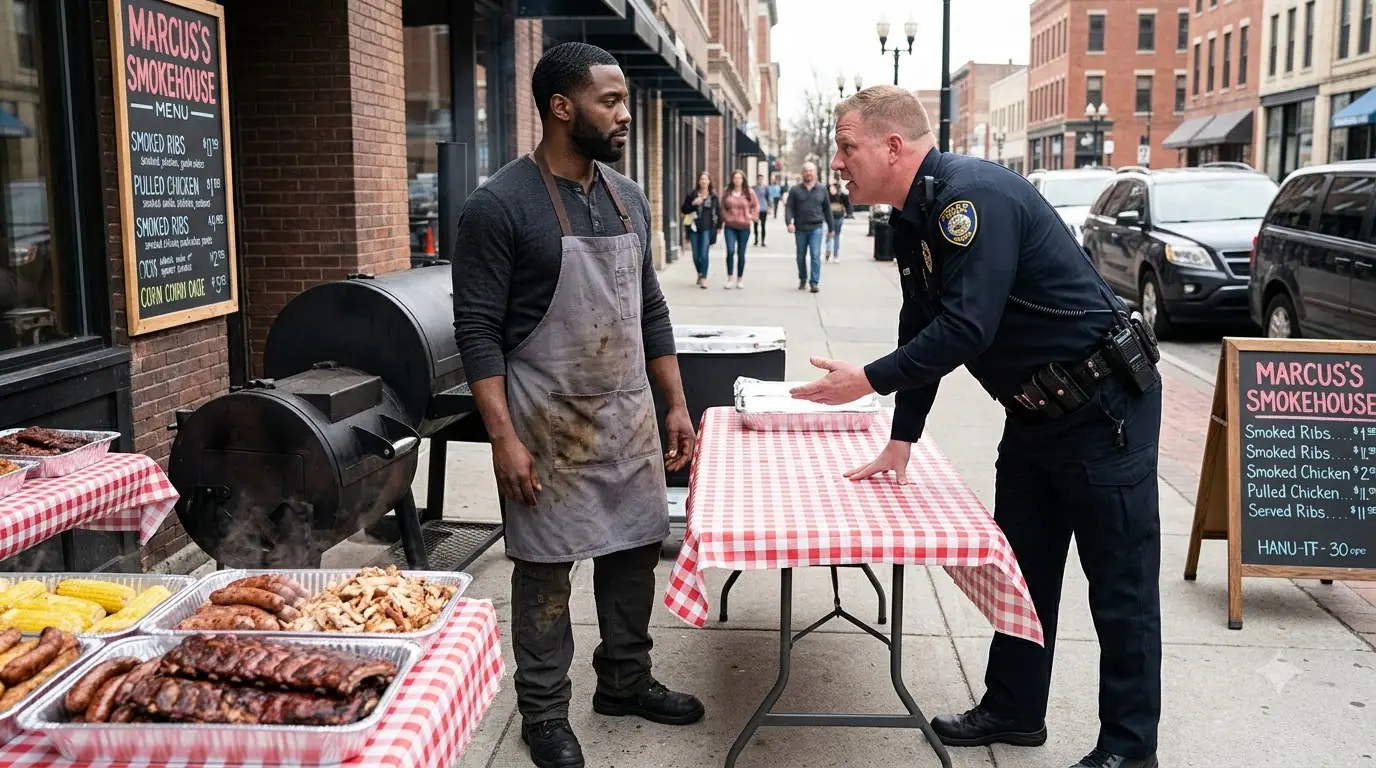
Marcus looked directly at Brett.
“Five hundred for what?”
Brett smiled.
It was not a friendly smile.
“For another week without problems.”
Marcus lifted one eyebrow.
“What problems?”
Brett leaned closer.
“You really want me to explain business to you?”
Marcus remained still.
His dark charcoal henley was damp beneath the gray barbecue apron, and the scent of oak smoke had settled into his beard after nearly six hours beside the smoker. To anyone watching, he looked like another hardworking food vendor trying to keep a modest operation alive. Nothing visible suggested that the apron pocket contained a concealed recording device, that an unmarked SUV was parked two blocks away, or that Marcus had spent eleven years investigating financial fraud and public corruption for the Federal Bureau of Investigation.
Brett did not know any of that.
That was why he kept talking.
“Health inspectors come through here all the time,” Brett said. “Fire code people too. Licensing. Parking enforcement. You’ve got propane, food, open flame, tables on public sidewalk. A man can lose a business over one bad afternoon.”
Marcus nodded slowly.
“So the five hundred prevents that?”
“It buys peace.”
“From who?”
Brett laughed.
“You ask too many questions.”
Marcus looked toward Brett’s open hand.
“Say the amount again.”
The officer’s smile disappeared.
“What?”
“Just so I understand.”
Brett stepped closer.
“Five hundred dollars.”
Marcus said nothing.
Brett slapped his palm against the edge of the table hard enough to shake a foil pan of cornbread.
“Five hundred every Friday, or I bury this place in violations before sunset.”
The customers nearest the stand fell silent.
Marcus looked at the officer.
Then at the table.
Then back at Brett.
“Every Friday?”
“You learn fast.”
Marcus slipped one hand into the large front pocket of his apron.
Brett relaxed.
“There you go.”
His confidence returned immediately.
“See? Nobody has to make this difficult.”
Marcus’s hand came out holding a black leather credential wallet.
Brett’s smile vanished before Marcus even opened it.
Then the badge became visible.
Gold against black.
Federal Bureau of Investigation.
Brett stopped breathing.
Marcus held it steady at chest level.
“Special Agent Marcus Grant.”
The officer’s eyes widened.
Behind Brett, the doors of an unmarked gray SUV opened.
Two people stepped out.
Then another vehicle pulled around the corner.
Marcus’s voice remained calm.
“You just made your last collection.”
For three seconds, Brett Lawson looked like a man whose mind had rejected what his eyes were reporting.
Then he tried to laugh.
It was a terrible sound.
“You’re joking.”
Marcus did not answer.
Brett looked at the approaching agents.
Then at the badge.
Then toward the street.
His hand moved instinctively toward his radio.
Marcus lowered the credentials slightly.
“Don’t.”
Brett froze.
The first federal agent reached the table.
Her name was Special Agent Lena Ortiz, forty-three years old, fourteen years with the bureau, and the case supervisor responsible for the operation that had finally placed Brett Lawson beside Marcus’s barbecue smoker.
“Officer Lawson,” Lena said, “keep your hands where we can see them.”
Brett’s face lost what little color remained.
“This is insane.”
Marcus removed his apron.
Underneath, clipped beneath the hem of his shirt, was another piece of equipment Brett had never noticed.
A transmitter.
Marcus switched it off.
Brett stared.
“How long?”
Marcus folded the apron once and placed it on the table.
“Long enough.”
That answer frightened Brett more than the badge.
Because suddenly five hundred dollars was no longer the problem.
Everything he had said before Marcus opened the wallet became the problem.
And Brett had been talking for nearly seven minutes.
The investigation had begun eight months earlier with a woman named Angela Price.
Angela owned a small Caribbean lunch cart on the south side of Riverton. She had spent six years building a customer base around jerk chicken, rice, plantains, and homemade ginger drink. Her cart was clean, licensed, inspected, and profitable enough to support Angela and her twelve-year-old daughter without anyone calling them wealthy.
Then Officer Brett Lawson started visiting.
The first time, he ordered lunch.
The second time, he asked questions about her permits.
The third time, he told Angela she was “occupying a sensitive corridor” and could attract complaints.
Angela showed him everything.
Health permit.
Vendor license.
Fire inspection.
Insurance.
Brett looked through the documents and smiled.
“Paper doesn’t stop problems.”
Angela did not understand what he meant until the following Friday.
Brett returned.
This time he asked for $300.
Angela thought he was joking.
He was not.
“What is it for?” she asked.
“Call it neighborhood protection.”
“Protection from what?”
“People who can make your week expensive.”
Angela refused.
By Monday, a city inspector appeared and cited her for improper placement of a trash container that had occupied the same location for nearly two years.
Tuesday brought a fire inspection.
Wednesday, police ordered her to move because of an alleged traffic complaint.
Friday, Brett returned.
“Three hundred.”
Angela paid.
The problems stopped.
For two months.
Then Brett raised it to four hundred.
Angela paid again.
She hated herself every time.
But she hated the idea of losing the cart more.
Angela might have continued indefinitely if Brett had not made one mistake.
He threatened the wrong person in front of the wrong witness.
That witness was Calvin Ross, a fifty-nine-year-old accountant who bought lunch from Angela every Thursday.
Calvin watched Brett take an envelope.
Then heard him say:
“You want to keep cooking here, you keep remembering who lets you.”
Calvin waited until Brett left.
Then asked Angela:
“What was that?”
She said nothing.
Calvin did not push.
The following week, he returned.
Brett came again.
Another envelope.
Another warning.
Calvin quietly contacted an old friend in the U.S. Attorney’s Office.
That call eventually reached Lena Ortiz.
At first, Lena did not know whether the allegation involved one officer, several officers, or nothing provable at all.
Public corruption cases were rarely simple.
The victims were often frightened.
Payments were usually cash.
Threats were disguised as discretion.
Records looked normal because the power being abused was itself legitimate.
Police could conduct inspections.
Departments could respond to complaints.
Cities could enforce licensing.
The challenge was proving that lawful authority had been converted into a private revenue stream.
Lena began with interviews.
Quiet ones.
Angela resisted.
“I don’t want trouble.”
Lena sat across from her in a back room of a church community center.
“You already have trouble.”
“If he finds out I talked to you, I lose everything.”
“We won’t use your name without discussing it.”
Angela shook her head.
“You don’t understand.”
Lena did not argue.
“What don’t I understand?”
Angela looked toward the closed door.
“It isn’t only him.”
That sentence changed the case.
Angela described a pattern.
Brett collected.
But inspections often followed refusals too quickly to feel random.
One health inspector appeared within hours.
A parking officer once arrived less than fifteen minutes after a vendor argued with Brett.
A city code employee repeatedly cited businesses that resisted.
Angela knew of at least six vendors paying cash.
Three were Black.
Two Latino.
One Vietnamese American.
All operated small businesses with limited legal resources.
None trusted the complaint process enough to risk becoming the first person to speak publicly.
Lena asked:
“Who else knows?”
Angela laughed bitterly.
“Everybody.”
“Then why hasn’t anybody reported it?”
“We did.”
Lena stopped.
“When?”
“Two years ago.”
“To who?”
“Police internal affairs.”
“What happened?”
Angela looked at her.
“Nothing.”
The internal complaint existed.
Lena found it three days later.
Actually, she found three.
One from a hot dog vendor.
One from a florist.
One from a convenience-store owner.
Each named Brett Lawson.
Each was closed for “insufficient evidence.”
The officer who reviewed two of them was Sergeant Harold Pike, Brett’s direct supervisor.
That made Lena cautious.
Not because Pike was automatically corrupt.
Because the case could no longer assume the department would remain outside the investigation.
The FBI coordinated with federal prosecutors and a small circle of trusted officials.
No local notification yet.
Then the surveillance began.
Brett’s routine appeared almost embarrassingly regular.
Fridays.
Late morning through early afternoon.
Mostly cash businesses.
Mostly operators with outdoor vending permits.
He rarely stayed long.
He never wrote anything.
He rarely accepted envelopes directly beside patrol cameras.
Some weeks he used a diner bathroom.
Other weeks a side alley.
Once, a vendor placed cash inside a folded takeout bag.
Brett carried it away with lunch.
Marcus Grant entered the case during the fifth week.
Marcus was forty-one and had grown up less than ninety miles from Riverton.
His father had operated an auto-repair shop in Macon for twenty-seven years. His mother worked nights at a hospital. Marcus understood small businesses not as abstract economic units but as places where utility bills sat under cash registers and owners sometimes worked sick because closing for one day meant somebody did not get paid.