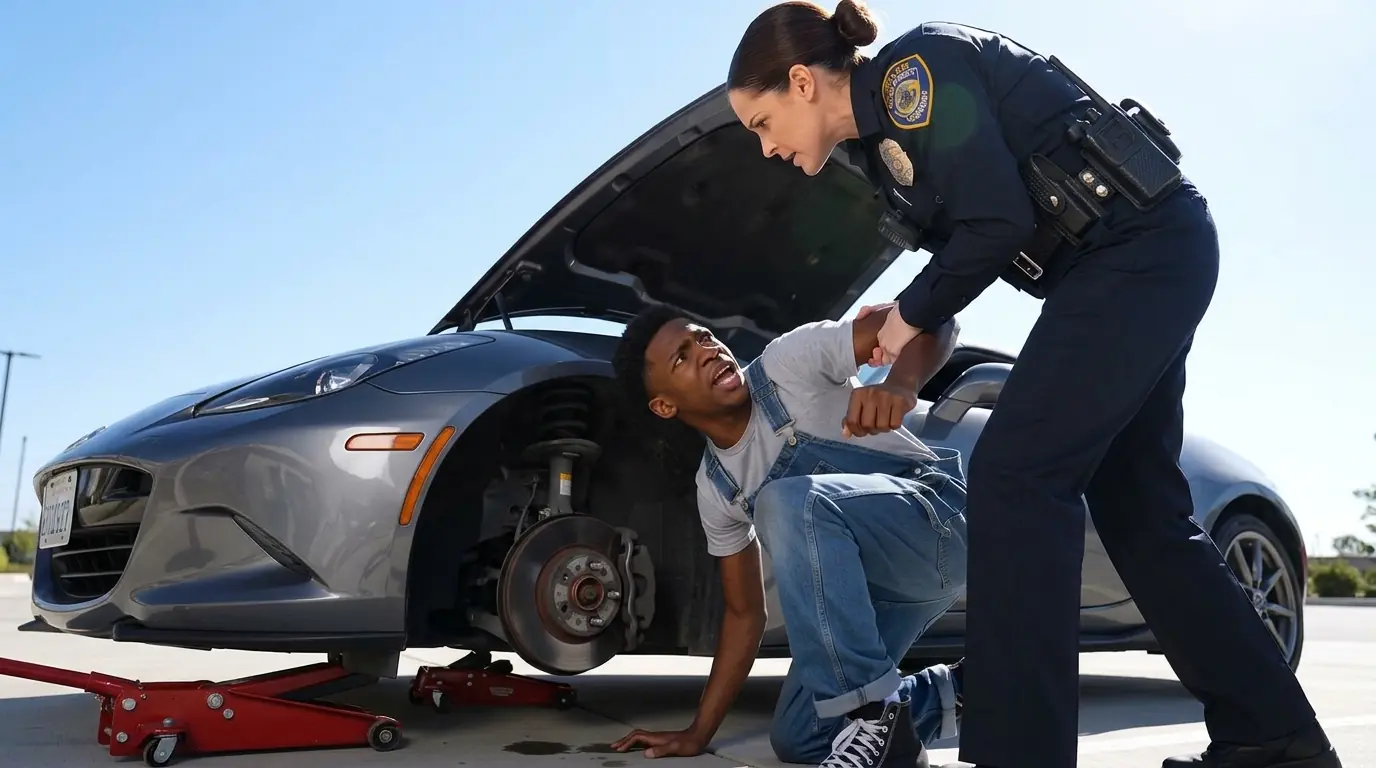
Officer Melissa Grant never asked the Black teenager beneath the silver Porsche what he was doing. She saw his legs sticking out from the front wheel well, saw the expensive car sitting in the driveway with its hood raised and one wheel removed, and decided she already understood the scene. Before Jordan Hayes could slide himself completely out from under the suspension, Melissa grabbed the shoulder of his denim overalls and yanked him hard enough that the wrench in his hand clattered across the concrete. “Get away from the car,” she snapped. “Now.”
Jordan landed on one knee, startled and confused. He was seventeen, tall but still narrow through the shoulders, wearing a white T-shirt beneath faded blue overalls and the gray sneakers he always used when working around grease. A streak of brake dust ran across one cheek, and both hands were black from the wheel assembly he had spent the previous forty minutes taking apart. He looked at Melissa’s uniform, then at the patrol SUV parked sideways across the end of the driveway.
“What are you doing?” he asked.
Melissa tightened her grip on his arm. “I could ask you the same thing.”
“I’m fixing the car.”
She looked toward the Porsche. “Whose car?”
Jordan stared at her.
“Seriously?”
Melissa’s expression hardened. “That’s your first mistake.”
“What mistake?”
“Getting smart with me.”
Jordan slowly raised both hands. “I’m not getting smart.”
The neighborhood around them was almost painfully quiet. Ridgemont Hills, outside Sacramento, California, was the kind of subdivision where the sidewalks curved around old sycamores, garages held cars worth more than some houses, and residents complained online when delivery vans stayed at the curb too long. On that warm Saturday morning, sprinklers clicked across clipped lawns while somewhere behind the houses a child bounced a basketball against concrete.
Jordan had been working in the driveway for almost an hour. The Porsche belonged to the man inside the house, and the damaged front suspension had become their weekend project after a pothole bent a control arm two days earlier. Jordan had removed the wheel, placed it flat beside the garage, opened the hood, and laid his tools in a neat line because the man inside had spent years teaching him that organized tools prevented stupid mistakes.
Melissa saw none of that.
Or perhaps she saw it and assigned another explanation.
“I need identification,” she said.
Jordan glanced toward the open garage. “My wallet’s inside.”
“Convenient.”
“What does that mean?”
“It means you’re under somebody’s car with parts removed and no identification.”
Jordan looked down at the wheel beside them. “You think I’m stealing a wheel while the car is in somebody’s driveway?”
“I think I’m asking the questions.”
“No, you already decided.”
Melissa moved closer. “Excuse me?”
Jordan immediately regretted saying it. Not because he believed it was wrong, but because he recognized the little change in her face. His father had taught him that moment too—the point where a conversation with an officer stops being about information and becomes about who is allowed to challenge whom.
“I said I’m repairing it.”
“Who gave you permission?”
“The owner.”
“Name.”
Jordan hesitated.
Melissa noticed. “That’s what I thought.”
“I know his name.”
“Then say it.”
“Why?”
Her jaw tightened. “Because you are underneath a ninety-thousand-dollar vehicle with the wheel removed.”
“It’s worth more than that.”
Melissa stared.
Jordan closed his eyes briefly. “That came out wrong.”
“You think this is funny?”
“No.”
“Then tell me who owns the car.”
Jordan looked toward the front door.
“Thomas Whitaker.”
Melissa waited.
The name meant nothing to her.
“Phone number.”
Jordan blinked. “I don’t know his number by memory.”
“You’re repairing his Porsche but you don’t know his phone number?”
“He’s inside.”
Melissa looked at the house.
Then back at Jordan.
“Of course he is.”
Jordan understood the disbelief before she said anything else. He had lived in Ridgemont Hills for almost three years, and he had learned that some people accepted explanations differently depending on who gave them. A white kid in dirty overalls working beneath an expensive car might look industrious. Jordan sometimes looked criminal before he opened his mouth.
“You can knock,” he said.
Melissa grabbed his wrist.
Jordan jerked automatically.
“Don’t touch me.”
“Stop resisting.”
“I’m not resisting.”
“You just pulled away.”
“Because you grabbed me.”
Melissa twisted his arm.
Jordan dropped to one hand.
Pain shot through his shoulder.
“Ma’am—”
“Hands behind your back.”
“For what?”
“Possible vehicle burglary.”
Jordan stared at her. “Vehicle burglary?”
“You were found tampering with a car.”
“I’m fixing it.”
“You keep saying that.”
“Because it’s true.”
Melissa reached toward her cuffs.
That was when Jordan looked toward the house again.
“Tom!”
Melissa tightened her grip. “Stop yelling.”
“Tom!”
“Quiet.”
“Tom!”
She pulled him upright.
Jordan’s wrench remained on the driveway.
The front wheel sat beside the Porsche.
The hood remained open.
Every visible fact supported exactly what Jordan had said, but Melissa no longer seemed interested in visible facts.
She was interested in control.
Three weeks earlier, Ridgemont Hills had experienced a series of vehicle break-ins. Two garages had been entered at night, one pickup truck disappeared, and several luxury vehicles were found with smashed windows. Neighborhood Facebook pages turned every unfamiliar car, teenager, delivery driver, landscaper, and dog walker into a potential suspect.
The police department increased patrols.
Residents were told to call if they saw something unusual.
That morning, someone did.
A woman living three houses away reported “a young Black male taking parts from a Porsche.”
The dispatcher asked whether the caller knew who owned the house.
No.
Had the teenager broken into the garage?
No.
Was he forcing entry into the car?
No.
Was anyone asking him to leave?
No.
The caller’s entire basis was what she could see from her upstairs window: a Black teenager working on an expensive vehicle.
Melissa arrived already carrying the caller’s conclusion.
Jordan did not know any of that yet.
He only knew his arm hurt.
“Turn around,” Melissa ordered.
“No.”
Her expression changed.
Jordan immediately clarified. “I mean, tell me why I’m being detained.”
“You don’t get to refuse lawful commands.”
“What crime did I commit?”
“I’m investigating one.”
“That’s not the same thing.”
“Who taught you that?”
Jordan looked toward her.
“My dad.”
Melissa gave a short laugh.
“Your dad a lawyer?”
“No.”
“Mechanic?”
Jordan almost smiled despite the pain.
“Not even close.”
“Then maybe stop getting legal advice from him.”
Jordan’s face became serious again.
The front door remained closed.
Melissa positioned him beside the front fender.
“Hands on the car.”
“I’m not putting grease on the paint.”
Melissa blinked.
“What?”
“My hands are filthy.”
He lifted them slightly.
Black brake dust covered both palms.
“The owner will kill me if I smear that on the paint.”
Melissa laughed.
“Right.”
Jordan looked toward her.
There it was again.
The disbelief.
Not about grease.
About belonging.
“You really don’t believe anything I say.”
“I believe evidence.”
Jordan looked around the driveway.
“The wheel is off.”
Melissa said nothing.
“The tools are mine.”
Nothing.
“The hood’s open.”
Nothing.
“I’m covered in brake dust.”
Nothing.
“The garage is open.”
Nothing.
“You could walk twenty feet and knock.”
Melissa pointed toward him. “You’re making this worse.”
“How?”
“Your attitude.”
Jordan exhaled.
That word.
He had heard it from teachers who later apologized, store employees who followed him through aisles, and one private security guard who once asked whether his school backpack contained merchandise.
Attitude.
Sometimes it meant nothing more than refusing to perform gratitude while being doubted.
“I’m trying to explain.”
“You’re arguing.”
“Because you keep accusing me of stealing.”
“I never said you stole anything.”
“You called it vehicle burglary.”
Melissa grabbed his elbow again.
Jordan moved away instinctively.
She reached for her cuffs.
“Enough.”
The front door opened.
Neither of them noticed immediately.
A tall white man in his early fifties stepped out wearing black police trousers and a dark uniform shirt he had not finished buttoning at the collar. Silver hair showed above his ears, and four gold stars sat above the badge on his chest. He stopped beneath the porch awning and stared at Jordan’s twisted arm.
His name was Chief Thomas Whitaker.
For the previous two years, he had served as chief of the Sacramento Metropolitan Police Department.
Melissa Grant worked for him.
More importantly, Jordan Hayes called him Dad.
Thomas did not shout.
That frightened Melissa more later than shouting would have.
He walked down the porch steps.
“Officer.”
Melissa turned.
“Sir, stay back. I’m dealing with—”
Then she saw his uniform.
Her sentence collapsed.
Thomas stopped halfway down the driveway.
“Let go of him.”
Melissa stared.
“Chief?”
“Release his arm.”
She did.
Jordan immediately stepped away and rubbed his shoulder.
Thomas looked at him first.
“You okay?”
Jordan nodded too quickly.
“I’m fine.”
Thomas knew that answer.
He had heard it from injured officers, scared witnesses, grieving families, and his own son.
“No, you aren’t.”
Then he looked toward Melissa.
She had gone pale.
“Chief, I got a suspicious-person call. He was underneath the Porsche, there was a wheel removed, and he couldn’t provide identification—”
Thomas raised one hand.
“Stop.”
Melissa stopped.
Thomas looked toward the patrol SUV.
“Body camera.”
Her eyes dropped.
“What about it?”
“Is it recording?”
Melissa touched her chest.
The indicator was dark.
Thomas’s face changed.
Jordan noticed.
“So you didn’t turn it on?”
“I thought I had.”
Thomas looked at her for several seconds.
“Do not touch it.”
Melissa froze.
“Chief—”
“Do not activate it now.”
She pulled her hand away.
Thomas took out his phone.
“Jordan.”
“Yeah?”
“Go stand by the garage.”
“I can stay.”
“No.”
Jordan looked at Melissa.
Then at Thomas.
“Dad—”
Melissa’s eyes snapped toward him.
The word landed harder than the four stars.
Dad.
Her mouth opened slightly.
Thomas looked toward Jordan.
“Garage.”
Jordan obeyed.
Melissa stared after him.
“That’s your son?”
Thomas turned back.
“Yes.”
The silence became enormous.
Melissa’s face changed in stages.
Confusion.
Recognition.
Fear.
Then something that looked almost like embarrassment.
“I didn’t know.”
Thomas’s expression remained unreadable.
“That is going to matter.”
Melissa swallowed.
“I was responding to a call.”
“I know.”
“You understand how it looked.”
Thomas’s eyes sharpened.
“No.”
The answer surprised her.
“No?”
“I understand how it looked to you.”
He stepped closer.
“That’s what concerns me.”
Melissa started speaking faster.
“The caller reported a Black male taking parts off a luxury vehicle. I arrived and observed him under the wheel well. He refused identification and became combative.”
Thomas looked toward Jordan.
The boy stood near the garage with both hands hanging awkwardly at his sides.
“Combative.”
“He pulled away.”
“After you grabbed him?”
Melissa hesitated.
Thomas saw the answer.
He took out his radio.
“Dispatch, Chief Whitaker. Send an uninvolved field supervisor to 1448 Larkspur Court.”
Melissa looked at him.
“Chief, we can handle this.”
“No.”