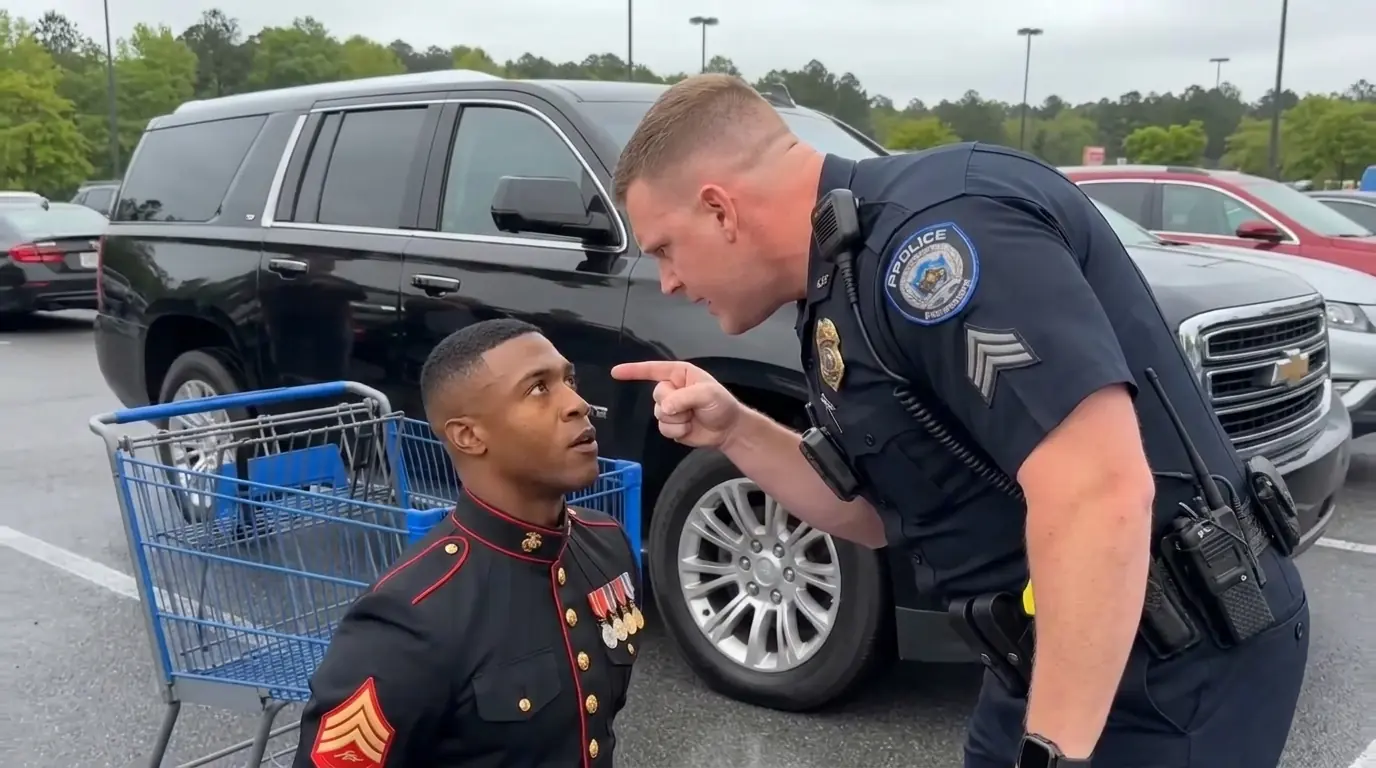
Staff Sergeant Isaiah Brooks noticed the old man’s cane before he noticed the white SUV. The cane appeared between two parked vehicles in the middle of Mesa Crossing Shopping Center in Killeen, Texas, while Saturday traffic crawled beneath a cloudless sky and families pushed carts toward pickup trucks shimmering in the heat. Isaiah had just spent three hours inside a veterans resource fair wearing his Army service uniform, and all he wanted now was air-conditioning, lunch, and the short drive back toward Fort Cavazos. Then the SUV’s reverse lights flashed on, and the old man stepped directly behind it.
Isaiah saw immediately that the driver was looking over his opposite shoulder. “Sir, stop,” he shouted, but the elderly man either did not hear him or did not understand that the warning was meant for him. The SUV rolled backward faster than Isaiah expected, so he dropped the folder he was carrying and crossed the lane in three long strides. When the bumper came within a few feet of the man, Isaiah slapped his open palm against the rear window and shouted, “Stop the car.”
The driver hit the brakes hard enough to rock the vehicle. The old man froze with one foot still in the lane, and his cane slipped from his fingers and struck the asphalt. Isaiah stepped around the back of the SUV, picked it up, and asked whether he had been hit. The man stared at the bumper and whispered, “No, but I think I almost was.”
Before Isaiah could say anything else, the driver’s door flew open. A heavyset white man in his late forties climbed out wearing a pale golf shirt, expensive sunglasses, pressed shorts, and the expression of someone who believed the biggest emergency had happened to his property. “What the hell is wrong with you?” he shouted as he looked at the rear glass. Isaiah answered, “You were backing into this gentleman.”
The driver said he had seen the man the entire time. The elderly pedestrian shook his head and said, “No, you didn’t, because I didn’t see you either.” Isaiah handed back the cane and told the driver there was no visible damage to the window. The man stepped closer and replied, “You don’t get to pound on my vehicle because you think you’re some kind of hero.”
Isaiah looked down at his own palm, then toward the perfectly intact glass. “I hit it once because yelling didn’t stop you,” he said. The driver pointed toward the ribbons on Isaiah’s uniform and told him military people were always looking for reasons to act like everyone else had to obey them. That remark bothered Isaiah more than the accusation about the window, but he kept his voice level. “This had nothing to do with my uniform,” he said.
Several shoppers had stopped nearby. A thirty-six-year-old elementary teacher named Rachel Foster stood beside a grocery cart with her phone already in her hand because she had seen the final seconds of the near collision. She told the driver that the SUV was still moving when Isaiah reached it. He immediately snapped, “Nobody asked you.”
Rachel looked at Isaiah. “I saw what happened,” she said. Isaiah nodded and asked whether she had recorded the SUV before it stopped. She had not, but she had started recording when the driver climbed out and began shouting. Isaiah told her the footage might still matter if police became involved.
The driver heard that and pulled out his own phone. “Police are already getting involved,” he said. He walked several yards away and told the dispatcher there was an aggressive man in military uniform who had struck his vehicle and was confronting people in the parking lot. Isaiah looked at the old man, whose name turned out to be Leonard Pierce, and asked whether he wanted to sit down.
Leonard was eighty years old and had undergone hip replacement surgery six months earlier. He pointed toward a shaded bench outside the pharmacy and admitted that his legs suddenly felt weaker than they had before the SUV stopped. Isaiah walked beside him slowly, matching the pace of the cane rather than rushing him across the lane. Behind them, the driver continued telling dispatch that an angry soldier had attacked his vehicle.
Isaiah considered leaving once Leonard was safely seated. He had done what he needed to do, his truck was only fifty yards away, and no one had been injured. Then he remembered the driver’s version of the emergency call and decided disappearing would create another fact someone could interpret however they liked. So he stayed beside Leonard and waited for police.
Rachel pushed her cart closer and introduced herself. She said the driver had been backing until Isaiah slapped the window, and she was willing to tell an officer exactly that. Isaiah thanked her without making the incident larger than it already was. Rachel studied him for a moment and asked, “How are you this calm?”
Isaiah looked toward the veterans center behind them. “It took practice,” he said. He had spent seventeen years in the Army, including multiple overseas deployments, and learned long ago that the moment another person became loud was usually the worst time to compete with them. Calm did not mean he felt nothing. It meant he had trained himself not to let the strongest emotion in a scene make the next decision.
The patrol cruiser entered Mesa Crossing less than five minutes later. Officer Nolan Briggs was forty-three, had twelve years with the local police department, and had been working since six that morning through a domestic dispute, a theft call, a minor collision, and two welfare checks. Dispatch told him a man in Army uniform had intentionally struck a complainant’s SUV during an argument, that no injuries were reported, and that another caller claimed the same man had prevented a pedestrian collision. Briggs acknowledged both updates before turning into the lot.
The driver walked toward the cruiser before Briggs had completely stepped out. His name was Gregory Caldwell, and he spoke with the comfortable urgency of someone accustomed to being listened to quickly. “Officer, that’s him,” he said while pointing at Isaiah. “He hit my vehicle and got aggressive when I confronted him.”
Briggs looked first at Gregory, then at Isaiah, then at Leonard sitting on the bench. He asked whether the vehicle had been damaged, and Gregory said he had not inspected it fully but that Isaiah struck the rear window hard. Briggs asked whether Isaiah had touched him personally. Gregory answered, “Not yet.”
Isaiah heard the phrase and almost responded, but Briggs raised one hand toward him. “I’ll get to you,” he said. Isaiah nodded and stopped. The officer spent nearly a minute listening to Gregory before walking across the lane.
“Identification,” Briggs said. Isaiah told him his wallet was inside his right trouser pocket and waited for permission before reaching. Briggs said, “Go ahead,” so Isaiah removed his driver’s license and military identification and handed both over. The officer looked at the cards and said, “Staff Sergeant Brooks, Fort Cavazos.”
“Yes, officer,” Isaiah replied. Briggs asked why he was at Mesa Crossing. Isaiah pointed toward the community center and explained the veterans employment and benefits fair. Briggs handed back the military ID but kept the driver’s license while asking what happened.
Isaiah described the event in chronological order. Leonard walked behind the SUV, the reverse lights appeared, the vehicle started moving, Isaiah shouted twice, and when the driver failed to stop, Isaiah crossed the lane and struck the rear window with an open hand. The SUV stopped before hitting Leonard. Isaiah said he saw no damage and never touched Gregory.
Briggs stared at him. “So you admit you intentionally hit the vehicle.” Isaiah answered, “With my open palm, to get the driver’s attention because a pedestrian was behind him.” Briggs asked why he could not simply yell. Isaiah said, “I did.”
The officer asked why he did not move the old man. Isaiah answered that he was closer to the vehicle than Leonard by the time he reached them and believed stopping a two-ton SUV was safer than grabbing an elderly person with a cane. Briggs’s mouth tightened slightly. Isaiah noticed that each explanation seemed to irritate him more rather than clarify the event.
“Did you threaten Mr. Caldwell?” Briggs asked. Isaiah said no. “Raise your voice?” Only during the warning. “Get in his face?” No.
Gregory called from behind the officer, “He accused me of almost killing that guy.” Isaiah looked toward him and said, “I said you nearly hit him.” Briggs turned sharply and told Isaiah, “I’m handling this.”
Isaiah nodded once. “Understood.” Briggs stepped closer and asked why Isaiah felt the need to correct every statement people made. Isaiah replied that he was answering questions accurately.
“You military guys always talk like you’re giving sworn testimony?” Briggs asked. Isaiah looked genuinely surprised by the comment. “No, sir.” The officer said he was getting “a lot of attitude for a simple parking-lot complaint.”
Isaiah shortened his answers. He had learned during deployments that sometimes being precise could be mistaken for challenging the person who expected agreement rather than information. Briggs asked again whether Isaiah knowingly struck the SUV. Isaiah said yes.
“Turn around,” Briggs said. Isaiah hesitated because nothing in the conversation had suggested the encounter was about to become physical. “Am I being detained?” he asked.
Briggs repeated the command. Isaiah stayed still and said, “Officer, I’ve provided identification and answered every question, so I’m asking what I’m being detained for.” Briggs moved forward before Isaiah finished the sentence.
He grabbed Isaiah’s right wrist and pulled the arm behind his back. Years of training caused Isaiah’s shoulders to tighten automatically when another person suddenly moved his arm past its natural position. Briggs said, “Don’t resist.” Isaiah immediately relaxed and answered, “I’m not resisting.”
Briggs demanded the second hand. Isaiah gave it to him. The cuffs closed hard enough that the edge of one bracelet pressed against the bone in his wrist.
Rachel gasped from several feet away. Leonard stood from the bench and shouted, “Officer, what are you doing?” Briggs turned toward him and ordered him to sit down.
Leonard remained standing. Isaiah looked at him and said calmly, “Mr. Pierce, please sit.” Leonard stared at Isaiah for several seconds, then lowered himself back onto the bench with visible frustration. Briggs pulled Isaiah toward the center of the parking lane.
“What am I detained for?” Isaiah asked. Briggs answered, “Disorderly conduct investigation.” Isaiah asked what specific conduct was disorderly.
“Keep pushing and we can discuss obstruction too,” Briggs said. Isaiah stopped talking. He knew the conversation had crossed into a place where asking for clarity was being interpreted as evidence against him.
Then Briggs told him to get down. Isaiah looked toward him. “Excuse me?”
“One knee,” Briggs said. Isaiah reminded him that he was already handcuffed and had not attempted to leave. Briggs pointed at the pavement and repeated the order.
The Texas asphalt had spent most of the afternoon beneath direct sun. Isaiah lowered himself carefully onto his right knee while more shoppers gathered around the scene. His polished uniform shoe scraped against the pavement, and sweat ran slowly down the back of his neck beneath the heavy service jacket.
Briggs stood above him. “That uniform isn’t going to protect you out here,” he said. Several people nearby reacted immediately.
Isaiah looked up. “My uniform wasn’t supposed to protect me.” Briggs leaned slightly closer and told him to keep complying. Isaiah nodded and said nothing else.
Gregory started walking toward his SUV. Briggs called after him and told him to remain nearby. Gregory answered that he had somewhere to be.
“You called us,” Briggs reminded him. Gregory glanced at Isaiah and replied, “Yeah, and you’ve got the guy.” Rachel’s phone recorded the exchange.
Those words stayed with Isaiah. Gregory had not said the officer had figured out what happened. He said he had gotten the guy. The distinction described the entire scene better than Gregory probably realized.
Rachel stepped closer and told Briggs she was an eyewitness. He ordered her back. She said, “I watched the SUV nearly hit Mr. Pierce.”
“You’re interfering with an investigation,” Briggs answered. Rachel stopped moving but kept her phone pointed toward them. Isaiah noticed that even the word eyewitness seemed to irritate the officer now.
Two additional police vehicles entered the shopping center from the east entrance. One was a marked sedan, and the other was an unmarked black SUV Isaiah recognized from a public-safety partnership meeting at Fort Cavazos several months earlier. Police Chief Denise Harper stepped from the passenger side.
Harper was fifty-four, with silver streaks running through dark hair pinned neatly behind her head. Beside her walked Lieutenant Victor Salazar and two patrol supervisors. Isaiah had met both command officers once during a joint military-community outreach program, but he did not know either personally.
Briggs had his back to them. He was still watching Isaiah. “Eyes forward,” he said.
Isaiah looked at him. “You should stop now.” Briggs laughed.
“Is that a threat?” he asked. Isaiah said no. Briggs leaned closer and told him threatening an officer while restrained would be an exceptionally bad decision.
Isaiah glanced past him. Chief Harper was less than forty feet away and had clearly seen the cuffs and kneeling position. Her walking pace increased.
Briggs straightened. “You need to understand that you’re in my jurisdiction now.” Isaiah looked at the chief approaching behind him. “I understand.”