Sergeant Grant Mercer did not look nervous when he raised his right hand.
That was the first thing Zuri Valemont noticed.
He stood beneath the high ceiling of Courtroom 4B in the Fulton County Justice Center with the posture of a man who had testified too many times to fear the ritual anymore. At fifty-one, Mercer was broad through the shoulders and neck, his close-cut gray hair emphasizing a square face weathered by almost three decades in uniform. His dark navy dress uniform was immaculate, every button polished, every crease sharp, every ribbon centered precisely above his badge.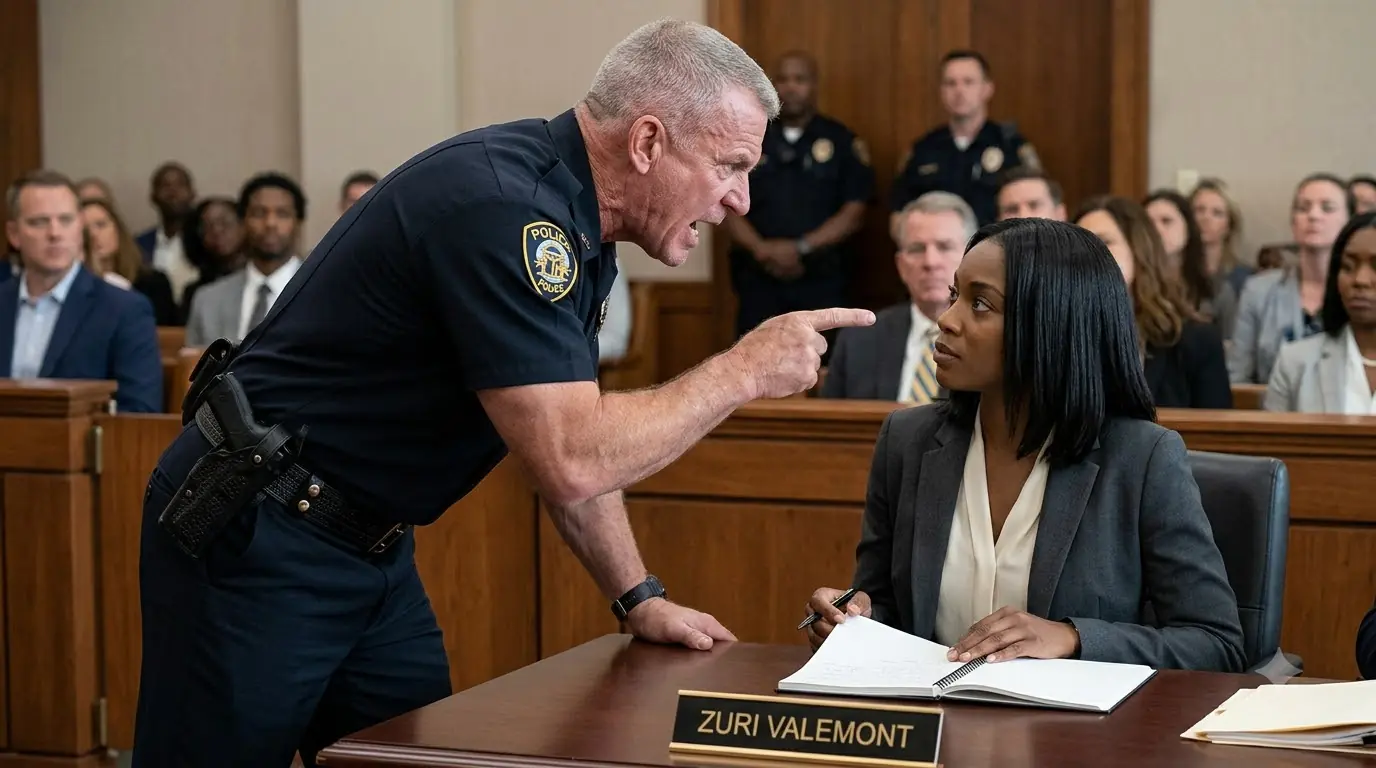
The clerk administered the oath.
Mercer answered without hesitation.
“I do.”
Then he sat.
Zuri watched him from the defense table.
She wore a charcoal-gray suit over a cream blouse, small pearl earrings, and no expression that anyone in the room could easily interpret. Her black hair fell in a smooth shoulder-length bob, and a legal pad rested open beneath her hands.
A brass nameplate on the table read:
ZURI VALEMONT
People in the gallery had been whispering about that name all morning.
Not because they recognized it.
Because they did not.
To everyone except four people in the courthouse, Zuri Valemont was simply the thirty-eight-year-old Black woman facing felony charges after a late-night traffic stop had allegedly turned violent.
Sergeant Mercer believed the same thing.
That was why he was so comfortable.
Assistant District Attorney Caleb Monroe approached the witness stand.
“Sergeant Mercer, how long have you been employed by the Riverton Police Department?”
“Twenty-seven years.”
“Current assignment?”
“Patrol operations supervisor, Third District.”
“Any disciplinary history?”
Mercer allowed himself a slight pause.
“No sustained findings.”
Monroe nodded.
He knew how juries heard that sentence.
Twenty-seven years.
Supervisor.
No sustained findings.
Credibility built before the facts even began.
“Directing your attention to the night of February seventeenth, were you working patrol?”
“Yes.”
“At approximately 11:42 p.m., did you observe a gray SUV traveling eastbound on Colfax Road?”
“Yes.”
“Did that vehicle attract your attention?”
“It did.”
“Why?”
Mercer looked toward Zuri.
For the first time that morning, their eyes met.
“The vehicle crossed the center line twice.”
Zuri did not react.
Monroe continued.
“What did you do?”
“I activated my emergency lights and conducted a traffic stop.”
“Who was driving?”
Mercer pointed.
“The defendant.”
Monroe turned slightly.
“For the record, you are identifying Ms. Zuri Valemont?”
“Yes.”
“What happened when you approached her vehicle?”
Mercer leaned forward.
“She became immediately hostile.”
Zuri’s attorney, Naomi Price, did not move.
She was forty-five, calm, highly experienced, and one of only four people in the courthouse who understood exactly why Zuri had refused every plea offer presented to her.
Monroe asked:
“How was she hostile?”
“She demanded to know why I stopped her.”
“Is that unusual?”
“Not by itself.”
“What was unusual?”
“Her tone.”
Zuri nearly smiled.
Tone.
A word capable of doing remarkable work when facts were inconvenient.
Mercer continued.
“She refused to provide registration.”
Monroe nodded.
“Did she provide identification?”
“Eventually.”
“Eventually?”
“She kept asking whether my body camera was operating.”
Several people in the gallery shifted.
Monroe glanced at his notes.
“And was it?”
Mercer answered smoothly.
“It malfunctioned.”
Naomi Price wrote something.
Mercer saw her and continued.
“The camera indicated low power. I attempted to reset it, but it did not record the contact.”
Monroe nodded sympathetically.
“Was that unusual?”
“No. We had battery issues with that model.”
“And what happened next?”
Mercer’s expression became more serious.
“I asked Ms. Valemont to step out of the vehicle because I detected the odor of alcohol.”
Zuri’s eyes narrowed slightly.
That was new.
Not in the first report.
Not in the supplemental report.
Alcohol had appeared only after the prosecutor asked Mercer why he had ordered her out of the vehicle despite finding no contraband and observing no confirmed traffic violation beyond his own claim.
Monroe asked:
“Did she comply?”
“No.”
“What did she do?”
“She locked the doors.”
A murmur moved through the gallery.
“She told me I had no lawful reason to remove her.”
“What did you do?”
“I advised her multiple times.”
“And eventually?”
“I opened the driver’s door after she unlocked it.”
Zuri looked at Naomi.
Naomi wrote two words.
Changed again.
Mercer’s original report claimed the door had already been unlocked.
His second supplemental report claimed he used the exterior handle after Zuri “refused commands.”
Now he was saying Zuri herself unlocked it.
Three versions.
Monroe continued.
“What happened when the door opened?”
Mercer’s jaw hardened.
“She shoved me.”
The courtroom became quiet.
Zuri watched him.
“Describe that.”
“With both hands.”
“Where?”
“In my chest.”
“Hard?”
“Hard enough to knock me backward.”
Monroe nodded.
“What did you do?”
“I attempted to control her wrists.”
“Did she resist?”
“Violently.”
“Did she strike you?”
“Yes.”
“Where?”
“Left side of my face.”
Monroe turned toward the jury box.
There was no jury yet.
This was a pretrial probable-cause and suppression hearing, but old habits made prosecutors perform for empty seats.
“Did you suffer injury?”
“Bruising.”
“Photographs?”
“Yes.”
“Were they introduced into evidence?”
“Yes.”
Monroe approached the table.
“Your Honor, may I display State’s Exhibit 12?”
Judge Elena Marlowe nodded.
The courtroom screen showed a photograph.
Mercer’s cheek appeared red beneath fluorescent station lighting.
Another photo showed a small abrasion near his jaw.
Monroe waited several seconds.
“What happened after Ms. Valemont struck you?”
“I took her to the ground.”
“Did you use any weapon?”
“No.”
“Strike her?”
“No.”
“Kick her?”
“No.”
“Threaten her?”
“No.”
Mercer looked directly at Zuri again.
“I used only the force necessary to stop her attack.”
Zuri's hands remained folded.
Monroe continued.
“What happened after she was restrained?”
“She made threats.”
“What kind?”
“She said I had no idea who I was dealing with.”
That line was true.
Zuri remembered saying it.
Not as a threat.
As a warning.
Mercer had interpreted it differently.
Monroe asked:
“Anything else?”
“She said I would lose my badge.”
Also true.
“Did that concern you?”
“No.”
“Why not?”
Mercer smiled slightly.
“People say things when they’re arrested.”
A few officers sitting in the rear gallery smiled too.
Zuri noticed them.
Mercer’s squad.
They had come to support him.
Some wore uniforms.
Others plain clothes.
One, Lieutenant Raymond Fisk, sat with his arms crossed and an expression that said the hearing was a waste of time.
Nine months earlier, Fisk’s name had appeared on the first internal pattern chart.
Mercer’s had been third.
Nobody in the gallery knew that.
Monroe finished direct examination twenty-two minutes later.
He painted an orderly picture.
Experienced officer.
Suspicious driver.
Lawful stop.
Noncompliant subject.
Sudden attack.
Necessary force.
Routine arrest.
A woman angry enough to threaten consequences afterward.
It was clean.
Too clean.
Judge Marlowe looked toward Naomi.
“Cross?”
Naomi stood.
“Yes, Your Honor.”
She approached Mercer slowly.
“Good morning, Sergeant.”
“Counselor.”
“You’ve testified in criminal proceedings before?”
“Hundreds of times.”
“You understand the importance of accuracy?”
“Yes.”
“You understand that your testimony today is under oath?”
Monroe stood.
“Argumentative.”
“Overruled.”
Mercer’s mouth tightened.
Naomi continued.
“You said Ms. Valemont crossed the center line twice.”