The Saturday morning sun fell softly across Oak Haven Drive, warming the brick sidewalks and turning every sprinkler mist into gold. Seventy-two-year-old Ernest Bellamy knelt beside the tomato plants he had tended behind the same white picket edging for almost thirty years, pulling weeds with slow, stubborn patience while his wife, Lila, worked beside him. 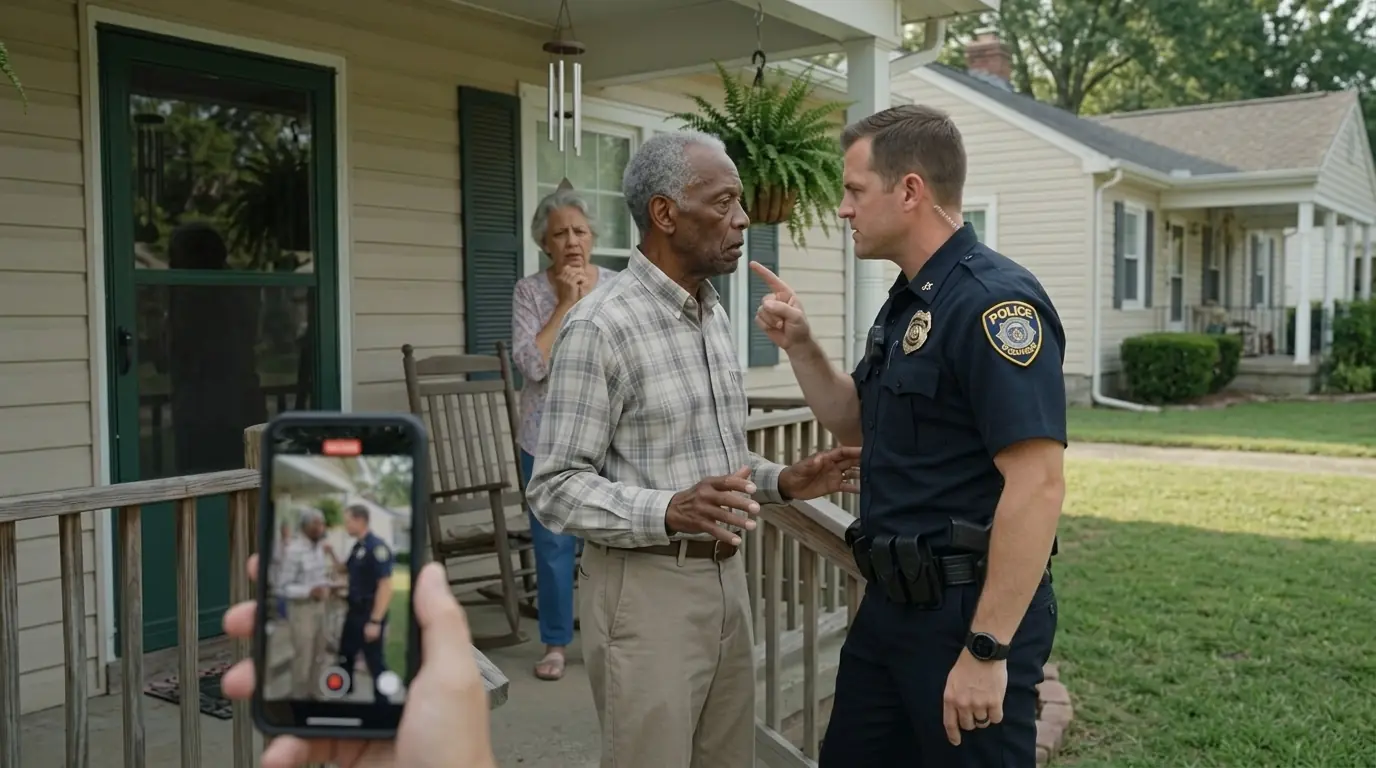
His knees hurt now, his back complained whenever he stayed bent too long, but the little garden belonged to him in a way few things ever had. After thirty-nine years of mortgage payments, repairs, storms, school mornings, funerals, birthdays, and ordinary dinners, the house behind them was not property to Ernest—it was the physical record of their life.
“You’re going to spend the whole afternoon bent over those tomatoes and then complain about your back tonight,” Lila said, nudging him with one gloved hand. Ernest smiled without looking up and told her sitting inside watching cable news would hurt him worse. She laughed the same way she had when they were twenty-five and broke, back when their first apartment had a leaking ceiling and exactly one good frying pan. Across the street, behind a lace curtain on the second floor of a renovated colonial, Cheryl Wexler watched them.
Cheryl had lived on Oak Haven for six years, long enough to know Ernest and Lila’s names, their routines, their son’s background, and exactly how many years they had owned the house. She also knew they were among the last homeowners refusing to sell to Horizon Row Development, a company quietly buying properties along the block before the city considered a major rezoning proposal the following spring. Cheryl held a minority investment stake through an LLC she believed none of her neighbors knew about, and the remaining holdouts were costing her a six-figure payout. That morning, she looked at the Bellamys gardening and saw not two elderly neighbors but a stubborn obstacle sitting on land she wanted converted into profit.
She picked up her phone and called 911. When the dispatcher asked what was wrong, Cheryl changed her voice into something softer and frightened, saying two people she did not recognize were wandering around a house on Oak Haven and appeared to be checking the property. The dispatcher asked whether either person was trying to enter by force or carrying a weapon, and Cheryl said no, but she was “concerned something wasn’t right.” She never mentioned that the supposed suspicious couple had lived across from her for years.
Nine minutes later, a police cruiser rolled slowly into the neighborhood. Ernest noticed it before Lila did, and an old tension settled into his shoulders almost automatically. He had grown up during the years when his father told him never to reach too quickly during a traffic stop and never assume age would protect him from being misunderstood. At seventy-two, Ernest hated that the lesson still lived inside his body.
Officer Cole Mercer stepped out wearing mirrored sunglasses and a pressed uniform, one hand resting near his duty belt before he had even crossed the curb. At forty-three, Mercer had spent almost fourteen years on the force and had developed the particular confidence of a man rarely forced to reconsider his first impression. He looked at Ernest’s gardening clothes, then at Lila, then at the expensive homes lining Oak Haven. “Morning,” he said, though the word sounded more like the beginning of an interrogation than a greeting.
Ernest stood slowly and wiped dirt from his palms. “Morning, Officer. Something I can help you with?” Mercer said someone had reported suspicious people around the property and asked whether they lived there. Lila answered immediately, “We’ve owned this home for nearly forty years.”
Mercer’s expression did not soften. “I need identification from both of you.” Ernest glanced toward his own front door. “For pulling weeds in my yard?”
“I didn’t ask what you were doing,” Mercer replied. “I asked for ID.” Lila stepped closer to Ernest because something about the officer’s tone frightened her more than the actual request. She had watched too many ordinary police encounters turn ugly because somebody asked one question too many.
“Our wallets are inside,” Ernest said carefully. Mercer pointed toward the porch. “Then go get them.” Ernest nodded and lifted both hands slightly, making his movements visible. “I’m walking to the kitchen counter, right through that door.”
Mercer said nothing. Ernest turned and took two slow steps toward the porch. His left foot reached the first stair. “Stop right there.”
Ernest froze. He looked back over his shoulder. “Officer, you just told me to go inside.”
“I told you to stop.” Mercer was already crossing the grass. “Turn around.”
Ernest did exactly that, slow enough that even the neighbors beginning to peek through curtains could see how deliberate he was. “I’m confused,” he said. “You told me to retrieve the identification.” Mercer’s jaw tightened as though confusion itself were disrespect.
“Are you deaf?” Mercer snapped. “I gave you an order.” He closed the distance and grabbed Ernest above the elbow. Ernest winced immediately as the officer’s fingers dug into the loose skin and twisted the arm behind him.
“Please let go,” Ernest said, his voice changing. “You’re hurting me.” Lila reacted before thought could catch up with fear. “Get your hands off my husband.”
She stepped between them. Mercer shoved her backward with his free hand. Lila stumbled into the porch railing hard enough to knock a flowerpot sideways, and the sound of ceramic hitting wood brought three neighbors outside almost at once.
“Ma’am, stay back.” Mercer tightened his grip on Ernest. “Both of you are making this worse.”
“We’re standing in our own yard,” Lila cried. “He did what you told him to do.” Mercer twisted Ernest’s arm higher. “That’s what everybody says once they decide not to cooperate.”
A teenage boy riding a bicycle stopped near the curb and immediately pulled out his phone. An older woman two houses down began recording from her porch, while another neighbor shouted that she knew Ernest and Lila and they absolutely lived there. Nobody moved close enough to physically intervene. Fear kept an invisible circle around Mercer.
Ernest’s breathing became shallow. He had spent his whole life teaching his children dignity, restraint, and caution around angry people with authority, yet there he stood at seventy-two feeling like a criminal in the yard he had paid taxes on for decades. “Please,” he said again. “I’m not fighting you.”
Lila’s eyes moved toward the house. Then she remembered who was upstairs. Their son was home for three days between assignments, sleeping late after arriving past midnight. “Marcus!” she screamed toward the front door.
The name tore through the quiet street. “Marcus, come outside! Somebody’s hurting your father!” For one painful second, nothing happened. Then the front door flew open.
Marcus Bellamy filled the doorway. At thirty-eight, he stood six-foot-four, broad through the chest and shoulders, with the dense physical build of somebody whose body had been trained for years to work under stress. He had spent most of his adult life in Naval Special Warfare and was currently serving as a senior petty officer attached to a SEAL unit. None of that mattered to him in the instant he saw his mother against the railing and an officer twisting his father’s arm.
Marcus crossed the porch quickly but did not run. His training overrode the fury rising through him, slowing his stride even while every instinct demanded he close the distance immediately. Mercer released Ernest and pivoted toward Marcus. His hand dropped to his Taser.
“Stay back!” Mercer shouted. “Do not come any closer.” Marcus continued walking, measured and controlled. “That man is my father.”
“I said stop.” Mercer began pulling the Taser free. “I will use this.” Marcus stopped several feet away and left both hands open at his sides. “You don’t need to.”
Mercer’s voice rose. “Final warning.” Marcus looked directly at him. “My name is Marcus Bellamy, United States Navy, Naval Special Warfare, and this is my parents’ property.”
Mercer blinked. Marcus slowly lifted the edge of his shirt enough to expose a military ID clipped inside his waistband. A second officer named Ethan Cole, who had arrived quietly in another cruiser moments earlier, noticed the faded trident tattoo on Marcus’s forearm. “Cole,” he said softly to Mercer, “look at his arm.”
Mercer glanced down. Something changed behind the mirrored sunglasses. The huge man standing in front of him was clearly strong enough to make the confrontation physically dangerous, yet Marcus had not clenched a fist, raised his voice, or stepped closer after being ordered to stop. “Doesn’t matter,” Mercer said, though his certainty had begun leaking from the words.
“It matters because the call was wrong,” Ethan said. “And because his father lives here.” Mercer looked toward the houses, finally noticing how many phones were pointed directly at him. His hand slowly left the Taser.
“Everybody needs to calm down,” Mercer said. Marcus did not move. “We are calm.”
That sentence seemed to hum across the yard. Ernest held his bruised arm against his chest. Lila’s face was wet with tears.
“You’re the one who needs to decide what you do next,” Marcus continued. He did not threaten. The control in his voice somehow made the statement heavier.
Mercer looked toward Ernest without meeting his eyes. “Sorry about the misunderstanding.” It was not an apology so much as an exit strategy. Ethan placed one hand lightly against his partner’s shoulder and told him they should leave.
The two officers returned to their cruisers. Mercer avoided the neighbors’ phones while climbing inside. Within seconds, both cars disappeared around the bend.
The neighborhood remained outside another minute before slowly retreating. Doors closed. Curtains fell back into place. Saturday morning tried to become normal again.
Marcus turned immediately toward his father. “Let me see your arm.” Ernest waved him off.
“I’m fine.” Marcus frowned. “You’re bruising already.”
Lila touched the red marks with trembling fingers. “That man had no right.” Marcus nodded. “No, ma’am.”
That evening, the Bellamys sat around the kitchen table under the yellow hanging light Lila had refused to replace since 1999. Ernest’s arm rested on a folded dish towel while everybody pretended to eat. Lila mentioned that Cheryl Wexler had been watching from across the street shortly before police arrived.
“She has been acting strange since that development meeting,” Lila said. “Always asking whether we’ve considered selling.” Ernest dismissed it at first. “Cheryl’s greedy and nosy, but calling police is something else.”
Marcus said nothing. Years of operational work had taught him to respect uneasy patterns even before they became proof. After dinner, he checked the locks, looked over the yard, then stood alone on the front porch staring toward Cheryl’s dark house.
“It’s probably over,” he whispered. He did not completely believe himself. Across town, Officer Cole Mercer was sitting beneath fluorescent lights writing a report designed to make sure it was not.
Mercer still felt humiliated. In his memory, he no longer saw himself hurting an old man. He saw phones pointed at him, Ethan questioning him, and Marcus standing calmly while Mercer’s own hand trembled near the Taser.
That could not become the official story. So Mercer began typing another one. He wrote that Ernest had behaved evasively and reached unexpectedly toward the residence after repeated commands to remain stationary.
He wrote that Marcus charged rapidly across the yard with clenched fists. He claimed Marcus ignored multiple lawful commands and moved aggressively enough that Mercer reasonably feared serious physical harm. When he reached the body-camera section, Mercer paused.
Equipment malfunction. Video unavailable. He hit submit. His account now existed inside the police system wearing the authority of an official report.
The next morning, Ernest and Lila went to the precinct to file a complaint. Ernest described the contradictory commands, the grab, his bruised arm, Lila being shoved, and Marcus’s attempt to de-escalate. A desk officer gave them a standard form and promised Professional Standards would review it. Ernest filled out every line carefully because he still believed paperwork might mean somebody had to read it.
The complaint reached the desk of Chief Warren Mercer before lunch. Warren was Cole Mercer’s maternal uncle. He had spent years quietly making his nephew’s smaller problems disappear before they became career problems.
Warren read Ernest’s complaint twice. Then he read Cole’s report. The contradictions were obvious.
He opened a lower desk drawer and slid the complaint beneath several old disciplinary files. “Damn kid,” he muttered. The words sounded irritated, but his next action proved where his loyalty remained.
Warren called the district attorney’s office. He said officers had been threatened by a physically imposing suspect with combat training. He asked that a warrant be reviewed for assault on an officer and resisting police.
When the assistant prosecutor mentioned Marcus’s service background, Warren cut him off. “Uniform doesn’t matter. Charge is the charge.” By early afternoon, the warrant had been signed.
The following day, Ernest and Marcus were outside resetting garden stakes knocked loose during the first confrontation. Ernest’s bruising had deepened to purple but he refused to stay indoors. For ten minutes, father and son joked like the previous weekend had never happened.
Then another cruiser turned onto Oak Haven. Marcus noticed before Ernest. Two officers stepped out.
A second patrol car followed. Cole Mercer emerged from it and leaned against the door with his arms folded. The expression on his face told Marcus everything before anyone spoke.
“Marcus Bellamy?” one officer called. Marcus stood. “That’s me.”