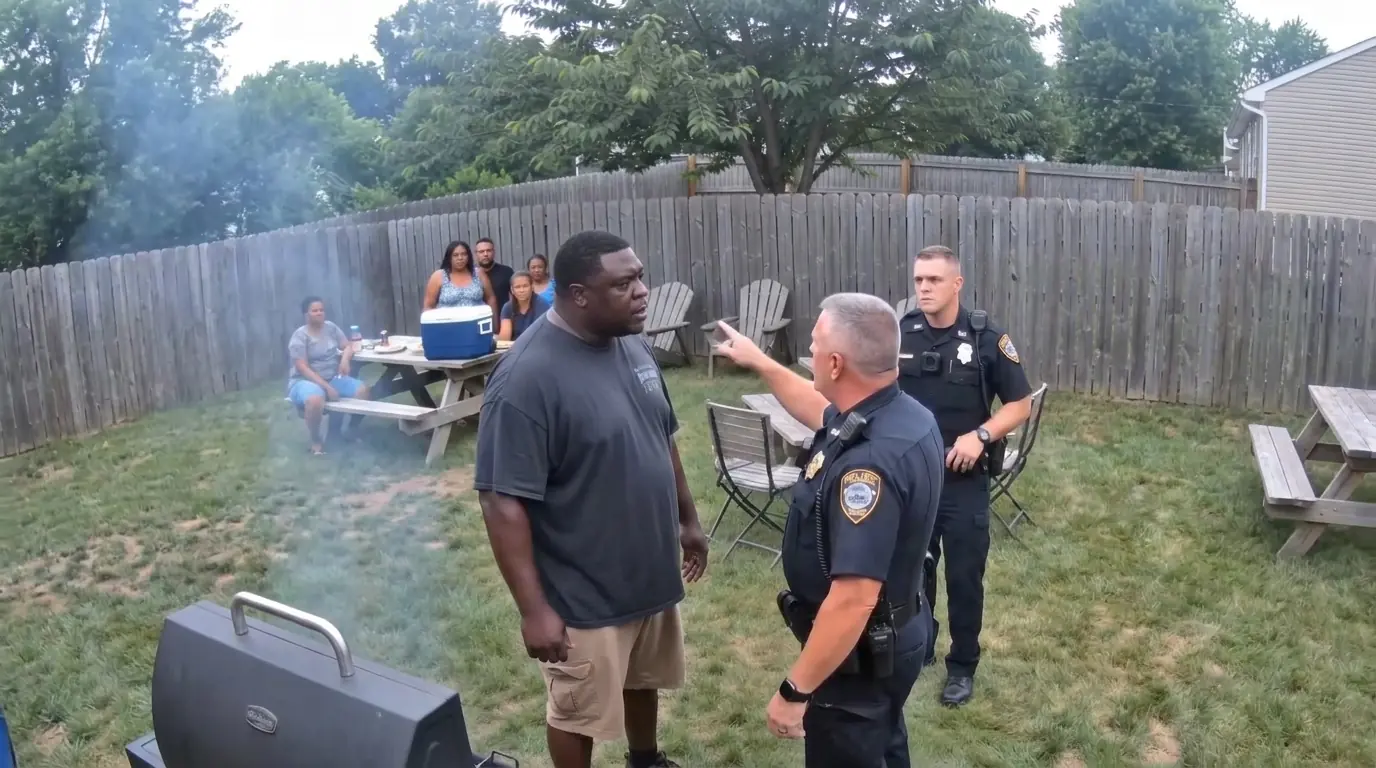
The first thing Officer Eric Danner did after stepping into Calvin Mercer’s backyard was knock a paper plate out of his hand. Smoked brisket landed on the grass, baked beans splattered across Calvin’s sneakers, and a piece of cornbread rolled beneath a folding chair where his eight-year-old granddaughter had been sitting a minute earlier. For several seconds, nobody in the yard said anything, because almost fifty people had just watched a police officer turn an ordinary family cookout into something nobody understood. Calvin looked down at the food, then slowly lifted both empty hands where the officer could see them.
“Keep them up,” Danner said. “You’re a big guy, and I don’t know what you’re about to do.”
Calvin was fifty-six years old, six-foot-four, around 255 pounds, and built like the defensive lineman everyone assumed he had once been. In reality, he had spent twenty-eight years behind desks, courtroom tables, conference-room doors, and government lecterns, although he still woke at five most mornings to lift weights because the habit had followed him out of the Army. That Saturday he wore faded jeans, an old gray T-shirt, white running shoes, and a black apron that said MERCER’S SMOKEHOUSE — IF YOU’RE STILL HUNGRY, THAT’S YOUR FAULT. Barbecue smoke drifted across his patio while old Motown played softly from a speaker near the pool.
“This is my house,” Calvin said.
Danner gave him a dry smile. “Sure.”
“It is.”
“Then you won’t mind sitting down while we sort out who belongs here.”
Calvin looked at him for a long second before pulling out a patio chair and sitting. His daughter, Tessa, had already started toward him from the deck, but Calvin raised one finger in her direction and gave the smallest possible shake of his head. Tessa stopped because she knew her father’s expressions well enough to understand the message. His nephew Malik, standing near the drink coolers, quietly lifted his phone and began recording.
Danner noticed.
“Tell him to put that away.”
Calvin looked toward Malik. “Keep recording.”
The officer’s jaw tightened. “I just told him to stop.”
“And I told him he doesn’t have to.”
“What exactly are you trying to prove?”
“Nothing.”
Calvin rested both hands on his thighs. “That’s the point.”
The backyard had been loud and happy twenty minutes earlier. Tessa had just returned from Boston after passing the Massachusetts bar exam, and Calvin had spent the entire week pretending the celebration would be small while ordering enough meat to feed a church convention. There were cousins, neighbors, retired judges, old military friends, law-school classmates, children running near the pool, and enough folding tables that Calvin had borrowed half of them from a community center.
Tessa had threatened to leave when she saw the banner.
CONGRATULATIONS COUNSELOR MERCER — OBJECTION OVERRULED
“Dad, this is humiliating.”
“You graduated Harvard Law.”
“So?”
“So humiliation is part of your reward.”
“I hate you.”
Calvin opened his arms.
“Come hug the man you hate.”
She did.
He held her slightly longer than usual because her mother should have been standing beside him.
Monica Mercer had died seven years earlier after a three-year battle with ovarian cancer. She was forty-nine and still telling Calvin how to season ribs from a hospital bed during her final summer, which was probably why he now cooked enough food for every celebration as though proving something to the universe. Tessa’s graduation was one of those milestones he had pictured Monica seeing, and throughout the morning he kept catching himself looking toward the kitchen door as though she might walk outside carrying a bowl and telling him he had added too much brown sugar.
By noon, the sadness had softened into gratitude.
At 12:40, an old friend named Evelyn Shaw arrived carrying two bakery boxes. She wore jeans, a loose linen shirt, sunglasses, and no makeup, which made her almost unrecognizable to people accustomed to seeing her behind a podium in full uniform. Calvin had known Evelyn for more than twenty years, back before either of them had enough authority to make anyone nervous.
She opened the first box.
Peach cobbler.
Calvin nodded approvingly. “You may stay.”
“I wasn’t asking.”
“What’s in the second?”
“Lemon cake.”
“Now you can definitely stay.”
Evelyn smiled. “I’m honored.”
She disappeared into the house looking for Tessa.
Across the street, a woman named Marjorie Phelps watched cars arrive.
Marjorie was sixty-two, divorced, retired from a property-management company, and had moved into the neighborhood eight months earlier. By Christmas she had already emailed the homeowners association about garbage cans being visible after sunset, teenagers parking too close to driveways, lawn crews beginning before eight, and one neighbor who left inflatable holiday decorations outside until January 4.
Most residents treated her as an annoyance.
Calvin had tried being polite.
Twice.
The second time occurred three months earlier after she walked into his driveway while he was trimming hedges and told him “whoever owns this house” needed to stop placing yard-waste bags near the curb before pickup day. Calvin reminded her the neighborhood ordinance allowed bags after five in the afternoon.
She asked whether he worked for the homeowner.
“No.”
“Then who are you?”
“Calvin Mercer.”
She stared.
He pointed toward the house.
“I live here.”
Marjorie looked unconvinced.
Apparently the information did not stick.
At 1:18 that Saturday, she called the non-emergency police number.
“There’s an enormous party across from me.”
The dispatcher asked whether there was fighting.
“No.”
“Loud music?”
“It’s noticeable.”
“Any threats?”
“I don’t know.”
The dispatcher paused. “Then what is the concern?”
“There’s a very large Black man going in and out of the house and yelling at people.”
Calvin had been yelling at his brother for stealing burnt ends.
The dispatcher asked whether the man might live there.
Marjorie answered, “I know the homeowners around here. He doesn’t look like one of them.”
That sentence sent Officers Eric Danner and Luke Brenner to Willow Brook Lane.
They arrived at 1:31.
One guest’s sedan was parked a little too close to a hydrant, which would have been the only clear issue if anyone had approached the situation normally. Brenner noticed it as soon as he stepped from the cruiser and suggested they simply ask someone to move the car.
Danner was already watching Calvin.
“Who’s the big guy?”
Brenner shrugged. “Probably host.”
“Doesn’t look like it.”
“What does a host look like?”
Danner glanced at him.
“Relax.”
They walked toward the side gate.
Calvin stood nearby carrying a plate he had just made for himself after spending three hours feeding everyone else.
Danner called out.
“Hey.”
Calvin turned.
“Yes?”
“What’s happening here?”
“Graduation cookout.”
“Whose?”
“My daughter’s.”
“You live here?”
“Yes.”
“Identification.”
Calvin balanced the plate in one hand. “Wallet’s inside.”
Danner immediately looked at his hands.
“Don’t reach.”
“I wasn’t.”
“You just said you needed your wallet.”
“I said it’s inside.”
Brenner looked toward the house.
“What’s your name, sir?”
“Calvin Mercer.”
Danner asked, “Owner’s name?”
Calvin stared at him.
“Calvin Mercer.”
“Rental property?”
“No.”
“You own this house?”
“Yes.”
Danner smiled slightly.
“Expensive place.”
Calvin’s expression changed.
“So?”
“Just making conversation.”
“Then you should probably get better at it.”
Brenner looked away because he nearly smiled.
Danner did not.
“What do you do?”
Calvin asked, “What does that have to do with a noise complaint?”
“Who said it was only noise?”
“You did thirty seconds ago.”
Danner shifted.
“We also received a suspicious-person complaint.”
Calvin looked toward the neighboring houses.
“About who?”
“You.”
For a moment, Calvin genuinely thought he had misunderstood.
“I’m suspicious at my own house.”
“We don’t know it’s your house.”
“You asked.”
“People lie.”
“Check the property record.”
Danner’s face tightened.
“Do not tell me how to conduct an investigation.”
Calvin nodded once.
“All right.”
He had spent enough of his career watching officers create bad facts with good intentions, and enough time prosecuting officers who created bad facts intentionally, to understand how quickly tone became a second case. Nothing he said now would be remembered as simply a homeowner speaking.
So he became careful.
Very careful.
“My identification is inside.”
Danner nodded toward the open side gate.
“Go get it.”
Calvin shifted the plate.
“You’ll need to stay here.”
“Why?”
“Because I haven’t invited you into my home.”
Danner stared.
“We need to verify your identity.”
“I can bring it out.”
“Why are you making this difficult?”
“I’m not.”
Danner stepped closer.
“Put the plate down.”
Calvin looked at him.
“Why?”
“I gave you an instruction.”
“There’s a table right there.”
“Then put it down.”
Calvin set the plate on a small stand beside the gate.
Brenner looked toward the parked cars.
“Eric, I can check the hydrant and run the address while he gets ID.”
Danner ignored him.
Then Marjorie called from across the street.
“Officer!”
Everyone turned.
She stood on her lawn with both arms folded.
“That’s the man.”
Calvin looked at her.
“The man doing what?”
Marjorie spoke toward the officers.
“He’s been going in and out all afternoon.”
Calvin almost laughed.
“I live here.”
She shook her head.
“I’ve never seen you before.”
“Marjorie.”
She stared.
“You argued with me about my yard-waste bags in March.”
Her face changed.
“I talk to a lot of people.”
“You were standing six feet from me.”
Danner raised one hand.
“Enough.”
Calvin looked toward him.
Danner’s voice hardened.
“Hands on the fence.”
“For what?”
“Suspicious behavior and failure to cooperate.”
“I’ve answered every question.”
“You’re challenging everything.”
“That isn’t a crime.”
Danner took one step forward.
“You see, that attitude?”
Calvin’s voice lowered even further.
“I am not raising my voice.”
“You’re a big man.”
“That doesn’t make my volume louder.”
“You want to test me?”
“No.”
Tessa reached the gate.
“Dad?”
Calvin immediately looked toward her.
“Stay there.”
Danner turned.
“Who are you?”
“His daughter.”
“You live here?”
“This is my family’s house.”
“Go back inside.”
Tessa’s expression hardened.
“I’m an adult.”
“Then act like one and follow instructions.”
Calvin’s eyes changed.
“Officer.”
Danner looked back.
“Don’t speak to her like that.”
“There.”
Danner pointed.
“That aggression.”
Tessa stared.
“My father is sitting there talking.”
Danner ignored her.
Calvin understood what was happening.
The word had arrived.
Aggressive.
Once written, it could do enormous work.
A large Black male became aggressive.
The subject’s physical size increased officer concern.
The subject began challenging commands.
The subject caused fear.
People often imagined police reports as neutral documents.
Calvin knew better.
Language could turn uncertainty into certainty faster than facts.
So he lifted his hands.
“I am not threatening anyone.”
Danner’s voice rose.
“Then do what I’m telling you.”
“What exactly are you telling me?”
“Move into the backyard.”
“I haven’t given you permission to enter.”
Danner stepped through the gate.
“So now you have.”
Brenner paused.
“Eric.”
“Come on.”
Calvin followed because Tessa and the rest of his family were already there.